



When Bitcoin surged past $70,000 in early 2024, social media exploded with posts about early buyers becoming millionaires. But just six months later, as prices dropped 30%, the same feeds filled with panic - "Sell everything!" What changed? Not the technology. Not the fundamentals. Just psychology.
How Bull Markets Are Born in Crypto
Bull markets in crypto don’t start with hype. They start with doubt. Look back at Bitcoin’s 2020-2021 rally. Early buyers weren’t excited. They were quietly accumulating during the pandemic, when others were selling off. That’s the first stage: pessimism. People thought crypto was a bubble. Some still do. But those who held saw prices slowly climb. Then skepticism kicked in. "Is this real?" they asked. News outlets began covering it. Miners expanded. Exchanges added new coins. More people joined. Confidence grew. By mid-2021, it wasn’t just investors - it was friends, coworkers, even your uncle. That’s maturity: optimism. Then came euphoria. People mortgaged homes. Paid-in-advance NFTs. Memecoins with no utility hit $1 billion market caps. That’s when the top forms.The pattern isn’t random. It’s human. As Davis Funds put it: "Bull markets are born on pessimism, grow on skepticism, mature on optimism, and die in euphoria." In crypto, this cycle repeats faster than in stocks - sometimes in months, not years. Why? Because crypto markets are smaller, less regulated, and more emotional. One tweet from Elon Musk can move $10 billion in value. That’s not economics. That’s psychology.
The Emotional Triggers That Drive Crypto Prices
Two forces dominate: fear and greed. They’re not just buzzwords. They’re measurable drivers of price action.Herd mentality is the biggest. When Ethereum hits a new high, thousands rush in - not because they understand staking or Layer 2 scaling, but because everyone else is. They don’t want to miss out. FOMO (fear of missing out) isn’t just a meme. It’s a behavioral pattern studied by behavioral economists. In 2021, Solana’s price jumped 10,000% in 18 months. Most buyers didn’t know what Solana was. They just saw the chart. That’s herd behavior. And it’s dangerous. When the crowd turns, the crash hits harder.
Loss aversion works differently in crypto than in stocks. If you bought Bitcoin at $20,000 and it dropped to $15,000, you’re likely to hold - hoping it goes back. But if it drops to $10,000? Now you panic. You sell. Why? Because losing $5,000 feels worse than gaining $5,000. Studies show humans feel losses twice as intensely as gains. In crypto, where volatility is extreme, this bias leads to selling low and buying high - the exact opposite of what you should do.
Overconfidence is rampant among day traders. A trader makes $5,000 in a week trading Shiba Inu. They think they’re a genius. They double down. Then the market flips. They lose $20,000. Why? Because they mistook luck for skill. Crypto’s 24/7 market makes this worse. There’s no "market close" to pause and reflect. You’re always watching. Always trading. Always thinking you’re in control.
Bear Markets: When Fear Takes Over
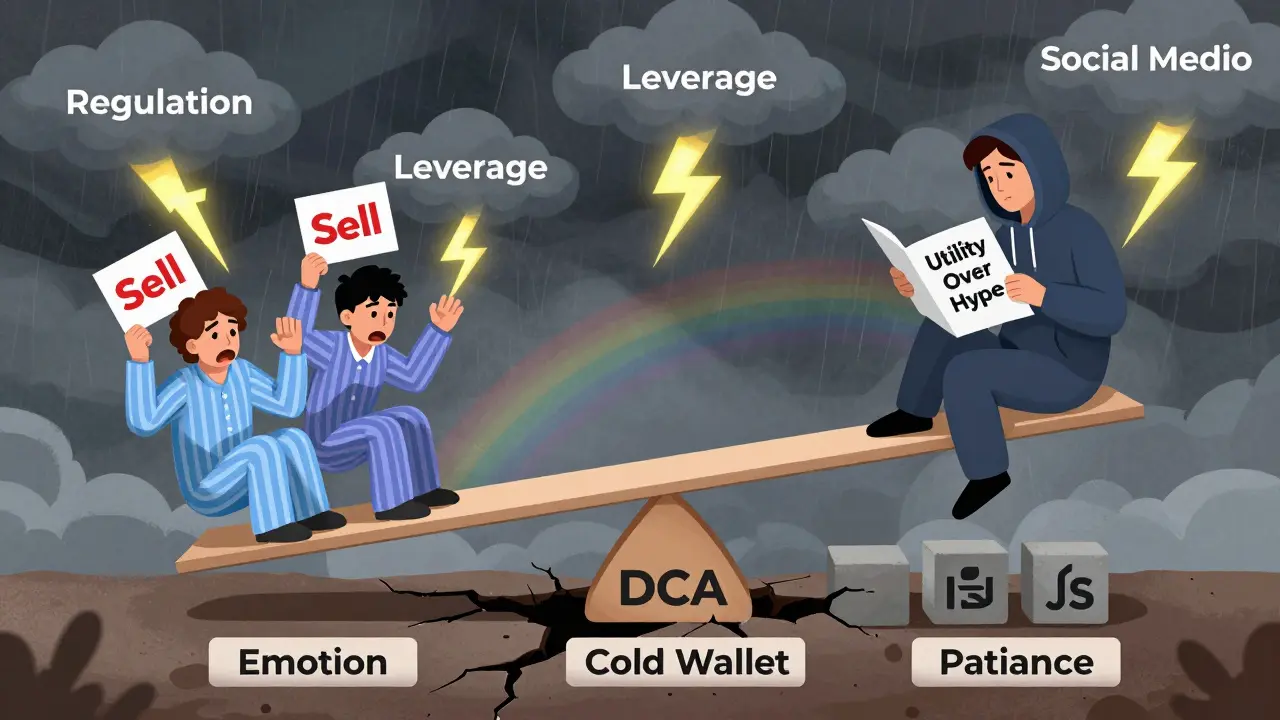
Bear markets in crypto aren’t just about falling prices. They’re about disappearing confidence. When Bitcoin falls below $30,000 after a $60,000 peak, the narrative changes. News headlines scream "Crypto Crash." Wallets empty. Exchanges report fewer deposits. Mining rigs shut down. Developers stop building. That’s the feedback loop.Three things cause bear markets in crypto:
- Economic pressure - rising interest rates, inflation, or recession fears make investors pull money out of risky assets like crypto.
- Liquidation waves - when leverage is too high, margin calls trigger cascading sells. In 2022, over $10 billion in leveraged positions were liquidated in a single week during the Terra collapse.
- Negative sentiment - when influencers, regulators, or media turn hostile, trust evaporates. The SEC’s lawsuits against Binance and Coinbase in 2023 didn’t just hurt those companies. They scared millions of retail investors away from the whole space.
During bear markets, investors don’t just sell. They abandon crypto entirely. They move to cash, gold, or bonds. They delete their wallets. They swear off crypto forever. That’s the psychological shift: from growth to survival.
Why Bear Markets Are Necessary
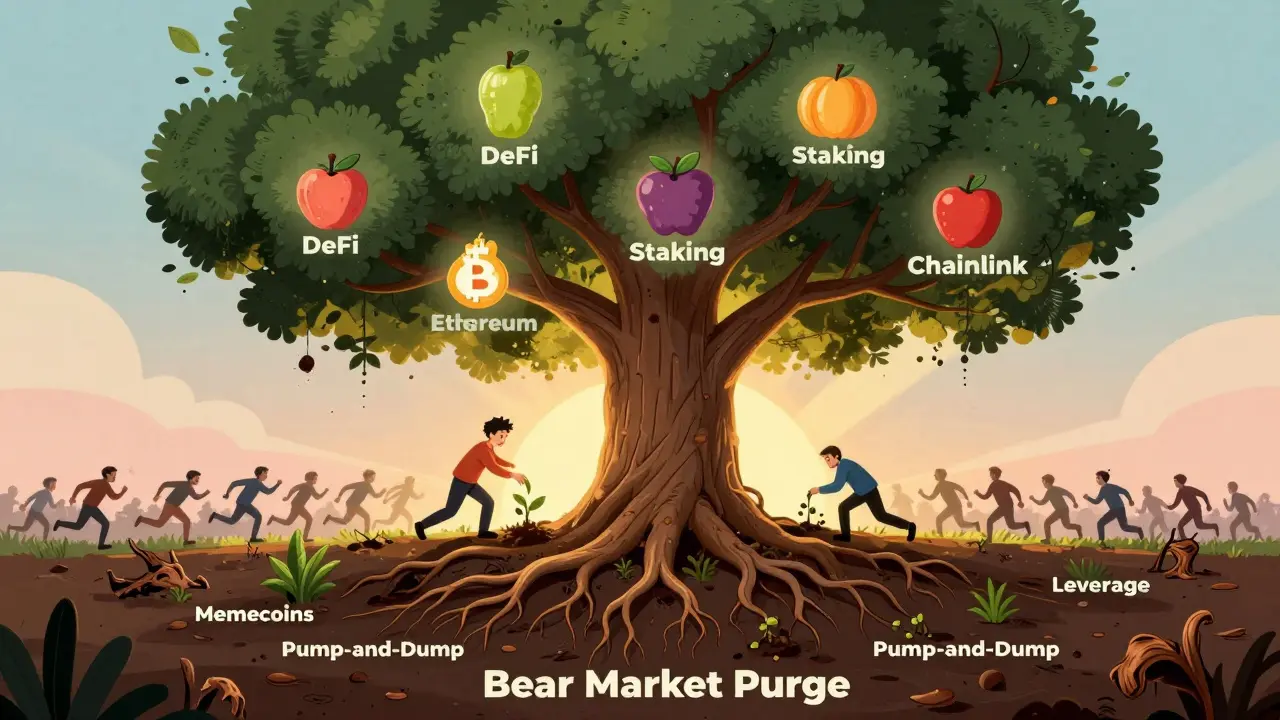
Most people see bear markets as failures. They’re not. They’re purges.Every bear market cleans out the weak hands. It kills projects with no real users. It shuts down exchanges with poor security. It forces developers to build better tech - not just hype. Look at the 2018-2019 bear market. Thousands of tokens vanished. But what survived? Ethereum, Bitcoin, Chainlink, Polkadot. Why? Because they had real utility. The bear market didn’t destroy crypto. It filtered it.
And here’s the truth: most people who make money in crypto do it during bear markets. Not by buying at the bottom - that’s nearly impossible. But by accumulating quietly. By learning. By building. While others are panicking, the smart ones are reading whitepapers, joining DAOs, and setting up cold wallets. When the next bull market hits, they’re ready. Not because they predicted it. But because they didn’t panic.
How to Survive Both Cycles
You can’t control the market. But you can control your reactions.- Ignore the noise. If your feed is full of "10x gains" or "crypto is dead," mute it. Real investors don’t talk. They act.
- Use dollar-cost averaging. Buy $50 a week, no matter the price. This removes emotion from timing. It’s the most reliable strategy for retail investors.
- Keep cash. Always have 10-20% in stablecoins or fiat. That’s your emergency fuel. When others are selling, you can buy.
- Focus on utility. Ask: "Does this project solve a real problem?" Not: "Will it go up next week?"
- Track your emotions. Write down why you bought or sold. After a month, review it. You’ll see patterns. You’ll see fear. You’ll see greed.
Markets move because people move. Not because of algorithms. Not because of news. Because of fear, hope, envy, and regret. Understanding that is the only edge you’ll ever need.
What Happens After the Next Bull Run?
History doesn’t repeat. But it rhymes. The next bull market will feel different - more institutional, more regulated, more mature. But the psychology? It’ll be the same. People will still buy because everyone else is. They’ll still sell because they’re scared. They’ll still think they’re smarter than the market.That’s why the best crypto investors aren’t the ones who time the top. They’re the ones who stay calm. Who don’t chase hype. Who remember: markets are driven by humans. And humans? They’re emotional. Always have been. Always will be.
What’s the difference between a bull and bear market in crypto?
A bull market in crypto is when prices rise 20% or more from a recent low, driven by optimism, increased adoption, and rising demand. A bear market is the opposite: prices fall 20% or more from a recent high, fueled by fear, selling pressure, and loss of confidence. In crypto, these shifts happen faster than in traditional markets - sometimes within weeks - because retail investors dominate trading and react emotionally to news, social media, and price swings.
Why do crypto investors panic during bear markets?
Crypto investors panic because of loss aversion - the psychological tendency to feel the pain of losing money more intensely than the joy of gaining it. When prices drop, fear spreads fast, especially in a market where 80% of traders are retail and not institutional. Social media amplifies panic, and margin calls on leveraged positions trigger cascading sells. Many investors also fear regulatory crackdowns or exchange failures, which adds to the emotional pressure. The result? Selling not because the asset is worthless, but because they can’t handle the stress.
Can you predict the next bull or bear market?
No one can reliably predict the exact timing of a bull or bear market. Technical indicators like moving averages or RSI can signal trends, but they’re lagging. Fundamentals like network usage or developer activity help, but they don’t capture emotion. The best approach is to prepare for both cycles. Build a strategy based on dollar-cost averaging, keep cash reserves, and avoid emotional trading. The market will move - your job is to stay calm and consistent.
How does herd behavior affect crypto prices?
Herd behavior makes crypto prices more volatile than other assets. When a popular coin surges - say, Dogecoin after a tweet - thousands buy in not because they understand it, but because others are. This creates artificial demand that pushes prices far beyond fundamentals. When the crowd turns, the same dynamic reverses: mass selling causes crashes. This cycle repeats in every crypto bull and bear market. It’s why memecoins can rise 1,000% in days and crash 90% in hours.
What’s the best strategy during a crypto bear market?
The best strategy is accumulation with discipline. Avoid trying to time the bottom. Instead, use dollar-cost averaging - buy small amounts regularly, regardless of price. Focus on projects with strong fundamentals: active users, clear use cases, and transparent teams. Keep your emotions in check. Use this time to learn: read whitepapers, join communities, and explore DeFi or staking. Bear markets aren’t about losing - they’re about preparing for the next rally.





People Comments
Crypto isn't about tech. It's about human behavior. Saw my uncle buy Dogecoin after a meme. Sold at the peak. Now he says 'I told you so' like it was a prediction. Classic.
The part about loss aversion hit hard. I held BTC through 2022 thinking it'd bounce. Turns out I wasn't patient-I was just in denial. Been DCAing since. No regrets.
Bear markets are the real training ground. Most people think they're investing. They're just gambling with vibes. When the noise dies down, you finally learn what 'fundamentals' even means.
Markets are mirrors. They don't show you price-they show you your own fear, your hunger, your ego. The blockchain is cold. But the people? Oh, they're burning hot. And that's why it moves.
I started DCAing $20 a week last year and honestly? It changed my whole vibe. No more checking prices every 5 mins. Just chillin'. And guess what? My portfolio grew without me screaming at my screen 😊
FOMO is real. I bought Solana at $260 because my Discord group was going wild. Lost half in a week. But then I read up on Solana's tech. Now I hold. Not because I'm smart-because I stopped being a sheep.
This post nailed it. The real edge isn't in charts. It's in noticing when you're panicking. I keep a journal. Last bear market, I wrote 'I'm scared' 47 times. This time? I wrote 'I'm learning.' Big difference.
DCA works because it removes emotion. Not because it's magic. Simple. No fluff. Just math and discipline.
It's fascinating how the same psychological patterns repeat across asset classes. The only difference in crypto is the velocity. Human nature doesn't change. The medium just accelerates it.
DCA? Please. If you're not swinging for the fences, you're already losing. Real investors go all in on the next 100x. You're just a babysitter of your portfolio.
So we're saying crypto's price is determined by whether someone's uncle posted a meme? Wow. I guess we can skip the whole 'economics' thing then. Just follow the TikTok trends. Makes sense.
People who say 'buy the dip' are the same ones who sold at the bottom last time. This whole 'strategy' is just a placebo for people who hate doing nothing.
You think you're deep? You're just a retail sheep who got lucky once. Real traders don't talk. They don't blog. They don't write essays. They just take money. And you? You're still typing.
Leverage liquidations are the real story. When 10B in margin calls hit during Terra collapse, it wasn't fear-it was systemic fragility. Retail didn't cause the crash. The structure did. You're blaming the wrong actors.
US regulators are the reason crypto is doomed. Always have been. Always will. Why do you think the EU is outpacing us? Because they don't let fear-mongers control the narrative. We're still stuck in 2018.
I appreciate how you framed bear markets as purges. That’s not a popular take, but it’s accurate. Most people think survival means holding on. But real survival means stepping back, learning, and waiting. That’s the quiet strength.
I remember when I first got into crypto. I thought I was a genius because I bought Bitcoin at $3K. Then I lost 70% in 2018. Then I lost another 50% in 2022. I cried. I deleted the app. I swore off it. But then I started reading. Not Reddit. Actual whitepapers. I started tracking on-chain data. I built a cold wallet. I joined a DAO. I didn't trade. I learned. And now? I'm not rich. But I'm not broke either. And I'm not scared anymore. Because I finally understood: it's not about timing. It's about becoming someone who doesn't need to time it. The market moves. You don't have to move with it. You just have to be steady. And that? That's the real edge. Not a strategy. Not a chart pattern. Just… calm. And patience. And knowing you're not here to win. You're here to be here.