


Coinbase Country Access Checker
Check Your Country Access
Want to buy Bitcoin on Coinbase but can’t? You’re not alone. Millions of people around the world hit a wall when they try to sign up - not because of technical issues, but because Coinbase blocks access based on where you live. It’s not random. It’s legal. And it’s getting more complex every year.
Why Coinbase Blocks Countries
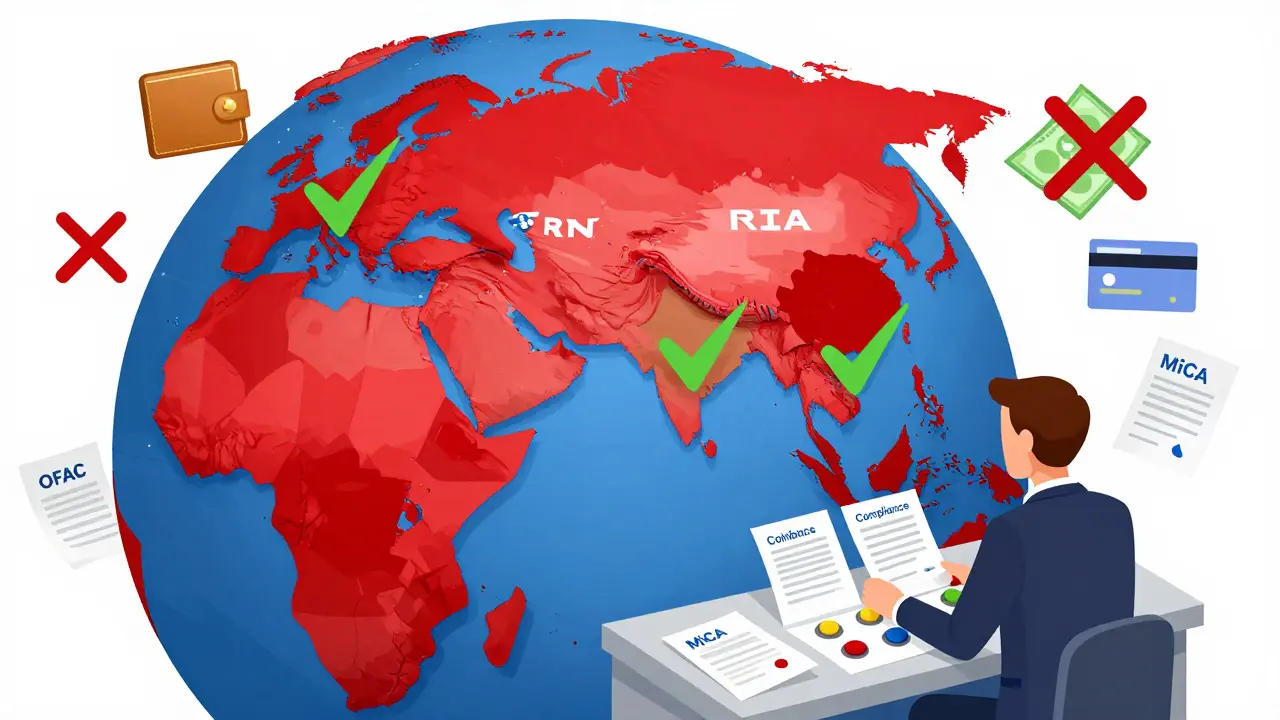
Coinbase doesn’t pick countries to block because it doesn’t like them. It blocks them because it has to. The company is registered in the U.S. and must follow rules from the U.S. Treasury’s Office of Foreign Assets Control (OFAC). That means if a country is under U.S. sanctions - like Russia, Iran, Syria, North Korea, or Crimea - Coinbase can’t offer services there. No exceptions. But it’s not just about sanctions. Even in countries with no official sanctions, local laws can force Coinbase to pull back. For example, Nigeria and Egypt banned crypto exchanges in early 2025. India is still in legal limbo after the Reserve Bank of India (RBI) refused to grant Coinbase a license. In these places, Coinbase doesn’t just choose to leave - it’s pushed out. The result? Coinbase operates in over 100 countries, but only 48 of them let you deposit or withdraw cash using bank transfers, cards, or Apple Pay. The rest? You might get access to Coinbase Wallet - a self-custody tool that lets you hold crypto - but you can’t buy it with real money. That’s a huge difference.Where You Can Use Coinbase (With Fiat)
If you want to buy crypto with dollars, euros, pounds, or Singapore dollars, you need to be in one of the 48 countries where Coinbase offers full fiat services. That includes:- United States
- United Kingdom
- Germany, France, Spain, Italy
- Canada (with limits)
- Australia, New Zealand
- Singapore, Japan, South Korea
- Most of the European Economic Area (EEA)
Where You Can’t Use Coinbase (But Might Think You Can)
Here’s where things get messy. Many users think if they can download the app, they can use it. That’s not true.- Pakistan: Coinbase Wallet works. You can store Bitcoin, Ethereum, and 5,500+ tokens. But you can’t deposit Pakistani rupees. Users report paying 8% premiums on Binance P2P just to buy crypto.
- Philippines: Same issue. 83% of crypto users here want to buy with pesos. Coinbase blocks fiat. Local exchanges like PDAX charge 3.5% fees - more than double Coinbase’s standard rate.
- UAE: Partial access. You can use Apple Pay and Google Pay to buy crypto. But bank transfers? Blocked. Credit cards? Sometimes. It’s confusing even for locals.
- Colombia: Valid ID, local address, phone number - all checked. Still blocked. Users say Binance processes COP deposits instantly. Coinbase? No response.
- Russia: Completely cut off from fiat since February 2022. Wallet still works for holding crypto, but no deposits, no withdrawals, no trading.
Why Coinbase Wallet Works Everywhere (Except Sanctioned Zones)
Coinbase Wallet is a different product. It’s not a crypto exchange. It’s a self-custody wallet - like MetaMask. You control your keys. You interact with decentralized apps (dApps). You don’t need to give Coinbase your ID. That’s why it works in 195+ countries - including places like Venezuela, Zimbabwe, and Ukraine - as long as they’re not under U.S. sanctions. You can send and receive crypto. You can swap tokens on Uniswap. You can stake Ethereum (if allowed locally). But here’s the catch: you can’t buy crypto with your bank account. You can’t cash out to your phone bill. You need to get crypto from somewhere else first - usually another exchange or a peer-to-peer trade. For many people, that’s a barrier.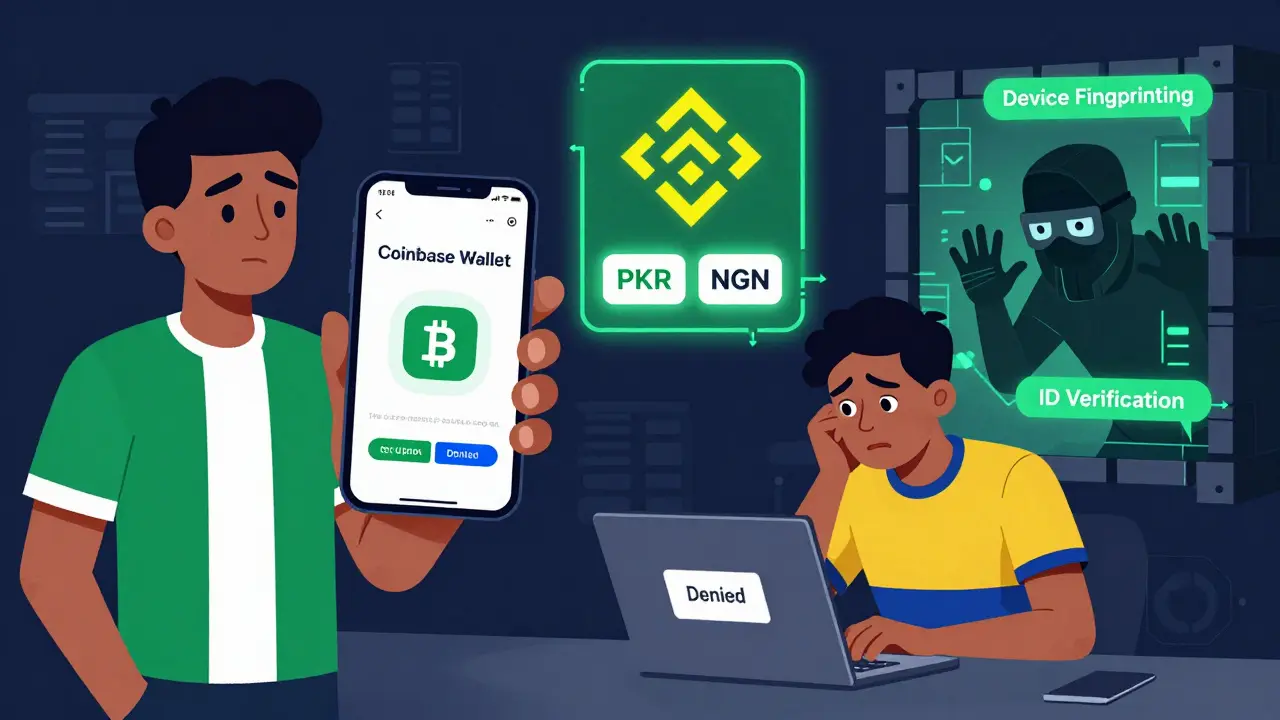
What Happens If You Try to Bypass the Block?
Some users try to trick Coinbase using VPNs. They change their IP address to appear as if they’re in the U.S. or Germany. It might work for a few days. But Coinbase checks more than just your IP. They verify your:- Government-issued ID (passport, driver’s license)
- Proof of address (utility bill, bank statement)
- Phone number (local area code matters)
- Device fingerprint (browser, OS, hardware ID)
How Coinbase Compares to Other Exchanges
Coinbase isn’t alone in geo-blocking. But it’s one of the strictest.- Binance: Available in 190+ countries. Offers local currency pairs in Pakistan (PKR), Nigeria (NGN), and Turkey (TRY). But it’s banned in Canada, the Netherlands, and parts of Europe.
- Kraken: Offers fiat services in 55 countries - more than Coinbase. But it doesn’t have the same brand trust in the U.S.
- MetaMask: Works in 195+ countries. No KYC. No fiat. Just crypto. Perfect for advanced users, useless for beginners.
Who Gets Hurt the Most?
The people who need crypto the most - people in countries with unstable currencies, high inflation, or no access to banks - are often the ones blocked. MIT’s Digital Currency Initiative found that Coinbase’s geo-blocks affect 12.7 million unbanked people in developing nations. In Nigeria, where inflation hit 33% in 2024, people turned to crypto to save money. But Coinbase doesn’t let them in. Binance does - and that’s why it dominates there. Trustpilot reviews show 68% of negative feedback comes from users in restricted countries. One Colombian user wrote: “I have a job, taxes, ID. I’m not a criminal. Why can’t I use Coinbase?”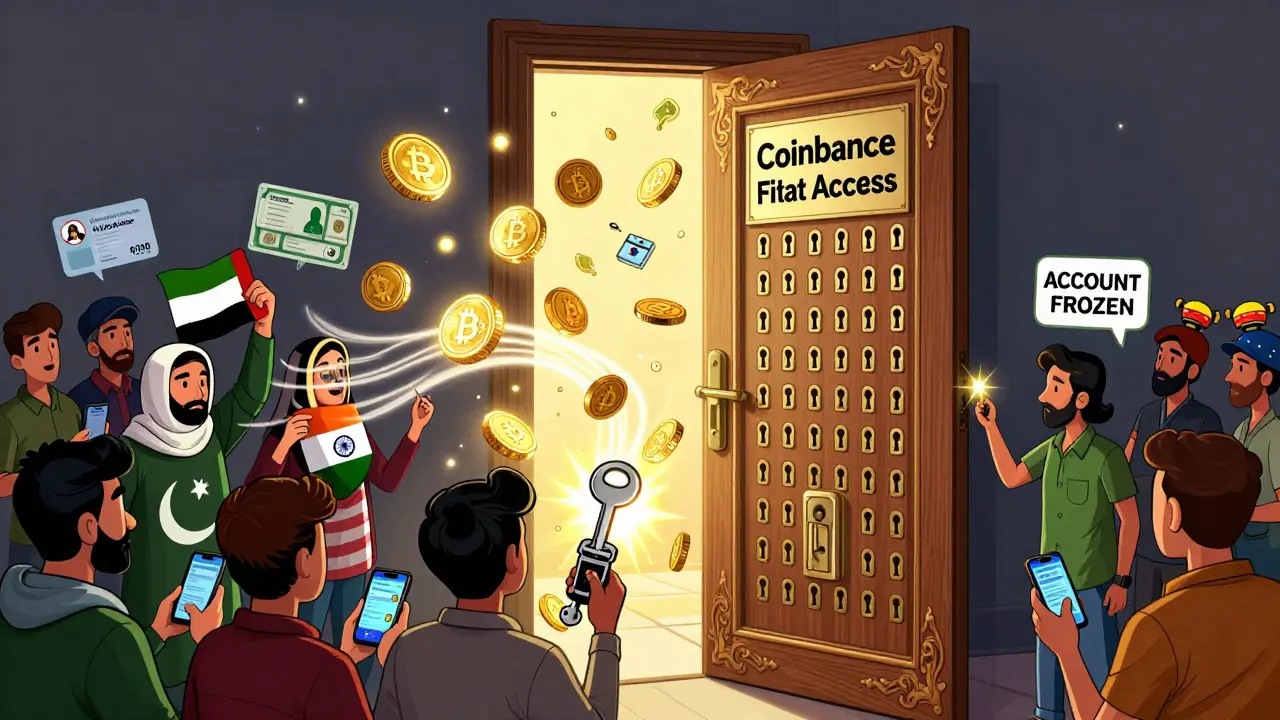
What’s Changing in 2025?
The biggest shift is MiCA in Europe. It’s forcing Coinbase to split its operations into country-specific legal entities. That’s why users in Malta now deal with Coinbase Luxembourg. It’s messy, but it’s the only way to stay legal. In India, things are still up in the air. The RBI hasn’t approved Coinbase yet. But the government is talking about a digital rupee. If that launches, Coinbase might reapply. Until then, Indian users are stuck. The SEC lawsuit against Coinbase (filed June 2023) could also change everything. If the court rules Coinbase is an unregistered securities exchange, it might have to pull out of even more countries to avoid liability.What Should You Do If You’re Blocked?
If you’re in a restricted country:- Use Coinbase Wallet to store crypto you already own.
- Use peer-to-peer platforms like Binance P2P or LocalCryptos to buy with local payment methods.
- Check local exchanges - they may have lower fees than you think.
- Never use a VPN to access fiat services. Your account will be frozen.
- Keep your ID and address documents ready. If rules change, you might get access quickly.
Final Thought: It’s Not About Technology - It’s About Law
Coinbase isn’t the villain. It’s a company trying to survive in a world where every country has different rules. It could expand faster. It could ignore some sanctions. But then it risks losing its U.S. license - and with it, everything. For now, if you want to use Coinbase like a bank - deposit cash, buy crypto, withdraw cash - you need to live in the right country. It’s frustrating. It’s unfair. But it’s the reality of crypto in 2025.Can I use Coinbase Wallet in any country?
Yes, Coinbase Wallet works in 195+ countries, as long as they’re not under U.S. sanctions (like Russia, Iran, Syria, North Korea, or Crimea). It’s a self-custody wallet, so you don’t need to verify your identity. But you can’t deposit or withdraw fiat currency - only send and receive crypto.
Why can’t I deposit money into Coinbase even though I’m in a supported country?
Even in supported countries, you might be blocked if your ID, address, or phone number don’t match your claimed location. Coinbase uses multiple checks - including device fingerprinting and bank account verification. If you recently moved or used a VPN, your account may be flagged. Try logging in from your home network with your official documents ready.
Is Coinbase available in India?
No, Coinbase does not offer fiat services in India. The Reserve Bank of India has not granted Coinbase a license, and the company suspended its operations there in 2023. You can still use Coinbase Wallet to store crypto, but you can’t buy or sell with Indian rupees. Some users use peer-to-peer platforms like Binance P2P as a workaround.
Can I use Coinbase in the UAE?
Yes, but with limits. In the UAE, you can use Apple Pay and Google Pay to buy crypto. Bank transfers and credit cards are blocked. This partial access is due to local financial regulations. Always check your account dashboard for real-time service availability - it updates automatically based on your location.
What happens if I use a VPN to access Coinbase?
Using a VPN to bypass geographic restrictions violates Coinbase’s User Agreement. The platform detects VPN usage through IP, device, and banking data. If caught, your account may be frozen or permanently terminated - even if you have funds in it. There is no appeal process for accounts terminated for location fraud.
Does Coinbase plan to expand to more countries?
Coinbase is focused on compliance, not expansion. It’s adding services in countries where regulations are clear - like those under MiCA in Europe. But it’s unlikely to enter countries with unclear or hostile crypto laws (like Pakistan, Nigeria, or Bangladesh) unless local regulators give official approval. Their priority is staying legal in the U.S. and EU, not chasing growth in risky markets.

People Comments
Okay but let’s be real - Coinbase isn’t the villain, it’s just a corporate puppet dancing to OFAC’s tune 🤷♀️✨
They could’ve built a decentralized, permissionless future… but nah, they chose SEC compliance over crypto’s original soul. It’s like Apple selling iPhones but only in ZIP codes they approve of. Sad. But predictable.
Meanwhile, Binance’s P2P network is literally keeping economies alive in Nigeria and Pakistan. Who’s the real innovator here? 🤔
Also, why does my Coinbase Wallet work in Venezuela but my bank account gets flagged for $50 transfers? Double standards, much?
This is exactly why crypto will never be mainstream. Too many rules. Too many borders. Too much bureaucracy wrapped in a blockchain hoodie.
You’re not alone if you’re blocked - and you’re not broken either.
Many of us are stuck in the same boat. The good news? Coinbase Wallet still works. That means your crypto is safe.
Use P2P. Learn to navigate LocalCryptos. Join local crypto Telegram groups. You’ll find people who’ve been there.
This isn’t the end. It’s just a detour. Keep going.
You’ve got this. 💪
Key point: Coinbase Wallet ≠ Exchange. That’s the confusion.
Wallet = keys you control. Exchange = they hold your keys.
So yes, you can store ETH in Venezuela. No, you can’t buy it with COP.
Use Binance P2P. It’s faster, cheaper, and doesn’t require a U.S. passport.
Also - stop using VPNs. It’s not worth losing your funds.
Simple. Clear. Done.
It is imperative to underscore the legal architecture underpinning Coinbase’s operational constraints. As a regulated financial institution subject to U.S. federal jurisdiction, the company is bound by the extraterritorial reach of OFAC sanctions, as well as evolving compliance obligations under MiCA and the SEC’s evolving interpretation of digital asset securities.
Moreover, the disparity between fiat access and wallet functionality reflects a deliberate risk mitigation strategy - one that prioritizes regulatory continuity over market expansion.
While this may appear exclusionary, it is structurally necessary to preserve institutional legitimacy in jurisdictions where regulatory clarity is absent.
Alternative platforms like Binance, while more accessible, operate in legal gray zones that may precipitate systemic instability.
Thus, the limitation is not a failure of technology, but a consequence of the global regulatory fragmentation that currently defines the digital asset landscape.
Oh so now the rich kids in Silicon Valley get to decide who gets to be rich? Cool.
Meanwhile, my cousin in Nigeria is buying Bitcoin with her mom’s phone bill because her bank won’t let her touch crypto.
And Coinbase? They’re too busy filing their 10-K to care.
It’s not a block - it’s a class system with a blockchain logo.
Also, who made you God? 🤡
I’m British and I still can’t use Apple Pay on Coinbase. WTF.
They said they’d support it. They didn’t. I feel betrayed.
And now I’m stuck with Kraken’s terrible UI and 5% fees.
Why do they even bother making apps if they’re gonna gatekeep like this?
Someone please explain this madness.
I just want to buy Bitcoin without jumping through 17 hoops.
It’s 2025. Not 1995.
💔
Let’s not pretend this is about compliance. It’s about profit margins.
They block Pakistan because P2P volumes are high and they can’t skim 1.5% off every trade.
They block Colombia because locals use cash and they can’t track it.
They block Bangladesh because they don’t want to hire local compliance officers.
It’s not law. It’s logistics.
And the fact that you’re still using Coinbase? That’s your problem.
Get a wallet. Use Binance. Move on.
You’re not entitled to a bank-grade crypto experience just because you have a passport.
The paradox of crypto’s decentralization ethos versus the centralized compliance infrastructure of its dominant platforms is both tragic and inevitable.
Coinbase’s architectural choices reflect not malice, but a tragic optimization: maximizing legal survivability at the cost of ideological purity.
Yet, the very users who champion decentralization often demand centralized services - fiat on-ramps, chargebacks, KYC, customer support.
This tension is not resolvable within current institutional frameworks.
Perhaps the future lies not in forcing Coinbase to expand, but in empowering community-run on-ramps - local cooperatives, decentralized liquidity pools, peer-to-peer settlement networks.
Until then, we are all living in the shadow of a system designed to serve capital, not citizens.
I see a lot of frustration here - and I get it.
But let’s remember: Coinbase is one of the few exchanges that actually pays taxes, reports to regulators, and doesn’t vanish overnight.
They’re not perfect. But they’re still here when other exchanges got shut down.
If you’re blocked, it’s not personal. It’s jurisdictional.
And honestly? The fact that you can still use Coinbase Wallet in 195 countries? That’s a win.
Use it to hold. Use P2P to buy. Stay patient.
Regulation is slow - but it’s moving. India might open up next year. Brazil is close.
Don’t give up. Just adapt.
Y’all mad because you can’t buy crypto with your phone? 😭
Here’s the truth - if you’re in Nigeria or Pakistan, you’re already winning. You’ve got crypto. You’ve got access. You’re just not using the *fancy* app.
Use Binance P2P. Use WhatsApp traders. Use cash. You’re not stuck. You’re just not on Coinbase.
And guess what? You’re probably paying less fees than those Americans with their $50K limits.
Stop crying. Start trading.
Bitcoin doesn’t care where you live. Only your bank does.
Go get it. 💥
There is a deeper philosophical rupture here - one that transcends regulatory frameworks and corporate policies.
Bitcoin was conceived as a system of trustless, borderless value transfer.
Yet, in practice, its most trusted custodian has become a gatekeeper of geopolitical privilege.
This is not merely a failure of business strategy - it is an existential contradiction.
Is crypto a revolution… or merely a new form of financial colonialism, rebranded with a whitepaper?
Perhaps the true decentralization lies not in the blockchain, but in our collective refusal to accept the legitimacy of these borders - even when they are enforced by code.
Coinbase is just a tool for rich white people to get richer while the rest of us beg for scraps.
They block Nigeria? Cool. They block Colombia? Sure. They block Bangladesh? Why not.
Meanwhile, they’re in the US getting tax breaks and SEC cozy-ups.
And you’re still using them? Bro.
They’re not your friend. They’re your landlord.
And you’re paying rent in Bitcoin.
Wake up.
Use Binance. Use P2P. Use whatever works.
And stop giving them your trust.
They don’t deserve it.