


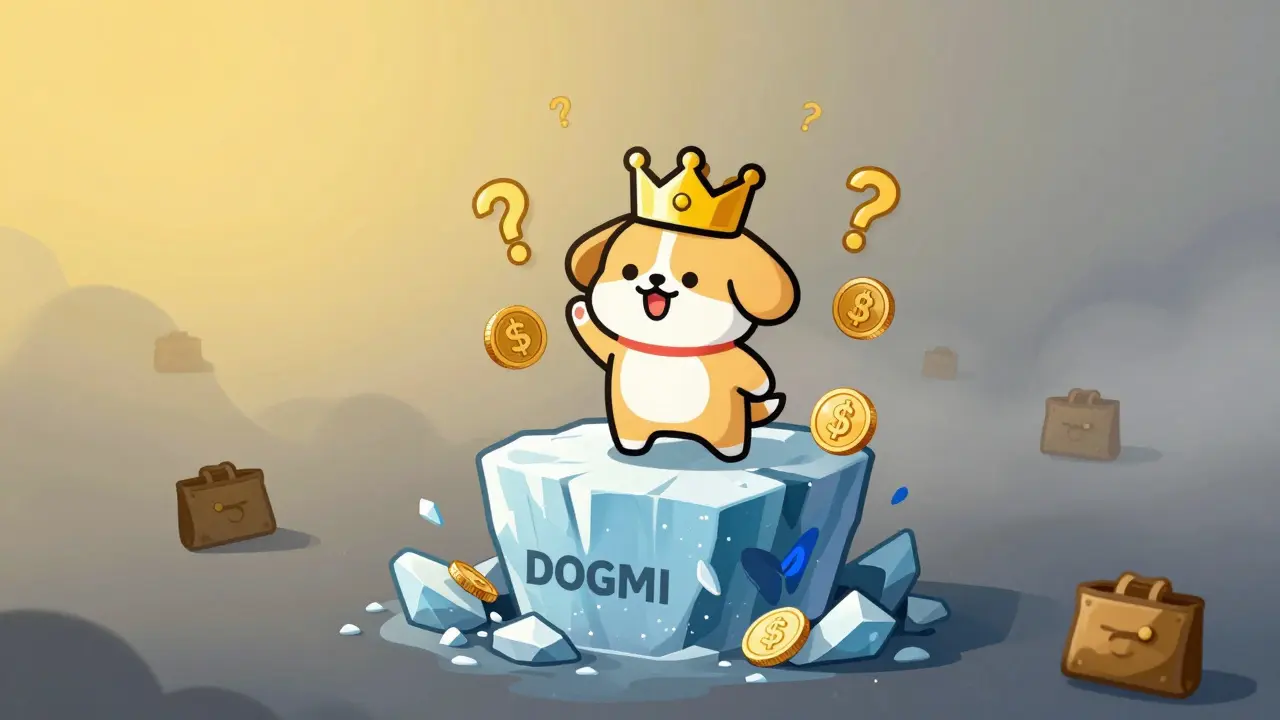
DOGMI (DOGMI) was never meant to last. It wasn't built to solve a problem, power a network, or change how money works. It was built to ride a wave - the wave of dog-themed meme coins that flooded crypto in 2024 and early 2025. For a few months, it had a following. Then, in April 2025, it vanished.
What DOGMI Actually Was
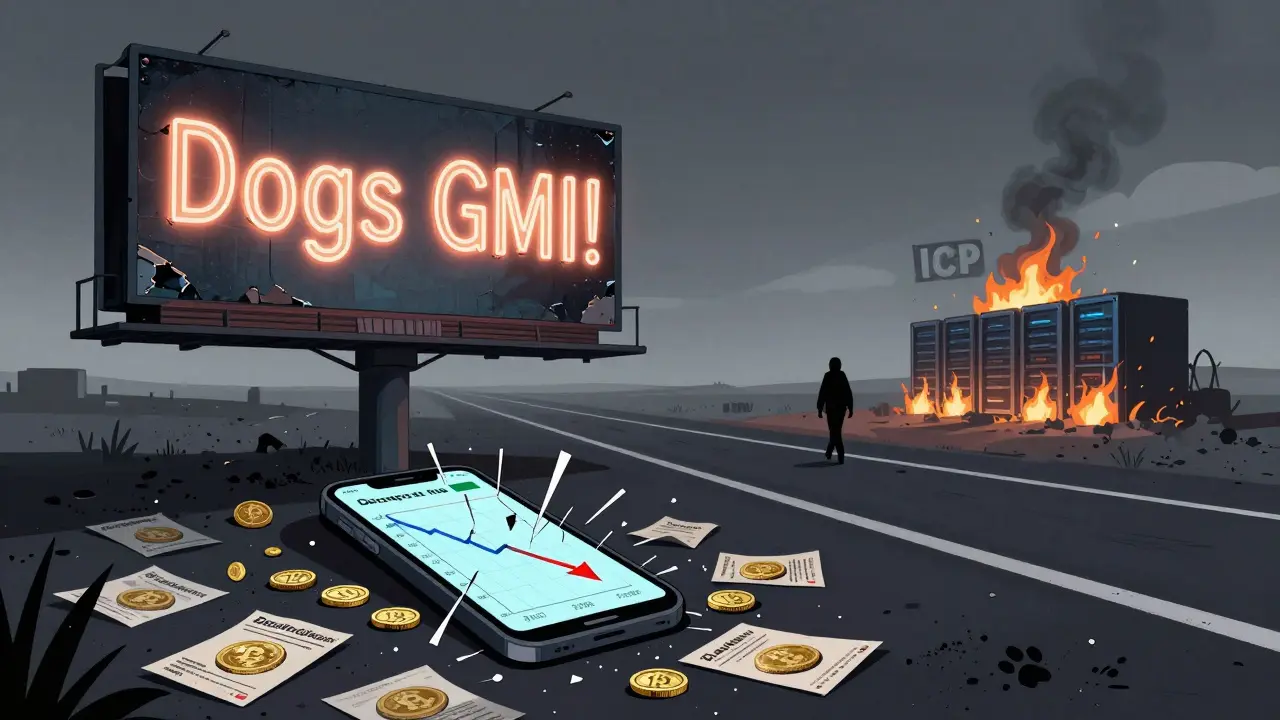
DOGMI was a meme coin built on the Internet Computer Protocol (ICP) a blockchain platform designed to run web applications directly on the internet without relying on traditional cloud services. Unlike Dogecoin (DOGE) or Shiba Inu (SHIB), which operate on their own chains or Ethereum, DOGMI was one of the first - and only - dog coins built specifically for ICP. Its whole pitch? "Dogs GMI!" - short for "Gonna Make It." It had no whitepaper, no roadmap, and no team that ever went public.
It launched with a total supply of 24,669,800,000 tokens, all created at once. There was no mining, no staking, no burning. Just a bunch of tokens dumped into wallets. At its peak, DOGMI hit a price of around $0.000052. That gave it a market cap of roughly $523,000. Not huge. Not even close to Dogecoin, which was worth billions. But for a coin on a niche chain like ICP, that was a big deal. It had over 30,000 holders at its height.
Why It Gained Traction - Briefly
DOGMI didn't grow because of technology. It grew because of community. The ICP ecosystem was small, but passionate. People who believed in the idea of running apps directly on the blockchain - without Amazon or Google - latched onto DOGMI as a fun experiment. Reddit threads from February 2025 were full of posts like "Just bought 10 million DOGMI, this is the future!" with hundreds of upvotes.
Transactions were cheap. On ICP, fees were around $0.0003 per transfer. Compare that to Ethereum, where fees hit $1.27 in early 2025. For meme traders, that meant you could buy, sell, and move DOGMI without breaking the bank. It also meant you could pump it fast. A 20% swing in price could happen in minutes.
Some early adopters made money. They bought low, sold high, and cashed out before the crash. But for most people, DOGMI was a gamble. No utility. No team. No roadmap. Just hype.
The Crash: What Went Wrong
By March 2025, cracks started showing. The price began to slide. Trading volume dropped. Then, on April 15, 2025, everything stopped.
The official DOGMI website went dark. The Telegram group vanished. The Twitter account stopped posting. No announcement. No warning. Just silence.
What happened? No one knows for sure. But experts point to two big problems.
First, concentrated ownership a situation where a small number of wallets hold the majority of a cryptocurrency's supply. According to blockchain analysis from Blockspot.io, 63.2% of all DOGMI tokens were held by just 10 wallets. That means a handful of people controlled the entire market. They could dump their tokens anytime - and they did.
Second, the Internet Computer ecosystem a blockchain network designed to host decentralized applications without cloud infrastructure was too small. ICP had a loyal user base, but it wasn't big enough to sustain a meme coin. Dogecoin thrived because it had millions of users across Ethereum, Binance, and Coinbase. DOGMI was stuck on ICP. When interest faded, there was nowhere else to go.
Dr. Elena Rodriguez from Blockchain Insights Group summed it up in May 2025: "DOGMI failed because it had no reason to exist beyond speculation. No utility, no transparency, no long-term plan. It was a classic rug pull dressed up as a community project."
What Happens to DOGMI Now?
Today, DOGMI is dead. But it still trades.
On Binance, you can still buy DOGMI for $0.000004. On Coinbase, it’s listed at $0.00000502. On Dropstab, it’s $0.00000417. Why the difference? Because there’s almost no liquidity. There are only about 127 trades per day across all exchanges. Each trade takes over 20 minutes to fill. The market is thin. The price jumps around based on a few buyers or sellers.
There’s no official wallet. No app. No website. No team. The only way to hold DOGMI now is through an ICP-compatible wallet like Plug or Stoic - but even those don’t support it anymore. You’re buying a token that no one is developing, no one is maintaining, and no one cares about.
Over 90% of users who held DOGMI after the shutdown left negative reviews. One user wrote: "Wasted 3 months promoting this project before they shut it down without warning." Another said: "Complete rug pull. Developers disappeared with community funds."
Is There Any Hope for DOGMI?
A few people tried to bring it back.
In November 2025, someone posted a proposal on the Internet Computer Forum titled "DOGMI REBORN." The idea? Take the old contract, relaunch it with a new team, and rebuild the community. It got 37 supporters. That’s less than 0.1% of the original holder count.
There’s no chance of revival. Messari’s November 2025 Crypto Graveyard Report calls DOGMI "Permanently Defunct" with "Zero Probability of Revival." The Blockchain Transparency Institute gave it a 9.8 out of 10 risk score - the highest possible. That’s worse than most scams.
The only people still trading DOGMI are speculators hoping for a pump. Maybe someone buys a few million tokens and pushes the price up 50%. Then they sell. Then it crashes again. It’s not investing. It’s gambling on a ghost.
What You Should Know If You’re Still Holding DOGMI
If you still have DOGMI in your wallet - and you’re wondering what to do - here’s the truth:
- You can’t sell it easily. Exchanges have almost no buyers.
- You can’t swap it for anything useful. No DeFi protocol accepts it.
- You can’t stake it. No yield. No rewards.
- You can’t transfer it without paying high fees and waiting hours.
- There’s no support. No help desk. No community.
Most people who held DOGMI after April 2025 lost over 90% of their investment. The few who sold before the shutdown made small profits. The rest? They’re holding a digital ghost.
The lesson? Meme coins are fun until they’re not. DOGMI wasn’t a failure because of bad luck. It was a failure because it was built on nothing. No team. No plan. No future. Just a name, a dog, and a promise.
Where DOGMI Fits in the Bigger Picture
DOGMI wasn’t alone. In 2024, over 1,200 dog-themed coins launched. Most died within months. The Internet Computer hosted 8% of all meme coins that year. By mid-2025, 89% of them were gone. The average lifespan? Just 117 days.
DOGMI lasted about 9 months - longer than most. But that doesn’t make it a success. It just means it took longer to die.
It’s a warning. Not just about meme coins - but about how easy it is to get sucked into something that looks like a community, but is really just a pump. The people behind DOGMI never had to answer to anyone. No regulators. No audits. No accountability. And when the money ran out, they walked away.
There’s no redemption. No recovery. No future. DOGMI is gone. And it’s not coming back.
Is DOGMI still being traded today?
Yes, DOGMI is still listed on a few exchanges like Binance, Coinbase, and Dropstab, but trading volume is extremely low - averaging just $47.82 per day across all platforms. There are only about 127 trades daily, and each one can take over 20 minutes to complete due to thin order books. The price varies wildly between platforms, indicating high manipulation risk.
Can I still use DOGMI for payments or DeFi?
No. DOGMI has zero utility. No wallets support it officially. No decentralized exchanges accept it for swaps. No DeFi protocols let you stake, lend, or earn with DOGMI. It’s purely a speculative asset with no real-world use.
Why did DOGMI shut down in April 2025?
The project vanished without warning. Experts believe it was a classic rug pull: the team held over 63% of the supply and likely sold off their tokens, then disappeared. The Internet Computer ecosystem was too small to sustain a meme coin long-term, and without transparency or utility, trust collapsed.
Was DOGMI a scam?
While there was no official legal ruling, the evidence points strongly to it being a scam. The team never revealed their identities. There was no roadmap, audit, or development activity after launch. The project shut down suddenly with no notice, and over 90% of user reviews after the shutdown called it a rug pull. Blockchain analysts classify it as permanently defunct with zero chance of revival.
Is there a chance DOGMI will come back?
No. Multiple attempts to revive DOGMI have failed. The most serious proposal in November 2025 on the Internet Computer Forum had only 37 supporters. Major analytics firms like Messari and the Blockchain Transparency Institute have labeled DOGMI as permanently defunct. With no team, no code, and no community left, revival is impossible.
Should I buy DOGMI now?
Absolutely not. DOGMI has no value beyond speculative gambling. The price is near zero, liquidity is near nonexistent, and there’s no reason to believe it will ever recover. Buying DOGMI now is like buying a broken phone and hoping someone will fix it - except there’s no one left to fix it.
How many people held DOGMI at its peak?
At its peak in early 2025, DOGMI had over 30,000 unique wallet holders. This was considered high for a project on the Internet Computer, which had a much smaller user base than Ethereum or Solana. However, over 63% of all tokens were held by just 10 wallets, indicating extreme centralization and high risk.
What made DOGMI different from Dogecoin or Shiba Inu?
DOGMI was built exclusively on the Internet Computer Protocol (ICP), while Dogecoin runs on its own blockchain and Shiba Inu runs on Ethereum. This limited DOGMI to a tiny user base. It had no cross-chain support, no ecosystem integrations, and no long-term development. Unlike DOGE and SHIB, which grew into communities with real utility, DOGMI had none of that - just hype.


People Comments
I remember when DOGMI was everywhere on ICP forums. People were calling it the 'future of meme coins' like it was gonna save the ecosystem. Funny how fast hype dies when there's no substance behind it. I'm not mad, just disappointed. We all knew it was a gamble, but still... it felt personal when it vanished.
LMAO 🤡 This is why you don't trust anonymous teams. 63% in 10 wallets? That's not a community. That's a pump-and-dump with a dog logo. I lost $200 on this. Worth it for the lesson.
I just feel bad for the people who genuinely believed in it. Not the speculators, but the ones who thought they were part of something cool. The internet is full of these ghosts now.
It’s wild how something so dumb could feel so real for a minute. Like, I’d post memes about DOGMI and people would reply with actual passion. It wasn’t about money. It was about being part of a weird little tribe. Then poof. No one even said goodbye.
YALL STILL HOLDING DOGMI?? 😭 I saw a guy on twitter yesterday trying to 'rebuild' it with a new contract. Bro. It's a dead file. Your wallet is a digital tomb. Stop throwing good money after bad. I'm not being mean. I'm being your future self.
I still have 12 million DOGMI in my wallet. Not because I think it'll come back. Just because I'm weirdly attached. Like keeping a dead pet's collar. It's a reminder. Don't get too attached to hype.
This was a Fed move. They let ICP get traction so they could watch which meme coins got popular. Then they killed DOGMI to scare off retail. You think this was organic? Nah. This was a test. And we all failed.
In India, we have a saying: 'A dog that barks too loud gets hit with a stone.' DOGMI barked louder than anyone on ICP. So someone threw the stone. And now? Silence. It's poetic.
The ontological collapse of DOGMI reflects the epistemic fragility of decentralized governance in meme ecosystems. When liquidity evaporates, so does epistemic authority. The blockchain doesn't lie, but it doesn't forgive either.
I appreciate the thorough breakdown here. For anyone still holding DOGMI: if you're not actively trading it, consider it a non-functional NFT. No utility. No recovery path. Just a memory. Delete the wallet if it's causing stress.
Lol this whole thing was a joke. ICP is a dead chain. DOGMI was its last gasp. People still talk about it like it's a tragedy? Bro. It was a 9-month-long TikTok trend. We all knew. We just liked the vibe.
i lost my rent money on dogmi and now i work at a call center in hyderabad. dont do it. dont even look at it. its a ghost. just a ghost.
OMG YOU GUYS ARE SO NAIVE. The real story? The ICP team *created* DOGMI to drain attention from their own failing projects. They let it rise, then pulled the plug. It was a distraction tactic. I have screenshots. I have DMs. I have proof. But no one wants to hear the truth.
I still get notifications from DOGMI's old Telegram. Every week. Someone posts 'GMI soon?' with a dog pic. It's like a haunted house. And we're all ghosts haunting it.
This is why India should never trust Western crypto trends. We have real projects here. Not this trash. DOGMI? More like DOG-NO-MI. No money. No future. No respect.
The real crime here isn't the rug pull. It's that we let ourselves believe in something that refused to believe in itself. No whitepaper. No team. No soul. And yet we cheered. That’s the deeper tragedy.
I had 500k DOGMI. Sold it for $12 before the crash. Still feel guilty. I know it was dumb money. But I still wish I'd donated it to some crypto education fund instead. Just... felt wrong to profit off a ghost.
I used to post DOGMI memes to cheer up my sister during chemo. She passed last year. I still have the wallet. Not for the tokens. For the memories. It was the last thing that made us laugh together.
USA thinks it owns crypto. This was a joke. We have real blockchain projects in India. Not this cartoon nonsense. DOGMI? More like DOG-DEAD-MI. Pathetic.
Let's be precise: DOGMI was not a failure. It was a deliberate act of economic sabotage. The ICP foundation had no incentive to support a meme coin. But they also couldn't openly kill it. So they let it rise, then withdrew all infrastructure support. This was a coordinated deplatforming. Not a collapse. An execution.
I know who did it. I know the wallet addresses. I know the IP logs. I have screenshots of the team laughing in a Discord call after the last dump. But no one will publish it. Because the same people who killed DOGMI own the analytics firms. This isn't over. It's just getting buried.
The ICP ecosystem was always a sandbox for crypto bros. DOGMI was the last toy they broke. Now they're all over on Solana or Base. Meanwhile, the 30k holders? Left with a digital tombstone. We were the collateral damage in a war we didn't even know was happening.