


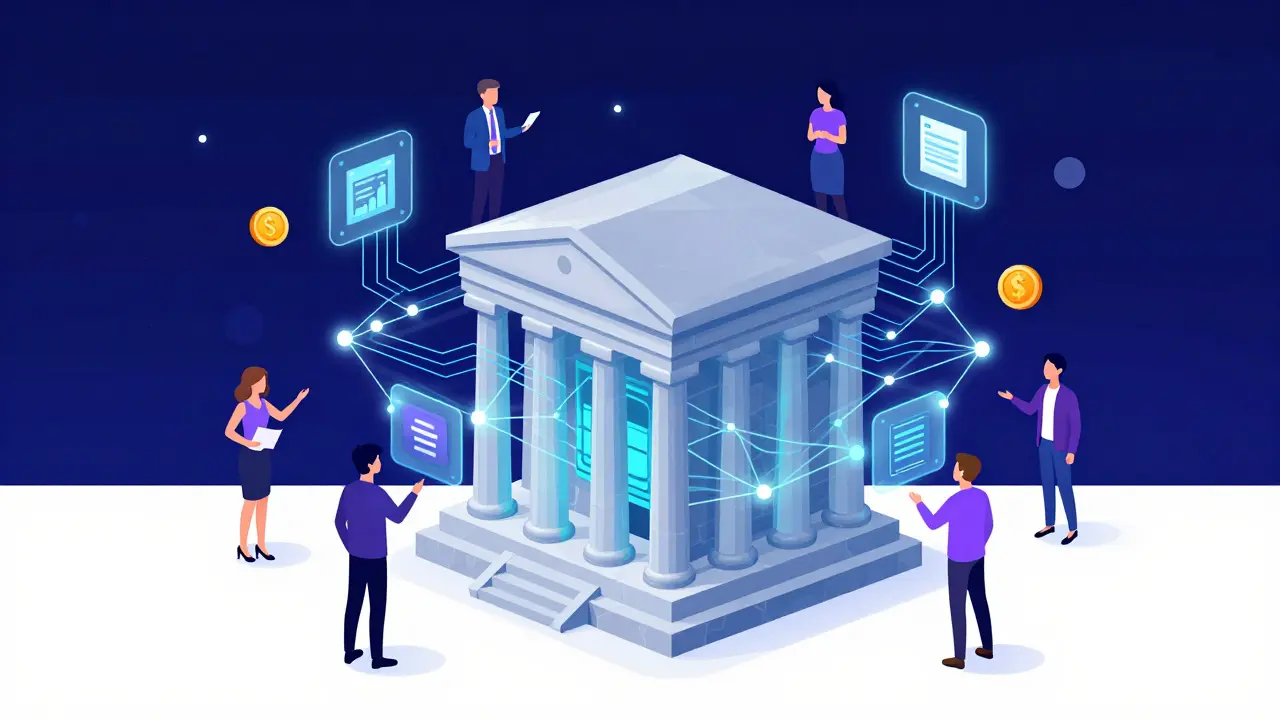
Imagine a world where you can earn interest on your savings, take out a loan, or trade assets without ever stepping foot in a bank or asking a manager for permission. That's exactly what DeFi is a system of decentralized financial services built on blockchain technology that removes the need for traditional intermediaries like banks. Instead of a company managing your money, a piece of self-executing code called a smart contract handles everything. While the idea sounds futuristic, it's already here, with over $112 billion currently locked in these protocols as of early 2026.
The Basics: How DeFi Actually Works
In a traditional bank, the institution is the "middleman." They hold your money, verify your identity, and decide if you qualify for a loan. DeFi flips this script. By using Blockchain technology, transactions happen peer-to-peer. If you want to lend money to someone, you don't need a bank to match you; you just deposit your assets into a liquidity pool governed by code.
The backbone of most of this activity is Ethereum, a programmable blockchain that allows developers to create complex financial apps. However, it's not the only player. Solana has become a favorite for beginners because it's incredibly fast and costs almost nothing to use. Whether you're using Ethereum or Solana, the goal is the same: keeping you in total control of your assets through a non-custodial setup.
Your First Steps: Setting Up Your Toolkit
You can't use DeFi with a standard bank account. You need a way to interact with the blockchain. This is where a non-custodial wallet comes in. Unlike an account on an exchange, a non-custodial wallet means you hold the "private keys"-essentially the master password to your funds. If you lose these keys, no one can reset your password for you.
For most people, MetaMask is the go-to choice, commanding nearly 87% of the market share for Ethereum users. If you're leaning toward the Solana ecosystem, Phantom is a highly rated alternative known for its clean interface. While software wallets are great for daily use, if you plan to hold a significant amount of money, spending $79 to $129 on a hardware wallet like Ledger is a smart move for extra security.
| Feature | Ethereum (Mainnet) | Layer 2 (Arbitrum/Optimism) | Solana |
|---|---|---|---|
| Avg. Transaction Fee | $1.50 - $15.00 | $0.02 - $0.15 | ~$0.00025 |
| Speed | Moderate | Fast | Very Fast |
| Market Share (TVL) | ~58.7% | Significant & Growing | ~12.3% |
| Best For | High-value security | Daily trading/Small sums | Ultra-low cost/Speed |
Moving Your Money into DeFi
Once your wallet is ready, you need assets to play with. Most beginners start by buying ETH or stablecoins like USDC (which stays pegged to the US Dollar) from a centralized exchange like Coinbase. From there, you send the funds to your wallet address. This process usually takes about 20 to 45 minutes including the necessary identity checks on the exchange side.
If you want to skip the exchange, some wallets let you buy crypto directly with a credit card. It's faster-taking only 10 to 15 minutes-but be prepared to pay higher fees, often between 2% and 5%. Once your funds land in your wallet, you are officially ready to interact with the DeFi world.
Top Ways to Use DeFi Today
Now that you have funds, what do you actually do with them? There are three main "jobs" most beginners want to accomplish:
- Trading (Swapping): Instead of a central order book, you use a Decentralized Exchange (DEX). If you're worried about "front-running" (where bots jump ahead of your trade to steal profit), tools like CoW Swap use intent-based trading to protect you.
- Lending and Borrowing: You can act like the bank. By depositing stablecoins into protocols like Aave or Compound, you can earn an APY (Annual Percentage Yield) that often beats traditional savings accounts. In 2026, stablecoin yields on Aave typically hover between 2.1% and 4.7%.
- Yield Farming: This is more advanced and involves providing liquidity to a pair of tokens to earn a share of the trading fees. While the returns can be higher-sometimes 8% to 12% on Solana platforms like Marginfi-it comes with a risk called "impermanent loss," where you might have been better off just holding the tokens.
Avoiding Common Newbie Traps
DeFi is a "wild west" where you are your own security guard. According to Professor David Yermack, about 90% of losses in DeFi come from user error, not technical glitches. The most common mistake? Excessive token approvals. When you use a site, it often asks for permission to spend your tokens. If you give "unlimited" approval to a sketchy site, they can drain your wallet even after you've left the page.
Another hurdle is "gas fees." On Ethereum, you pay a fee for every single action. If the network is busy, a simple swap can cost you $15. To avoid this, use Layer 2 solutions. These are networks built on top of Ethereum that slash fees down to pennies. Also, always start small. Use $10 or $20 for your first few transactions to make sure you understand the flow before committing larger sums.

The Road Ahead: Is it Getting Easier?
The good news is that the learning curve is dropping. A major update called "account abstraction" (EIP-3074) has started making wallets feel more like regular apps, allowing for social recovery of keys so you don't lose everything if you misplace a seed phrase. We're also seeing "Learn Modes" on platforms like Uniswap that explain what's happening in real-time as you click through a trade.
While regulators are still figuring things out-with the SEC and other bodies creating a fragmented landscape-the technology is moving toward financial inclusion. The World Bank has noted that DeFi could eventually drop the cost of sending money across borders from 6.5% to less than 1%. It's not perfect, and it lacks the safety net of FDIC insurance, but for those willing to learn, the potential is huge.
Is DeFi safe for beginners?
It can be, but it requires a different mindset. You are responsible for your own security. While the protocols themselves are generally robust, the biggest risks are scams, phishing links, and losing your private keys. Always use a hardware wallet for large amounts and double-check the URLs of the sites you visit.
What is the difference between a CEX and a DEX?
A CEX (Centralized Exchange) like Coinbase is a company that holds your funds and manages trades. A DEX (Decentralized Exchange) like Uniswap or CoW Swap is a piece of code that allows you to trade directly from your own wallet without a middleman.
What are gas fees and why are they so high on Ethereum?
Gas fees are payments made to the people who keep the blockchain running. Because Ethereum is so popular, the "space" for transactions is limited. When many people try to use it at once, fees spike. Using Layer 2 networks (like Arbitrum) is the best way to avoid this.
What is a stablecoin?
A stablecoin is a cryptocurrency designed to have a steady value, usually pegged 1:1 to a fiat currency like the US Dollar. Examples include USDC and DAI. They are used in DeFi to avoid the volatility of coins like ETH or BTC while still earning interest.
What happens if I lose my seed phrase?
In a non-custodial wallet, your seed phrase is the only key to your money. If you lose it and don't have a backup, your funds are gone forever. There is no "Forgot Password" button in DeFi. This is why writing it down on paper and storing it in a safe is critical.
Next Steps for Your DeFi Journey
If you're feeling overwhelmed, don't try to do everything at once. Start by installing MetaMask or Phantom and just exploring the interface. Once you're comfortable, move a small amount of funds-maybe $20-to a Layer 2 network. Try a simple swap or deposit a small amount of USDC into Aave to see how the interest accrues over a week.
For those who want to go deeper, look into the concept of "Account Abstraction" to see how your wallet experience can be simplified. Just remember: if a project promises returns that sound too good to be true (like 100% APY), it usually is. Stick to the established protocols with high Total Value Locked (TVL) while you're still learning the ropes.
- Poplular Tags
- DeFi
- decentralized finance
- MetaMask
- Ethereum
- crypto wallets



People Comments
Solana is just way smoother for this stuff 🚀
Totally agree that starting small is the way to go! It's so much easier to learn when you aren't stressed about a huge sum of money.
I'd also suggest looking into some community forums where people share their early mistakes so you can avoid them too! We're all in this together and it's a great way to build confidence before diving into the deeper end of the pool.
The mention of MetaMask's market share is interesting, although it fails to acknowledge the rapid ascent of wallet abstraction layers that render the traditional 'plugin' model obsolete. Furthermore, the distinction between a CEX and a DEX is far more nuanced than a simple 'middleman' explanation. One must consider the implications of liquidity provider risks and the systemic vulnerabilities of automated market makers if they truly wish to understand the landscape.
The concept of non-custodial ownership is essentially a return to the primordial definition of property. In the traditional system, we do not own our assets; we own a promise from a bank that they will allow us to access our assets. By removing the intermediary, DeFi isn't just a financial tool, it is a philosophical shift toward absolute individual sovereignty. However, this freedom comes with a burden of responsibility that most people are psychologically unprepared for, which is why we see so many losses due to simple human error.
just a heads up for anyone starting out... make sure you double check the network you are sending to
sending eth to a solana address is a mistake you only make once but it hurts
It is truly fascinating how we mistake these digital tokens for actual wealth while ignoring the moral decay of a society that prizes algorithmic efficiency over human connection. We are essentially replacing a human banker we don't like with a piece of code that doesn't care if we exist at all. Is this truly progress, or are we just building a more efficient cage for our greed? I feel we must question the ethics of 'yield farming' when it's essentially just extracting value from a vacuum of nothingness.
wow a guide that tells us to not click sketchy links... truly revolutionary stuff here lol
can't wait for the 2027 guide telling us to use a password
Who cares about these L2s. Only the main chain matters if you have real money. Most of these other coins are just trash anyway. Only Americans really get how to make big money in this game because we have the best systems. The rest of you are just playing with pennies while the big players win.
The analysis regarding the SEC's fragmented landscape is laughably understated. The reality is that most of these protocols are operating in a legal gray area that will eventually collapse under the weight of regulatory scrutiny. If you are using Aave as a primary savings vehicle, you are essentially betting that the US government won't decide to freeze the stablecoin gateways. It is a reckless gamble masquerading as financial innovation.
for those wondering about the hardware wallets just get a trezor or ledger and keep the seed phrase on metal not paper because paper burns or rots over time
I've been experimenting with the account abstraction mentioned and it really is a game changer for onboarding. The ability to pay gas fees in the token you are swapping rather than needing a separate native coin for gas removes the biggest friction point for new users. I wonder if we'll eventually see a world where the blockchain layer is completely invisible to the user, making it feel exactly like a traditional app but with all the security of a decentralized backend.
too much reading but whatever
You got this everyone! 🌟 Just take it slow and don't be afraid to make a tiny mistake with $1 to learn how it works. It feels scary at first but it's so empowering once you realize you're your own bank! Keep going! ✨