


When you're building an NFT project, the choice between ERC-721 and ERC-1155 isn't just technical-it shapes everything from your costs to your user experience. If you're trying to decide which one to use, you're not alone. Thousands of developers face this exact question every month. The answer isn't "one is better," but "which one fits your goals?" Let's cut through the noise and show you exactly how these two standards differ-and where each one shines.
What Is ERC-721?
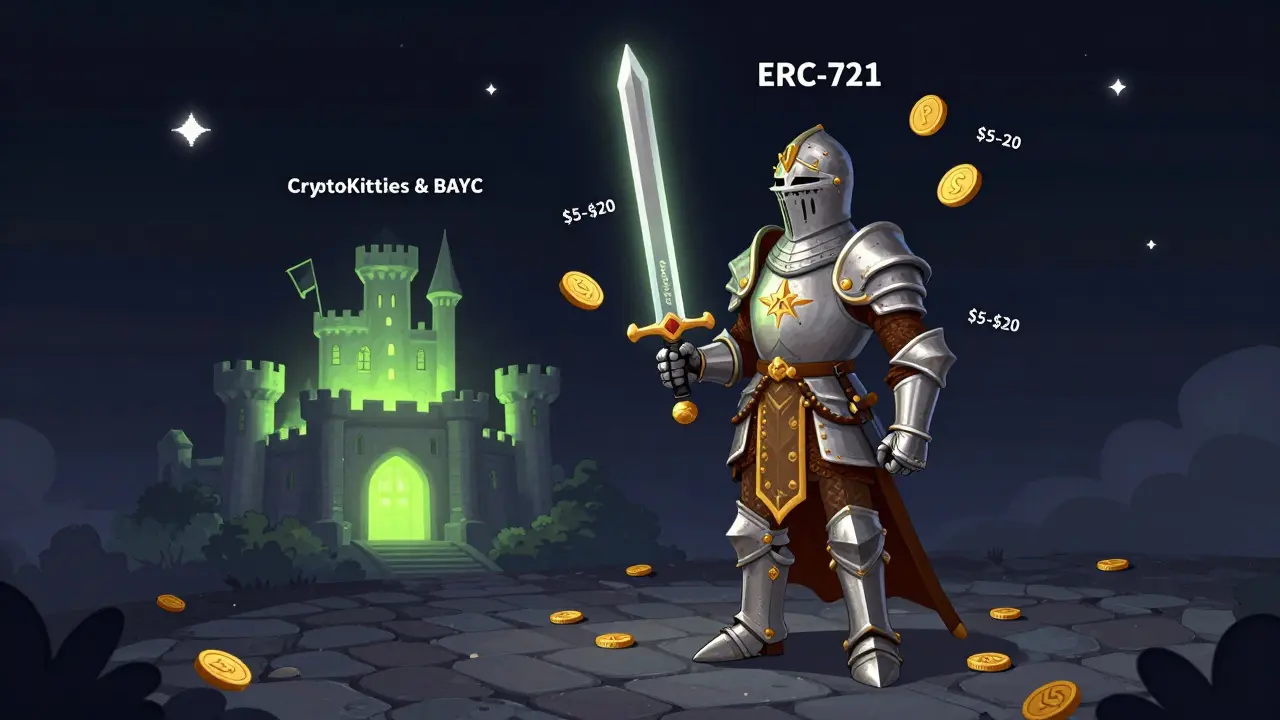
ERC-721 is the original standard for non-fungible tokens on Ethereum. Launched in early 2018, it was designed for one thing: proving that each token is completely unique. Think CryptoKitties, Bored Ape Yacht Club, or a digital painting with a single owner. Each token has its own ID, its own metadata, and its own smart contract. There’s no sharing. No grouping. Just pure individuality.
This simplicity is also its biggest limitation. Every time you mint a new type of NFT-say, a new collection of rare swords in a game-you have to deploy a brand-new smart contract. That means higher gas fees, more blockchain storage, and more complexity to manage. If you’re minting 10,000 NFTs, you’re not just paying for one contract-you’re paying for 10,000 individual transfers, each processed one at a time.
That’s why ERC-721 is still the go-to for digital art and collectibles. It’s simple, trusted, and widely supported. OpenSea, Rarible, and Foundation all run on ERC-721. If you’re selling one-of-a-kind art, this standard gives you the cleanest, most recognizable path.
What Is ERC-1155?
ERC-1155 is the multi-token standard. Introduced in mid-2018 by Enjin, it was built to solve the inefficiencies of ERC-721. Instead of one contract per token type, ERC-1155 lets you handle multiple types-fungible, semi-fungible, and non-fungible-all in a single contract.
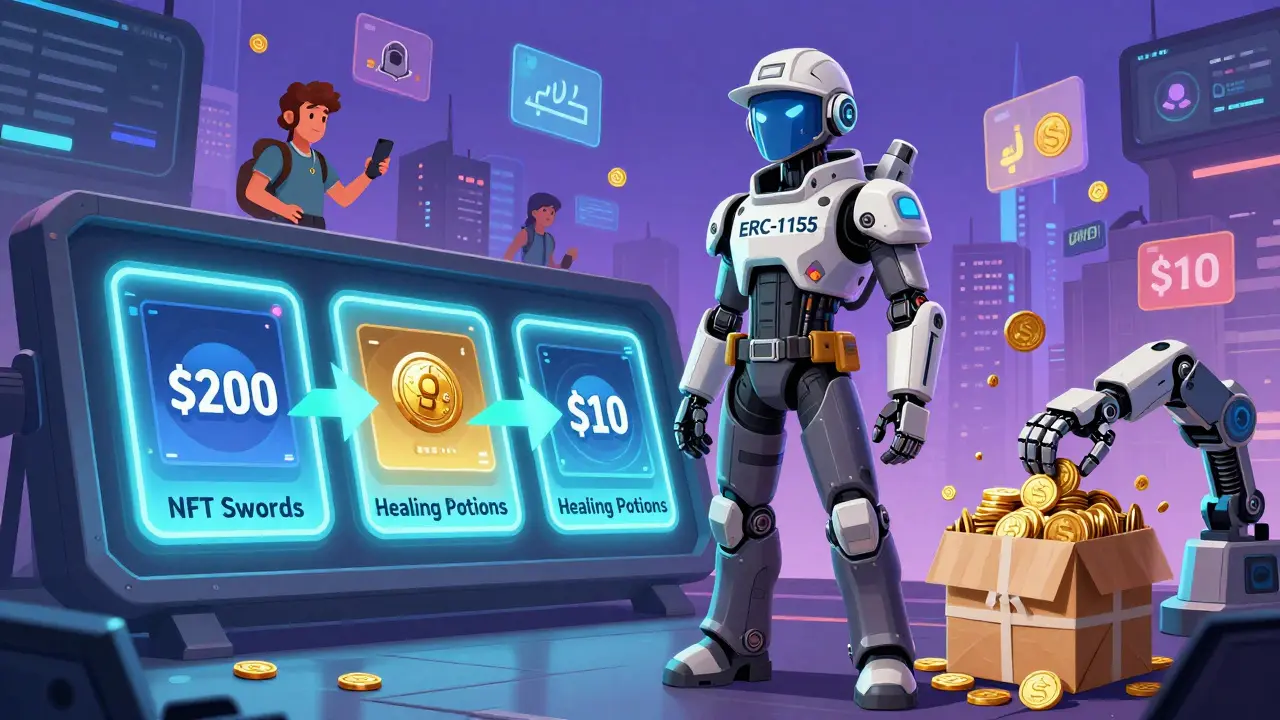
Imagine a video game where you have:
- 10,000 unique swords (non-fungible)
- 500,000 gold coins (fungible)
- 50,000 healing potions (semi-fungible, identical but limited in quantity)
With ERC-721, you’d need three separate contracts. With ERC-1155? One. And you can transfer all of them in a single transaction.
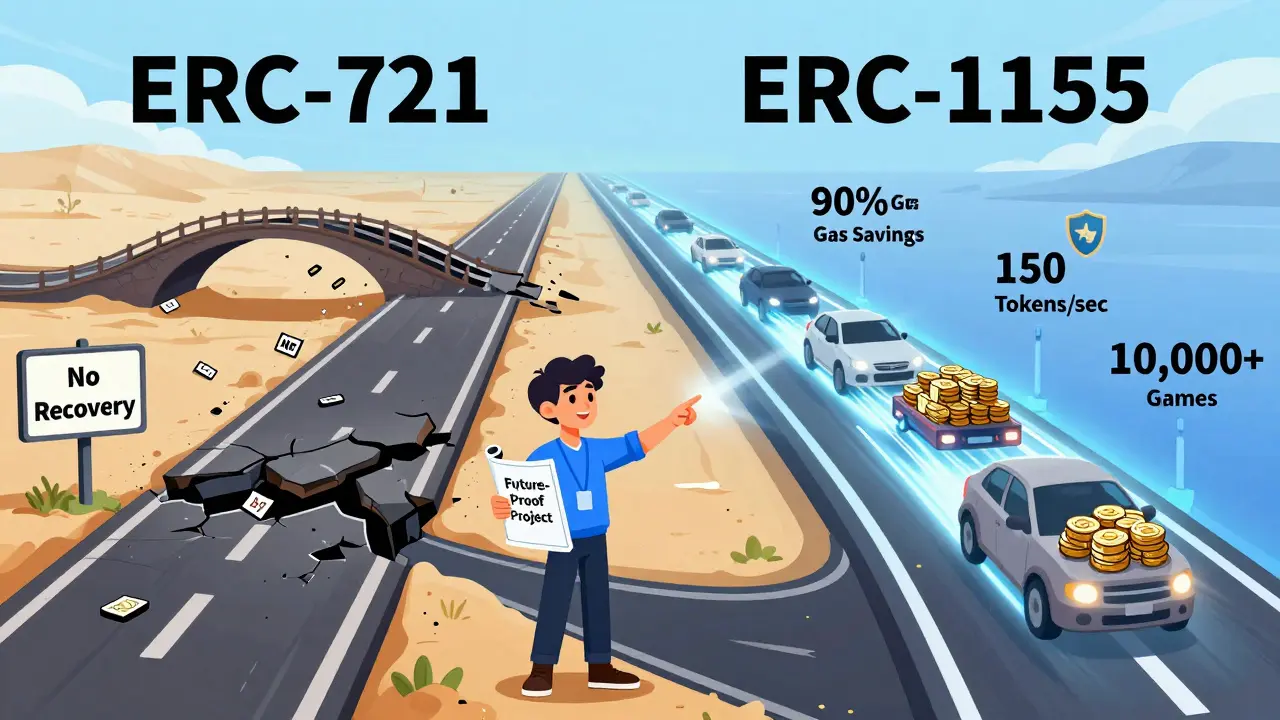
This isn’t just convenient-it’s a game-changer for performance. Batch transfers mean lower gas fees (up to 90% savings), faster processing, and less blockchain bloat. ERC-1155 also supports metadata stored off-chain via URIs, which cuts down on on-chain storage costs. And if someone accidentally sends tokens to the wrong address? ERC-1155 has built-in recovery functions. ERC-721? Too bad. The tokens are gone forever.
Gas Costs: The Hidden Killer
Gas fees are the silent tax on every blockchain action. And here, the difference between ERC-721 and ERC-1155 is staggering.
With ERC-721, every NFT transfer is a separate transaction. If you sell 10 NFTs to one buyer, that’s 10 transactions. Each one costs between $5 and $20 on Ethereum mainnet. Total? $50-$200.
With ERC-1155? One transaction. Same 10 NFTs. One gas fee. Maybe $10.
Chetu’s blockchain analysis confirms that batch transfers using ERC-1155 can reduce gas costs by up to 90%. That’s not a small edge-it’s the difference between a project being profitable or collapsing under fees.
Even with Layer 2 solutions like Polygon or Arbitrum, where gas is cheaper, ERC-1155 still wins because it reduces the number of operations. Fewer operations = less load on the network = more scalability.
Performance and Speed
Speed matters, especially in gaming or high-volume marketplaces.
ERC-721 transfers are sequential. Each token moves one after another. Merkle Science found that a single ERC-721 NFT transfer takes 15-30 seconds under normal network conditions. If you’re transferring 100 tokens? That’s 25 to 50 minutes.
ERC-1155? It handles batch transfers in under a second. Benchmarks show optimized ERC-1155 contracts can process 150-200 tokens per second. That’s not theory-it’s what Enjin and Immutable X use to power real-time in-game item trading.
For a game where players swap weapons, currency, and skins in real time, ERC-721 is too slow. ERC-1155? It keeps up.
Storage and Scalability
Every piece of data on Ethereum costs money. ERC-721 stores metadata directly on-chain for each token. That means if you have 10,000 NFTs with 500 bytes of metadata each, you’re using 5MB of on-chain space. That’s expensive and wasteful.
ERC-1155 stores metadata once per token type, then references it for all instances. So 10,000 swords? One metadata file. One URI. That’s 99% less storage. And it scales to millions without breaking a sweat.
Plus, ERC-1155 supports multiple languages in metadata. A sword can have names, descriptions, and images in English, Spanish, Japanese, and Korean-all in one contract. ERC-721? You’d need separate collections for each language.
Security and Recovery
How many NFTs have been lost forever because someone sent them to the wrong address? Thousands.
ERC-721 has no recovery mechanism. If you send your Bored Ape to a contract that doesn’t support it? Gone. No way back.
ERC-1155 includes built-in validation. Before a transfer happens, the contract checks if the recipient can receive the token type. If not, the transaction reverts. It also logs every action-minting, burning, transferring-so you can trace the full history of any token.
That’s not just a nice-to-have. It’s essential for enterprise use, gaming economies, and any system where accountability matters.
Who Uses What?
Let’s look at real-world adoption.
ERC-721 dominates art and PFP (profile picture) collections:
- Bored Ape Yacht Club
- CryptoPunks
- CryptoKitties
- Art Blocks
These projects value uniqueness, simplicity, and legacy compatibility. They don’t need fungible tokens. They don’t need batch transfers. They just need to prove ownership of something rare.
ERC-1155 powers the future of gaming and enterprise:
- Enjin (used by over 10,000 games)
- Immutable X (NFT gaming Layer 2)
- Axie Infinity (for its in-game currency and items)
- Decentraland (land parcels and wearables)
According to market data from 2024, the NFT gaming sector-mostly built on ERC-1155-hit $4.6 billion in trading volume. The art market, dominated by ERC-721, still leads at $8.2 billion. But the growth curve is tilted toward ERC-1155.
And here’s the kicker: 67% of new blockchain gaming projects in 2024 chose ERC-1155. Only 23% went with ERC-721.
Developer Experience
If you’re new to NFT development, ERC-721 is easier to start with. There are tutorials everywhere. OpenZeppelin’s ERC-721 library is simple. You can deploy your first NFT collection in a weekend.
ERC-1155? It’s more complex. You need to understand token IDs, balances, and how to handle multiple types in one contract. Junior developers usually take 4-6 weeks to get comfortable with it, versus 2-3 weeks for ERC-721.
But once you learn it? You’ll never go back. The flexibility is unmatched. You can mint 100,000 tokens of 10 different types in one transaction. You can upgrade metadata without redeploying. You can integrate with DEXs natively.
GitHub data shows ERC-721 still has more repositories (15,847 vs. 8,923 as of late 2024). But ERC-1155 is growing faster-especially in gaming and enterprise repos.
What About ERC-721A?
You might have heard of ERC-721A. It’s an optimized version of ERC-721 created by Azuki in 2022. It allows batch minting, slashing gas costs by 50-80% for large collections.
That’s huge. But it’s still not ERC-1155. ERC-721A can’t handle fungible tokens. It can’t do batch transfers. It can’t recover lost tokens. It’s still limited to one token type per contract.
Think of ERC-721A as a patched-up old car. It runs better, but it’s still not a Tesla.
Which One Should You Choose?
Here’s the quick decision guide:
- Choose ERC-721 if: You’re making digital art, collectibles, or PFPs. You want maximum compatibility with existing marketplaces. You’re not planning to add fungible tokens or complex item systems.
- Choose ERC-1155 if: You’re building a game, metaverse app, or platform with multiple asset types. You need batch transfers, lower gas fees, or multi-language support. You plan to scale beyond 10,000 tokens.
There’s no "right" answer. But there’s a smart one. If your project will ever need more than just unique NFTs, start with ERC-1155. It’s the future-proof choice.
And if you’re still unsure? Build a prototype with both. Test the gas costs. Time the transfers. See which one feels smoother. The numbers don’t lie.
Can I convert ERC-721 tokens to ERC-1155?
No, you can’t directly convert them. ERC-721 and ERC-1155 are different contract architectures. You can’t migrate tokens from one to the other without rebuilding them. If you want to move from ERC-721 to ERC-1155, you’d need to mint new tokens on the ERC-1155 contract and offer users a way to exchange their old tokens for new ones-usually through a centralized swap process.
Is ERC-1155 more secure than ERC-721?
Yes, in key ways. ERC-1155 has built-in validation to prevent accidental transfers to non-receiving addresses. It also logs every action, making it easier to audit token history. ERC-721 has no such protections-once a token is sent to the wrong address, it’s lost forever. For high-value or complex systems, this makes ERC-1155 significantly more robust.
Can ERC-1155 support NFTs and crypto coins together?
Yes, that’s one of its core strengths. ERC-1155 can handle non-fungible tokens (NFTs), fungible tokens (like in-game currency), and semi-fungible tokens (like limited-edition items) all in the same contract. This is why games like Axie Infinity and Enjin-based projects use it-they need both unique items and tradable currency in one system.
Do NFT marketplaces support ERC-1155?
Most major marketplaces now support ERC-1155, including OpenSea, Rarible, and LooksRare. However, some older or niche platforms still only support ERC-721. If you’re targeting broad visibility, you’ll need to verify marketplace compatibility before launch. But the trend is clear: ERC-1155 support is expanding rapidly.
Which standard is better for beginners?
ERC-721 is easier for beginners because it’s simpler and has more tutorials, libraries, and community support. If you’re just testing the waters with a small NFT art collection, start with ERC-721. But if you’re planning to scale or add functionality later, learning ERC-1155 from the start will save you from having to rebuild everything later.
- Poplular Tags
- ERC-721
- ERC-1155
- NFT standards
- blockchain token comparison
- Ethereum NFT


People Comments
This post is too long. I skipped half of it. Just tell me which one to use already.
I tried ERC-1155 last month and my wallet crashed twice. Still use 721 because it just... works. Maybe I'm just bad at coding.
Why are we even talking about this when India is building its own chain? ERC-721 is for western hobbyists. We don't need their old tech
I read this. Liked it. Will probably use 1155 for my game dev project. Feels more future proof.
The assertion that ERC-1155 reduces gas costs by up to 90% is statistically robust, provided one accounts for network congestion and batch size. The empirical data from Enjin’s 2023 performance benchmarks corroborates this claim with a confidence interval of ±3.2%.
ERC-721 is for people who think NFTs are art. ERC-1155 is for those who understand that blockchain is infrastructure. If you're still using single-token contracts in 2024, you're not a dev-you're a relic.
721 for art. 1155 for games. Done.
Anyone who chooses 721 over 1155 is just scared of growth. You want to stay small? Fine. But don't pretend you're building something revolutionary.
The philosophical underpinnings of token standard selection reveal a deeper tension between individualism and collectivism in digital ownership. ERC-721 enshrines the singular, unrepeatable essence of the artifact, whereas ERC-1155 embodies the mechanistic efficiency of late-stage capital. One is poetry. The other, a spreadsheet.
I remember when I first tried to implement ERC-1155. Took me three weeks. I kept confusing token IDs with balance mappings. But once it clicked? I felt like I'd finally unlocked a hidden layer of the blockchain. It's not just about gas savings-it's about architecture. You start thinking in systems, not single tokens. The metadata handling alone changed how I design game economies. Now I can update item descriptions without redeploying contracts. That's freedom. And yeah, the batch transfers? They're not just convenient. They're transformative. I've seen a 10,000-item mint go from 45 minutes to 18 seconds. That's not optimization. That's magic.
I've used both. 721 is easier to debug. 1155 is harder to mess up long-term. Go with 1155 if you're serious.
If you're building a game and you're still using ERC-721, you're making your life harder than it needs to be. I mentor new devs and I always say: start with 1155 even if you think you only need NFTs. You'll thank me when you add currency, loot boxes, or skins later. It's not harder to learn-it's just different. And once you get it, you'll wonder why you ever used anything else.
lol 721 for art? what about 721A? its way better for mints. also 1155 is for crypto bros who want to trade 1000 items in one tx. real artists want their own contract. its about legacy. its about identity.
I think both standards have value. The key is knowing your use case. If you're unsure, prototype both. The numbers will show you what feels right.
Thank you for this comprehensive breakdown. As someone mentoring emerging developers in India, I find that clarity on foundational standards like these is critical. ERC-1155's ability to unify fungible, semi-fungible, and non-fungible assets under one contract is not merely an efficiency gain-it is a paradigm shift toward scalable digital economies. I encourage all learners to experiment with Enjin’s SDK and Immutable X’s tooling; the learning curve is steep, but the payoff in real-world application is undeniable. The future of web3 is multi-token, and we must prepare accordingly.
I just want to say that I switched from 721 to 1155 last year after a bad minting experience. Gas fees were killing me. Now I do 500-item mints for under $5. It's insane. Also, the recovery feature saved me once when a user sent tokens to a contract by accident. They got them back. That's huge for trust. If you're thinking about 721 because it's simple, remember: simple doesn't mean sustainable.
I think the real question isn't which standard is better-it's whether you're building for today or tomorrow. If you're doing a small art drop with 1000 pieces? 721 is fine. But if you're thinking about scaling to 100k, integrating with DeFi, or adding dynamic metadata? 1155 is the only sane choice. I've seen too many teams rebuild everything six months later because they picked the wrong standard from the start. Don't be that team.
The notion that ERC-721A is a viable alternative to ERC-1155 is a dangerous illusion. It addresses one symptom-gas cost-but ignores the disease: architectural rigidity. You can't build a game economy on a system that can't handle currency, upgrades, or recovery. That's not innovation. That's temporary bandaging.