


You’re staring at a bill from Amazon S3 or Google Cloud that looks like it was written in alien hieroglyphs. You know there’s a cheaper way to store your data, but the world of decentralized storage is a distributed network model where data is encrypted and split across multiple independent nodes rather than centralized servers, making it sound complicated and risky. Is it actually cheaper? Or are you just trading one set of problems for another?
The short answer is yes, it is significantly cheaper-for specific use cases. But if you treat decentralized storage exactly like traditional cloud storage, you will bleed money on hidden fees. The landscape has shifted dramatically since 2024. With hardware costs dropping and new protocols emerging, the math now favors decentralization for archival, cold storage, and even some enterprise workloads. However, the devil is in the details of egress fees, token volatility, and retrieval speeds.
The Real Price Tag: Decentralized vs. Centralized
Let’s cut through the marketing hype. When people talk about decentralized storage being "cheap," they usually mean the raw cost of keeping data alive (storage). They rarely mention the cost of getting that data back (retrieval/egress). This distinction is critical.
According to comprehensive market analysis from late 2025, the average cost for 1TB of monthly storage on decentralized networks sits around $2.11. Compare that to the roughly $9.88 you’d pay for equivalent capacity on major centralized providers like AWS or Azure. That’s a nearly 79% reduction in pure storage costs. For enterprise-grade object storage, the gap widens into absurdity. Amazon S3 charges approximately $23.00 per TB per month. Meanwhile, Filecoin is a blockchain-based decentralized storage network launched in 2017 that uses proof-of-replication and proof-of-spacetime consensus mechanisms offers similar capacity for as little as $0.19 per TB per month. That is a 121x price difference.
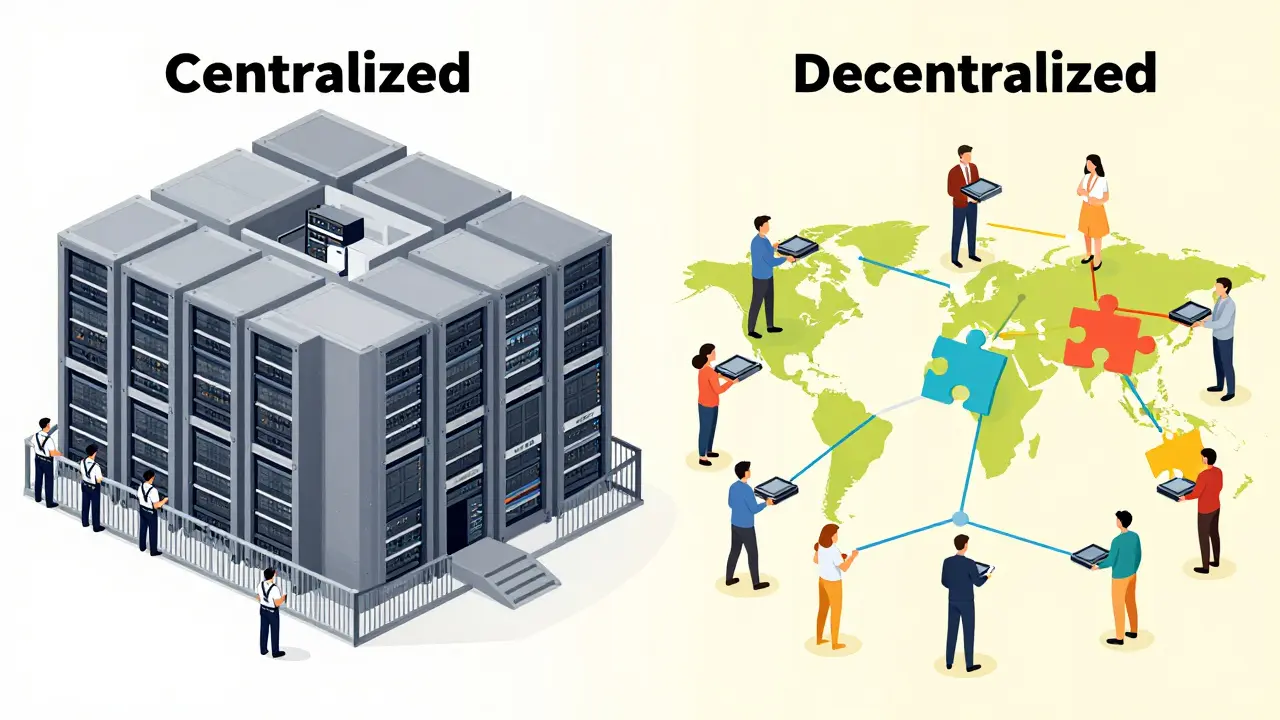
Why such a massive gap? Centralized providers build massive data centers with redundant power, cooling, and security teams. Decentralized networks rent out unused hard drive space from individuals and small businesses worldwide. You aren’t paying for a facility; you’re paying for spare capacity. But this model introduces variable pricing based on cryptocurrency markets, which brings us to the specific players in the game.
Major Players and Their Pricing Models
Not all decentralized storage solutions are created equal. Each platform has a different economic engine, leading to wildly different user experiences and costs. Here is how the big three stack up as of mid-2026.
| Platform | Storage Cost (per TB/Mo) | Egress/Download Fee | Best Use Case |
|---|---|---|---|
| Storj is a decentralized cloud storage platform launched in 2014 that utilizes erasure coding and AES-256 encryption to distribute data across a global network of nodes | $4.00 | $7.00 / TB | Enterprise applications needing API compatibility with S3 |
| Filecoin | $0.19 - $0.50 | Variable (often high due to gas/retrieval deals) | Cold storage, archival, long-term preservation |
| Sia is a decentralized cloud storage service launched in 2015 that uses smart contracts to automatically negotiate storage agreements between hosts and renters | $1.00 - $2.00 | Included in contract (low) | Budget-conscious users, automated backups |
| Arweave is a permanent data storage protocol launched in 2018 that uses an endowment model to fund storage forever rather than recurring payments | One-time fee (~$1.50/TB lifetime) | Low/Included | Permanent records, historical archives, NFT metadata |
Storj positions itself as the most "enterprise-friendly" option. It mimics the Amazon S3 interface, making migration easier for developers. However, watch those egress fees. If you store 1TB for $4 but download that same 1TB frequently, you’ll pay $7 every time. It’s great for static assets like website images or video hosting where files are uploaded once and read many times by CDNs, but terrible for active databases.
Filecoin remains the king of cheap bulk storage. Its price advantage comes from its sheer scale and the low value of its native FIL token relative to the amount of storage provided. However, Filecoin is complex. You don’t just "upload" a file; you create a deal with miners. Retrieving data can be slow and expensive if you haven’t paid for premium retrieval deals upfront. It’s ideal for the Internet Archive or scientific datasets that sit untouched for years.
Sia strikes a middle ground. It uses a simpler contract system where you rent space from hosts for a period. The pricing is stable enough for budgeting, and because bandwidth is often bundled into the storage contract, you avoid surprise egress bills. It’s less polished than Storj but more predictable than Filecoin.
Arweave operates on a completely different logic: permanence. You pay once, and your data stays forever. This isn’t cheap monthly storage; it’s an investment in immutability. For storing legal documents, historical records, or NFT metadata that must never disappear, Arweave is unmatched. For temporary project files, it’s overkill.
The Hidden Costs: Egress, Volatility, and Complexity
If storage prices were the only factor, everyone would have migrated to decentralized networks by now. The hesitation comes from three hidden friction points.
1. The Egress Trap
In centralized clouds, AWS gives you 1GB of free outbound data daily. In decentralized networks, moving data out is often penalized heavily. Storj’s $7/TB egress fee is a classic example. If you run a streaming service or a frequent backup rotation, these fees can erase your storage savings. Always calculate your "read-to-write" ratio before choosing a provider.
2. Token Volatility
Most decentralized storage networks require payment in their native cryptocurrency. When the crypto market crashes, storage providers (the people renting out their hard drives) earn less. Some may leave the network, reducing redundancy. Conversely, when tokens spike, your fixed USD budget buys less storage. Sia and Filecoin have seen significant fluctuations here. Storj attempts to mitigate this by allowing fiat payments via partners, abstracting away the crypto complexity for enterprises.
3. Technical Overhead
Setting up a decentralized storage solution isn’t as simple as clicking "Create Bucket." You need to manage wallets, understand gas fees (on Ethereum-based chains), configure encryption keys, and monitor node health. For a solo developer, this might take 3-5 hours of setup. For a large enterprise, it requires dedicated blockchain engineers. The learning curve is real.
Who Should Switch? A Decision Framework
Don’t switch blindly. Use this simple heuristic to decide if decentralized storage makes sense for your project.
- Choose Decentralized If:
- Your data is "cold" (written once, read rarely).
- You need censorship resistance (data cannot be taken down by a single entity).
- You are storing massive amounts of data (petabytes) where even a 10% saving matters.
- You want permanent archiving (Arweave).
- Stick with Centralized If:
- Your application requires low-latency access (real-time gaming, live transactions).
- You have unpredictable, high-volume download patterns.
- You lack technical resources to manage crypto wallets and key rotation.
- You need strict compliance certifications (SOC2, HIPAA) that are easier to obtain from AWS/Azure.
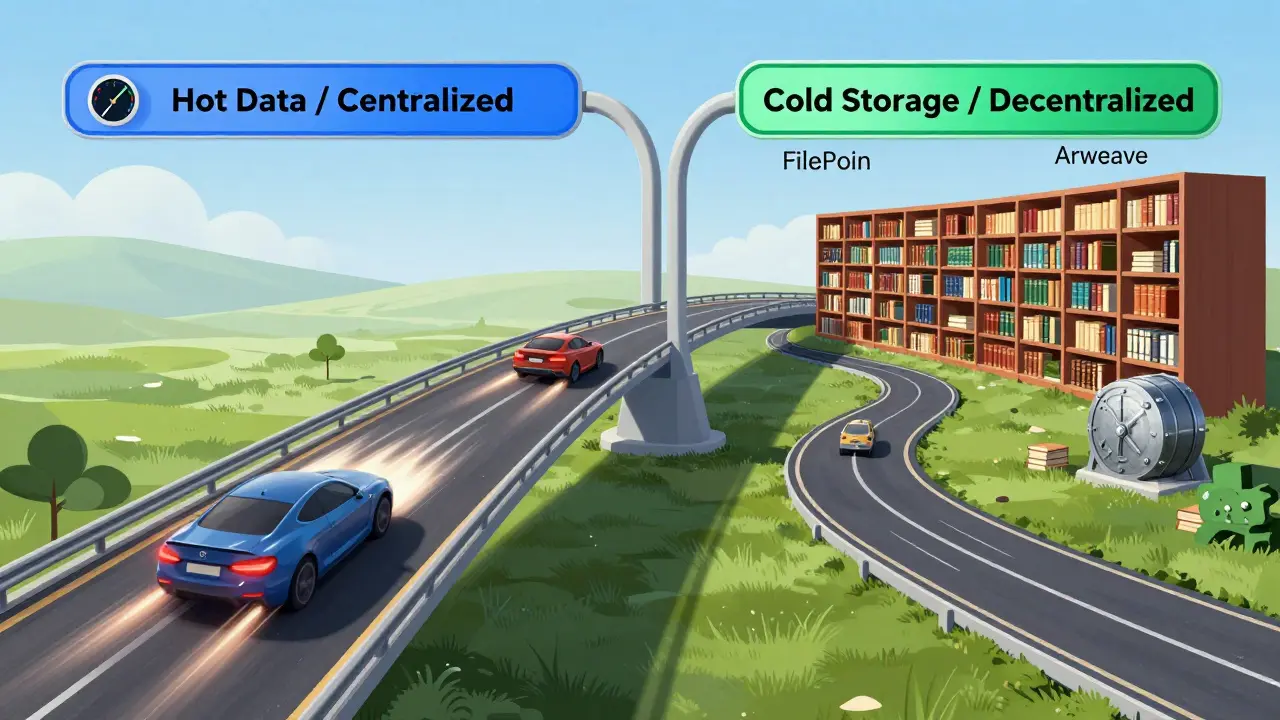
A hybrid approach is becoming the standard for savvy tech leaders. Use centralized storage for hot, active data that needs speed. Use decentralized storage for cold backups, media archives, and disaster recovery. This maximizes performance while minimizing costs.
Future Outlook: 2026 and Beyond
The decentralized storage market is maturing rapidly. By 2026, we’re seeing the emergence of specialized protocols like Walrus is a decentralized data availability layer designed to provide low-cost, high-throughput storage specifically optimized for AI training datasets and modular blockchains. These new entrants aim to solve the latency and cost issues of earlier generations.
Additionally, the rise of AI is driving demand for massive, cheap storage. Training models requires petabytes of data that doesn’t need instant access. Decentralized networks are perfectly positioned to capture this market. As hardware costs continue to drop (HDD prices falling toward $0.01/GB), the economic pressure on centralized providers will increase, forcing them to lower prices or risk losing the bulk storage segment entirely.
Regulatory clarity is also improving. With frameworks like the EU’s Digital Markets Act pushing for interoperability, decentralized alternatives are gaining legitimacy. Expect more enterprise integrations, better UI tools, and perhaps even fiat-backed stablecoin payments to become standard across all major platforms, removing the volatility headache for non-crypto-native businesses.
Is decentralized storage safer than cloud storage?
Safety depends on what you mean. Decentralized storage is more secure against censorship and single-point failures because data is encrypted and split across thousands of independent nodes. No single company can shut it down or hack the entire database. However, it is less safe if you lose your private encryption keys. In centralized clouds, you can reset your password. In decentralized systems, lost keys mean lost data forever.
Can I use decentralized storage for my website?
Yes, but with caveats. You can host static assets (images, CSS, JS) on platforms like Storj or IPFS gateways. However, do not host dynamic databases or server-side code directly on decentralized storage due to higher latency and slower retrieval speeds compared to traditional CDN-connected servers.
How does Filecoin compare to Amazon S3 in cost?
For pure storage, Filecoin is drastically cheaper-often 100x less expensive than S3. However, S3 includes fast, predictable retrieval. Filecoin retrieval can be slow and costly unless you pre-pay for premium bandwidth. If your data is rarely accessed, Filecoin wins. If you access it daily, S3 may be more cost-effective overall.
What happens if a decentralized storage node goes offline?
These networks use erasure coding and redundancy. Your file is split into pieces and stored across multiple nodes. If one node fails, the network retrieves the data from other nodes. Most systems require only a fraction of the total pieces to reconstruct the original file, ensuring high durability even with node churn.
Do I need to know blockchain to use decentralized storage?
Basic knowledge helps, but you don’t need to be an expert. Platforms like Storj offer SDKs that integrate seamlessly with existing codebases. You will need to manage a digital wallet for payments, but many services now allow credit card payments that handle the crypto conversion behind the scenes.