


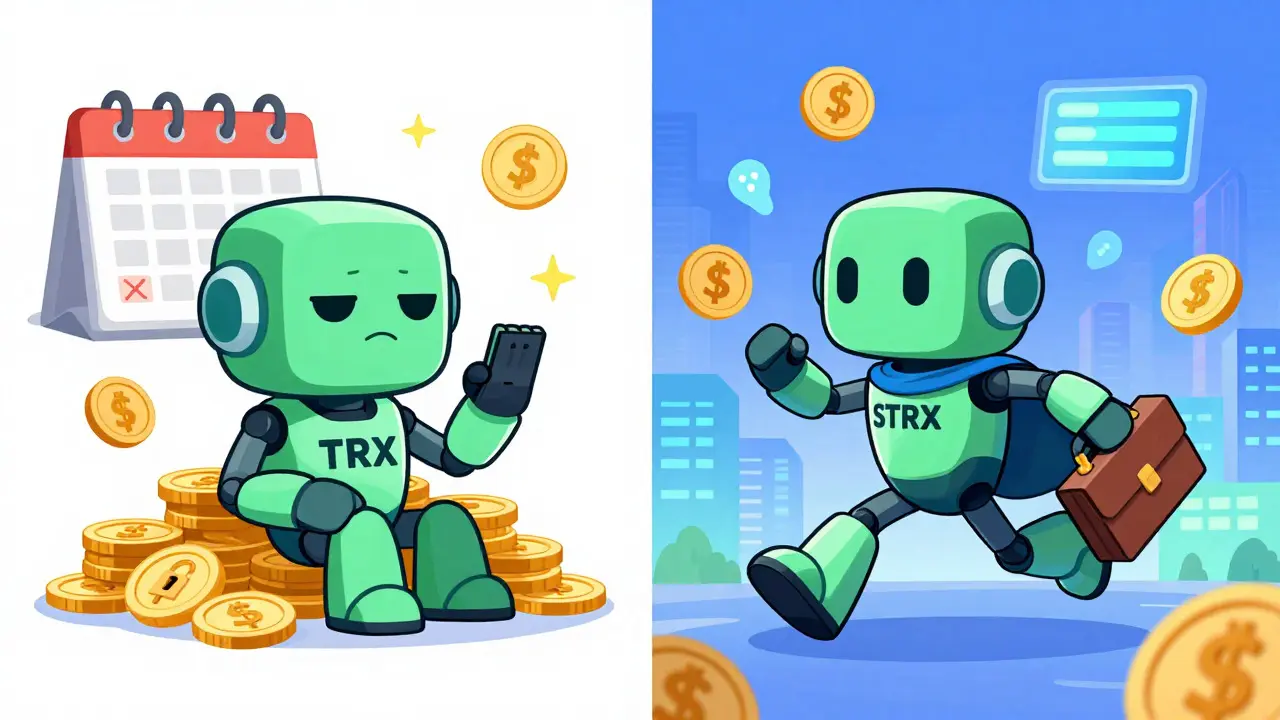
Imagine locking your savings in a high-yield account but still being able to spend the money whenever you want. That sounds like a dream, right? In the world of cryptocurrency, this concept is called liquid staking, and Staked TRX (STRX) is a derivative token on the TRON blockchain that represents locked TRX while allowing users to earn rewards and trade freely. It was created by JustLend DAO as part of their Stake 2.0 system. Instead of letting your TRX sit idle or locking it up for months with no way to access it, STRX lets you keep earning governance rewards and energy rental income while keeping your assets tradable in decentralized finance (DeFi).
If you have been holding TRX, you might have noticed that simply keeping it in a wallet doesn't generate passive income. You could stake it manually, but that requires constant attention to vote for Super Representatives and claim rewards. STRX solves this headache by automating the entire process. But how does it actually work under the hood? Let's break down what STRX is, where it comes from, and whether it fits into your crypto strategy.
How STRX Works: The Mechanics of Liquid Staking
To understand STRX, you first need to grasp the basics of TRON’s consensus mechanism. TRON uses a delegated Proof-of-Stake (DPoS) model. This means that network security and transaction validation are handled by Super Representatives (SRs), who are voted in by TRX holders. When you stake TRX, you gain "TRON Power," which allows you to vote for these SRs. In return, SRs share a portion of their block rewards with voters.
Traditionally, this process was clunky. You had to lock your TRX, manually vote every few days, and wait for rewards to accrue. If you wanted to sell your TRX during this time, you’d have to unstake it, which often involved waiting periods or lost rewards. Enter JustLend DAO’s Stake 2.0 feature. When you deposit TRX into the JustLend protocol, you receive sTRX (often listed as STRX on exchanges) in return. This token is a TRC-20 receipt that proves you own the underlying staked TRX plus all future rewards.
The magic happens in the exchange rate. As the staked TRX earns rewards from SR voting and energy rentals, the value of each sTRX increases relative to the base TRX. So, if you hold 100 sTRX today, after a year, those same 100 tokens might be redeemable for 115 TRX because the accumulated rewards have been baked into the token’s value. This means you don’t need to manually claim rewards; they accumulate automatically within the token itself.
Yield Sources: Where Does the Profit Come From?
One common question is where the returns on STRX actually come from. Unlike some yield farming strategies that rely on inflationary token emissions, STRX generates yield from two primary sources within the TRON ecosystem:
- Super Representative Voting Rewards: JustLend DAO pools the TRON Power from all staked TRX and votes for top-performing Super Representatives. These SRs distribute block rewards to voters, which are then passed on to sTRX holders.
- Energy Rental Revenue: TRON has a unique resource model where transactions require "Energy" and "Bandwidth." Users can rent out their unused Energy to others. JustLend optimizes this by renting out Energy generated from the staked positions, adding an extra layer of income on top of the voting rewards.
This dual-source approach makes STRX more robust than simple staking. Even if voting rewards fluctuate, the energy rental market provides a steady stream of additional revenue. According to JustLend’s documentation updated in July 2026, this combination is designed to maximize efficiency without requiring any manual intervention from the user.
Market Data and Token Supply
As of mid-2026, STRX has established itself as a significant player in the TRON DeFi space. Market data aggregators like CoinMarketCap and CoinGecko track STRX closely. Here is a snapshot of its current standing:
| Metric | Value |
|---|---|
| Market Rank | #53 |
| Circulating Supply | ~486.16 million STRX |
| Max Supply | ~486.16 million STRX |
| Price Range (2024-2026) | $0.30 - $0.45 USD |
| Contract Address | TU3kjFuhtEo42tsCBtfYUAZxoqQ4yuSLQ5 |
Note that there is some discrepancy in supply figures across different platforms. While most aggregators report a circulating supply around 486 million, some exchange listings like HTX have shown higher numbers in the past. This usually stems from differences in how wrapped versions or exchange-specific representations are counted. For most traders, the ~486 million figure is the standard reference for the native sTRX contract on TRON Mainnet.
The price of STRX generally tracks the price of TRX but includes a premium due to the accrued yields. If TRX is trading at $0.10, STRX might trade at $0.12, reflecting the embedded rewards. This premium can vary based on market sentiment and the expected annual percentage yield (APY).
How to Get Started with STRX
Getting your hands on STRX is straightforward if you already hold TRX. You don’t need to buy STRX directly on an exchange initially; instead, you create it by staking your TRX through JustLend. Here is the step-by-step process:
- Set Up a Wallet: You’ll need a Web3 wallet compatible with TRON, such as TronLink. Make sure you have some TRX in your wallet to pay for transaction fees (bandwidth/energy).
- Connect to JustLend: Navigate to the JustLend DAO interface and connect your wallet. Look for the “Staked TRX” or “Stake 2.0” section.
- Stake Your TRX: Enter the amount of TRX you wish to stake and click “Stake Now.” The protocol will lock your TRX and mint an equivalent amount of sTRX to your wallet.
- Use or Hold: You can now use your sTRX in other DeFi protocols as collateral, swap it on decentralized exchanges like SunSwap, or simply hold it to let the exchange rate grow.
If you prefer not to deal with wallets and DeFi interfaces, you can also buy STRX directly on centralized exchanges like HTX, Coinbase, or Kraken, provided they list the pair. However, buying directly means you’re entering the secondary market, so check the spread and liquidity before placing large orders.
Risks and Considerations
No investment is without risk, and STRX is no exception. Before diving in, consider these factors:
- Smart Contract Risk: STRX relies on the JustLend smart contracts (specifically TU3kjFuhtEo42tsCBtfYUAZxoqQ4yuSLQ5). While audits are standard, bugs or exploits can occur. Always do your own research on the security history of the protocol.
- Rehypothecation: Some liquid staking protocols reuse staked assets for lending or other purposes. Check JustLend’s documentation to understand if your underlying TRX is solely used for staking or if it’s leveraged elsewhere.
- TRON Governance Changes: Since yields depend on SR rewards and energy rental, changes in TRON’s network parameters or SR behavior can impact returns. If fewer people rent energy or SR rewards drop, your APY may decrease.
- Liquidity Risk: While STRX is tradable, sudden market crashes could lead to slippage when swapping back to TRX or stablecoins.
STRX vs. Traditional Staking
Why choose STRX over just staking TRX directly on the TRON wallet? The main difference is liquidity and convenience. With traditional staking, your principal is locked until you decide to unstake, and you must manually manage votes. With STRX, your asset is liquid. You can sell it instantly on a DEX or CEX, use it as collateral for loans, or provide liquidity in pools. This flexibility makes STRX a powerful tool for active DeFi participants who want to maximize capital efficiency.
Additionally, JustLend’s automation ensures that you always vote for the most profitable SRs and optimize energy rental, something that would take hours of manual effort to replicate individually. For the average holder, the time saved and the potential for higher optimized yields make STRX an attractive option.
Is STRX the same as TRX?
No, STRX is a derivative token representing staked TRX. While 1 STRX is roughly equivalent to 1 TRX in value, STRX accumulates yield over time, meaning its exchange rate to TRX increases. TRX is the base currency, while STRX is the receipt for staked TRX.
Can I lose my money with STRX?
Yes, like any crypto investment. Risks include smart contract vulnerabilities, drops in TRON’s network activity affecting yields, and general market volatility. If the value of TRX crashes, the value of STRX will likely follow suit, even if the yield remains positive.
How do I cash out STRX?
You can unstake STRX directly through the JustLend interface to get your TRX back, or you can sell STRX on supported exchanges like HTX, Coinbase, or decentralized platforms like SunSwap. Selling on an exchange is usually faster but may involve trading fees.
What is the APY for STRX?
The APY varies based on TRON network conditions, SR reward distributions, and energy rental demand. As of mid-2026, yields typically range between 3% to 8% annually, but this should be checked on the JustLend dashboard for real-time data.
Is STRX available on Binance?
Availability depends on current listings. As of late 2025 and early 2026, STRX has been prominently listed on HTX, Coinbase, Kraken, and Crypto.com. Always check the specific exchange for the latest trading pairs and support.
- Poplular Tags
- Staked TRX
- STRX crypto
- liquid staking
- JustLend DAO
- TRON blockchain





People Comments
so basically its like a savings account but for crypto? i always thought staking meant your money was stuck for months. this sounds way better if its true.
This is precisely the kind of financial engineering designed to keep you tethered to their ecosystem while they siphon value through invisible fees. The concept of 'liquid' staking is an oxymoron crafted by venture capitalists to mask the inherent illiquidity of proof-of-stake chains. You think you are earning rewards, but in reality, you are subsidizing the infrastructure costs of a centralized cartel known as Super Representatives. The energy rental market is merely a mechanism to extract surplus value from desperate users who cannot afford bandwidth. Do not be fooled by the automated convenience; it is a trap that removes your agency and locks you into a proprietary ledger controlled by JustLend DAO. They hold the keys, and when the music stops, you will find your assets frozen or devalued by arbitrary governance changes. It is a pyramid scheme dressed up in blockchain jargon.
The philosophical underpinning of liquid staking suggests a shift in how we perceive ownership versus utility. By converting TRX into STRX, one effectively separates the voting power from the spendable asset, creating a derivative layer that complicates the notion of sovereignty. Is the token truly yours if its value is contingent upon the performance of third-party validators and the efficiency of an external protocol? This duality raises questions about the nature of trust in decentralized systems. We are trading direct control for convenience, which is a recurring theme in technological evolution. One must weigh the benefits of passive income against the risks of smart contract dependency and potential centralization of voting power within large DAO pools.
Ive been using this for a while now :) its actually pretty simple once you get the hang of it. just make sure you check the exchange rate before you swap back though because sometimes there is a slight difference depending on where you trade it. also dont forget to keep some trx for gas fees otherwise you might get stuck lol
its all rigged man. they want you to lock up your coins so they can manipulate the price. nobody reads the terms of service. just hodl the real thing and stay away from these fancy derivatives. its a scam waiting to happen. trust no one.
Oh honey, if you are still manually voting every few days you are doing it wrong. Seriously. Life is too short to babysit your crypto votes. I switched everything to STRX ages ago and now I just watch the number go up while I drink my coffee. It is literally free money if you have the brains to automate it. Why are people still struggling with this basic concept? It is embarrassing really. Get with the program or stay poor.
I think it is cool that there is an option for people who want liquidity. Not everyone wants to lock up their funds for years. It gives more flexibility to the community. As long as people do their own research on the risks, it seems like a fair trade-off for the extra yield. Everyone has different goals for their portfolio.
It feels so good to know my assets are working for me even when I am sleeping! I was so stressed about missing out on rewards or forgetting to vote. Now I just sit back and let the magic happen. Thank you for explaining this clearly, it really helped ease my anxiety about managing my wallet. I feel empowered to take advantage of DeFi without the headache!
You guys are all missing the point here. Sure, it sounds convenient, but have you considered the massive overhead of maintaining these smart contracts? And what happens when the network upgrades and breaks compatibility? I remember back in the day when we had to manage our keys properly, and it built character. Now everyone wants a button-click solution that hides all the complexity until something goes wrong. Plus, the energy rental part is basically renting out your compute power to bots, which isn't exactly sustainable. It is a band-aid solution for a lazy user base that doesn't understand the underlying mechanics of DPoS. You are trading security for ease of use, and eventually, the bill comes due. I prefer to keep my TRX in a cold wallet and ignore the noise. Let the degens play with their derivatives while I preserve capital.
This is a fantastic development for the TRON ecosystem. The ability to earn yield while maintaining liquidity is a game-changer for many investors. I have personally seen the APY fluctuate, but the consistency of the energy rental revenue provides a nice buffer. It is encouraging to see protocols like JustLend innovating to solve real user pain points. Keep up the great work!
in india we love passive income options :) but i am worried about the slippage when i try to sell. does anyone know if the liquidity is deep enough for larger amounts? i dont want to lose too much on fees. thanks!
the cosmic dance of tokens... strx is like a shadow self of trx. it grows in the dark while the original shines in the light. beautiful metaphor for dual existence. i think the yield is karmic reward for patience. but beware the snake in the garden of eden (smart contracts). anyway, vibes are good right now. 🌿✨
Hey folks! 👋 Just wanted to add that if you are new to this, make sure you double-check the contract address before you stake. There have been some fake sites popping up lately. Stay safe out there! 🛡️💰 Also, the UI on JustLend is pretty intuitive if you take your time with it. Happy staking! 🚀
Indeed; the prospectus outlines a rather compelling argument for capital efficiency. However, one must remain vigilant regarding the regulatory landscape. As governments tighten their grip on DeFi, protocols like JustLend may face scrutiny. Nevertheless, the technical implementation appears robust. Well written article. ;)
morality in finance is dead. we just chase yields now. whether its ethical to rent out energy or vote blindly doesnt matter if the apy is high. survival of the fittest applies to portfolios too. stop overthinking and start stacking.