


Imagine a digital ledger where every page is locked in place by mathematics, not trust. That is the essence of the Bitcoin block, which serves as the fundamental container for transactions on the network. If you are trying to understand how Bitcoin achieves security without a central bank, you have to look at these blocks. They are not just random collections of data; they are precisely engineered structures that link together to form an immutable history. This guide breaks down exactly what is inside a block, why each byte matters, and how miners use this structure to secure the entire system.
The Anatomy of a Bitcoin Block
A Bitcoin block consists of two main parts: the block header and the transaction list. The header is small, fixed, and critical for security. It is exactly 80 bytes long. The transaction list varies in size, containing all the actual value transfers included in that specific block. Understanding this split is key because the header is what miners actually work on, while the body contains the economic activity.
The block header acts like a fingerprint for the entire block. It contains metadata that links this block to the previous one, proves the computational work done, and summarizes all transactions inside. Because the header is only 80 bytes, it can be transmitted quickly across the network. Nodes can verify the proof-of-work on the header before downloading the potentially large transaction data. This efficiency is crucial for keeping the decentralized network synchronized.
Decoding the 80-Byte Block Header
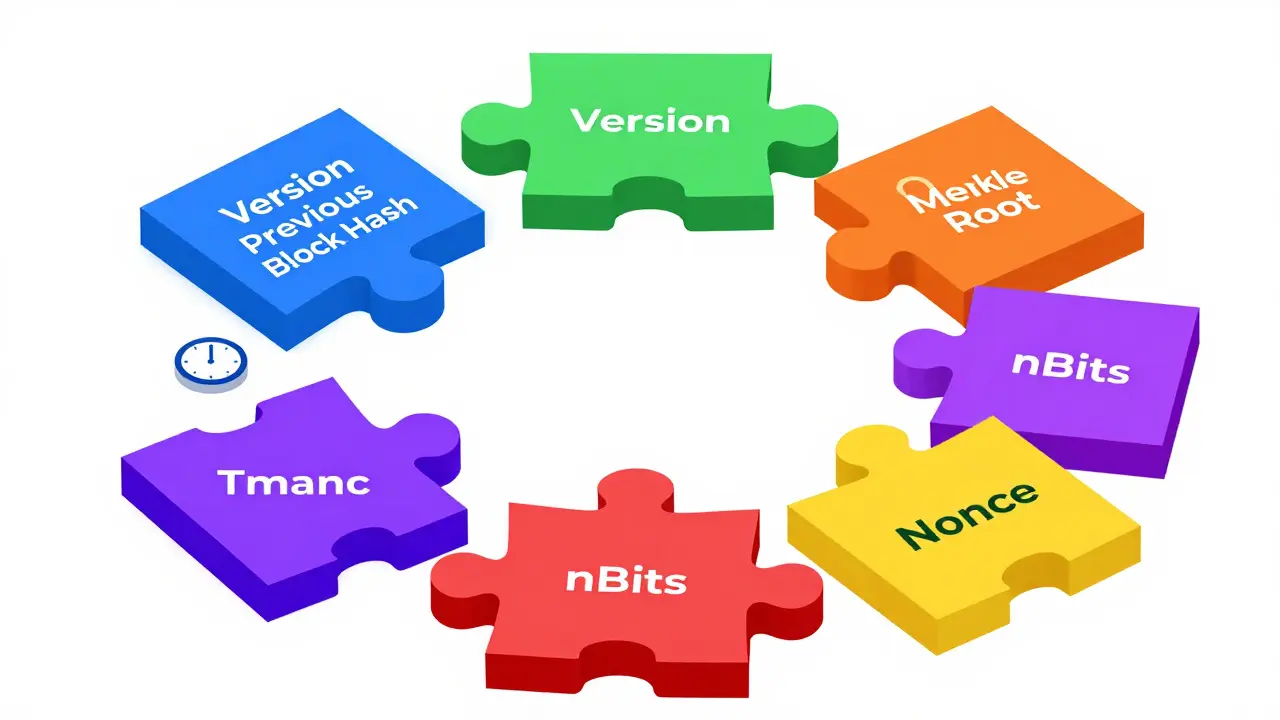
The block header is composed of six specific fields. Each field has a precise size and purpose. Together, they create the cryptographic chain that makes Bitcoin tamper-proof. Let's look at each field individually.
- Version (4 bytes): This integer tells nodes which set of rules the miner followed when creating the block. It allows for protocol upgrades. For example, higher version numbers signaled support for Segregated Witness or Taproot soft forks. If a node sees a version it doesn't recognize, it rejects the block based on its current consensus rules.
- Previous Block Hash (32 bytes): This is the SHA-256 hash of the previous block's header. It creates the "chain" in blockchain. By including this hash, the current block cryptographically commits to the history before it. Changing any single transaction in a past block would change its hash, breaking the link to all subsequent blocks.
- Merkle Root (32 bytes): This is a single hash that represents all transactions in the block. Transactions are paired and hashed recursively until only one hash remains. This allows for efficient verification. You can prove a specific transaction is in a block without downloading the whole block, using something called a Merkle Proof.
- Timestamp (4 bytes): This records when the miner started hashing the header. It must be greater than the median time of the previous 11 blocks and cannot be more than two hours in the future. This prevents miners from manipulating time-based rules.
- nBits (4 bytes): This is a compact representation of the target difficulty. It defines how low the block hash must be to be considered valid. As more computing power joins the network, this target adjusts every 2016 blocks to keep the average block time near 10 minutes.
- Nonce (4 bytes): This is a number miners change repeatedly to find a valid hash. Since the other fields are mostly fixed once the block is assembled, the nonce is the variable that allows miners to generate trillions of different hashes per second until they hit one below the target.
| Field Name | Size (Bytes) | Purpose |
|---|---|---|
| Version | 4 | Indicates consensus rule set used |
| Previous Block Hash | 32 | Links to the parent block |
| Merkle Root | 32 | Fingerprint of all transactions |
| Timestamp | 4 | Time when mining began |
| nBits (Target) | 4 | Difficulty threshold for validity |
| Nonce | 4 | Variable changed to solve proof-of-work |
The Transaction Section and UTXOs
Following the header is the transaction list. This section starts with a count of how many transactions are included, encoded in a compact format. Then come the individual transactions. Each transaction follows a strict structure involving inputs and outputs.
Bitcoin does not use accounts with balances like a bank. Instead, it uses Unspent Transaction Outputs (UTXOs). When you send Bitcoin, you are essentially spending a UTXO from a previous transaction and creating new UTXOs for the recipient and your change. The transaction input references a specific UTXO by its transaction ID and index. The output specifies the amount and the script conditions required to spend it later.
This model ensures that double-spending is impossible. A UTXO can only be spent once. Once it is referenced in a new transaction and included in a block, it is marked as spent. The collective set of all UTXOs across the entire blockchain represents the total supply of unspent Bitcoin. This stateless nature simplifies verification; nodes don't need to track every historical balance, just the current set of available UTXOs.
How Mining Uses Block Structure
Mining is the process of finding a valid nonce for the block header. Miners collect pending transactions from the mempool, assemble them into a candidate block, and calculate the Merkle Root. They then take the header fields-version, previous hash, Merkle root, timestamp, and nBits-and combine them with a nonce.
They hash this 80-byte header using SHA-256 twice. The goal is to get a result that is numerically lower than the current target (nBits). This is a game of chance. There is no shortcut to finding the right nonce. Miners try billions of nonces per second. When someone finds a valid hash, they broadcast the block to the network. Other nodes verify the header hash, check the Merkle Root against the transactions, and ensure all inputs are valid UTXOs. If everything checks out, the block is added to their local copy of the blockchain.

SegWit and Taproot Enhancements
The core block structure has remained stable, but upgrades have enhanced it. Segregated Witness (SegWit), activated in 2017, separated signature data from the main transaction structure. This witness data is stored separately but still contributes to the Merkle Root calculation via a separate witness Merkle tree. This fix addressed transaction malleability and increased effective block capacity without changing the base block size limit of 1 megabyte.
Later, Taproot, activated in 2021, updated the scripting capabilities. It introduced Schnorr signatures and improved privacy by making complex smart contracts look like simple payments. These upgrades were implemented as soft forks, meaning they are backward compatible. Older nodes still see the blocks as valid, even if they don't fully understand the new features. This preserves the integrity of the consensus while allowing innovation.
Verifying Blocks with Explorers
You don't need to run a full node to inspect block structure. Blockchain explorers parse raw block data and present it in a readable format. You can look up any block number or hash to see its height, timestamp, transaction count, and fee rates. Explorers also show the Merkle Path for specific transactions, allowing you to verify inclusion independently. This transparency is a core feature of Bitcoin. Anyone can audit the ledger, ensuring that no hidden fees or unauthorized transactions exist.
Why is the block header only 80 bytes?
The 80-byte size is a design choice by Satoshi Nakamoto to balance information density with transmission efficiency. It contains just enough data to link blocks, summarize transactions, and prove work without being bloated. This allows lightweight clients to verify the chain's existence and order without downloading every transaction.
What happens if a miner changes a transaction in a block?
Changing any transaction alters the Merkle Root. Since the Merkle Root is part of the header, the header hash changes. This invalidates the proof-of-work. The miner would have to redo the entire mining process to find a new valid nonce. Additionally, other nodes would reject the block because the Merkle Root wouldn't match the transactions they verified.
How does the Previous Block Hash prevent tampering?
It creates a cryptographic dependency. Block N contains the hash of Block N-1. If you alter Block N-1, its hash changes. Block N now points to an incorrect hash, making it invalid. To fix Block N, you must re-mine it. But then Block N+1 becomes invalid, and so on. Tampering requires re-mining all subsequent blocks, which is computationally infeasible.
What is the role of the Nonce in Bitcoin mining?
The nonce is a counter that miners increment to generate different hash outputs. Since the other header fields are largely fixed during the mining attempt, the nonce provides the variability needed to search for a hash that meets the difficulty target. It is the primary tool miners use to perform proof-of-work.
Can I view the raw hex data of a Bitcoin block?
Yes. Most blockchain explorers offer a "raw" or "hex" view of blocks. This shows the exact byte sequence of the header and transactions. Developers often use this to debug software or analyze specific encoding details, such as variable-length integers or script opcodes.