


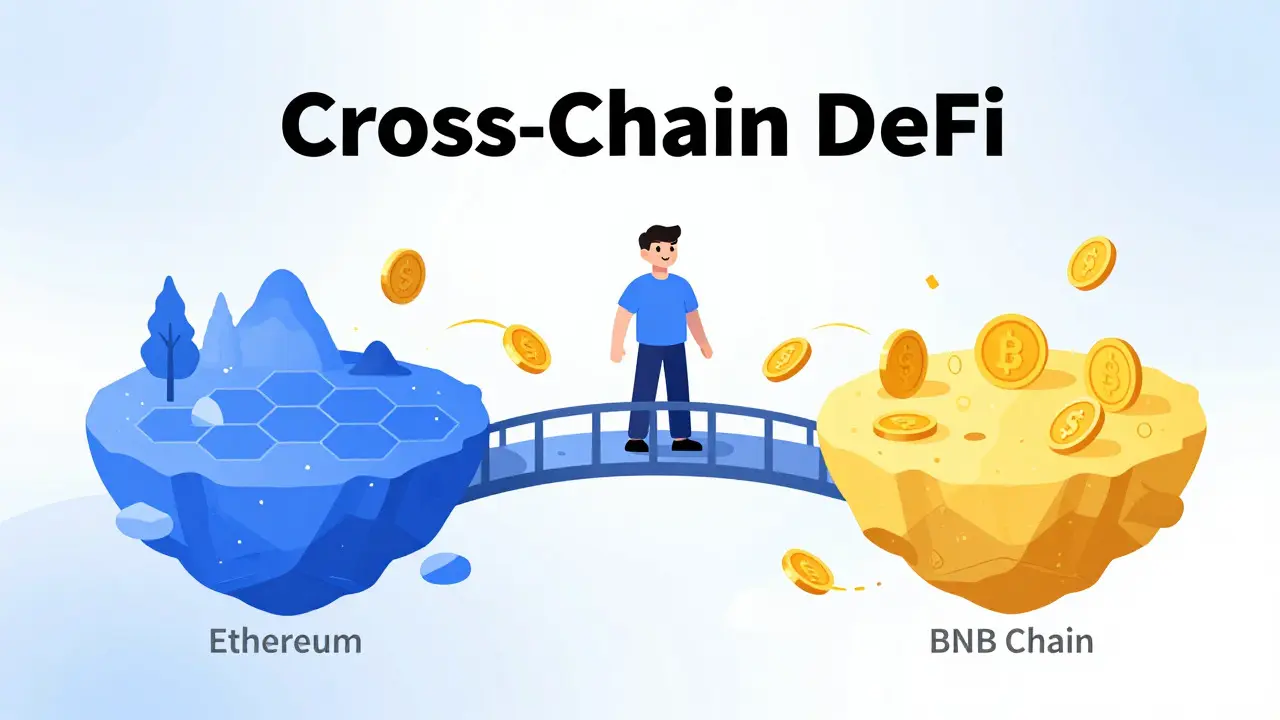
Have you ever wondered how your crypto assets can work for you across different blockchains without moving them manually? That is the promise of ForTube, a decentralized finance protocol that aims to bridge the gap between isolated blockchain networks. If you are new to DeFi or just looking for the next big opportunity, understanding what ForTube actually does-and where it stands in 2026-is crucial before you commit any funds.
Quick Summary: Key Takeaways
- What it is: ForTube (formerly Force Protocol) is a multi-chain DeFi platform focused on cross-chain lending and borrowing.
- The Token: The FOR token has a fixed supply of 1 billion, used for governance and staking rewards.
- Key Feature: It allows users to deposit assets on one chain (like Ethereum) and borrow against them using liquidity from another (like BNB Chain).
- Current Status: As of 2026, ForTube operates with a smaller market cap compared to giants like Aave, positioning it as a niche player.
- Risk Level: Moderate to High. While it uses Chainlink oracles for security, its lower trading volume means less liquidity than top-tier protocols.
Understanding the ForTube Protocol
To get the basics right, let’s look at what ForTube actually is. Launched in its current form as ForTube 2.0 in September 2020, the project evolved from its earlier incarnation known as Force Protocol. At its core, ForTube is an infrastructure layer for decentralized finance. Think of it not just as a place to lend money, but as a toolkit that allows developers and users to access financial services across multiple blockchains simultaneously.
Most early DeFi projects were stuck on a single chain, usually Ethereum. This created silos where liquidity couldn’t move freely. ForTube solved this by building a multi-chain architecture. It operates primarily on Ethereum and BNB Chain. This setup lets you use your Ethereum-based assets as collateral to borrow tokens available on the BNB Chain, all managed through smart contracts. This cross-chain functionality was a major selling point when the protocol first gained traction, allowing for more flexible investment strategies.
The protocol integrates three main components: a bond financing protocol, a cryptocurrency lending protocol, and a decentralized stablecoin protocol. Together, these form a comprehensive open financial service platform. You aren't just limited to simple loans; you can also engage in yield farming and participate in the issuance of stablecoins backed by cross-chain collateral.
How the FOR Token Works
Every DeFi protocol has a native token, and for ForTube, that is the FOR token. But why does it exist, and what can you do with it? Understanding the tokenomics is essential because the value of the token often drives the health of the entire ecosystem.
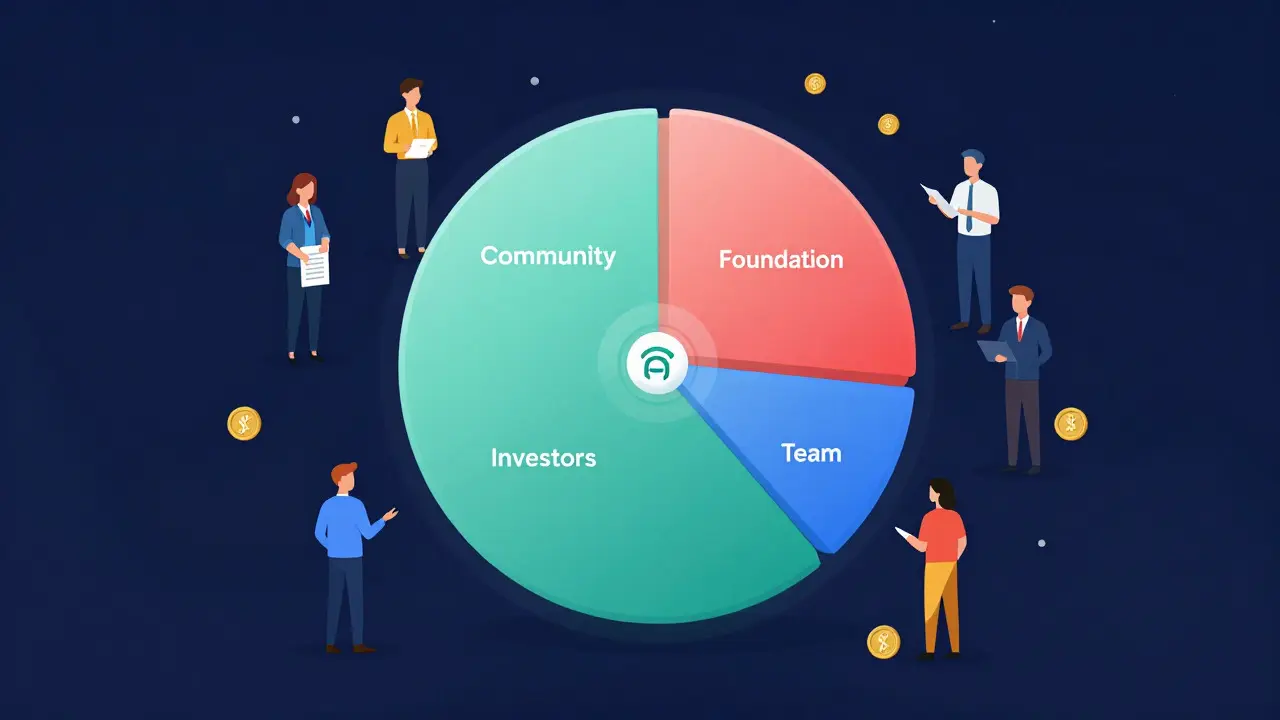
The FOR token has a hard cap of 1 billion units. There is no inflationary mechanism planned, meaning no new tokens will be minted after the initial distribution. This fixed supply model is designed to create scarcity, potentially supporting the token's value if demand remains steady. Here is how those 1 billion tokens are allocated:
- 30% Community Ecosystem: Reserved for rewarding users, liquidity providers, and community initiatives.
- 25% Foundation: Held by The Force Protocol Foundation to support long-term development and operations.
- 30% Strategic Investors & Donations: Allocated to early backers and community grants to bootstrap growth.
- 15% Team & Development: Reserved for the founding and dev teams, subject to strict lock-up periods.
Speaking of lock-ups, transparency is key in crypto. The team’s 15% allocation isn’t immediately liquid. Thirty percent unlocks 12 months after public trading, another 30% at 24 months, and the final 40% at 36 months. This vesting schedule aligns the team’s interests with long-term success rather than a quick exit.
As a holder, you can stake your FOR tokens to earn rewards from the protocol’s fees. More importantly, holding FOR gives you governance rights. You can vote on proposals regarding fee structures, new asset listings, and protocol upgrades. In a decentralized system, your voice matters-if you hold the keys.
Cross-Chain Lending: How It Actually Works
Let’s break down the user experience. Imagine you hold ETH on the Ethereum network but need USDT on the BNB Chain for a specific trade or payment. Traditionally, you’d have to bridge your ETH to BNB Chain, swap it, and then manage two separate accounts. ForTube simplifies this through its cross-chain lending engine.
- Connect Wallet: You link a compatible wallet like MetaMask to the ForTube interface.
- Deposit Collateral: You deposit your ETH into the ForTube smart contract on Ethereum.
- Borrow Assets: The protocol calculates your collateralization ratio using real-time data from Chainlink oracles. Based on this, you can borrow USDT (or other supported assets) which may be sourced from liquidity pools on the BNB Chain.
- Earn Interest: Meanwhile, your deposited ETH earns interest from borrowers. You receive interest-bearing tokens representing your principal plus accrued gains.
This process relies heavily on accurate price feeds. ForTube partnered with Chainlink in May 2020 to ensure that collateral values are updated reliably. If the price of your collateral drops too low relative to your loan, the protocol triggers a liquidation event to protect lenders. This integration addresses one of the biggest risks in DeFi: oracle manipulation or failure.
Market Position and Competition in 2026
No project exists in a vacuum. To understand ForTube’s potential, we need to look at who else is playing in this space. The DeFi lending sector is dominated by giants like Aave and Compound. These protocols have billions in Total Value Locked (TVL) and massive brand recognition.
| Protocol | Primary Chains | Key Differentiator | Market Cap (Approx.) |
|---|---|---|---|
| ForTube (FOR) | Ethereum, BNB Chain | Cross-chain lending infrastructure | $277K - $500K range |
| Aave | Multi-chain (Ethereum, Arbitrum, Polygon, etc.) | Largest TVL, wide asset support | $Billions |
| Compound | Ethereum, Base | Simple UI, strong institutional adoption | $Billions |
As of 2026, ForTube’s market capitalization sits around $277,000, with daily trading volumes occasionally dipping below $10,000. This indicates it is a small-cap asset. While it reached a peak TVL of $150 million shortly after its 2.0 launch in 2020, current activity suggests a decline in user engagement compared to its heyday. Why? Because competition intensified. Larger protocols improved their own cross-chain capabilities, reducing ForTube’s unique advantage.
However, being smaller isn’t always bad. Smaller caps can offer higher percentage returns on yield farming if they manage to capture even a fraction of the market again. The question for investors is whether ForTube’s roadmap-specifically Version 3.5 and physical asset integration-can reignite interest.

Security and Risks to Consider
Before you connect your wallet, you need to know where the bodies are buried. Security in DeFi is paramount. ForTube uses audited smart contracts and Chainlink oracles, which are industry standards. However, "audited" doesn’t mean "immune." Smart contract bugs can still exist, and cross-chain bridges are historically vulnerable targets for hackers.
Here are the specific risks associated with ForTube:
- Liquidity Risk: With lower trading volume, large withdrawals might suffer from slippage or fail if there isn’t enough depth in the pool.
- Smart Contract Risk: Despite audits, code vulnerabilities can be exploited. Always check for recent audit reports from reputable firms.
- Regulatory Uncertainty: As governments tighten rules on DeFi, protocols that facilitate anonymous lending face scrutiny. ForTube’s global nature makes it susceptible to regulatory shifts.
- Competition: If users migrate to larger platforms like Aave for better security guarantees and higher liquidity, ForTube’s revenue-and thus FOR token rewards-could dry up.
Also, keep in mind that technical analysis for FOR often shows neutral to bearish trends in the short term. While the broader Ethereum ecosystem benefits from upgrades like ETH2 (now fully integrated), individual tokens depend on their own utility and adoption metrics.
Future Roadmap: What’s Next?
So, is ForTube dead in the water? Not necessarily. The team has outlined ambitious plans for the future. The roadmap includes the release of Version 3.5, which promises enhanced aggregation of farming functions and a more robust multi-chain ecosystem architecture. Perhaps most intriguingly, they plan to integrate physical assets into the DeFi protocol. Imagine using real-world estate or commodities as collateral for crypto loans-that would be a game-changer.
Additionally, expanding support to more mainstream public chains beyond Ethereum and BNB Chain could open new markets. If they successfully execute these plans, ForTube could transition from a niche lending tool to a comprehensive decentralized financial service provider. Until then, it remains a high-risk, high-reward play for those willing to bet on its technological vision.
Is ForTube (FOR) a good investment in 2026?
ForTube is considered a high-risk, small-cap investment. While it offers innovative cross-chain features, its market cap and trading volume are significantly lower than competitors like Aave. It may suit speculative investors who believe in its roadmap, but conservative investors should prefer established protocols with deeper liquidity.
What is the total supply of FOR tokens?
The total supply of FOR tokens is fixed at 1 billion. There are no additional tokens planned for issuance, making it a deflationary asset in terms of supply mechanics, though value depends on demand.
Which blockchains does ForTube support?
ForTube primarily operates on Ethereum and BNB Chain. Its core value proposition is enabling cross-chain interactions between these two networks, allowing users to leverage assets from one chain to borrow on another.
How secure is ForTube?
ForTube utilizes Chainlink oracles for accurate price feeds and employs audited smart contracts. However, as with all DeFi protocols, users face risks related to smart contract vulnerabilities and cross-chain bridge exploits. Always start with small amounts to test the waters.
Can I earn passive income with ForTube?
Yes, you can earn passive income by depositing assets to lend them out or by staking FOR tokens. Depositors earn interest from borrowers, while stakers receive rewards from the protocol’s ecosystem fund. Returns vary based on market demand and liquidity pool depth.
What happened to Force Protocol?
Force Protocol rebranded to ForTube in 2020 to reflect its evolution into a comprehensive cross-chain financial service platform. The 2.0 launch marked this transition, introducing enhanced features like cross-chain lending and stablecoin issuance.






People Comments
man this is so boring to read i just want the price to go up why do we need all this tech babble about sdk and apis its giving me a headache honestly
Another piece of American technological imperialism disguised as 'innovation'!!!. The US wants to control your liquidity through these centralized-looking protocols.. ForTube is likely a front for surveillance capitalism... Wake up sheeple!!!!.
You guys are missing the big picture here! This is actually a great opportunity to learn about cross-chain mechanics. Don't let the noise distract you from the potential. Keep pushing forward and stay positive!
I feel like everyone here is just ignoring the ethical implications of gambling with people's life savings on such an unstable platform. It’s selfish. Why are we celebrating financial instability? It drains the energy out of the community.
The grammar in this article was decent, but the substance is lacking. It’s another cookie-cutter DeFi project that failed to capture the market. Honestly, it’s pathetic how many people still fall for these rebranded scams. One would think after 2022 lessons were learned.
If you look at the underlying architecture, the use of Chainlink oracles provides a robust layer of security that many newer protocols lack. The cross-chain lending mechanism is essentially a clever utilization of existing liquidity pools rather than creating new ones from scratch, which reduces slippage significantly during volatile markets.
its all a trap the smart contracts are backdoored by the foundation they claim decentralization but the team holds too much power check the vesting schedule again its obvious manipulation typical web2 mindset trying to infiltrate web3 dont trust them
Just holding 📉📈 Not sure what to think tbh 😐
There is something poetic about the struggle of smaller protocols against giants like Aave. It mirrors the human condition itself, doesn't it? We strive for connection across divides, yet remain isolated by our own limitations. Perhaps ForTube is less about finance and more about the philosophy of bridging gaps.
Hey folks, I think there's real value here if you look past the hype. In my culture, we believe in planting seeds for the future. This protocol might be small now, but who knows? Stay curious and open-minded!
I’m just watching from the sidelines. The UI looks kinda sleek though. Maybe I’ll dip a toe in later if things calm down.
the meta-narrative of this protocol is flawed because it relies on external validation via oracles which creates a dependency loop that undermines the very essence of decentralized autonomy we must question the hegemony of chainlink
It is evident that the global elite are using these platforms to track transactions. The 'cross-chain' feature is merely a Trojan horse for data harvesting. You must be vigilant. Do not connect your wallet unless you wish to be monitored by the shadow government.
One must consider the historical precedent of similar lending protocols. The decline in TVL suggests a fundamental shift in user preference towards more established entities. Therefore, the risk-adjusted return appears unfavorable at present.