

Have you ever stared at your wallet screen, heart sinking as you watched a simple token transfer demand a $45 fee? You aren't alone. In the early days of crypto, paying more for a transaction than the value being sent was a common nightmare. But in 2026, the landscape has shifted dramatically. The question is no longer just "how much does it cost?" but rather, "which network gives me the best balance of speed, security, and price for my specific need?"
Transaction fees are not arbitrary penalties; they are the fuel that keeps decentralized networks running. They compensate validators for their work and prevent spam from clogging the system. However, the cost of this fuel varies wildly depending on the engine under the hood. Some blockchains charge fractions of a cent, while others remain premium services for high-value storage.
The Anatomy of a Blockchain Fee
Before comparing prices, it helps to understand what you are actually paying for. If you think of a blockchain as a digital ledger, every entry requires computational power to verify and write. This computation consumes resources-electricity, hardware wear, and bandwidth.
Different networks measure this consumption differently. Bitcoin is the first cryptocurrency, which calculates fees based on the size of the transaction data in bytes. Think of it like shipping a package: the heavier and bulkier the box (more inputs and outputs), the higher the postage. Users set a rate in satoshis per byte, and miners prioritize the most expensive packages first.
Ethereum, launched in 2015, uses a different model called Gas. It is a smart contract platform where fees are calculated by multiplying the complexity of the operation (gas limit) by the current market price of computation (gas price). Here, the cost isn't just about data size; it's about how hard the computer has to think. Sending ETH is cheap because it's a simple math problem. Minting an NFT or swapping tokens on a decentralized exchange is expensive because it triggers complex code execution.
This fundamental difference explains why a simple Bitcoin transfer might be cheaper than a complex Ethereum interaction, even if Ethereum is technically faster. The key takeaway? Complexity drives cost on EVM-compatible chains, while data size drives cost on Bitcoin.
The Heavyweights: Bitcoin and Ethereum Mainnet
Let’s look at the two giants. As of mid-2026, these networks serve distinct purposes, reflected in their pricing structures.
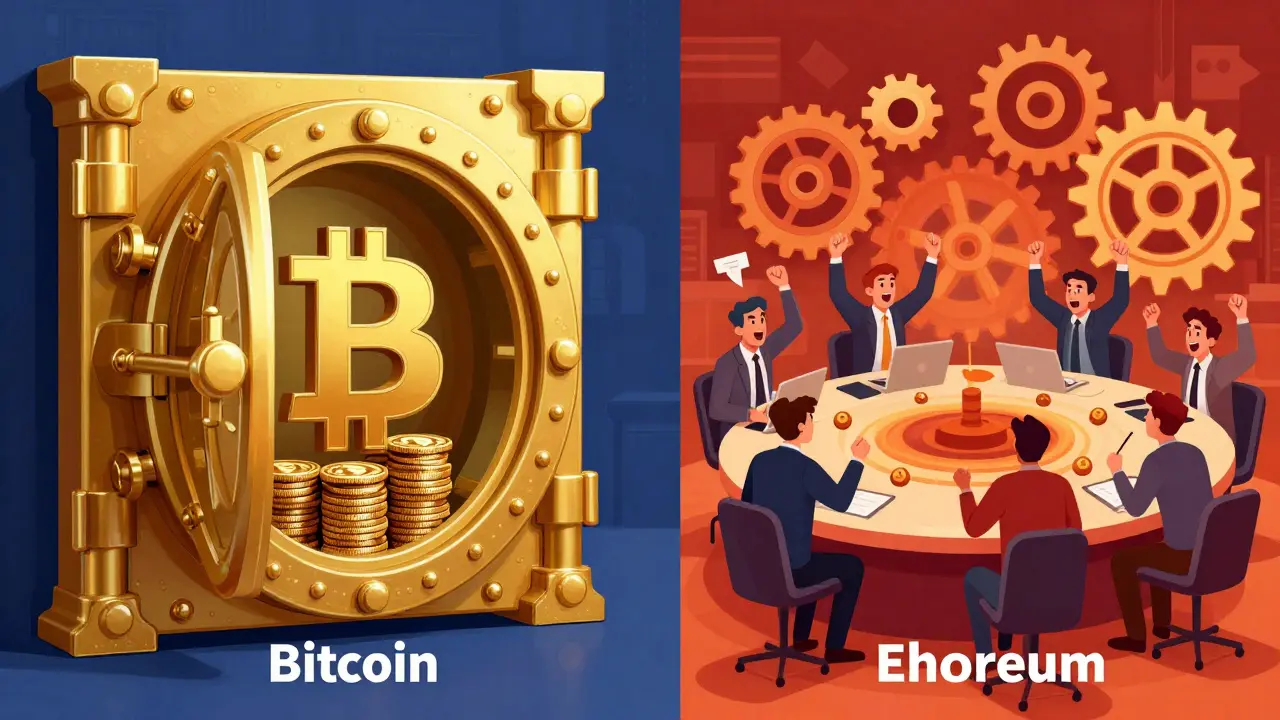
Bitcoin (BTC) remains the gold standard for secure, long-term value storage. Its transaction fees typically range from $1 to $20+ during normal activity. During periods of extreme congestion-like when many people are moving large amounts of capital simultaneously-fees can spike to over $55. With confirmation times averaging around 10 minutes, Bitcoin is not designed for buying coffee. It is designed for settling significant debts or storing wealth securely. The high fee acts as a filter, ensuring only valuable transactions occupy this highly secured ledger.
Ethereum (ETH) is the world’s programmable computer. Its fees are notoriously volatile, ranging from $0.50 to over $50. Why such a wide gap? Network congestion. When millions of users interact with DeFi protocols or mint NFTs simultaneously, competition for block space intensifies. Ethereum’s EIP-1559 upgrade introduced a "base fee" that burns away, plus a "priority tip" for validators. This makes fees predictable in quiet times but explosive during peak usage. Despite the cost, Ethereum retains dominance in DeFi and NFTs due to its massive liquidity and developer ecosystem. You pay the premium for access to the deepest markets.
The Efficiency Kings: Solana and High-Speed Chains
If Bitcoin is a bank vault and Ethereum is a bustling stock exchange, Solana is a high-performance blockchain optimized for speed and low costs, utilizing Proof of History consensus. Solana processes thousands of transactions per second with average fees hovering around $0.00025. Yes, that is less than one-tenth of a penny. With confirmation times near one second, Solana is ideal for microtransactions, high-frequency trading bots, and gaming applications where charging $5 for a sword purchase would kill the user experience.
Other chains follow similar efficiency models. XRP charges less than $0.01 per transaction, making it a favorite for cross-border payments. Dogecoin and Litecoin often approach zero-cost fees, though they lack the smart contract sophistication of newer platforms. These networks prove that blockchains can be affordable, but they often trade off some decentralization or security guarantees to achieve those speeds.

The Smart Middle Ground: Layer-2 Solutions and Sidechains
Here is where the real innovation happens in 2026. Many users want Ethereum’s security without Ethereum’s price tag. Enter Layer-2 solutions and sidechains.
Polygon operates as a sidechain solution that processes transactions off the main Ethereum network before batching them together. By doing so, it reduces the load on Ethereum mainnet. The result? Transactions cost approximately $0.01 and confirm in about 2 seconds. Polygon has become the go-to chain for everyday payments and gaming because it offers a familiar user experience with negligible costs.
Arbitrum takes a slightly different approach using "rollup" technology. It bundles hundreds of transactions into a single proof submitted to Ethereum. This inherits Ethereum’s top-tier security while slashing costs to between $0.05 and $0.30 per transaction. For DeFi users who need deep liquidity but hate gas wars, Arbitrum (and similar L2s like Optimism) provides the perfect compromise. You get Ethereum’s safety net with a fraction of the bill.
Binance Smart Chain (BSC) also competes in this space, offering gas fees similar in structure to Ethereum but significantly lower in cost, averaging $0.10-$0.30. While it has faced criticism regarding centralization, its affordability keeps it popular for meme coins and quick swaps.
| Network | Avg. Cost (USD) | Confirmation Time | Best Use Case |
|---|---|---|---|
| Solana | $0.00025 | ~1 second | Trading, Gaming, Micro-payments |
| Polygon | $0.01 | ~2 seconds | Everyday Payments, dApps |
| Arbitrum | $0.05 - $0.30 | ~5 seconds | DeFi, Ethereum Access |
| Binance Smart Chain | $0.10 - $0.30 | ~3 seconds | Quick Swaps, Meme Coins |
| Ethereum | $0.50 - $50+ | ~15 seconds | High-Value DeFi, NFTs |
| Bitcoin | $1 - $20+ | ~10 minutes | Large Value Storage/Transfer |
Why Do Fees Fluctuate So Much?
You might notice that your $0.10 Polygon fee yesterday became $0.50 today. What changed? The primary driver is network congestion.
Imagine a highway with a fixed number of lanes. If 10 cars show up, everyone gets through quickly. If 10,000 cars show up, traffic jams occur. On blockchains, users bid against each other to get into the next block. During peak hours-or when a popular NFT collection drops-users add higher "tips" to validators to prioritize their transactions. This auction dynamic pushes prices up.
Conversely, during off-peak hours (often late night UTC), congestion drops, and fees can plummet by 90% or more. Timing matters. If your transaction isn’t urgent, waiting for a quiet period can save you significant money.

Strategies to Slash Your Transaction Costs
You don’t have to accept whatever fee the network demands. Here are practical ways to optimize your spending:
- Batch Your Transactions: Instead of sending five separate payments, combine them into one multi-recipient transaction. This distributes the computational overhead across all recipients, lowering the per-unit cost.
- Use Layer-2 Networks: Move your assets to Arbitrum, Optimism, or Polygon before performing frequent interactions. Bridge back to Ethereum mainnet only when necessary for maximum security.
- Time Your Moves: Check fee trackers (like EthGasNow or Mempool.space) before transacting. Avoid weekends and major market open hours if possible.
- Leverage Replace-by-Fee (RBF): On Bitcoin, if you send a transaction with a low fee and it gets stuck, you can broadcast a replacement with a higher fee. This prevents you from overpaying upfront for non-urgent transfers.
- Choose the Right Chain for the Job: Don’t use Ethereum to buy a $5 digital sticker. Use Solana or Polygon. Reserve Ethereum for high-stakes DeFi positions where liquidity depth outweighs the gas cost.
The Future of Blockchain Fees
Where do we go from here? The trend is clear: fees are going down, but they will never hit zero. Security costs money. Validators need incentives to keep the network honest and online.
Ethereum’s roadmap includes "Danksharding," a scaling upgrade aimed at reducing Layer-2 data costs further, potentially pushing L2 fees below $0.01 permanently. Bitcoin’s Lightning Network continues to grow, enabling instant, near-zero fee payments off-chain. Meanwhile, new consensus mechanisms are emerging that aim to balance energy efficiency with decentralization.
In 2026, the market has matured. We’ve moved past the "one chain fits all" mentality. Users now act like savvy consumers, switching networks based on utility. You use Bitcoin for savings, Ethereum for complex finance, and Solana or Polygon for daily apps. Understanding these differences empowers you to keep more of your money in your pocket.
Which blockchain has the lowest transaction fees in 2026?
Solana currently offers the lowest average transaction fees, costing approximately $0.00025 per transaction. Other low-cost options include Polygon ($0.01) and XRP (less than $0.01). However, always consider the security and decentralization trade-offs associated with ultra-low fee networks.
Why are Ethereum transaction fees so high compared to other chains?
Ethereum fees are high due to intense network demand and limited block space. It hosts the majority of decentralized finance (DeFi) and NFT activity, creating competition among users to include their transactions in blocks. Additionally, complex smart contract executions require more "gas" (computational power), increasing costs.
What is the difference between Bitcoin and Ethereum fee structures?
Bitcoin fees are based on transaction size in bytes (data weight). Larger transactions with multiple inputs/outputs cost more. Ethereum fees are based on "gas," which measures computational complexity. Simple transfers cost little gas, while complex smart contract interactions consume significant gas, regardless of data size.
Are Layer-2 solutions like Arbitrum safe?
Yes, Layer-2 solutions like Arbitrum inherit the security guarantees of the Ethereum mainnet. They process transactions off-chain and post compressed proofs to Ethereum. This means you get lower fees and faster speeds while relying on Ethereum’s robust validator network for final settlement and security.
How can I reduce my crypto transaction fees?
You can reduce fees by batching multiple transactions into one, using Layer-2 networks (like Polygon or Arbitrum) for daily activities, timing transactions during off-peak hours, and choosing the appropriate blockchain for your specific use case (e.g., avoiding Ethereum for small purchases).
Will blockchain transaction fees ever reach zero?
It is unlikely that fees will reach absolute zero. Fees serve as an economic mechanism to prevent spam and compensate validators for their resources. While fees may approach negligible levels (fractions of a cent) on highly efficient networks, a baseline cost will remain to ensure network sustainability and security.