


Imagine writing a book, having it stolen, and getting zero credit. Now imagine fixing that with code. That’s the core pitch of LikeCoin, a cryptocurrency project that started as a way to reward content creators and has evolved into something much more specific: a decentralized book publishing ecosystem known as DeBook. If you’ve seen the ticker LIKE on exchanges like Bybit or CoinGecko and wondered if it’s just another meme coin or a serious infrastructure play, you’re in the right place. It’s neither. It’s a niche tool for authors and readers who want ownership over their digital content.
The Core Problem LikeCoin Solves
Digital content is easy to copy but hard to own. When you post an article or publish an e-book, platforms like Medium or Amazon keep most of the profit and control the data. LikeCoin flips this model. It uses blockchain technology to create a permanent record of who created what content. This isn’t about storing the whole PDF on the chain-that’s too expensive. Instead, it stores the metadata and a unique identifier called an ISCN (International Standard Content Number). Think of an ISCN as a digital fingerprint for your work. Once registered, no one can claim they wrote it first, and you get a verifiable proof of creation.
But why does this matter? Because ownership leads to rewards. In traditional publishing, the middleman takes the biggest cut. In the LikeCoin ecosystem, specifically through its current iteration, 3ook.com, readers directly support authors. They don’t just buy a book; they stake tokens against it. This staking mechanism acts like a vote of confidence. The more people stake on a book, the higher it ranks, and the more visibility it gets. It turns passive reading into active curation.
From Ethereum Token to Sovereign Chain
LikeCoin didn’t start as a standalone blockchain. Back in 2018, it launched as an ERC-20 token on Ethereum. The whitepaper promised a fixed supply of 2 billion tokens, aiming to "reinvent the Like" by giving value back to users who liked and shared content. But Ethereum was congested and expensive. So, between 2019 and 2020, the team migrated to their own sovereign blockchain built on the Cosmos SDK.
This move was significant. It meant LikeCoin became an application-specific blockchain optimized for content management rather than general-purpose smart contracts. It uses a consensus mechanism called Bonded Proof-of-Stake (BPoS), which the community sometimes brands as "Proof of Creativity." Validators secure the network by locking up LIKE tokens. If they behave badly or go offline, they lose those tokens. This ensures that the people running the network have skin in the game regarding the integrity of the content registry.
| Phase | Network | Primary Function | Key Feature |
|---|---|---|---|
| V1 (2018) | Ethereum | ERC-20 Utility Token | Rewarding likes/shares on social media |
| V2 (2020-2024) | Cosmos SDK | Sovereign Blockchain | ISCN Registration & Inter-chain communication |
| V3 (2025-Present) | Base L2 / Cosmos | DeBook Protocol | Decentralized Bookstore (3ook.com) & Staking |
How the DeBook Protocol Works
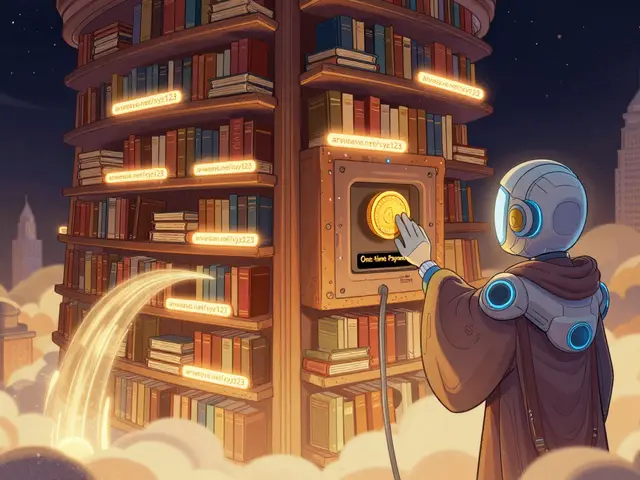
As of 2026, LikeCoin has pivoted sharply toward books. This is the DeBook protocol. The idea is simple: build a bookstore where the community governs the shelves. Authors upload their books to persistent storage solutions like IPFS or Arweave. Then, they register the metadata on-chain. Readers browse 3ook.com, find a title they love, and stake LIKE tokens on it.
Here’s the twist: staking isn’t just a vote. It’s an investment. If a book becomes popular because many people staked on it, the stakers might share in the revenue generated from sales. It aligns incentives perfectly. Authors want good books; readers want good recommendations; stakers want successful titles. The tokenomics support this loop. While early versions had inflationary models, the v3 proposal suggests a capped supply of 1.5 billion LIKE tokens to prevent dilution and encourage scarcity.

Governance: Liquid Democracy in Action
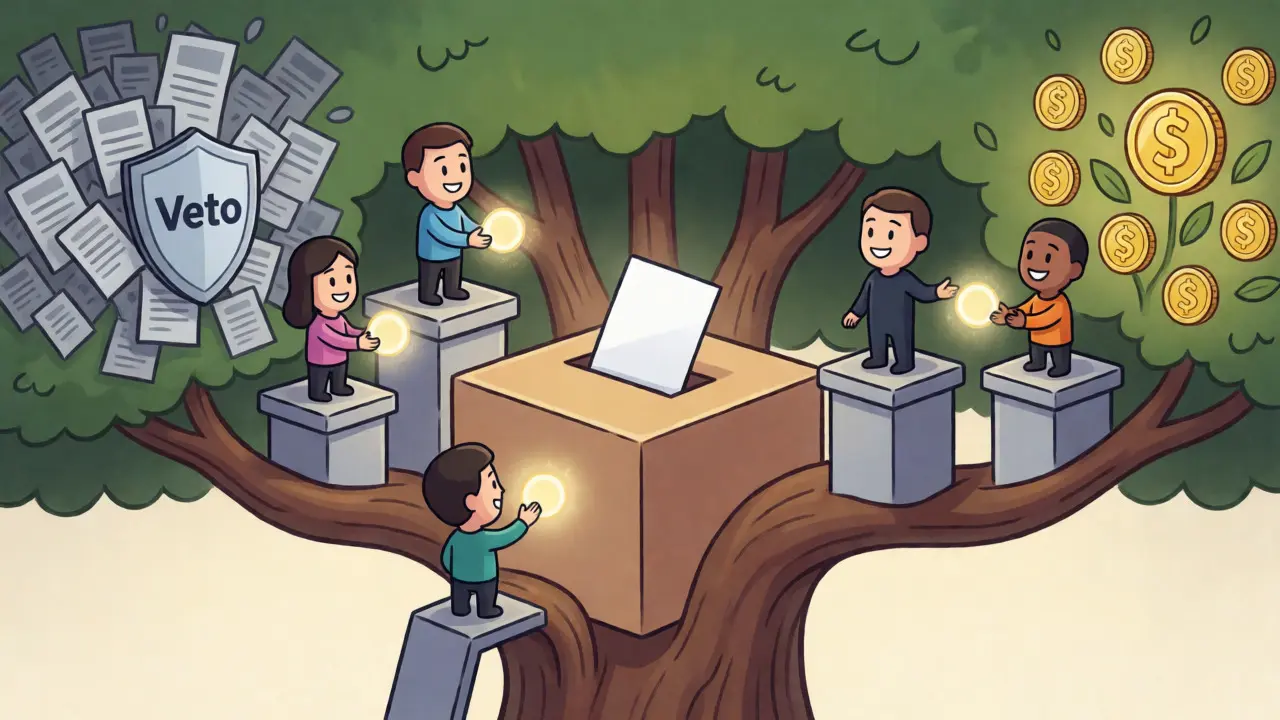
You might wonder, "Who decides the rules?" Not a CEO. Not a board of directors. The LikeCoin DAO runs things using liquid democracy. In traditional voting, you pick a representative every four years. In liquid democracy, you can delegate your voting power to someone you trust-like a validator-and change your mind at any time.
If you hold LIKE tokens, you have a say. You can propose changes to the protocol, such as adjusting inflation rates or approving new features for 3ook.com. Proposals require a deposit of 100,000 LIKE to enter the voting period. During the week-long vote, holders can choose Yes, No, Abstain, or Veto. A Veto is powerful: if more than one-third of the voting power vetoes a proposal, it fails, and the deposit is burned. This prevents spam proposals and ensures only serious ideas reach the community.
Tokenomics: Confusion and Clarity
Let’s address the elephant in the room: supply numbers. Sources often conflict. Some older articles cite a 2 billion cap. Others mention hyperinflation with no cap. As of late 2025 and into 2026, the narrative has shifted toward a fixed cap of 1.5 billion tokens under the v3 DeBook model. Why the discrepancy? Because the project evolved. The original Ethereum token had different rules than the Cosmos native token, which had different rules again from the proposed Base L2 token.
Currently, market data shows a circulating supply around 1.2 to 1.3 billion LIKE. Prices hover near $0.002 USD, giving it a small market cap of roughly $2.5 million. This makes LIKE a micro-cap asset. Liquidity is thin. You won’t see massive volume spikes like Bitcoin or Ethereum. Trading volumes on major exchanges are often under $5,000 per day. For investors, this means volatility is high, and exit liquidity can be tricky. You need patience and a long-term view on the utility side, not just speculation.
Why Choose LikeCoin Over Other Content Tokens?
There are other projects trying to decentralize content, like Audius for music or Mirror.xyz for essays. What sets LikeCoin apart is its focus on *books* and its use of Cosmos interoperability. Because it’s built on Cosmos, it can communicate with other chains via IBC (Inter-Blockchain Communication). This allows assets to move freely within the Cosmos ecosystem without relying on messy bridges.
Also, the integration with 3ook.com provides a tangible product. Many crypto projects promise a platform but never deliver. LikeCoin has a functioning marketplace where you can actually buy and stake on books today. It’s not vaporware. However, adoption remains niche. Most mainstream authors still prefer Amazon KDP. To win them over, LikeCoin needs better user experience tools for non-crypto natives. Managing wallets and gas fees is still a hurdle for the average reader.
Getting Started with LIKE
If you want to participate, here’s the practical path:
- Acquire Tokens: Buy LIKE on exchanges like Bybit or OTC markets. Be aware of low liquidity.
- Set Up a Wallet: Use a wallet compatible with Cosmos SDK chains, such as Keplr or Leap.
- Stake: Delegate your tokens to a validator to earn rewards and gain voting rights.
- Publish or Read: Go to 3ook.com. Upload a manuscript or browse existing titles. Stake on books you believe in.
For developers, the @likecoin/cosmos-api NPM package simplifies interaction with the chain. You can query balances, submit transactions, and integrate content publishing workflows into your own dApps with minimal backend code.
Final Thoughts
LikeCoin is a fascinating experiment in economic alignment. It tries to fix the broken incentive structure of digital publishing by making readers stakeholders. It’s not going to replace Amazon tomorrow. The market cap is tiny, and awareness is limited. But for authors tired of losing control over their intellectual property, and for readers who want to influence what gets discovered, it offers a compelling alternative. Keep an eye on the v3 migration to Base L2. If that succeeds in lowering costs and speeding up transactions, LikeCoin could find its groove in the Web3 literature space.
Is LikeCoin a good investment?
LikeCoin is a high-risk, micro-cap asset. Its value depends heavily on the adoption of the DeBook protocol and 3ook.com. With low trading volume and a small market cap, it is susceptible to high volatility. It suits investors who believe in the future of decentralized publishing and are willing to tolerate illiquidity.
Where can I buy LIKE tokens?
You can purchase LIKE on several exchanges, including Bybit and potentially others listed on aggregators like CoinGecko. Due to lower liquidity, always check the order book depth before placing large orders to avoid significant slippage.
What is the difference between LikeCoin and other content coins?
Unlike general content tokens, LikeCoin focuses specifically on book publishing and uses the Cosmos SDK for interoperability. Its unique feature is the ISCN (International Standard Content Number) system for provenance and the staking-based curation model on its proprietary platform, 3ook.com.
Can I mine LIKE tokens?
No, you cannot mine LIKE in the traditional sense. LikeCoin uses a Proof-of-Stake consensus mechanism. You earn rewards by staking your tokens and participating in network validation or delegation, not by solving computational puzzles.
What happens if a validator goes offline?
If a validator goes offline or misbehaves, they can be "jailed." This means they stop earning rewards and may lose a portion of their bonded stake. Delegators who staked with that validator also miss out on rewards during the downtime until the validator is reactivated.
- Poplular Tags
- LikeCoin
- LIKE token
- DeBook protocol
- decentralized publishing
- Cosmos SDK