


Ever feel like you're losing a chunk of your profits just to pay for gas fees on Ethereum? Or maybe you've tried liquidity providing but hated the idea of having to hold two different assets just to earn a yield. This is exactly where Behodler is a specialized single-sided Automated Market Maker (AMM) protocol designed to lower gas costs and reduce the pain of impermanent loss. By changing how liquidity is handled and capturing value that usually goes to miners, it tries to make DeFi more accessible for the average user.
Key Takeaways for Quick Reading
- Single-Sided Liquidity: You only need to deposit one asset, not a pair.
- Gas Efficiency: Claims to cost about 50% less in gas than Uniswap V2.
- MEV Integration: Uses Miner Extracted Value to benefit the protocol and token holders.
- Deflationary Token: The EYE token has a hard cap of 10 million coins.
- Niche Market: Great for small, frequent yield farm moves, but struggles with high-volume trades.
How Behodler Actually Works
Most people are used to the standard AMM model where you provide a 50/50 split of two tokens (like ETH and USDC). Behodler flips this. It operates as a single-sided AMM. This means you can deposit just one asset, and the protocol manages the pairing through a universal liquidity token a mechanism that allows providers to earn yield without managing a complex pair of assets manually. This significantly lowers the risk of impermanent loss-the phenomenon where your assets lose value compared to simply holding them-by roughly 37.8%.
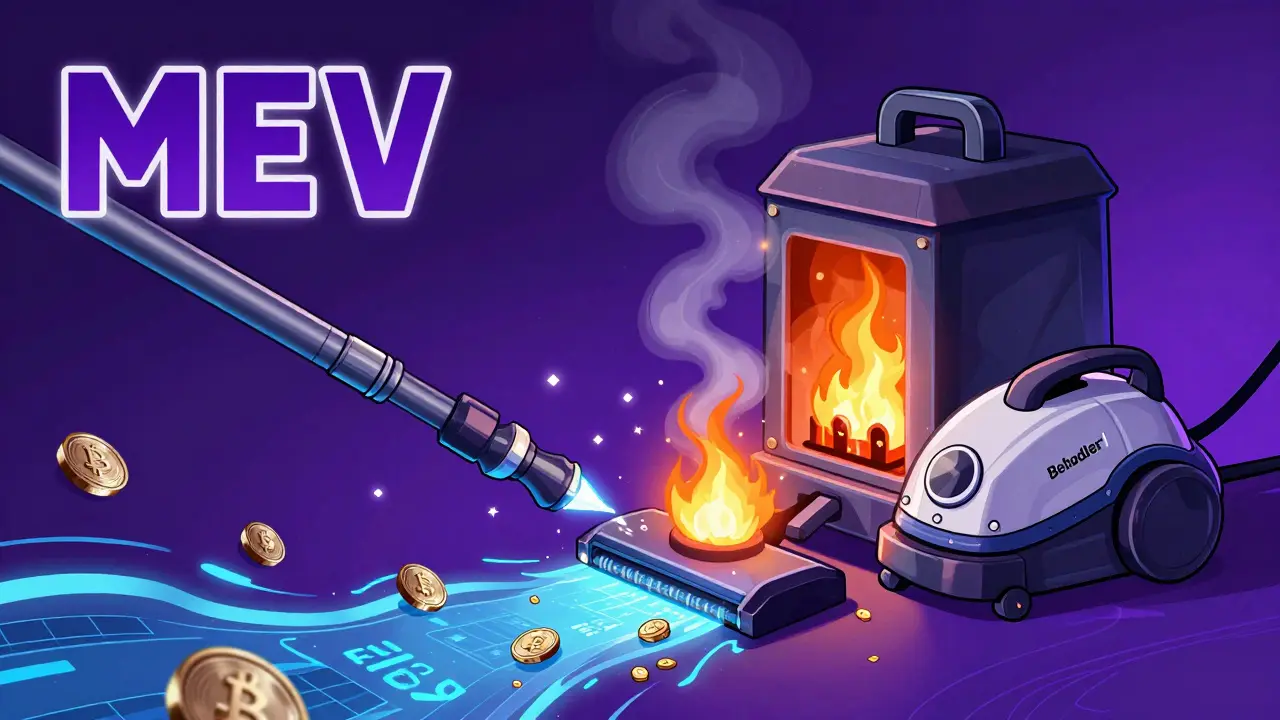
Another clever bit of engineering here is the focus on MEV Miner Extracted Value, which refers to the profit miners make by reordering transactions in a block. Usually, sophisticated bots swoop in and take this value via arbitrage. Behodler's architecture is designed to capture some of this value and funnel it back into the system. Specifically, 0.3% of all trading fees are used to burn EYE the native governance and utility token of the Behodler protocol tokens, making the currency deflationary over time.
The EYE Token: More Than Just a Ticker
The EYE token isn't just for speculation; it's the engine of the protocol. With a total supply capped at 10 million tokens, it's intentionally scarce. This scarcity is paired with a burn mechanism, meaning as the platform grows and more people trade, the total number of EYE tokens in existence actually drops.
However, if you're looking at this from an investment angle, there are some red flags to consider. A look at Etherscan reveals that about 10 wallets control over 67% of the total supply. This high level of concentration means a few "whales" have a massive influence on the price and governance. For a retail investor, this creates a risk where a single large sell-off could send the price plummeting.
Behodler vs. The Giants: A Comparison
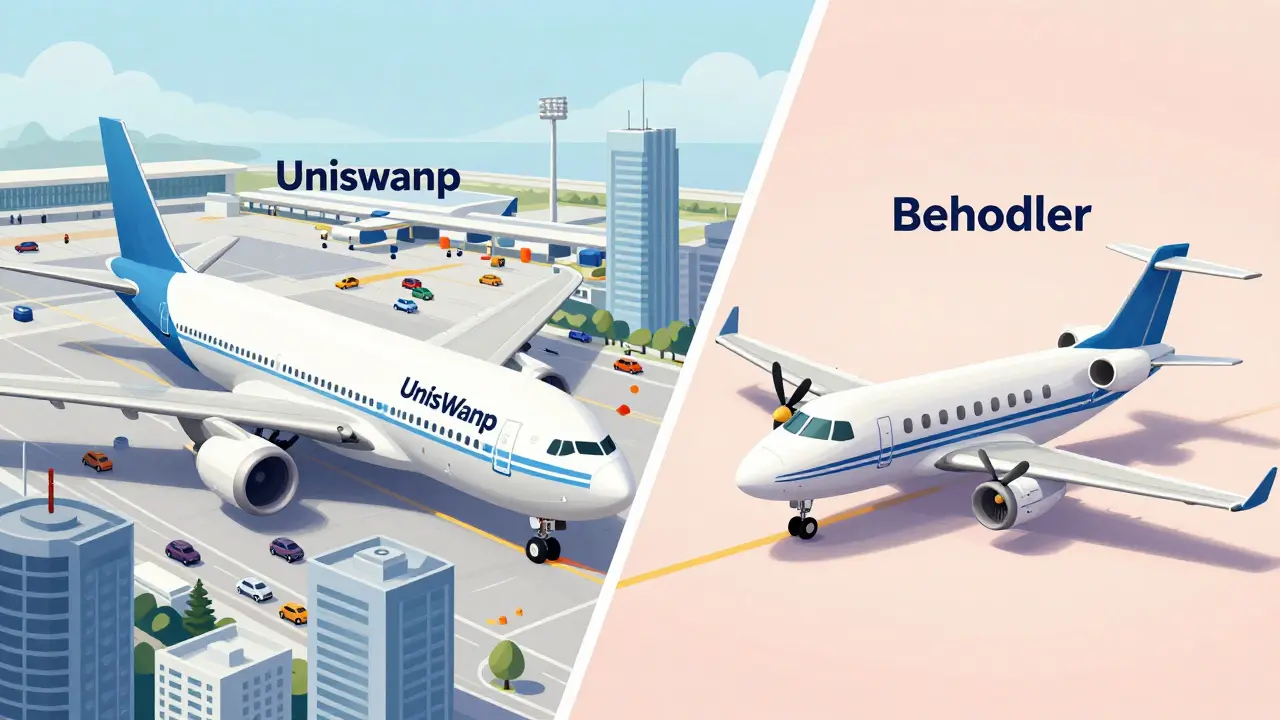
It's tempting to compare Behodler to Uniswap, but they serve different purposes. Uniswap is like a massive metropolitan airport-it handles huge volumes and massive trades with ease. Behodler is more like a specialized regional airstrip. It's faster and cheaper for specific types of trips, but it can't handle a jumbo jet.
| Feature | Behodler (EYE) | Uniswap V2 | Curve Finance |
|---|---|---|---|
| Liquidity Model | Single-Sided | Paired (50/50) | Stablecoin-focused |
| Avg. Gas Cost | ~50% Lower | Standard | Moderate |
| TVL (Approx) | $1.13 Million | $1.12 Billion | Multi-Billion |
| Slippage on $5k+ | High (>2.5%) | Low (0.8%) | Very Low |
As the table shows, Behodler wins on gas efficiency and ease of entry. If you're "zapping" in and out of yield farms frequently, you might save a significant amount of money. In one reported case, a user saved $42 in gas over two weeks by choosing Behodler over Uniswap. But if you try to swap $5,000 or more, you'll likely run into high slippage, meaning you get far fewer tokens than the market price suggests.
Practical Guide: How to Get Started
Using Behodler is relatively straightforward if you've used MetaMask before. You don't need to be a coder, but you do need to understand that you're playing in a niche market with lower liquidity.
- Set Up Your Wallet: Ensure you have an ERC-20 compatible wallet like MetaMask with some ETH for gas.
- Access the Protocol: Head to the official site and connect your wallet.
- Deposit Assets: Choose the asset you want to provide liquidity for. Unlike other platforms, you don't need to find a matching pair.
- Manage Your Yield: Use the interface to track your earnings and the universal liquidity tokens.
- Exit Strategically: Because liquidity is low, avoid large single-transaction exits to prevent high slippage.
Expect a small learning curve. Most DeFi veterans can master the interface in 2-3 hours, but new users might find the UI a bit clunky. There are some open issues on their GitHub regarding the user experience, so be patient with the interface.
The Risks: What the Hype Doesn't Tell You
We can't talk about a project like Behodler without talking about the risks. The most glaring issue is the trading volume. At times, the 24-hour volume has dropped as low as $1,129. For a global cryptocurrency, that's incredibly low. This leads to a "liquidity trap" where it's easy to get into a position but hard to get out without moving the price against yourself.
There's also the issue of institutional backing. While Uniswap has hundreds of millions in venture capital, Behodler is largely run by a DAO with an anonymous founding team. While anonymity is common in crypto, it does mean there's less accountability if things go sideways. Additionally, security firms have pointed out that the Vol/Mkt Cap ratio is well below the 5-10% healthy threshold recommended by firms like CertiK.
The Future Outlook
Behodler is currently betting on a few new developments. One is the "Limbo" farming dApp, which aims to help with token listing migration pools. If they can successfully launch this and attract more users, the liquidity problem might solve itself. There is also talk of cross-chain implementation, which would allow users to move their efficiency gains beyond the Ethereum mainnet.
Analysts are split. Some, like Dr. Alan Chen, praise the innovation of the single-sided model. Others, like Maria Gomez, argue that without massive liquidity depth, the project remains a curiosity rather than a tool for mainstream adoption. The survival rate for similar protocols from the 2021 era is only about 12%, so Behodler is fighting an uphill battle.
Is Behodler (EYE) a safe investment?
No investment in small-cap DeFi protocols is "safe." Behodler has significant risks, including extremely low trading volume, high token concentration in a few wallets, and low liquidity which can lead to high slippage. It is considered a high-risk, niche project.
How is Behodler different from Uniswap?
The biggest difference is the liquidity model. Uniswap requires you to provide a pair of tokens. Behodler allows single-sided liquidity, meaning you only deposit one asset. It also focuses heavily on gas efficiency and capturing MEV to benefit the protocol.
What is the maximum supply of EYE tokens?
The total supply of EYE tokens is capped at 10 million. The protocol also employs a burn mechanism where 0.3% of trading fees are used to permanently remove tokens from circulation.
Can I use Behodler with a mobile wallet?
Yes, as long as your wallet is ERC-20 compatible. Most users use MetaMask, which works via a browser extension or mobile app.
What is "slippage" and why does it matter for Behodler?
Slippage is the difference between the expected price of a trade and the price at which the trade is actually executed. Because Behodler has much lower liquidity than giants like Uniswap, large trades (over $5,000) can cause the price to shift significantly, resulting in a worse deal for the trader.

People Comments
Sounds like a proper niche play for those avoiding the gas wars.
I love seeing new ways to make DeFi more inclusive for everyone! The single-sided liquidity is such a game changer for smaller portfolios. Let's hope the community grows and pushes this forward!
Oh honey, calling this a "deep dive" is absolutely adorable when we're basically talking about a ghost-town liquidity pool with a TVL that wouldn't even cover a modest condo in some US suburbs.
Let's be real about the asymptotic behavior of these micro-cap AMMs where the slippage essentially converts your portfolio into a charitable donation to the few whales holding 67% of the supply-because nothing says "decentralization" like a tiny oligarchy of anonymous wallets controlling the entire ecosystem while the rest of us play with pennies.
The MEV-capture narrative is just a shiny wrapper for a protocol that's effectively a liquidity trap for the unsuspecting retail trader who thinks they've found a "gas efficient" shortcut to wealth.
If you're actually "zapping" into this, you're basically just paying a premium for the privilege of being exit liquidity for the founding team.
It's a fascinating exercise in theoretical efficiency that fails the moment it encounters a trade larger than a Starbucks order.
I mean, the 12% survival rate mentioned is actually generous considering most of these 2021 relics are just zombie chains waiting for the last dev to stop pretending the project is alive.
The "Limbo" dApp sounds like a perfect name for where your funds will actually stay once you realize you can't swap $5k without losing your shirt to slippage.
The math on the 37.8% impermanent loss reduction is cute, but it doesn't matter if there's no volume to actually realize those gains.
Watching this attempt to compete with Uniswap is like watching a tricycle race a Formula 1 car and claiming the tricycle is "more efficient" because it doesn't need as much fuel.
The burn mechanism is a classic distraction technique to keep people holding the bag while the whales decide when to dump.
I'm sure the anonymous DAO is doing a great job of "governance" behind the scenes.
The Vol/Mkt Cap ratio is a disaster and CertiK warnings are usually the only honest part of these audits.
Basically, it's a clever piece of engineering that is completely impractical in a real-world market.
Good luck to anyone trying to navigate that clunky UI for two hours just to lose money to slippage.
Absolute peak DeFi comedy.
Lol everyone acting like this is new. I've seen a dozen protocols try the single-sided thing and they all end up as rugs or ghost towns because liquidity depth is the only thing that actually matters in an AMM. You can't just "innovate" away the need for volume.
I feel so deeply for the people who might lose money here...
It is truly heart-breaking that the supply is so concentrated in just a few wallets. It seems so unfair to the small investors who just want to help the project grow, despite the technical diffculties with the interfac.
purely a joke that people still trust anonymous DAOs in this day and age total circus of a project if you ask me
For anyone feeling intimidated by the slippage or the UI-don't sweat it! Just start with very small amounts to get a feel for how the single-sided deposits work. It's a learning experience and the gas savings are actually a great way to keep more of your hard-earned crypto in your own pocket!
The claim that gas efficiency is the primary driver for user adoption is fundamentally flawed. Users prioritize liquidity and security over a few dollars in gas savings, which is precisely why Uniswap maintains its dominance despite the costs.
It's interesting to think about the trade-off between systemic efficiency and actual usability. Maybe the goal isn't to beat the giants, but to provide a specific sanctuary for those of us who prefer slower, more deliberate movements in the market.
you really think the dao is anonymous... probably just a front for the same suits running the big exchanges to trap retail in low volume pools so they can frontrun everything
it just feels like everything is so complicated now we just want simple money
The gas savings part is actually super spicy! 🌶️ Just be careful with those big trades so you don't get wrecked by the slippage! Stay safe everyone! 🚀
Love the vibe of this project! 🌈 It's all about finding those hidden gems that actually try to solve real problems like gas fees. Keep exploring and keep sharing! ✨
The audacity to call a project with a $1M TVL a "competitor" to Uniswap is simply breathtaking. 🙄 It's a quaint little experiment for the financially adventurous, or those who enjoy burning money through slippage. 🤡
If you can't see that 67% whale concentration is an immediate deal-breaker, you're too blind to trade. This isn't a project, it's a coordinated dump waiting to happen.
I've seen better interfaces on 90s GeoCities pages. The clunky UI is just a symptom of the overall lack of effort here.
This is such an amazing innovation! 🇮🇳 I believe these kinds of efficient tools will help so many people in my country enter the DeFi space more easily!
It is prudent to remember that the anonymity of the founding team introduces a level of counterparty risk that may be unacceptable for institutional-grade portfolios. (•_•)
basically just a glorified yield farm with a fancy name for MEV capture... lol the
I'm curious if the single-sided model could eventually be adopted by larger platforms to attract more retail users. It seems like a very friendly way to start.
The Vol/Mkt Cap ratio is the only metric that matters and it's dead. This is a textbook example of a project designed to inflate a token price via a fake burn mechanism while the inner circle exits via the back door.
Don't let the negativity get to you! Every big project started small and had some bugs to iron out. Let's focus on the potential for the Limbo dApp to bring in more liquidity! 🌟