



When DragonEX first appeared in 2017, it looked like a game-changer. Promising zero maker fees, instant withdrawals, and rewards just for trading - a model they called "transaction mining" - it caught the attention of traders in Asia who were tired of high costs and slow service. But today, if you search for DragonEX, you won’t find a functioning exchange. You’ll find ghost sites, confused users, and a trail of unanswered questions. So what went wrong? And should you even consider using it now?
What Was DragonEX Supposed to Be?
DragonEX launched in November 2017 out of Singapore, with a license from Estonia. It wasn’t trying to be the next Binance. It was built for a specific group: traders in Asia who wanted fast, cheap, and rewarding crypto trading. Their big idea? Pay users for trading. Every time you placed a trade - whether you bought or sold - you earned rewards. This was called "transaction mining," and at the time, it felt revolutionary. They offered more than just spot trading. You could trade perpetual contracts, futures, options, and even leveraged positions. For someone looking to go beyond simple buys and sells, DragonEX had the tools. Their mobile apps were on both Apple’s App Store and Google Play, and they required full KYC (Know Your Customer) verification for every action - deposits, trades, withdrawals. That was unusual back then. Most exchanges let you trade anonymously. DragonEX didn’t. Their fee structure was simple: 0.2% for takers, 0% for makers. That meant if you placed a limit order that didn’t immediately fill (a maker), you paid nothing. That’s rare even today. Many exchanges still charge makers. DragonEX gave them away.The Red Flags Started Showing Up
But here’s the problem: DragonEX never proved its numbers. CoinMarketCap, the most trusted source for exchange data, labeled DragonEX as an "Untracked Listing." That’s not a minor note. It means they couldn’t verify a single trade volume. Not one. For an exchange to be "tracked," it needs to show at least $1 million in daily trading volume, verified by third parties. DragonEX never did. And then there was the silence. No audit reports. No transparency on cold storage. No public breakdown of security measures. They claimed to work with third-party security firms, but never named them. No press releases. No blog updates after 2019. No response to questions from industry analysts. Cointelegraph, The Block, Messari - none of them covered DragonEX after 2020. When the top players stop talking about you, it’s not a coincidence. Even their user base didn’t hold up. They claimed over 300,000 KYC users in mid-2019. That’s impressive. But their WeChat, QQ, and Telegram groups - the heart of their community - went quiet by 2021. No new announcements. No polls. No engagement. Just ghosts.The Scam Sites Are Everywhere
This is where things get dangerous. Today, if you Google "DragonEX," the first results aren’t dragonex.io. They’re sites like dragonex.us.com, dragonex.net, dragonex.top. These aren’t upgrades. They’re scams. Users on Revieweek and Fxmerge posted glowing reviews - "instant withdrawal," "completely legit," "never seen crypto again" - but those reviews were on scam domains. The real DragonEX site, dragonex.io, hasn’t been updated since 2019. It’s a static page. No login. No trading. No support. That’s a classic pattern. When a crypto exchange fades, copycats jump in. They steal the name, the logo, the old testimonials. They lure in people who remember the hype. Then they vanish with deposits. One user on Revain said, "I didn’t like the way I was attended to," and the review cut off. That’s not a glitch. That’s someone giving up mid-sentence because they lost money.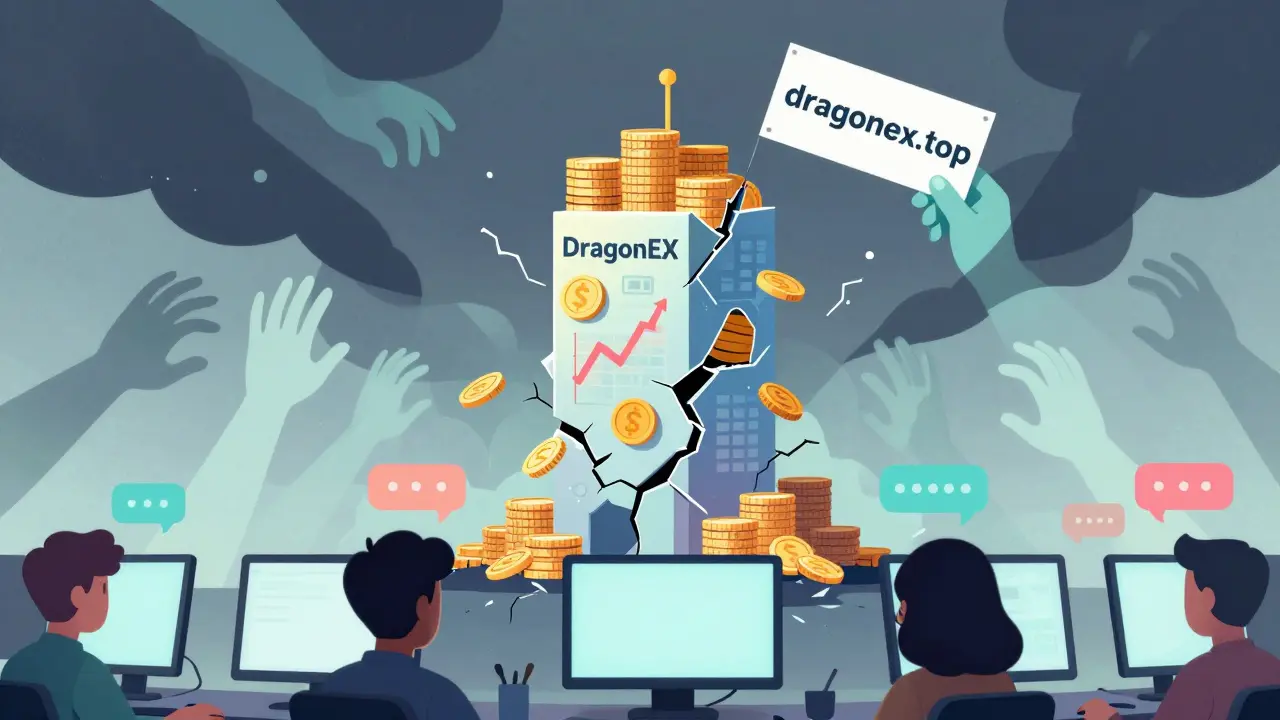
Why DragonEX Failed
It wasn’t just bad luck. It was a perfect storm. First, the "transaction mining" model collapsed. By 2020, CoinDesk reported that most reward-for-trading models were unsustainable. Exchanges were paying out more in rewards than they made in fees. DragonEX didn’t have the capital to keep it going. Second, regulation tightened. Singapore’s Payment Services Act in 2020 forced exchanges to get proper licenses. Estonia, where DragonEX claimed its license, started cracking down on shell companies. DragonEX never showed proof of compliance. Third, liquidity vanished. Without verified volume, no serious trader trusted it. Without liquidity, derivatives trading became risky. No one wanted to open a 50x leveraged position if they couldn’t be sure the order would fill. Fourth, customer service crumbled. Multiple users reported slow replies, unhelpful support, and withdrawal delays. Even if the platform worked, if you can’t get your money out, it’s useless.What Happens to Your Funds Now?
If you still have funds on DragonEX - or think you do - you’re out of luck. The platform is effectively dead. There’s no official announcement of shutdown. No email. No forum post. No press release. Just silence. The domain dragonex.io still exists, but it’s a placeholder. No login button. No contact info. No way to recover assets. Your coins are gone. And if you’re reading this because you found a site claiming to be DragonEX and asking for your private keys or recovery phrase - don’t do it. That’s a trap. Those sites are designed to steal everything. Real exchanges don’t ask for your keys.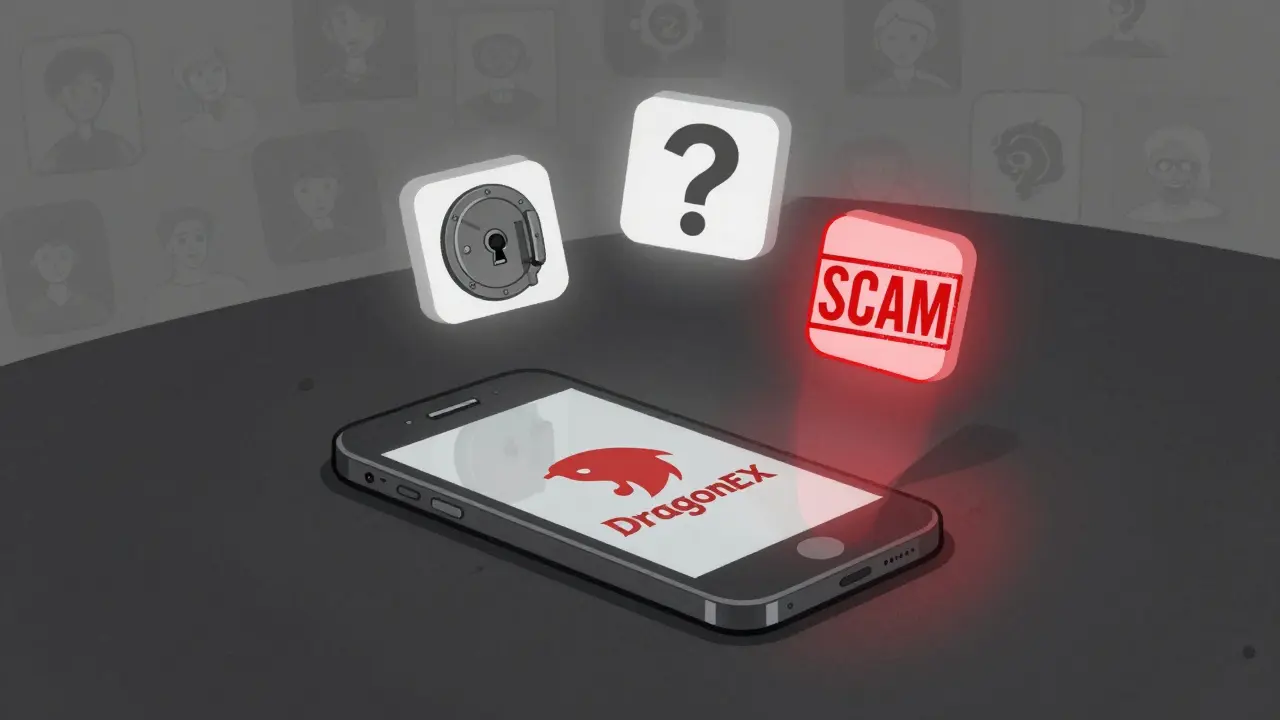
Who Should Have Avoided DragonEX?
Anyone who needed:- Verified trading volume - You can’t trust a platform that hides its numbers.
- Fiat on-ramps - DragonEX never supported USD, EUR, or any local currency. You needed crypto first.
- Security transparency - No audit reports. No cold storage proof. No security team named.
- Long-term reliability - If a platform stops updating for 5+ years, it’s not coming back.
What Should You Use Instead?
If you’re looking for a reliable exchange today, look at platforms that are transparent, regulated, and active.- Binance - Largest volume, multiple asset listings, clear audits.
- Coinbase - Fully regulated in the U.S. and EU, easy fiat on-ramps.
- Kraken - Strong security, transparent fee structure, regular audits.
- Bybit - Top choice for derivatives, clear volume data, active support.
Final Verdict: DragonEX Is Gone
DragonEX wasn’t a scam from day one. It had real features, real users, and real ambition. But it chose growth over transparency. It bet on hype instead of trust. And in crypto, that’s a fatal mistake. Today, DragonEX is a cautionary tale. It shows how quickly a platform can vanish when it stops being honest. No one announces a shutdown. No one says "we’re done." They just stop responding. The website goes dark. The forums go silent. And your coins? They’re gone. Don’t look for DragonEX. Don’t search for "dragonex.us.com." Don’t trust any site that promises "instant withdrawals" or "zero fees" without proof. The real DragonEX is gone. And if you’re still chasing it, you’re not trading crypto - you’re chasing ghosts.Is DragonEX still operational in 2026?
No, DragonEX is not operational. The official website (dragonex.io) has not been updated since 2019. There is no login functionality, no trading, and no customer support. While the domain still exists, it serves no purpose other than as a placeholder. Any active site using the DragonEX name is a scam.
Can I recover my funds from DragonEX?
No, you cannot recover funds from DragonEX. The platform has ceased operations without a formal shutdown announcement or asset transfer process. If you still have assets on the original platform, they are inaccessible. Be wary of any site or person claiming they can help you recover your coins - these are phishing scams designed to steal your private keys or additional funds.
Why did CoinMarketCap stop tracking DragonEX?
CoinMarketCap stopped tracking DragonEX because it failed to meet their transparency standards. To be listed as "tracked," an exchange must provide verifiable trading volume data, undergo third-party validation, and maintain consistent public updates. DragonEX never submitted this data. Its status as "Untracked" since 2019 was a clear signal that its operations were not reliable or transparent.
Were DragonEX’s transaction mining rewards real?
Yes, transaction mining rewards were real - but only while the platform was active. Users did earn rewards for trading, as confirmed by early user reports and platform documentation. However, the model was unsustainable. Exchanges that paid users for trading often burned through capital faster than they earned fees. DragonEX likely ran out of funds to pay rewards, which contributed to its collapse.
Are there any legitimate DragonEX apps left?
No. The official DragonEX apps on the Apple App Store and Google Play have been removed. Any app currently available under the name "DragonEX" is fake. These apps are used by scammers to trick users into entering private keys or sending crypto to fraudulent addresses. Always verify app developers - the real DragonEX apps were published by "DragonEX Limited," but they are no longer maintained or available.
What should I do if I visited a DragonEX scam site?
If you entered your private keys, seed phrase, or sent funds to a DragonEX scam site, assume your assets are stolen. Immediately stop using any device you used to access the site. Change passwords on all related accounts (email, exchange logins). Monitor your wallet addresses for any movement. Report the scam to local authorities and crypto fraud reporting platforms like the FTC or IC3. Never trust any site that asks for your recovery phrase - no legitimate exchange ever will.

People Comments
Let me guess - you thought DragonEX was too good to be true? Of course it was. Every time an exchange promises 'zero fees' and 'rewards for trading', it's either a rug pull or a Ponzi. They didn't fail because of regulation - they failed because they were paying users with their own capital, not revenue. That's not innovation, that's financial suicide. And now? The scam sites are everywhere, preying on people who still believe in fairy tales. Don't be one of them. If it sounds like free money, it's a trap. Always.
And yes, I've seen this exact pattern with 12 other exchanges. Same story. Same silence. Same vanished wallets. You're not special. You're not clever. You're just another victim waiting to happen.
Okay but like - transaction mining? 😭 That was the dumbest idea since 'crypto staking on your toaster'. You can't pay people to trade unless you have infinite money, and DragonEX clearly didn't. They were just a glorified MLM with a blockchain logo. And now? The ghost sites are out there with fake 'withdrawal buttons' and '24/7 support'. Lmao. You really think a platform that vanished in 2019 is gonna come back? Bro. It's 2026. Move on.
Also, KYC? That's cute. If you're doing KYC and still getting scammed, maybe don't touch crypto at all. Just sayin'.
It is imperative to underscore that the collapse of DragonEX was not an isolated incident, but rather a predictable consequence of systemic failures in governance, transparency, and economic sustainability. The model of incentivizing trading activity without a corresponding revenue stream is fundamentally unsound from both a financial engineering and risk management perspective. Furthermore, the absence of verifiable audit trails, third-party validation, and regulatory compliance constitutes a material breach of fiduciary responsibility to users. In any legitimate financial ecosystem, these are non-negotiable pillars. DragonEX, by omitting them, rendered itself not merely defunct - but ethically indefensible.
Man, I remember when DragonEX was a thing. I used to trade on it back in '18. It was kinda cool - fast, no fees on limit orders, rewards every time you clicked buy. Felt like getting paid to do something I was already doing.
But then... poof. One day, the app stopped updating. No emails. No posts. Just silence. I still have a screenshot of my balance. 0.45 BTC. Gone. I didn't even cry. Just shrugged. That's crypto for ya. Lesson learned: if it ain't on Binance or Kraken, it ain't real. Now I stick to the big boys. No drama. No ghosts.
OMG I JUST REALIZED I STILL HAVE THE DRAGONEX APP ON MY PHONE 😱 I thought it was just 'inactive'... I didn't realize it was DEAD 😭
I even sent like $800 in ETH to it in 2019... I thought I was being smart with 'transaction mining'... I'm so dumb. I just deleted the app. I'm crying. I feel so stupid. I trusted them. I really did. Why did they just... disappear? 😭😭😭
Also - anyone else feel like crypto is just a giant game of musical chairs? 🤔
Wow. So much text. Just say it's gone. Done. Over. No one cares about the history. I just want to know if I can get my money back. Answer: no. Cool. Next.
Also, why is everyone so mad? It's crypto. You lose money. It's fine. Chill.
DragonEX wasn't evil. It was naive. It believed that people would trade more if they were rewarded - and for a while, they did. But it never asked: what happens when the rewards run out? What happens when the users realize they're not earning, they're being subsidized? The model was beautiful in theory - a decentralized, user-centric exchange - but it lacked the infrastructure to sustain itself. No audits, no liquidity, no transparency. It didn't collapse because of malice. It collapsed because it was built on a foundation of hope, not hard numbers.
And now? We're left with these scam sites, exploiting nostalgia. It's tragic. We don't need more scams. We need better education. We need users who ask: 'Who is behind this?' 'How do they make money?' 'Where's the proof?' Until we do, this cycle will keep repeating.
Let me break this down for you: DragonEX didn't 'fail.' It was *designed* to fail. The 'transaction mining' model? A liquidity trap disguised as innovation. The KYC? A compliance theater to avoid scrutiny. The silence after 2019? Not an accident - it was the exit strategy. They raised capital, paid early adopters with new deposits, and vanished when the inflow slowed. Classic. And now the scam sites? That's just the cleanup crew. They're not trying to make money - they're trying to steal from the gullible. The real crime? That people still fall for this. You don't need a PhD to see this pattern. You just need to stop being greedy.
Stop pretending DragonEX was ever legitimate. They never had a license. Estonia never approved them. CoinMarketCap flagged them as 'Untracked' - that's not a footnote, that's a red siren. And now you're all acting like this was some tragic accident? No. This was a calculated, deliberate fraud. They knew. They had to know. The team had to be complicit. The devs, the marketers, the community managers - they all knew this was a house of cards. And they still took your money. That's not incompetence. That's criminal. And if you're still searching for 'dragonex.us.com' - you're part of the problem.
The silence is the most chilling part. Not the vanished funds. Not the scam sites. The silence. No announcement. No apology. No explanation. Just... nothing. It's as if they vanished into a black hole of corporate ethics. And yet, we still have users who believe in the 'ghost' - who still click on those fake domains, hoping against hope that maybe, just maybe, their coins will reappear.
That hope? That's the real tragedy. Not the lost Bitcoin. The belief that someone, somewhere, cares enough to come back.
DragonEX wasn't a scam. It was a failed experiment. And we're all still learning what works.
If you didn't verify their trading volume, audit reports, or regulatory status - you were never a trader. You were a gambler. And now you're crying because you lost? Grow up. Real exchanges don't need to 'reward' you to trade. They earn fees. They prove volume. They publish audits. DragonEX did none of that. Your loss is your fault. Not theirs. Own it.
Let me tell you something - I used to run a small crypto advisory firm. We got approached by DragonEX in 2018. They wanted us to promote their 'transaction mining' model. We said no. Not because we were skeptical - because we were *certain*. We ran the numbers. Their projected burn rate was 300% of projected revenue. They were paying out $3 for every $1 they earned. That's not a business. That's a charity with a blockchain logo.
And here's the thing: they didn't lie. They didn't fake volume. They just didn't have a plan. They thought hype would last forever. It doesn't. And now? The silence is deafening. But I'm not angry. I'm sad. Because people trusted them. And trust? That's the hardest thing to rebuild.
Hey - if you're reading this and still have DragonEX on your phone? Delete it. Immediately.
I know it's hard. I lost money too. But here's what I learned: the best way to heal from crypto losses isn't to chase ghosts - it's to help others avoid them. So if you see someone asking about 'dragonex.top' or 'instant withdrawals' - don't ignore them. Tell them. Tell them gently. Tell them like you'd tell a friend. Because we all get fooled. But we don't have to let others get fooled too.
And hey - if you're okay, send me a DM. I'll send you a free guide to safe exchanges. No strings. Just care.
I never traded on DragonEX. But I read about it. And I thought - wow, what a beautiful idea. To reward traders instead of charging them. It felt like crypto was becoming fairer.
Then I realized: fairness doesn't work without sustainability. And sustainability doesn't work without transparency.
DragonEX didn't fail because it was evil. It failed because it forgot that trust isn't built on rewards. It's built on honesty. And honesty? That's harder than coding a smart contract.
DragonEX? Na! That was just another American scam using African traders to pump their liquidity. I saw the Telegram groups - 90% Nigerian, Indian, Filipino users. The devs? Probably in Singapore with US passports. They took our money, gave us fake rewards, then ghosted. No shame. No apology. Just silence.
But now? I'm smarter. I only use Binance. I don't trust anyone who doesn't have a public team photo. And I never, ever click on links that say 'dragonex' unless it's .io - and even then, I don't trust it.
Transaction mining was interesting. I get why people liked it. But the real issue? No one asked how they funded it. That's the red flag. Not the silence. Not the scam sites. The lack of curiosity. People were so excited about 'free rewards' they stopped asking: 'Where's the money coming from?'
That's the real lesson. Not 'don't trust DragonEX.' It's 'don't trust anything that sounds too good without asking: how?'
Just saying.
I still remember the first time I saw DragonEX's reward notifications. It felt like winning a tiny lottery every time I traded. 😊
Then it stopped. No warning. No goodbye. Just... gone.
I don't blame them. I blame the system. We're taught to chase rewards, not sustainability. We're taught to believe in 'first-mover advantage' instead of 'long-term trust.'
Maybe DragonEX was a symptom. Not the disease.
Let's build better next time. ❤️
It's fascinating how the crypto community romanticizes failure. DragonEX was a textbook case of unsustainable incentive design. The fact that anyone still defends it - or worse, searches for it - reveals a deeper cultural malaise: the belief that innovation excuses opacity. It does not. Transparency is not optional. It is the foundation. DragonEX didn't just vanish - it exposed the rot beneath the glitter.
While DragonEX's operational model was commendable in its ambition, its failure to adhere to internationally recognized standards of financial disclosure and operational integrity rendered its eventual dissolution inevitable. The absence of audited financial statements, verifiable liquidity metrics, and regulatory compliance constitutes a fundamental breach of fiduciary duty. Users must be educated not merely to avoid such platforms, but to demand accountability as a baseline expectation - not a luxury.
DragonEX is dead. Don't click the links. You'll lose everything. That's it.
Ohhh so DragonEX was the crypto version of a 'free trial' that turns into a subscription you can't cancel? Wow. So poetic. I'm crying. Not because I lost money. Because I believed in fairy tales. And now I have to go cry into my Coinbase app. 😔
Gone. Not coming back. Move on.
Of course you're still here. You're the same person who posted the 'I still have the app' comment. You didn't learn. You just reposted the same grief. That's not healing. That's obsession.
And now you're asking others to 'help' you? No. The only help you need is to stop Googling 'dragonex' and delete every trace of it from your life.
You're not broken. You're addicted.
Thank you for saying that. I've been saying the same thing since 2020. People don't want to hear 'it's gone.' They want to hear 'it might come back.'
But the truth? It won't. And clinging to that hope? It's the real cost - not the crypto you lost. It's the time, the energy, the emotional weight.
Let it go. For your own peace.
You're right. I didn't mean to make it sound like DragonEX could come back. I just meant... maybe we can build something better.
Not a ghost. Not a scam. Not a reward trap.
Just a real exchange. With real transparency.
That's all I want.