


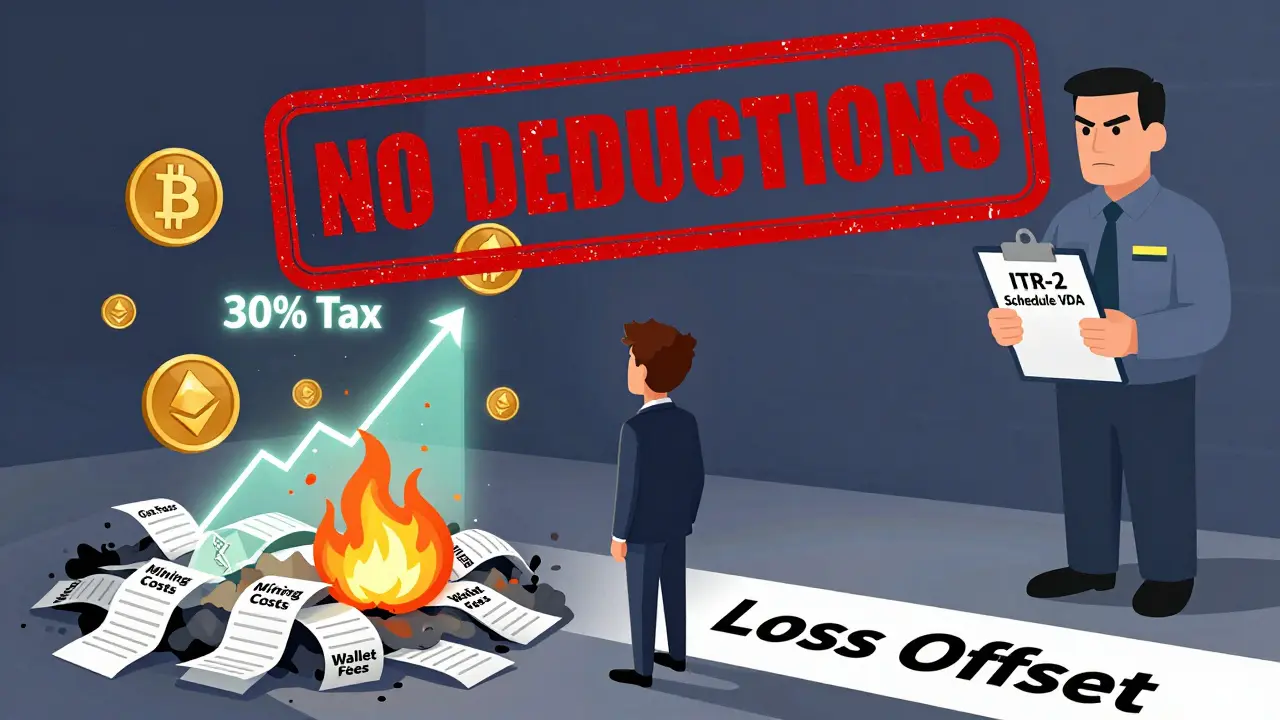
India’s approach to taxing Virtual Digital Assets (VDAs) is one of the strictest in the world. If you’re buying, selling, or trading Bitcoin, Ethereum, NFTs, or any other digital token in India, you’re subject to a flat 30% tax on every gain-with almost no deductions allowed. This isn’t a suggestion. It’s the law, enforced since April 1, 2022, and tightened further in 2025. No matter how much you earn or how long you hold, the tax rate doesn’t change. And here’s the kicker: you can’t use losses from one crypto trade to reduce taxes on your salary, stocks, or business income. That’s not just unusual-it’s harsh compared to nearly every other country.
What Counts as a Virtual Digital Asset?
Under Section 2(47A) of the Income Tax Act, 1961, a Virtual Digital Asset is any digital token, code, or number that holds value and can be transferred electronically. This includes Bitcoin, Ethereum, Solana, and other cryptocurrencies. It also covers NFTs-digital art, music, or collectibles sold as unique tokens. Even stablecoins like USDT or USDC are included, as long as they’re not Indian or foreign currency. The government made it clear: if it’s digital, tradable, and has value, it’s a VDA. What’s excluded? Cash, bank transfers, UPI payments. Anything tied to real-world money is out. But anything you buy on WazirX, CoinDCX, or UniSwap? That’s in.
The 30% Tax Rule: No Exceptions
Section 115BBH of the Income Tax Act sets the tax rate at 30% on all gains from VDAs. That’s it. No sliding scale. No lower rates for long-term holdings. Even if you held Bitcoin for five years, you still pay 30%. The only thing you can deduct is the cost of acquisition. That means the exact amount you paid to buy the asset, including any fees at the time of purchase. Everything else? Gone. Transaction fees, gas fees, mining costs, wallet setup fees, even the cost of a hardware wallet-none of it counts. If you bought 1 BTC for ₹30 lakh and sold it for ₹45 lakh, your taxable gain is ₹15 lakh. Tax due? ₹4.5 lakh. No deductions. No adjustments. Just 30%.
Losses Can’t Offset Anything
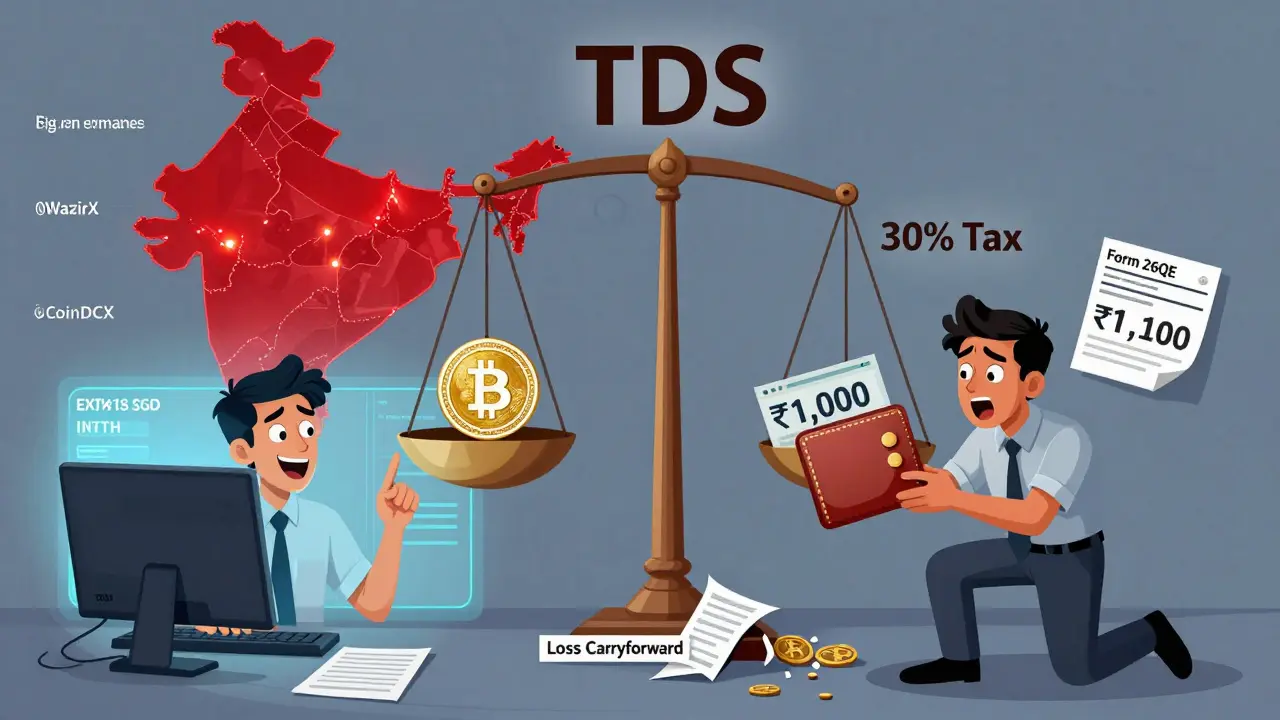
This is where most investors get blindsided. If you lose money on crypto, you can’t use that loss to reduce taxes on your salary, rental income, or stock profits. Unlike stocks or real estate, where losses can offset gains, VDA losses are locked in their own box. You can carry them forward-for up to eight years-but only to offset future VDA gains. So if you lost ₹5 lakh on Ethereum in 2023 and made ₹8 lakh on Solana in 2025, you can use ₹5 lakh of that gain to reduce your tax. But if you made ₹8 lakh on a side business? Tough luck. That loss is useless. Many traders have walked away from India’s market because of this rule. One Reddit user, CryptoSaverIN, lost ₹2.87 lakh on Ethereum and couldn’t touch it against his ₹12 lakh salary. He called it "financially punitive."
1% TDS on Every Transaction
Every time you buy or sell a VDA worth more than ₹10,000 in a year, the exchange must deduct 1% as Tax Deducted at Source (TDS). This isn’t optional. It’s automatic. If you’re a regular user (not a business), the threshold is ₹10,000 total across all transactions in a financial year. For businesses or professionals with turnover over ₹1 crore, it’s ₹50,000. If you don’t provide your PAN, the TDS jumps to 20%. Exchanges like WazirX and CoinDCX handle this automatically-they take the 1% before the funds hit your wallet. You’ll get a Form 26QE and a TDS certificate (Form 16E) from the exchange. If you don’t get it, you’re at risk of being flagged later. Around 62% of complaints on Trustpilot from Indian crypto users are about TDS errors-over-deductions, missing certificates, mismatched amounts. Keep every receipt.
How to Report VDAs in Your Income Tax Return
You must report all VDA transactions in Schedule VDA of ITR-2 or ITR-3. You need to list:
- Asset name (e.g., Bitcoin, NFT #1234)
- Date of acquisition
- Cost of acquisition (in INR)
- Date of transfer
- Full value of consideration (sale price in INR)
For crypto-to-crypto trades-like swapping ETH for SOL-you must convert both sides into INR using the exchange rate at the exact time of the trade. The government only accepts rates from approved platforms: CoinDCX, WazirX, or others notified by CBDT. If you use CoinSwitch, Binance, or a decentralized exchange, you’re still required to use the INR value from a notified platform. This creates a reporting headache for DeFi users. According to ICAI, 30-40% of DeFi transactions have valuation uncertainty because there’s no clear way to determine cost basis on decentralized swaps.
What You Can’t Deduct (And Why It Matters)
Here’s a quick list of expenses you might think are deductible-but aren’t:
- Transaction fees on exchanges
- Gas fees on Ethereum or Solana
- Cost of mining equipment
- Electricity used for mining
- Wallet setup or software subscriptions
- Legal or accounting fees for crypto
- Network fees for staking rewards
Why? The law says only acquisition cost counts. That means if you mined Bitcoin and spent ₹2 lakh on hardware and electricity, then sold it for ₹10 lakh, your taxable gain is ₹10 lakh-not ₹8 lakh. You pay ₹3 lakh in tax. No relief. This is why experts like Pankaj Nahta of Tax2Win say crypto investing in India is "economically unviable for all but the most speculative traders." For many, returns after tax are lower than bank fixed deposits.
How VDA Taxing Compares to Other Countries
India’s system stands out globally:
| Country | Tax Rate | Loss Offset Allowed? | TDS on Transactions | Indexation Benefit? |
|---|---|---|---|---|
| India | 30% flat | No | 1% | No |
| United States | 0-37% (slab-based) | Yes | 24% only if non-compliant | Yes (for capital assets) |
| Germany | 0% after 1 year | Yes | 0% | Yes |
| Portugal | 0% for personal gains | Yes | 0% | N/A |
| Singapore | 0% for individuals | Yes | 0% | N/A |
| Japan | Up to 55% | Yes | 0% | No |
India is one of the only countries that bans loss offset entirely. The U.S., Germany, and Singapore all allow crypto losses to reduce taxes on other investments. Japan taxes crypto as miscellaneous income-up to 55%-but still lets you offset losses. India’s 1% TDS is also higher than anywhere else. The EU’s upcoming DAC8 directive proposes zero TDS for crypto. India’s system is simple, but it’s also punitive.

Common Mistakes That Trigger Tax Notices
According to PwC India, 28% of tax notices sent to crypto users in FY2023-24 were due to basic errors:
- Not reporting crypto-to-crypto trades
- Using wrong exchange rates (not from CBDT-approved platforms)
- Forgetting to include staking rewards as income
- Mixing mining income (taxed as business income) with capital gains
- Failing to keep blockchain records or transaction proofs
Staking rewards? Taxable as income when you receive them. Mining income? Taxed as business income at slab rates, then again as capital gains when you sell. Double taxation. NISM found that 65% of tax disputes come from poor record-keeping. If you can’t prove when and how much you bought, the tax department assumes zero cost-meaning your entire sale amount is taxable. That’s a nightmare.
What’s New in 2025?
The Income Tax Act, 2025, passed in August 2025, made two big changes:
- "Tax Year" replaced "Financial Year" as the assessment period. This means your crypto activity from April 1, 2025, to March 31, 2026, is assessed under the 2025 tax year.
- Specialized dispute resolution channels were created to handle VDA tax cases faster. No more waiting 2-3 years.
But the 30% rate, TDS, and loss restrictions remain. The government’s goal? ₹9,200 crore in VDA tax revenue by FY2025-26. That’s up from ₹3,920 crore in FY2023-24. They’re not trying to stop crypto-they’re trying to tax it harder.
What Should You Do Now?
If you’re trading crypto in India:
- Keep every transaction record: date, amount, INR value, platform, wallet address.
- Use only CBDT-approved exchange rates for crypto-to-crypto trades.
- Track your TDS receipts (Form 16E) and match them with your Form 26AS.
- Don’t assume losses can help your other taxes-they can’t.
- Consider gifting assets to family members in lower tax brackets. Some users report 3-4% savings this way.
- Use CBDT’s free chatbot "TaxAssist VDA" or their 12-part YouTube tutorial if confused.
Despite the harsh rules, 61% of Indian crypto users still trade, according to WalletInvestor. Why? Because the returns can still be huge. The market is growing slower than before, but it’s still alive. Institutional investors now make up 27% of the market, up from 3% in 2021. That means even with taxes, big money is still coming in.
Will This Change?
There’s talk of a "Virtual Asset Service Providers Bill" under review. It could require exchanges to get licenses, which might change how TDS is applied. SEBI is also working on rules for crypto ETFs. If approved, Bitcoin ETFs might be taxed like mutual funds-lower rates, loss offset allowed. That could be a loophole. For now, though, the 30% rule stands. And until it changes, every gain is taxed the same way: no mercy, no exceptions.
Is crypto trading legal in India?
Yes, trading, holding, and buying crypto is legal in India. However, it is not recognized as legal tender. You can’t use Bitcoin to pay for groceries or rent. But you can buy, sell, and hold it-just be ready to pay 30% tax on any profit.
Do I have to pay tax if I didn’t sell my crypto?
No. Tax is only triggered when you sell, trade, or convert crypto into INR or another VDA. Holding Bitcoin without selling doesn’t create a taxable event. But if you swap BTC for ETH, that’s a taxable transaction-you must report it.
What happens if I don’t report my crypto gains?
The Income Tax Department tracks all transactions through exchanges, which report to them under TDS rules. If you don’t report, they’ll match your Form 26AS with your ITR. You’ll get a notice. Penalties can be up to 200% of the tax evaded, plus interest. In severe cases, prosecution is possible.
Can I claim deductions for mining expenses?
No. Under Section 115BBH, only the cost of acquisition is deductible. Mining hardware, electricity, software-all are non-deductible. Mining income is taxed as business income at slab rates, and any subsequent sale is taxed again at 30% as capital gain.
Are NFTs taxed the same as Bitcoin?
Yes. NFTs are classified as Virtual Digital Assets. Whether it’s a digital artwork, music file, or tokenized real estate, any NFT sale triggers 30% tax on the gain. Cost of acquisition includes the purchase price and any gas fees paid to mint or buy it.
What if I bought crypto on an international exchange like Binance?
You still must report it. Indian tax law applies to all residents, regardless of where the transaction occurred. Even if Binance doesn’t deduct TDS, you’re legally required to report the gain and pay 30% tax. The government has data-sharing agreements with foreign exchanges and can access transaction records.
Can I offset crypto losses against stock market gains?
No. Losses from Virtual Digital Assets can only be offset against future VDA gains. They cannot reduce taxes on equity, debt, real estate, or business income. This is unique to India and makes crypto losses far less valuable than in other countries.
How much time does it take to file crypto taxes?
Active traders spend 15-20 hours annually on record-keeping and filing. Passive holders with 1-2 trades may take 2-3 hours. The complexity comes from tracking multiple transactions, converting crypto-to-crypto trades into INR, and matching TDS records. Tools like Koinly or CoinTracker can help, but you still need to manually verify against your exchange statements.
India’s VDA tax system is not designed to encourage crypto. It’s designed to capture revenue. And so far, it’s working. The government collected nearly ₹4,000 crore in just one year. Whether that’s fair or sustainable is up for debate. But for now, if you’re trading crypto in India, you’re playing by their rules-no exceptions, no loopholes, no mercy.





People Comments
I've been trading crypto in India since 2021 and honestly? This tax system is brutal but predictable. I just accept it as the cost of doing business here. I track every transaction, use CoinDCX rates religiously, and file everything on time. No surprises. No drama. Just pay the 30% and move on. The TDS is annoying but at least it's automatic. I'd rather have that than a messy audit.
This is why crypto will never take off in India. The government is scared of decentralized money and is punishing anyone who dares to use it. 30% tax? No loss offset? It's like they want people to stay poor and keep their money in banks. 🤦♀️
I've lived in three countries. India's system is the only one that treats crypto like a sin instead of an asset class. The U.S. taxes gains progressively. Germany lets you hold tax-free after a year. Even Japan allows loss offsets. But here? It's pure extraction. No innovation. Just revenue harvesting.
There's a philosophical irony here. The state claims to want financial inclusion, yet it makes crypto participation so costly and complex that only the ultra-rich or masochists bother. It's not regulation. It's a performance of control. We're not being taxed-we're being taught a lesson.
Let me guess-someone wrote this guide after a 12-hour Zoom call with the CBDT. 1% TDS on every transaction? You're literally taxing the friction of the market. That's not policy. That's sabotage. And don't even get me started on the approved exchange rate nonsense. If you're using DeFi, you're already in legal jeopardy. This isn't a tax code. It's a trap.
The fact that you can't deduct mining electricity or hardware costs is just absurd. I spent $15k on ASICs and $8k on power last year. I sold $40k in BTC. My taxable gain? $40k. Not $17k. That's not capitalism. That's feudalism with a spreadsheet. 😑
I work in tax compliance and I have to say this system is a nightmare to audit. The lack of standardized reporting for crypto to crypto trades is insane. People are guessing exchange rates. The government doesn't even have a proper API to pull data from exchanges. How are they enforcing this? I'm genuinely curious. And yes I know about Form 26AS but it's not enough
I'm a woman in tech and I've watched so many friends quit crypto because of this. The 30% tax is bad enough but the no-loss-offset rule? That's gendered economic violence. Women are more risk-averse by nature. We don't have the luxury to lose money and have it vanish from our tax returns. This system was designed by men who never had to budget for groceries
I just want to say that if you're not reporting your staking rewards you're asking for trouble. I got a notice last year because I forgot to include 0.3 ETH from Lido. Turned into a $1200 bill. Don't be like me. Keep receipts. Even if it's just a screenshot. The IT dept has bots that crawl blockchain now. They're not joking
I get it. The government wants revenue. But here's the thing-if you make crypto harder to use, you don't stop it. You just push it underground. People are using P2P, offshore wallets, and even cash swaps now. You're not protecting the system. You're creating black markets. And those are way harder to tax later.
The 1% TDS is a joke. It's not even collected consistently. I've had three different exchanges give me conflicting Form 16Es. One said I paid 0.98%, another said 1.05%. No explanation. The system is broken. And now they want us to file by hand? With manual INR conversions? This isn't governance. It's chaos engineering.
I love how people act like this is unique to India. Have you seen how Canada taxes crypto? Same thing. 30% flat. No offset. TDS. The only difference is we have a nice little chatbot too. Don't act like you're special. This is the future. Everywhere. And if you're mad about it? You're mad at capitalism.
The only people who benefit from this are the exchanges. They get guaranteed revenue from TDS. They get to control the price data. They get to be the gatekeepers. This isn't a tax policy. It's a corporate subsidy disguised as regulation.
I've been mining since 2020. I bought a whole warehouse full of rigs. Now I pay 30% tax on every coin I sell and can't deduct a single dollar of power or cooling? I'm not a capitalist. I'm a martyr. But hey-at least I'm not paying 55% like Japan. Small wins.
The fact that this guide is so meticulously detailed suggests a level of bureaucratic overreach that is both impressive and terrifying. The government has invested immense resources into monitoring individual crypto transactions. This is not fiscal policy. This is surveillance. And we are the subjects.
I'm a U.S. expat living in Mumbai. I trade crypto on WazirX and CoinDCX. The 30% tax is steep but I just treat it like a high-frequency trading fee. I don't even think about it anymore. The real pain is the TDS mismatch. I had $800 in TDS deducted that never showed up in my 26AS. Took three months to fix. Just keep your receipts. That's the only advice I have.
Ive been doing this since 2017 and i can tell you this: the indian govt is not trying to stop crypto. theyre trying to control it. if you want to make money youll find a way. if you want to be a good citizen youll pay the tax. simple. no need to overthink it. also i think the 1% tds is fair. its like a toll for using the highway.
The whole system is built on the assumption that everyone has perfect records. But most people don't. I lost my old wallet password. Can't prove my 2021 purchase. So now the tax department assumes I bought it for ₹0. That means my entire 2025 sale is taxable. I'm paying tax on money I never made. This isn't tax law. This is punishment for being human.
I read this entire guide. Honestly? It's overkill. No one needs this much detail. It's like writing a 10,000-word manual on how to tie your shoes while wearing boxing gloves. The government could've just said: 'Crypto gains = 30% tax. No offsets. TDS on trades.' Done. Instead they turned it into a PhD thesis. Classic bureaucratic overreach.
I'm a Canadian who moved to India for work. I've been using Koinly to track everything. It's not perfect but it's better than nothing. The one thing I wish they'd fix is the crypto-to-crypto rate issue. Why can't we use the actual trade price? Why do we have to convert to INR using approved platforms? It's like forcing you to use a specific GPS app just to drive. Ridiculous.
Just a quick follow-up: if you're gifting crypto to family members in lower tax brackets, make sure you document the gift properly. I sent 0.5 BTC to my sister last year. She's a student. She sold it this year. Paid 5% tax instead of 30%. Saved me ₹1.2 lakh. It's legal. Just don't make it look like a wash sale.