



Imagine finding a single line of code that could drain millions of dollars from a decentralized finance protocol. Now imagine getting paid $2 million for reporting it before anyone else does. This isn't a Hollywood plot; it is the reality of smart contract bug bounty programs. In the world of blockchain, where code is law and errors are often irreversible, these programs have become the frontline defense against catastrophic financial loss.
If you are a developer, a security researcher, or a project founder, understanding how these programs work is no longer optional. It is essential. The landscape has shifted dramatically since the early days of Web3. What started as informal 'safe havens' in 2017-2018 has evolved into a multi-million dollar industry protecting billions in user funds. But with high rewards come complex rules, strict scopes, and fierce competition. Let’s break down exactly how smart contract bug bounties operate, who pays what, and how you can navigate this high-stakes environment effectively.
What Is a Smart Contract Bug Bounty Program?
At its core, a smart contract bug bounty program is a proactive security measure. Unlike traditional software, smart contracts deployed on blockchains like Ethereum are typically immutable. Once they are live, you cannot simply patch them if a flaw is discovered. If a hacker finds a backdoor, they can drain the entire pool of funds, and there is no customer support to call for a refund.
To mitigate this risk, projects invite ethical hackers-often called white-hat researchers-to probe their code for weaknesses. If you find a valid vulnerability, you report it responsibly through a designated platform. In return, the project pays you a bounty. This model shifts security from a passive audit (a one-time check) to an active, continuous hunt. It aligns incentives: hackers get paid for doing good, and projects get their code stress-tested by thousands of eyes instead of just a few auditors.
How the Reward Structure Works
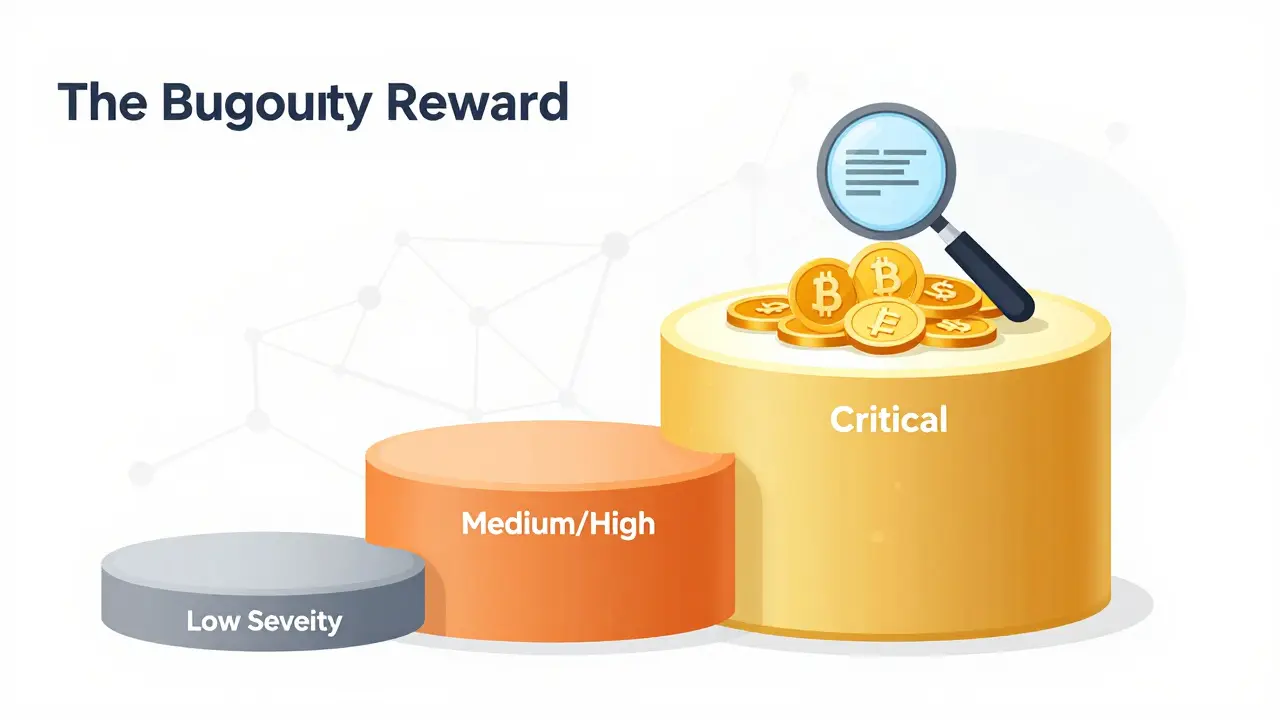
The money in bug bounties is real, but it is not distributed equally. Platforms use a tiered severity system to determine payouts. Understanding these tiers is crucial because it dictates your potential earnings and the effort required.
| Severity Level | Description | Typical Payout Range |
|---|---|---|
| Critical | Loss of funds, full contract control, or permanent halt of protocol | $15,000 - $10,000,000+ |
| High | Significant fund loss potential or partial control without direct theft | $5,000 - $100,000 |
| Medium | Minor fund loss, denial of service, or logic errors with limited impact | $1,000 - $5,000 |
| Low / Informational | Cosmetic issues, gas optimizations, or theoretical flaws with no exploit path | $0 - $1,000 (or recognition only) |
Note that these numbers vary wildly depending on the Total Value Locked (TVL) of the protocol. A critical bug in a small new project might pay $15,000, while the same bug in a giant like Aave or Curve Finance could net you millions. The industry standard, championed by platforms like ImmuneFi, suggests that bounties should scale with risk. Specifically, a common heuristic is that the bounty should be roughly 10% of the funds at risk. If a vulnerability threatens $200 million, a $20 million bounty is justified to motivate top-tier researchers.
Major Platforms: Where to Hunt
You don’t usually deal directly with the project team. Instead, you submit findings through specialized platforms that handle triage, verification, and payment. Each platform has its own culture, features, and market share.
- ImmuneFi: The dominant player in the DeFi space, holding approximately 78% of the market share as of late 2023. They protect over $25 billion in user funds across more than 350 programs. ImmuneFi is known for offering the highest bounties, sometimes reaching up to $10 million for critical issues. Their "scaling bug bounty" model ties rewards directly to the TVL, making them attractive for large protocols.
- Sherlock.xyz: A newer competitor that differentiates itself through technical innovation. Sherlock requires a $250 stake per submission to prevent spam-a move that reduced invalid submissions from 65% to 22%. They also offer faster setup times (under 5 minutes for projects) and expert triage by lead auditors. Sherlock is gaining traction among projects that want higher-quality reports and less noise.
- HackerOne: The veteran general-purpose bug bounty platform. While not Web3-native, it hosts major blockchain programs like ChainLink and MakerDAO. HackerOne supports fiat payments, which is a plus for some researchers, but it lacks some of the automated token payout features found in dedicated crypto platforms.
- HackenProof: Focuses on connecting projects with a massive global community of over 850,000 researchers. While they handle significant volume, their Web3-specific focus is narrower compared to ImmuneFi and Sherlock.
How to Submit a Valid Report
Finding a bug is only half the battle. Getting paid requires a flawless submission process. Here is the typical workflow you will encounter on most platforms:
- Discovery: You identify a vulnerability using tools like static analyzers, fuzzing frameworks (e.g., Echidna, Foundry), or manual code review.
- Proof of Concept (PoC): You must write a script or provide step-by-step instructions that demonstrate the exploit. Without a working PoC, your report will likely be rejected as "theoretical" or "invalid."
- Submission: You submit the report through the platform. On Sherlock, you must lock your $250 stake. On ImmuneFi, you fill out a detailed form describing the impact.
- Triage: Platform experts verify the bug. They check if it is a duplicate, if it is within scope, and if the impact matches your claim. This step can take anywhere from 72 hours to two weeks, depending on the platform’s workload.
- Resolution & Payment: If accepted, the bounty is calculated based on severity. Payments are usually made in cryptocurrency (ETH, USDC) or sometimes fiat, depending on the platform and project preferences.
A critical tip: Read the scope documentation carefully. Many projects explicitly exclude certain types of bugs, such as those requiring insider knowledge or social engineering. For example, Yearn Finance focuses exclusively on smart contracts related to user fund protection, excluding theoretical vulnerabilities without practical exploit paths. Ignoring scope is the fastest way to get your report rejected.
Common Pitfalls and How to Avoid Them
Even experienced hunters make mistakes. Here are the most common reasons reports get rejected and how to sidestep them.
False Positives: This happens when you think you found a bug, but the code actually handles it correctly. Always test your PoC locally before submitting. Use local testnets like Hardhat or Anvil to simulate the attack. If your script fails to execute the exploit in a controlled environment, it won’t work on mainnet either.
Out-of-Scope Findings: Projects define what they care about. Reporting a low-gas optimization or a cosmetic UI issue on a smart contract bounty page will result in a rejection. Stick to vulnerabilities that affect fund safety, access control, or protocol stability.
Duplicate Reports: The bug bounty space is competitive. Someone else might have found the same bug and submitted it first. To minimize this risk, focus on complex, novel attack vectors rather than obvious reentrancy flaws. Also, act quickly once you spot something suspicious.
Poor Documentation: Your report is your sales pitch. If the triager cannot understand your PoC, they cannot verify the bug. Write clear, concise explanations. Include comments in your code. Explain the business impact: how much money could be lost? How many users would be affected?

Are Bug Bounties Enough?
Here is the hard truth: bug bounties are not a silver bullet. Experts like Michael Kalinin from ConsenSys Diligence emphasize that bounties complement, but do not replace, formal security audits. Audits provide a systematic, comprehensive review of all code paths. Bug bounties rely on individual researchers finding specific issues. A project that relies solely on bounties may miss subtle, systemic design flaws that no single hacker thinks to look for.
The best security posture involves a layered approach: independent audits, continuous bug bounties, and automated monitoring tools. As the DeFi ecosystem matures, we are seeing more projects integrate these elements seamlessly. For instance, Sherlock now offers integration between their audit platform and bug bounty programs, allowing automatic scope updates after code changes. This hybrid model ensures that security keeps pace with development.
Future Trends in Web3 Security
The bug bounty landscape is evolving rapidly. By 2025, industry analysts predict that 90% of major DeFi protocols will maintain continuous bug bounty programs, up from 65% in 2023. We are also seeing a shift toward standardized severity assessments. Currently, only about 32% of programs use standardized frameworks like the Web3 Severity Levels proposed by OpenZeppelin. Standardization will help reduce disputes over payouts and create a fairer playing field for researchers.
Additionally, regulatory pressure is increasing. The SEC’s guidance on smart contract vulnerabilities suggests that centralized entities managing DeFi protocols may face disclosure requirements. This could drive more adoption of formal bug bounty programs as a compliance measure. For researchers, this means more opportunities, but also stricter rules around responsible disclosure.
Is it legal to participate in smart contract bug bounty programs?
Yes, participating in authorized bug bounty programs is legal and encouraged. These programs provide explicit permission to test specific codebases under defined rules. However, testing smart contracts outside of these programs without permission can be considered unauthorized access or hacking, which is illegal in many jurisdictions. Always stick to the scope defined by the platform and the project.
Do I need to be an expert programmer to earn bounties?
While deep programming knowledge helps, you don’t need to be a senior engineer to start. Many successful hunters begin by learning Solidity basics and studying past bug reports. Platforms like Sherlock and ImmuneFi provide resources and examples. Start with medium-severity bugs and gradually work your way up to critical exploits as you gain experience.
How long does it take to get paid?
Payment timelines vary by platform. ImmuneFi aims for rapid payouts, often within days of validation. Sherlock processes payments quickly after triage approval. HackerOne may take longer due to their broader infrastructure. On average, expect 1-3 weeks from submission to payment, assuming your report is valid and not disputed.
Can I lose money participating in bug bounties?
Generally, no. Most platforms do not charge fees for researchers. However, Sherlock requires a $250 stake per submission, which is refunded if the report is valid. If your report is invalid, you lose the stake. This mechanism filters out low-effort submissions. Other platforms like ImmuneFi do not require stakes, so there is no financial risk beyond your time investment.
What is the difference between a bug bounty and a security audit?
A security audit is a comprehensive, systematic review conducted by a firm of auditors who examine all code paths. It is a one-time event with a fixed fee. A bug bounty is a continuous program where individual researchers hunt for specific vulnerabilities. Bounties are paid only for valid findings. Audits provide broad coverage; bounties provide deep, targeted testing by diverse minds.
- Poplular Tags
- smart contract bug bounty
- Web3 security
- DeFi audits
- ethical hacking
- ImmuneFi