


You’ve probably seen the name RadioShack pop up in your feed or on a shady forum. Maybe it was advertised as a revolutionary new crypto exchange built on the Moonriver blockchain. You click through, expecting a familiar brand entering the Web3 space, only to find... nothing. Or worse, a broken link. Before you lose sleep wondering if you missed out on the next big thing, let’s clear the air. The short answer? There is no legitimate "RadioShack" crypto exchange operating on Moonriver. In fact, the very idea is likely a confusion with other platforms-or, more dangerously, a setup for a scam.
The Confusion: RadioShack vs. FreeRiver
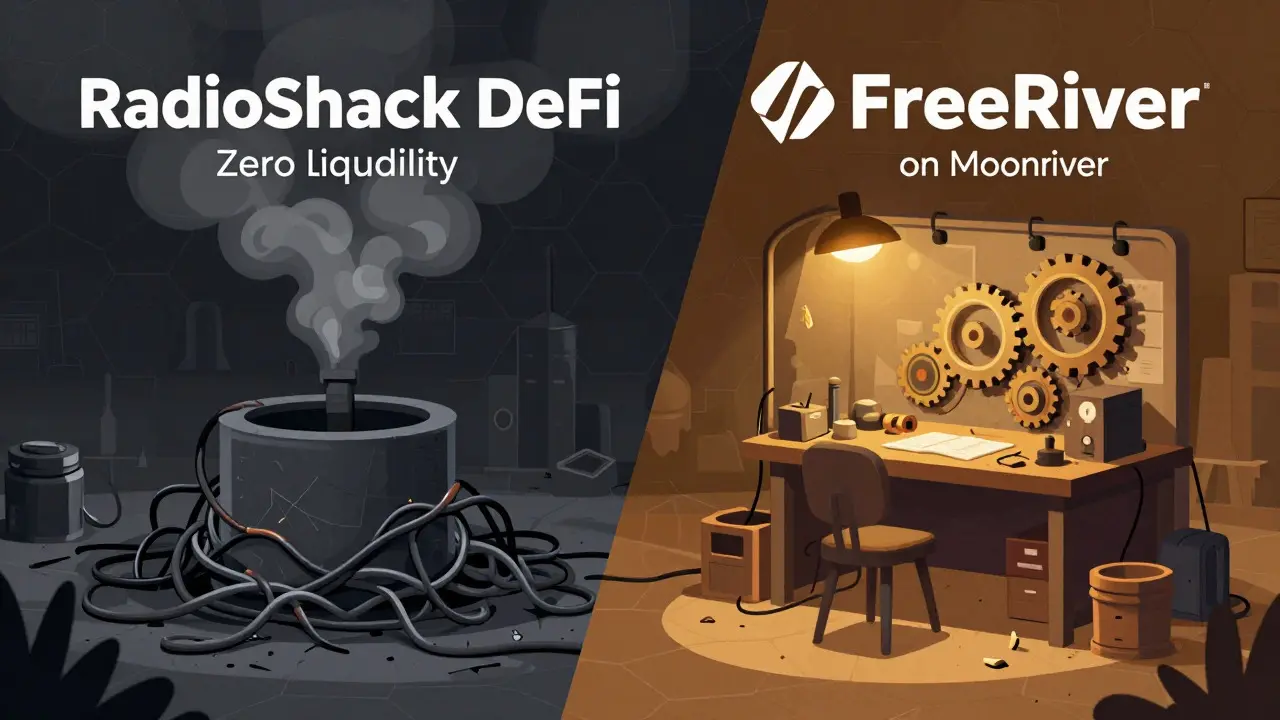
To understand why this review feels so strange, we have to look at where the confusion comes from. If you search for "RadioShack DeFi," you might stumble upon comparison pages on sites like SourceForge or Slashdot that pit "RadioShack DeFi" against FreeRiver. This creates a false equivalence. FreeRiver is a decentralized exchange (DEX) actually built on the Moonriver blockchain, offering token swaps and liquidity pools. It has code, users, and a place in the ecosystem.
RadioShack DeFi, on the other hand, appears to be a ghost. While some enterprise-focused listings mention it aiming to bridge corporate leaders with cryptocurrency, there is zero evidence of it operating on Moonriver. There are no smart contracts deployed by a verified RadioShack entity on the Moonriver network. When you dig into the technical specs, RadioShack DeFi lacks a GitHub repository, active developer commits, or verifiable transaction history on block explorers. It’s a name floating in the void, often confused with the legitimate but niche FreeRiver platform.
Moonriver: The Actual Blockchain
Let’s talk about the tech that *is* real here: Moonriver. Launched in June 2021 by PureStake, Moonriver isn’t just any blockchain. It serves as a "canary net" for its sibling chain, Moonbeam. Think of it as a testing ground. Developers deploy their apps on Moonriver first to catch bugs and test mechanics before moving them to the main Polkadot network via Moonbeam.
This makes Moonriver incredibly valuable for innovation but risky for casual investors. It runs on the Kusama network, which is known for being experimental and fast-moving. The native token, MOVR, powers transactions. As of mid-2024 data, MOVR hovered around $7.00, with a market cap nearing $68 million. But here’s the kicker: because it’s a canary network, it inherits Kusama’s volatility. Messari analysts noted in Q2 2025 that this reliance on an experimental network deters large-scale enterprise adoption. If you’re looking for stability, Moonriver is the opposite. It’s for builders who want to break things safely.
Why RadioShack DeFi Should Raise Red Flags
If a site claims to be "RadioShack Crypto Exchange on Moonriver," run. Here’s why:
- No Technical Footprint: Legitimate DeFi protocols publish their smart contracts. RadioShack DeFi has no verified presence on Etherscan-style explorers for Moonriver.
- Dead Website: Archives show that radioshackdefi.com returned 404 errors as recently as October 2025. A dead website is the universal sign of an abandoned project or a phishing trap.
- Brand Dilution: The original RadioShack filed for bankruptcy in 2015. Any crypto project using this name faces what Blockworks called "potentially insurmountable" credibility hurdles. Legacy brands rarely succeed in crypto without massive backing and clear utility, neither of which RadioShack DeFi possesses.
- Zero Liquidity: Platforms like TokenTerminal and DeFi Llama track volume. RadioShack DeFi shows zero trading volume. Without liquidity, you can’t trade anything anyway.
CryptoSlate reported in January 2025 that revival projects using nostalgic names struggle immensely. They lack differentiation in a crowded market. If you see ads for RadioShack DeFi offering high yields or exclusive tokens, assume they are trying to exploit the brand recognition to steal your funds.
The Real Option: FreeRiver on Moonriver
If you want to trade on Moonriver, you need a working DEX. That’s where FreeRiver comes in. Unlike the phantom RadioShack project, FreeRiver has actual code. It uses React for its frontend and integrates with Substrate for blockchain operations. It allows users to swap tokens, provide liquidity, and farm yields within the Moonriver ecosystem.
However, don’t expect perfection. User feedback on SourceForge gives FreeRiver a mediocre 3.2 out of 5 stars. Common complaints include insufficient liquidity and a steep learning curve. One Reddit user noted experiencing 8% slippage on swaps over $500, forcing them to use alternative bridges like Pangolin. This highlights a broader issue with Moonriver-based DEXs: they hold only about 1.2% of the total DEX market share. You won’t find deep order books here. It’s fine for small tests or niche assets, but not for heavy trading.
| Feature | RadioShack DeFi | FreeRiver |
|---|---|---|
| Blockchain Network | None (Likely Fake) | Moonriver (Kusama) |
| Smart Contracts Verified? | No | Yes |
| Trading Volume | $0 | Low (Niche) |
| User Reviews | None | 3.2/5 Stars |
| Development Activity | Dead (404 Errors) | Slow (Last update April 2025) |
| Risk Level | Extreme (Scam Likely) | Medium (Liquidity Issues) |
How to Spot Fake Crypto Exchanges
The RadioShack situation is a textbook example of how to vet a crypto platform. With thousands of new projects launching weekly, due diligence is your best defense. Here’s a quick checklist to protect yourself:
- Check the Contract Address: Never trust a URL alone. Go to a block explorer (like Moonscan for Moonriver) and verify the contract address matches official announcements.
- Look for GitHub Activity: Real projects have public code. Check for recent commits. If the repo hasn’t been updated in months, or doesn’t exist, walk away.
- Verify Liquidity: Use tools like DeFi Llama. If a DEX claims to be huge but shows zero TVL (Total Value Locked), it’s empty.
- Search for Community Sentiment: Check Reddit and Discord. Are people discussing features, or just asking "Is this a scam?" For RadioShack DeFi, the r/DeFi subreddit showed mostly skepticism.
- Beware of Brand Names: Just because it says "Apple," "Nike," or "RadioShack" doesn’t mean it’s affiliated. Most are impersonators.

The Future of Moonriver and Its Ecosystem
While RadioShack DeFi is dead, Moonriver itself has a future, albeit a specialized one. PureStake released version 9.6.0 in August 2025, improving transaction throughput by 22%. The roadmap focuses on cross-chain interoperability and lower gas fees. However, DappRadar reports a decline in active projects, dropping from 112 in Q1 2025 to 87 in Q3 2025.
Analysts predict a 65% chance that Moonriver will consolidate with Moonbeam by 2028. This means the separate identity of Moonriver might fade as the ecosystem matures. For traders, this implies that liquidity could eventually shift entirely to Moonbeam, making Moonriver even less relevant for long-term holding. If you’re interacting with Moonriver today, do it for specific testing purposes or niche asset access, not as a primary trading hub.
Conclusion: Stay Safe and Stick to Verified Protocols
So, is RadioShack a Moonriver crypto exchange? No. It’s a non-entity that preys on confusion. The real action on Moonriver happens with established, albeit smaller, protocols like FreeRiver, Stellaswap, or BeamSwap. Always prioritize transparency. If a platform hides its team, its code, or its liquidity, it’s hiding something bad. In the world of DeFi, your wallet is your responsibility. Don’t let a nostalgic brand name trick you into signing a malicious transaction. Stick to verified contracts, check the community sentiment, and keep your funds safe.
Is RadioShack DeFi a scam?
It is highly likely. RadioShack DeFi has no verifiable smart contracts, zero trading volume, and a dead website. These are classic signs of a defunct project or a phishing attempt designed to steal funds.
What is the best exchange on Moonriver?
There is no single "best" exchange, but popular options include Stellaswap, BeamSwap, and FreeRiver. These platforms have verified contracts and active communities, though liquidity can be low compared to Ethereum-based DEXs.
Does RadioShack own a crypto company?
No. The original RadioShack retail chain went bankrupt in 2015. Any crypto project using the name is unauthorized and likely exploiting the brand's nostalgia for fraudulent purposes.
Is Moonriver safe to use?
Moonriver is technically secure as it runs on the Kusama network. However, the risk lies in the individual dApps and contracts you interact with. Always audit the contract address before connecting your wallet.
Why is FreeRiver not more popular?
FreeRiver suffers from low liquidity and a complex interface. Moonriver itself holds a small market share (1.2%) of the total DEX volume, limiting the depth of trading pairs available.




People Comments
It is absolutely exhausting to watch people fall for these nostalgic brand scams over and over again. You would think after the FTX collapse, everyone would have learned basic due diligence, but no. Here we are, still chasing ghosts because a name sounds familiar from our childhoods. It’s not just financial stupidity; it’s a moral failing of the crypto community to let these predators operate with such ease. We need to shame the victims into being smarter, otherwise, they deserve what happens to their wallets.
The sheer audacity of using the RadioShack name is truly despicable.
These scammers prey on the elderly and the technologically illiterate who remember buying batteries there in the 90s. It is a betrayal of trust that should be prosecuted to the fullest extent of the law. The article correctly identifies the lack of smart contracts, but it fails to condemn the ethical bankruptcy of the perpetrators. How dare they exploit a bankrupt legacy brand? It is repulsive.
I’ve been digging into the Moonriver ecosystem for a while now, and this distinction between FreeRiver and the phantom RadioShack is crucial.
FreeRiver isn’t perfect-the slippage issues mentioned are real pain points-but at least the code is open. I actually pulled up the GitHub repo last week and noticed the commit history is sparse but present. That’s the difference between a project that’s struggling and one that’s fabricated. If you’re looking to test cross-chain mechanics, Moonriver is still the sandbox, but bring your own liquidity depth expectations down to earth.
moonriver is just a canary net for purestake to bleed users dry before moonbeam takes over. the consolidation prediction is obvious. they want centralization under the guise of interoperability. radio shack was never real it was a honeypot to track wallet addresses of gullible retail investors. check the metadata in the dead website archives its full of tracking scripts. wake up sheeple.
Dead website 😱
Zero volume 📉
No github 🚫
Classic scam signs. Why do people still click?
There is something deeply poetic about the death of RadioShack as a physical entity and its resurrection as a digital ghost.
It represents the hollowing out of commerce, where brand recognition is stripped of utility and sold back to us as speculative fiction. We are trading memories for volatility. The Moonriver network itself feels like a metaphor for this-a testing ground for ideas that may never survive the harsh sunlight of mainnet adoption. It is beautiful in its fragility, but dangerous if mistaken for solidity.
Hey folks! Don't let the doom and gloom get you down. Just because RadioShack is fake doesn't mean the spirit of innovation is dead.
Moonriver is still a vibrant place for builders. Sure, FreeRiver has some kinks to work out, but that's part of the journey. We're all learning together. Keep exploring, keep testing, and keep supporting the devs who are actually shipping code. The future is bright, even if the past is haunted by bad actors!
I just sat here reading this while sipping my coffee. It’s wild how much energy goes into debunking things that don’t exist.
RadioShack DeFi is like a rumor about a celebrity breakup-everyone talks about it, but nobody actually knows the person involved. Meanwhile, FreeRiver is quietly doing its thing in the corner. Not exciting, but real. I guess I’ll stick to watching the chaos from the sidelines.
the concept of value is subjective anyway why does it matter if the contract is verified or not if the community believes in the narrative the market cap exists in the mind. radio shack is a symbol of resistance against corporate bankruptcy. free river is just another tool for the elite to extract rent. look deeper into the substrate layer its all connected.
THE AUTHOR IS OBVIOUSLY PART OF THE COVER UP.
Notice how he pushes FreeRiver? Who owns FreeRiver? PureStake? Probably. They are silencing the truth about RadioShack because it threatens their monopoly on the Kusama canary network. This is classic disinformation. Check the IP logs of the author. He is lying to protect his vested interests. Do not trust this analysis. Trust your gut.
One must consider the structural integrity of the argument presented. The absence of evidence is not necessarily evidence of absence, yet in the realm of blockchain transparency, it often serves as a sufficient proxy for non-existence.
The comparison to FreeRiver provides a necessary control group in this observational study of DeFi viability. However, the reliance on user sentiment from SourceForge is methodologically weak. A more rigorous approach would involve analyzing gas fee patterns and transaction success rates on the Moonscan explorer directly.
I’ve been in crypto since 2017, and I can tell you that brand dilution is the most common vector for phishing attacks.
People see 'Nike' or 'Apple' or 'RadioShack' and their brains short-circuit. It’s passive-aggressive genius by the scammers. They know you won’t check the contract address if the logo looks right. Just because Erica says so doesn’t make it true, but I’m right this time. 😉
its simple really. the masses are stupid. they want easy money. radio shack is a trap for the uneducated. free river is better but still flawed. the system is rigged against the little guy. purestake controls everything. nothing is decentralized. its all a lie. stay away from moonriver unless you want to lose your shirt.
Omg this makes me so sad. People are losing so much hope and money over nothing.
You guys need to take care of yourselves. The stress of checking every single contract is draining. Just breathe. Maybe RadioShack was a dream we all shared. Is it real? Does it matter? If it hurts, it’s real. My heart breaks for those who lost funds. Send love not hate. ❤️
Let’s try to keep the conversation constructive here. Yes, RadioShack is likely a scam, but attacking the users isn’t helpful.
We all start somewhere. The fact that FreeRiver exists shows that there is still room for experimentation on Moonriver. Let’s focus on how we can improve security awareness rather than shaming each other. Peace and prosperity to all traders.
I hear you all, and it’s clear there’s a lot of frustration here.
But let’s not forget that innovation requires risk. Moonriver is a testing ground, and sometimes things break. Sometimes things disappear. But the community remains. Let’s support each other through the volatility. Your feelings are valid, whether you lost money or just wasted time. We are in this together.
Oh, please. Everyone says Moonriver is risky, but then they buy MOVR anyway.
And sure, RadioShack is fake, but maybe it’s fake in a good way? Like, what if it’s an art project? A commentary on consumerism? You guys are too literal. FreeRiver is boring. It’s just a swap interface. Where’s the soul? Where’s the drama? I miss the days when crypto had mystery. Now it’s all audits and KYC. Boring.
i think the table in the article is very helpfull. it clearly shows the diffrence between the two. radio shack has zero volume which is scary. free river has low volume but at least its there. i usually check defillama before i trade anything. typos aside, good info.
This is a fantastic breakdown of the situation.
Thank you for highlighting the specific red flags like the 404 errors and the lack of GitHub activity. These are concrete details that empower users to make informed decisions. While the tone of some comments here is harsh, the underlying message is important: verification is key. Let’s keep pushing for higher standards in the DeFi space.
in india we have many scams too. people use famous names to trick others. it is sad. moonriver is small but growing. free river is okay for small trades. dont put all eggs in one basket. be careful friends. 🙏
the duality of man is reflected in the duality of moonriver. it is both a playground and a graveyard. radio shack is the ghost of capitalism past haunting the blockchain future. free river is the pragmatic survivor. but who is really surviving? the developers or the users? the question lingers like smoke in a data center. typos happen when the mind races ahead of the fingers.
Great post! 👍
It’s always good to have these reality checks. Crypto can be confusing, especially with all the similar names. Sticking to verified protocols is the best advice anyone can give. Keep spreading the knowledge! 🌟
In conclusion, the evidence is irrefutable.
RadioShack DeFi is a non-entity. FreeRiver, while imperfect, offers a tangible alternative. Users are urged to exercise extreme caution. The future of Moonriver remains uncertain, but vigilance is certain. Thank you for your attention to this matter.