


You just spent six months designing a logo. You file the trademark. Two years later, you find it on a product in Shenzhen and another in São Paulo. Proving you owned it first? That’s a legal nightmare involving slow courts, expensive lawyers, and jurisdictional headaches. Now imagine if your creation date was stamped into a global ledger the second you finished it, visible to anyone, unchangeable by anyone, and enforceable via code.
That isn’t sci-fi anymore. As of September 2026, Blockchain is actively reshaping how we protect intellectual property. It’s not just about Bitcoin; it’s about creating an immutable, decentralized record system that solves the age-old problem of proving who owns what, when, and where. If you’re a creator, inventor, or brand owner, understanding this shift isn’t optional-it’s survival.
Why Traditional IP Systems Are Breaking Down
Let’s be honest: traditional IP protection is clunky. It relies on centralized databases managed by national offices like the USPTO or local copyright agencies. These systems are siloed. A patent filed in New Zealand doesn’t automatically speak to a database in Germany. This fragmentation creates gaps where infringement thrives.
Think about the costs. Registering a trademark across multiple countries involves separate applications, translations, and fees. Then comes enforcement. If someone steals your design, you need evidence. Traditional paper trails can be lost, altered, or disputed. Legal battles over "who came up with it first" often hinge on subjective interpretation of dates and drafts. It’s slow, expensive, and geographically limited.
Blockchain flips this model. Instead of trusting a single office, you trust a distributed network. Every transaction, registration, or license agreement is recorded on a public or permissioned ledger. Once written, it cannot be erased or tampered with without consensus from the network. This transparency builds trust between creators, buyers, and regulators in a way centralized databases simply can’t match.
The Core Tech: Immutability and Smart Contracts
Two features make blockchain powerful for IP: Immutability and Smart Contracts. Let’s break them down without the jargon.
Immutable Record-Keeping means permanent proof. When you register a work-say, a song or a software code snippet-the blockchain assigns it a unique hash (a digital fingerprint) and a timestamp. This record proves exactly when the work existed and who claimed ownership. In court, this timestamped hash serves as irrefutable evidence of prior art or original creation. No more arguing over email dates or notarized envelopes.
Smart Contracts are self-executing agreements coded directly onto the blockchain. Imagine licensing your music for a commercial. Traditionally, you’d sign a contract, wait for payment processing, and hope the licensee reports usage correctly. With a smart contract, the terms are embedded in code. If the ad plays, the royalty payment triggers automatically. No invoices, no chasing late payments, no accounting errors. The money moves instantly to your wallet.
| Feature | Traditional System | Blockchain System |
|---|---|---|
| Ownership Proof | Centralized registry entry (can be disputed) | Cryptographic hash + timestamp (immutable) |
| Licensing | Manual contracts, slow payments | Automated smart contracts, instant royalties |
| Global Reach | Jurisdiction-specific registrations required | Borderless verification accessible worldwide |
| Cost | High legal/admin fees per country | Lower transaction fees, reduced admin overhead |
| Transparency | Limited public visibility | Public audit trail of all transfers/licenses |
Real-World Applications Across IP Domains
Blockchain isn’t one-size-fits-all, but its utility spans patents, copyrights, trademarks, and trade secrets. Here’s how it works in practice right now.
Copyrights: Artists and writers use platforms like Po.et or KodakOne (and their 2026 successors) to timestamp works upon creation. This establishes authorship instantly. For digital content, this is huge. It helps track AI-generated materials too, ensuring human creators get credit amidst the flood of synthetic media.
Trademarks: Counterfeiting is a multi-billion dollar industry. By storing trademark records on a blockchain, brands create a verifiable chain of custody. A luxury handbag manufacturer can embed a chip linked to a blockchain record. Scanners at customs verify authenticity against the ledger, flagging fakes immediately. This reduces the burden on law enforcement and protects brand reputation.
Patents: The patent process is notoriously slow. Blockchain accelerates this by allowing inventors to publish preliminary findings to a secure ledger, establishing priority dates without full formal filing initially. This "provisional proof" protects inventors during the long examination period. Furthermore, open innovation networks use blockchain to manage collaborative patents, tracking contributions from developers globally.
The Rise of IP Tokenization
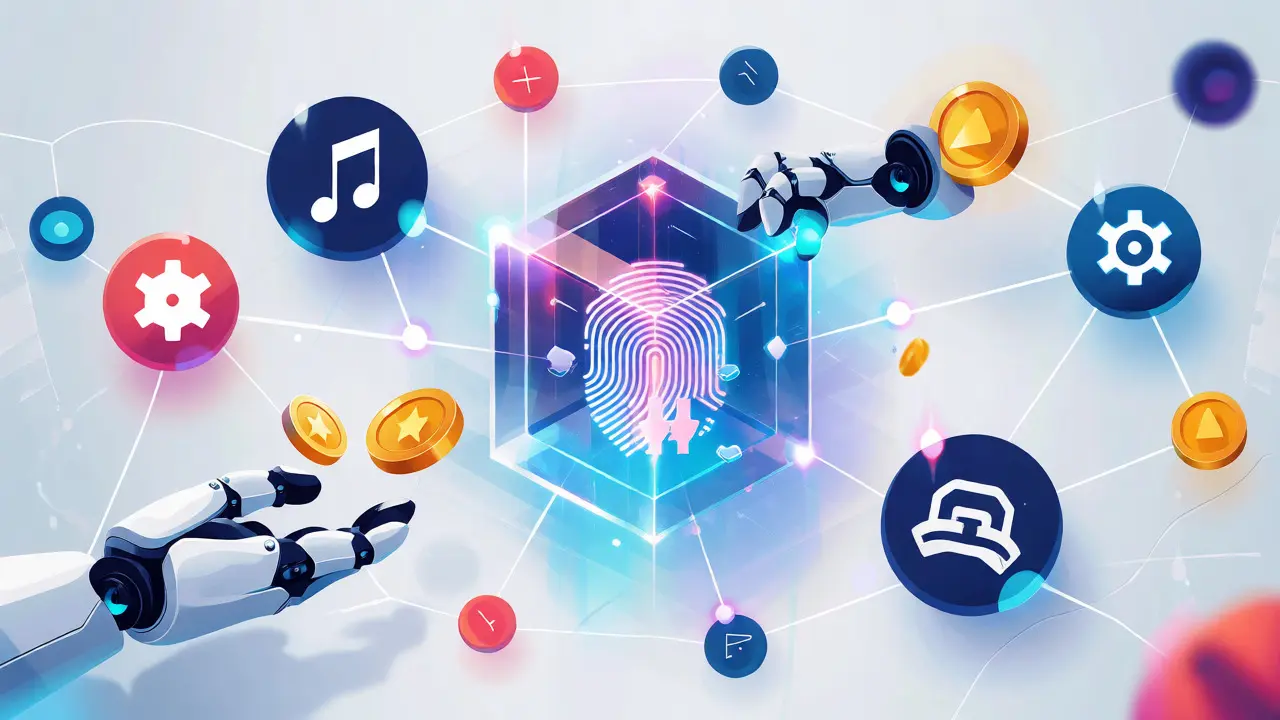
Here’s where things get interesting for investors and creators alike: Tokenization. This converts IP rights into digital tokens on a blockchain. Think of it like turning a share of a company into a tradable asset, but for a song, a patent, or a book.
Why does this matter? Liquidity. Historically, selling a partial stake in a patent portfolio was difficult. Who buys 5% of a pharmaceutical patent? Hard to find. On a blockchain platform, these assets become divisible and tradable 24/7. Real-world asset (RWA) platforms are expanding rapidly in 2026, allowing everyday investors to buy fractions of high-value IP assets. This democratizes access to IP investment and provides creators with new funding models beyond traditional loans.
For example, a musician might tokenize their master recording. Fans buy tokens representing a share of future streaming royalties. The smart contract handles distribution automatically. No record label middleman taking a cut for administration. It’s direct, transparent, and efficient.
Challenges Holding Back Mass Adoption
It’s not all smooth sailing. Several hurdles remain before blockchain becomes the default standard for IP.
Legal Uncertainty: Laws haven’t caught up. Does a blockchain hash count as legal proof in every country? Not yet. While some jurisdictions accept it, others require traditional documentation. Harmonizing these laws is critical. The World Intellectual Property Organization (WIPO) is working on this through its Blockchain Task Force, aiming for global standards by 2027.
Interoperability: There are dozens of blockchains. Ethereum, Solana, Hyperledger, Polygon-they don’t always talk to each other. If your patent is on Chain A and your licensing deal is on Chain B, integration gets messy. Standardized protocols are emerging, but widespread compatibility is still a work in progress.
Enforcement Gap: Blockchain proves ownership, but it doesn’t physically stop theft. If someone infringes on your blockchain-verified design, you still need to sue them. The technology provides better evidence, making lawsuits faster and cheaper, but it doesn’t replace the legal system. You still need lawyers and judges.
Complexity: Setting up a blockchain-based IP strategy requires technical expertise. Many small businesses lack the resources to implement these solutions independently. User-friendly interfaces and service providers are bridging this gap, but the learning curve remains steep for non-tech-savvy users.

What’s Next for 2026 and Beyond?
We are past the hype phase. In 2026, blockchain IP tools are moving from pilot projects to core infrastructure. Major law firms are integrating blockchain audits into their due diligence processes. Companies are partnering with development firms to build custom ledgers for their specific IP portfolios.
Look for three trends to dominate the next five years:
- AI Integration: Artificial intelligence will scan blockchain ledgers to detect infringements automatically. AI can analyze millions of transactions and images, spotting unauthorized use faster than any human team.
- Regulatory Clarity: Expect clearer guidelines from bodies like WIPO and national IP offices. This will reduce risk for enterprises adopting blockchain solutions.
- Standardization: Inter-chain communication protocols will mature, allowing seamless movement of IP assets across different networks.
The future isn’t about replacing lawyers or patent offices entirely. It’s about augmenting them. Blockchain removes the administrative friction, providing a trusted layer of truth beneath the legal framework. This makes IP management faster, fairer, and more accessible.
Frequently Asked Questions
Is blockchain legally binding for IP ownership?
Not universally yet. While blockchain provides strong evidentiary support for ownership claims, its legal weight varies by jurisdiction. Some courts accept cryptographic hashes as proof of existence, while others require traditional registration. However, the trend is toward greater acceptance as standards evolve.
Can blockchain prevent copyright infringement completely?
No. Blockchain prevents disputes about who owns the work and when it was created. It simplifies detection of infringement through transparent tracking. However, stopping the actual act of copying or using the work without permission still requires legal action or technological barriers like DRM.
How much does it cost to register IP on a blockchain?
Costs vary significantly depending on the blockchain used and network congestion. Transaction fees (gas fees) can range from cents on low-cost chains to dollars on major networks like Ethereum. Compared to international trademark filings which cost thousands, blockchain registration is generally much cheaper, especially for digital-first assets.
What is IP tokenization?
IP tokenization represents intellectual property rights as digital tokens on a blockchain. These tokens can be bought, sold, or traded like cryptocurrencies. It allows fractional ownership of assets like patents or music royalties, increasing liquidity and accessibility for investors and creators.
Do I need to abandon my current IP registrations?
No. Blockchain complements existing systems rather than replacing them overnight. Most experts recommend a hybrid approach: maintain official government registrations for legal enforceability while using blockchain for internal tracking, proof of creation, and streamlined licensing.