


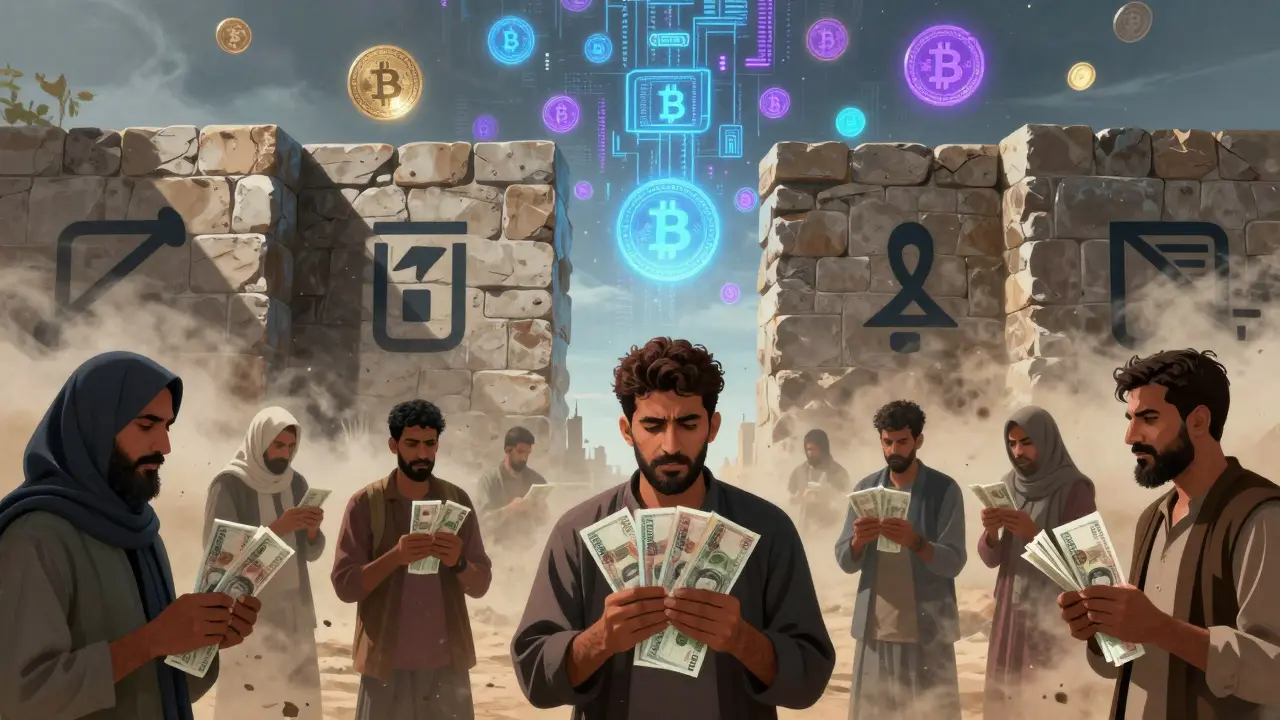
Imagine trying to save your life savings from a currency that loses value by the hour. For millions of Iranians, this isn't a hypothetical scenario; it is daily reality. The Iranian rial has suffered catastrophic depreciation due to international sanctions and domestic inflation. Naturally, many turned to cryptocurrency as a lifeline. But the government sees digital assets not just as a hedge against inflation, but as a threat to its control over capital flows. This tension has created one of the most complex and contradictory regulatory landscapes in the world.
If you are looking to trade crypto involving the Iranian rial in 2026, you need to understand that the rules have tightened significantly since late 2024. The Central Bank of Iran (CBI) has shifted from ambiguous warnings to hard blocks, caps, and taxes. Here is what you need to know about the current state of crypto trading, stablecoin limits, and the underground workarounds Iranians are using to survive.
The Great Blockade: From Payment Gateways to Total Control
The turning point came on December 27, 2024. On this date, the Central Bank of Iran (CBI) effectively cut off all direct payment channels between the Iranian rial and cryptocurrencies via internet websites within the country. Before this, users could relatively easily buy Bitcoin or Ethereum using local bank cards through various exchange platforms. After this date, those gates were slammed shut.
This wasn't just a technical glitch; it was a deliberate policy shift. The CBI required all cryptocurrency platforms operating in Iran to obtain specific licenses and submit detailed transaction data for government oversight. In January 2025, the bank began selectively unblocking some exchanges, but only if they integrated with a new government API system. This system gives authorities full visibility into user identities and transaction histories. Essentially, the government decided it would allow crypto trading only if it could watch every move.
Why did they do this? It comes down to two conflicting goals. First, the state wants to prevent capital flight. When people convert rials to dollars or Bitcoin, the demand for foreign currency spikes, pushing the rial's value even lower. Second, the government needs to maintain strict monetary control to manage an economy already strained by energy shortages and global isolation.
Stablecoin Caps: The $10,000 Ceiling
While general crypto trading faced hurdles, the real hammer fell on stablecoins. Stablecoins like Tether (USDT) are crucial for Iranians because they offer stability equivalent to the US dollar without leaving the crypto ecosystem. However, their popularity made them a primary target for regulators.
On September 27, 2025, just hours before the reinstatement of UN sanctions, Asghar Abolhasani, deputy governor of the Central Bank, announced severe new directives during a state television interview. The rules were precise and unforgiving:
- Annual Purchase Cap: Individuals and corporations can purchase no more than $5,000 worth of stablecoins per year.
- Total Holding Limit: No individual can hold more than $10,000 in stablecoins at any given time.
- Compliance Window: Existing holders with amounts exceeding the $10,000 limit were given exactly one month to reduce their holdings to comply.
These limits directly impact ordinary citizens trying to preserve wealth. If you earn enough to save $15,000 annually, you legally cannot protect that entire amount in stablecoins under these rules. The timing suggests a coordinated effort to limit the velocity of money leaving the traditional banking system while maximizing state revenue through other means.
| Date | Restriction Type | Details |
|---|---|---|
| Dec 27, 2024 | Payment Gateway Block | All rial-to-crypto payments via websites blocked unless licensed. |
| Feb 2025 | Advertising Ban | Global ban on all crypto advertising, online and offline. |
| Sept 27, 2025 | Stablecoin Caps | $5k annual purchase limit; $10k total holding limit. |
| Aug 2025 | Taxation Law | Capital gains tax imposed on crypto trading profits. |
The Advertising Blackout and Taxation Era
In February 2025, Iran escalated its crackdown by implementing a comprehensive ban on cryptocurrency advertising. This prohibition covered both physical billboards and digital platforms. You won't see influencers promoting exchanges, nor will you find ads for crypto wallets on Iranian social media. This makes it difficult for new users to enter the market legally and creates an information vacuum where misinformation can thrive.
Simultaneously, the government moved to monetize the remaining legal activity. In August 2025, Iran enacted the "Law on Taxation of Speculation and Profiteering." This legislation treats cryptocurrency similarly to gold, real estate, and foreign exchange. Traders must now pay capital gains tax on profits derived from digital asset sales. This signals a shift from outright prohibition to formal regulation and revenue generation. The state acknowledges the market exists and decides to take a cut rather than pretend it isn't there.

Miners vs. Traders: A Divided Policy
Here is where the contradiction becomes stark. While trading and payments are heavily restricted, cryptocurrency mining remains legal and even encouraged. Iran possesses abundant, cheap electricity-often subsidized by the state-which attracts mining operations. Currently, Iran accounts for approximately 4.5% of global Bitcoin mining power, generating roughly $1 billion annually in revenue for the state.
The government views mining as a way to circumvent international sanctions and generate hard currency reserves. However, this energy-intensive industry strains the national electrical grid, leading to rolling blackouts for residential users. The state imposes consumption caps on miners but continues to support the sector because the financial benefits outweigh the infrastructure costs. So, you can mine Bitcoin for the state's benefit, but you cannot easily sell it for rials without navigating a maze of bureaucratic hurdles.
The Tether Freeze and the Shift to DAI
International pressure also plays a massive role. Tether, the issuer of USDT, has become increasingly aggressive in enforcing compliance with US sanctions. On July 2, 2025, Tether executed its largest-ever freeze of Iranian-linked funds, targeting 42 cryptocurrency addresses. More than half of these addresses had significant exposure to Nobitex, Iran's largest domestic exchange. Many of the frozen wallets showed transaction flows linked to entities affiliated with the Islamic Revolutionary Guard Corps (IRGC).
This event sent shockwaves through the Iranian crypto community. Users realized that holding USDT carried a tangible risk of asset seizure. In response, a coordinated migration occurred. Influencers and exchange operators urged users to divest from USDT and convert their holdings to DAI, another stablecoin, via the Polygon network. Polygon offers faster transactions and lower fees compared to Ethereum, making it an attractive alternative for moving value discreetly. This shift demonstrates the agility of the Iranian market in adapting to external enforcement pressures.

Underground Markets and P2P Survival
Despite these restrictions, the demand for crypto remains high. As of late 2020, Iranians were trading between $16 million and $20 million daily across 12 different cryptocurrencies. That volume has likely grown, driven by the continued freefall of the rial. Since official channels are blocked or capped, users have turned to Peer-to-Peer (P2P) markets and unofficial networks.
In these underground markets, trust is the scarcest resource. Buyers and sellers negotiate directly, often using encrypted messaging apps. Transactions are settled via cash deposits or informal transfer methods to avoid triggering bank alerts. The risks are high: scams, fraud, and potential legal repercussions if caught violating advertising or holding bans. Yet, for many, the alternative-watching their rial savings evaporate-is worse.
The government’s own digital currency initiative, called "Rial Currency," attempts to compete in this space. Launched as a pilot on Kish Island, this central bank digital currency (CBDC) is designed to reduce dependency on the US dollar and provide a controlled digital alternative. Unlike Bitcoin, it cannot be mined, and its supply is strictly regulated by the CBI. However, adoption has been slow because citizens lack trust in the rial's long-term value, preferring decentralized assets despite the risks.
Navigating the Risks: What Should You Do?
If you are an Iranian resident or dealing with counterparts in Iran, here are practical steps to consider:
- Avoid Public Promotion: Do not advertise crypto services or discuss holdings publicly on social media due to the 2025 advertising ban.
- Respect Stablecoin Caps: Keep USDT or similar holdings below the $10,000 threshold to avoid scrutiny from the Central Bank.
- Diversify Networks: Consider using Layer-2 solutions like Polygon for transfers to reduce traceability and fees, following the trend toward DAI.
- Use Licensed Exchanges: If trading officially, stick to platforms like Nobitex that have integrated with the government API, understanding that your data is monitored.
- Beware of Scams: In P2P markets, verify counterparties thoroughly. The lack of regulation means no recourse if a deal goes wrong.
The landscape is volatile. Regulations can change overnight, especially in response to international diplomatic shifts. Stay informed, keep records minimal, and prioritize security above yield.
Is cryptocurrency illegal in Iran?
No, cryptocurrency itself is not illegal. Mining is legal and encouraged. However, using crypto for domestic payments is prohibited, and trading is heavily restricted with strict licensing, advertising bans, and holding caps for stablecoins.
What is the limit on stablecoin holdings in Iran?
As of September 2025, individuals can hold a maximum of $10,000 in stablecoins. Additionally, annual purchases are capped at $5,000 per person or entity.
Can I use my Iranian bank card to buy Bitcoin?
Directly, no. Since December 2024, the Central Bank of Iran has blocked rial-to-crypto payment gateways on websites. You must use licensed exchanges that integrate with government APIs, which monitor all transactions.
Why did Tether freeze Iranian accounts?
Tether froze accounts to comply with international sanctions, particularly those targeting the Islamic Revolutionary Guard Corps (IRGC). They identified addresses linked to Iranian exchanges like Nobitex that facilitated transactions with sanctioned entities.
Is crypto mining profitable in Iran?
Yes, due to heavily subsidized electricity costs, mining is highly profitable. Iran generates approximately $1 billion annually from Bitcoin mining, accounting for 4.5% of global hash rate. However, miners face consumption caps and grid strain issues.
What happened to crypto advertising in Iran?
In February 2025, Iran implemented a total ban on cryptocurrency advertising, both online and offline. This includes social media posts, billboards, and influencer promotions, making public discussion of crypto risky.
Do I have to pay tax on crypto profits in Iran?
Yes. The "Law on Taxation of Speculation and Profiteering" enacted in August 2025 imposes capital gains tax on cryptocurrency trading profits, treating them similarly to gold and real estate investments.




People Comments
It is honestly tragic to see how much control the state exerts over personal finance. The irony of banning ads while encouraging mining is just peak bureaucratic absurdity.
This whole situation proves that centralized systems are fundamentally broken when they try to suppress free market forces. The US sanctions are doing more damage than any local regulation could ever hope to achieve, yet here we are watching the collateral damage on ordinary citizens who just want to keep their savings from evaporating into thin air.
oh great another country deciding that its people dont know what to do with their own money lol
the $10k cap is basically a joke because inflation moves faster than anyone can react by then your ten grand is worth half as much so why even bother trying to play nice with the central bank
The Tether freeze was not an accident. It was a coordinated effort by Western intelligence agencies to cripple the Iranian economy further. They knew exactly which addresses were linked to the IRGC and targeted them specifically to send a message. This is financial warfare disguised as compliance.
i feel so bad for these ppl 😭
its like living in a horror movie where the monster is inflation and the police are also the monsters 🤡
why does no one help them???
Typical third world chaos. You cannot expect stability when the government is this incompetent. The fact that they allow mining but ban trading shows they only care about extracting value for themselves rather than fostering any kind of legitimate economic growth for the populace.
Also the spelling in the article was decent but the logic is flawed.
The shift to DAI via Polygon is a fascinating technical adaptation. It highlights how decentralized networks can provide resilience against centralized censorship attempts. However, the reliance on Layer-2 solutions introduces its own set of risks regarding bridge security and smart contract vulnerabilities that users may not fully understand.
I think people underestimate the psychological toll of this constant surveillance. Knowing that every transaction is monitored creates a climate of fear that stifles innovation. The capital gains tax is just another layer of oppression designed to punish those who manage to succeed despite the odds stacked against them.
You know what I find hilarious? That everyone thinks crypto is the savior. It's not. It's just another casino with better marketing. The real issue is the underlying economic mismanagement that has nothing to do with digital currency and everything to do with decades of poor policy decisions.
My heart goes out to the families affected by this. Imagine working hard all year only to have your savings wiped out by inflation and then being told you can't protect what little you have left. It is a devastating cycle of poverty that technology alone cannot fix without systemic change.
So let me get this straight. The government blocks the gates, then opens them up but installs cameras everywhere, and then tells you that if you look at the camera too long they will fine you. Brilliant strategy really. Just brilliant.
i mean its pretty clear they dont trust their own currency so why should anyone else trust it?
the CBDC idea is just a way to track every single purchase you make from now on forever
creepy af tbh
The philosophical implication of state-controlled digital currency versus decentralized assets is profound. One represents total submission to authority, the other represents individual sovereignty. In Iran, this choice is forced upon citizens, making their daily transactions a political act of resistance or compliance.
thanks for sharing this info
it helps to understand whats going on over there
hope things get better soon for everyone involved
If you are actually in Iran and reading this, please stop using P2P markets unless you have verified contacts. The risk of scams is incredibly high and there is no recourse. Also, keep your holdings under the radar. Do not post about your crypto anywhere online. Stay safe.
We need to remember that behind these statistics are real human beings struggling to survive. It is important to approach this topic with empathy rather than judgment. Let us support initiatives that promote financial inclusion and education for those in restrictive environments.
thats crazy how fast the rules change
one day you can buy btc next day its illegal
must be stressful living like that
im glad im in canada lol
you think this is weird
wait till you see what happens when AI takes over the banking sector
then nobody will even know why their money disappeared
just assume its gone and move on
Here is the thing about stablecoins in sanctioned countries: they are a double-edged sword. On one hand, they preserve value. On the other, they create a paper trail that can be frozen by entities like Tether. Always diversify across multiple chains and consider privacy-focused coins if you are serious about asset protection.
As a financial advisor, I must emphasize that the legal risks here are substantial. While the desire to protect wealth is understandable, violating Central Bank regulations can lead to severe penalties including asset seizure and imprisonment. It is crucial to consult with local legal experts before engaging in any gray-area activities.
The energy grid strain caused by mining is a critical point often overlooked. Subsidized electricity benefits miners but harms residential users who face blackouts. This imbalance needs to be addressed through market-based pricing mechanisms rather than arbitrary caps that favor large operators over small households.
I wonder if there is a way for international communities to support these individuals without violating sanctions. Perhaps through educational resources on blockchain technology that empower them to navigate these complex regulatory landscapes more safely.
It is imperative that we recognize the severity of the situation. The Central Bank's actions are not merely regulatory; they are existential threats to the financial autonomy of the Iranian people. We must demand greater transparency from international bodies regarding the enforcement of sanctions and their humanitarian impact.