



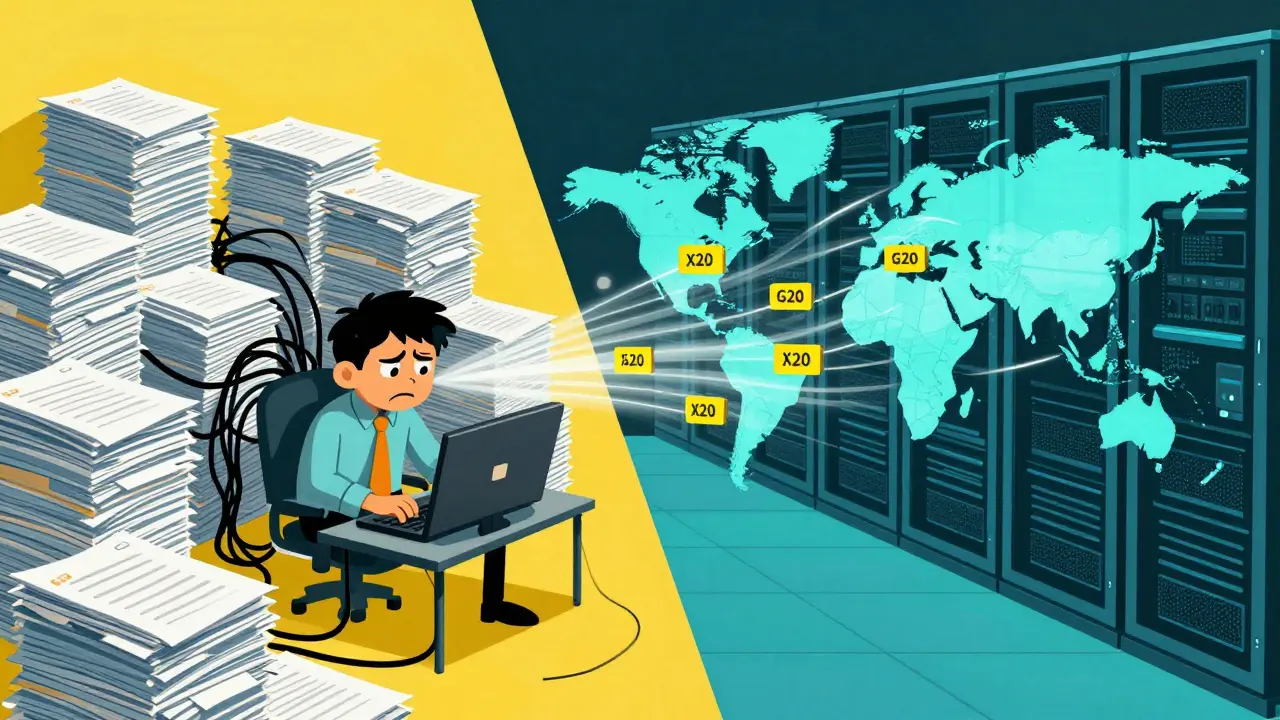
Think your offshore crypto wallet is a secret? Not for long. India is officially joining a global effort to end the "wild west" era of digital asset tax evasion. By adopting the OECD Crypto-Asset Reporting Framework (CARF), the Indian government is essentially building a digital dragnet to catch unreported gains, regardless of where the exchange or the wallet is located.
This isn't just another vague guideline. It is a coordinated strike by 67 jurisdictions, backed by the G20, to ensure that tax authorities know exactly who owns what in the crypto space. If you've been holding assets on international platforms to avoid the 30% crypto tax, the window for that strategy is closing fast.
Key Takeaways for Investors and Businesses
- Deadline: Full implementation starts April 1, 2027.
- Legal Hook: Section 285BAA of the Income Tax Act mandates reporting from April 1, 2026.
- Scope: Focuses on the automatic exchange of information (AEOI) regarding crypto transactions.
- Goal: To eliminate tax evasion via offshore digital asset holdings.
What is CARF and Why Does It Matter?
At its core, CARF is a set of global standards developed by the OECD (Organisation for Economic Co-operation and Development). It is designed to do for crypto-assets what the Common Reporting Standard (CRS) did for traditional bank accounts back in 2015.
For years, tax authorities struggled because crypto is borderless. You could open an account on a Seychelles-based exchange, and the Indian tax office would have no way of knowing it existed unless you told them. CARF changes the game by requiring crypto service providers to collect user data and share it automatically with the relevant tax authorities. It transforms the reporting process from "voluntary disclosure" to "automated surveillance."
During its G20 Presidency, India pushed for the New Delhi Leaders' Declaration to endorse this framework. This shows that the Indian government isn't just following the trend-they are leading the charge to secure their fiscal sovereignty in a digital-first economy.
The Legal Roadmap: From 2026 to 2027
The rollout isn't happening overnight. There is a phased approach to ensure the technical infrastructure can handle the massive amount of data being moved. The most critical piece of the puzzle is the Finance Bill 2025, which introduces section 285BAA under the Income Tax Act.
Here is how the timeline breaks down:
- April 1, 2026: Section 285BAA takes effect. This is the legislative trigger that requires designated reporting entities (like exchanges) to start gathering and providing information on crypto transactions.
- 2025 (Signing): India is expected to sign a specific Multilateral Competent Authority Agreement (MCAA) specifically for crypto assets. This is the legal treaty that allows different countries to swap data.
- April 1, 2027: Full CARF implementation. This is when the automatic exchange of information officially goes live.
This 12-month gap between the tax law taking effect (2026) and the full exchange of data (2027) is a transition window. It gives exchanges time to upgrade their systems to match the XML reporting standards published by the OECD in October 2024. If an exchange doesn't comply, they risk losing their ability to operate legally within the jurisdiction.
| Feature | Common Reporting Standard (CRS) | Crypto-Asset Reporting Framework (CARF) |
|---|---|---|
| Asset Focus | Bank accounts, equities, trusts | Bitcoin, Ethereum, Stablecoins, NFTs |
| Indian Adoption | Signed MCAA in 2015 | Full Implementation April 2027 |
| Mechanism | Automatic exchange of data | Automatic exchange of data |
| Primary Goal | Stop offshore bank tax evasion | Stop offshore crypto tax evasion |
The Burden on Crypto Exchanges and Service Providers
For the average user, CARF just means more transparency. But for the companies running the exchanges, it's a technical nightmare. Imagine having to track every single movement of a user across multiple blockchains and then formatting that data into a very specific XML file that the government can read. It's a massive administrative lift.
Large exchanges are generally okay with this because they already have robust KYC (Know Your Customer) and AML (Anti-Money Laundering) systems. However, smaller providers are sweating. The cost of implementing these reporting systems can be astronomical for a startup. Many will likely have to buy expensive third-party compliance software just to stay in business.
Moreover, the technical complexity isn't just about the data-it's about the type of data. The OECD guidelines require detailed information on the value of holdings, the nature of the transactions, and the identity of the beneficial owner. In a world of DeFi (Decentralized Finance) and self-custody wallets, capturing this data is significantly harder than tracking a traditional brokerage account.

Will This Kill Privacy in Crypto?
This is the million-dollar question on forums like Reddit and X. Crypto was born from a desire for privacy and decentralization. CARF is the opposite of that. It treats crypto-assets as transparent financial instruments.
While the government argues that this is about "tax transparency," users are rightly concerned about how this data is stored and who has access to it. The risk of data breaches is a real worry when the government is holding a master list of every citizen's crypto wealth. On the flip side, some investors welcome the move. Why? Because formal regulation often leads to institutional adoption. When the "big money" (banks and hedge funds) sees a clear legal framework, they are more likely to enter the market, which usually drives prices up.
How to Prepare for the 2027 Shift
If you are an investor or a business owner in India, waiting until 2027 to "fix" your taxes is a dangerous game. The government will have a historical record of your transactions once the data starts flowing from international exchanges. When the data from an exchange in Dubai or Singapore hits the Indian tax office, and it doesn't match your filed returns, you can expect an audit and heavy penalties.
Here is a practical approach to getting your house in order:
- Audit Your Holdings: Create a comprehensive list of all assets held on offshore exchanges.
- Review Past Filings: Check if you've disclosed foreign assets in your Income Tax returns.
- Consult a Pro: Talk to a tax professional who understands the nuances of the 30% crypto tax and the upcoming CARF requirements.
- Document Everything: Keep records of your acquisition costs (buy price) for every asset. Once the automated reporting starts, the burden of proof will be on you to show that you've paid the correct tax.
Does CARF apply to hardware wallets like Ledger or Trezor?
CARF primarily targets "reporting entities," which means centralized exchanges and crypto-asset service providers. It cannot directly "read" a private hardware wallet. However, the moment you move funds from a hardware wallet to a regulated exchange to cash out, that exchange will report the transaction. The goal is to catch the money at the entry and exit points of the regulated financial system.
What happens if I don't report my offshore crypto?
Once CARF is active in 2027, the Indian government will receive automated reports from other participating countries. If there is a mismatch between these reports and your tax filings, you could face penalties for under-reporting income, interest on unpaid taxes, and potential legal action for tax evasion under the Income Tax Act.
Is the 30% crypto tax still applicable under CARF?
Yes. CARF is a reporting framework, not a taxing framework. It provides the data that allows the government to enforce the existing tax laws, including the 30% tax on virtual digital assets introduced in 2022.
Which countries are participating in this?
Over 67 jurisdictions have committed to the framework, including most G20 nations. This means a vast majority of the world's major financial hubs will be swapping crypto tax data by 2027-2028.
When exactly does Section 285BAA start?
Section 285BAA is proposed to take effect from April 1, 2026. This is the law that mandates the collection of data, even though the international exchange of that data isn't fully operational until 2027.






People Comments
Good to see things getting organized. It might be a bit scary at first, but clear rules usually help the market grow in the long run.
It is an absolute travesty that individuals believed they could hoard wealth in the shadows while avoiding their civic duty to the state. One must maintain the utmost integrity in their financial dealings, and those who attempted to circumvent the law through offshore accounts deserve every bit of the scrutiny they are now facing. Such greed is morally reprehensible and fundamentally contrary to the principles of a functioning society.
Totaly a trap lol. OECD is just a front for the New World Order to track every single satoshi we own. They want total control of the money supply so they can switch us to CBDCs and freeze your wallet if you say something they dont like. Once the AEOI kicks in, privacy is dead forever. Just move everything to non-custodial cold storage and never touch a CEX again if you value your freedom.
India is finally showing the world how to handle this. We are leading the G20 and actually implementing a framework while other countries are just talking. It's about time we stopped the tax leakages and made sure everyone pays their fair share for the development of our nation. If you can't handle the 30% tax, maybe you shouldn't have gambled on volatile coins.
I believe this transition provides a wonderful opportunity for all investors to synchronize their records and move toward a more sustainable financial future. By collaborating with tax professionals now, we can ensure that the shift in 2027 is seamless and stress-free for everyone involved. Let's embrace this transparency as a step toward institutional maturity!
The integration of XML reporting standards for CARF is going to be quite the lift for mid-tier exchanges. We're essentially talking about a massive API overhaul to ensure data parity across jurisdictions. It's a classic regulatory compliance hurdle, but the systemic risk reduction from better KYC/AML oversight is a net positive for the global ecosystem.
This is exactly why the US should be dominating this space and not letting these foreign bodies tell us how to manage assets. Its frankly discusting that people think they can just hide money in some tropical island and not pay the government that protects them. We need stronger enforcement and more patriotism in the financial sector because honestly the lack of morals in the crypto community is just pathetic and a stain on the american dream of hard work and honest pay.
The 12-month gap is just a psychological play to make people think they have time to comply. In reality, they're probably already scraping the data via backdoors and just waiting for the legal date to start the audits. It's all part of the larger surveillance grid.
Honestly, just a heads up to everyone-don't panic. Just start documenting your trades now. It's a bit of a pain, but it's way better than dealing with a tax audit three years from now. You've got this!
just more gov control. they dont care about taxes, they just want a list of everyone who knows how to use a wallet so they can target them later. totaly a scam.
Time to shake off the dust and get those spreadsheets sparkling! This is a golden opportunity to treat your portfolio like a real business. Get your records in tip-top shape and ride the wave of institutional adoption into the stratosphere! Let's get it!
Seems like the end of the wild west era.
Lol imagine thinking your Ledger saves you. The moment you try to buy a house or a car with that money, the government will find you. This whole 'privacy' thing is just a joke anyway.
The technical side of this is wild. How are they actually planning to handle the 'beneficial owner' part of the reporting for DeFi protocols? Most of those aren't even entities that can be served a legal notice, let alone provide an XML file to the OECD. This sounds like a regulatory nightmare that will only work for CEXs.
Absolutely catastrophic! The sheer audacity of the state to penetrate our digital sanctuaries is enough to make anyone scream into a pillow! My portfolio is practically a work of art, and now they want to treat it like a common bank account? The tragedy of lost anonymity is a wound that will never truly heal in the heart of the crypto community!
It's an interesting evolution of the social contract. We trade a bit of our digital anonymity for the stability that allows the 'big money' to enter. In a way, it's the death of the rebel phase of crypto and the birth of its adulthood. 🚀
Imagine actually thinking you were a mastermind for using a Seychelles exchange. You're not a hacker, you're just a guy with a login. Now the government is just doing the bookkeeping for you. How sweet!
Oh great, another way for the government to take my money. I'm sure the 'technical infrastructure' will work perfectly and won't leak everyone's data in a massive breach within two weeks of launch. Typical.
Regardless of your views on the tax, the most important thing right now is to stay compliant. If you have family members investing in crypto, now is the time to mentor them on how to properly document their assets before the 2026 deadline hits. Being proactive is the only way to avoid those heavy penalties.
I just hope people don't panic sell because of this. It's a big change, but if we all just take a breath and organize our records, it'll be fine.
its funny how we thought we were escaping the system but the system just grows a new arm to reach us... its like a digital octopus that just keeps stretching across the ocean to find where we hid our coins... and honestly who even cares about tax when the whole concept of money is just a shared hallucination anyway right??