


The shift in Afghanistan is a country that went from being a global leader in cryptocurrency adoption to one of the few nations with a total ban on digital assets happened faster than most experts predicted. In just twelve months, the landscape changed completely. By August 2022, the Taliban government is the de facto ruling authority in Afghanistan that implemented a comprehensive ban on all cryptocurrency activities citing religious grounds declared all forms of crypto trading illegal. They called it "haram" (forbidden) under their interpretation of Sharia law is Islamic jurisprudence used by the Taliban to justify the prohibition of speculative financial instruments like cryptocurrencies. This wasn't just a minor policy tweak; it was a hard reset that erased years of organic growth in the sector.
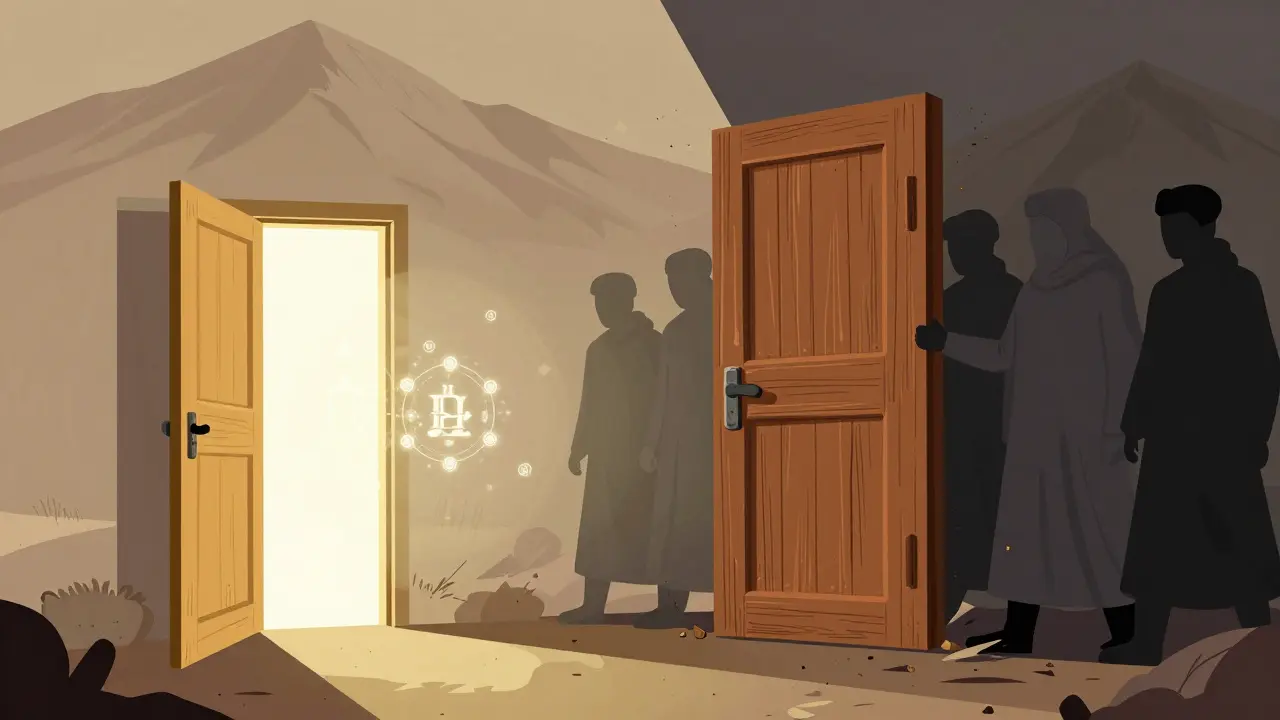
If you look at the numbers from 2021, the picture looks very different. Back then, Afghanistan ranked 20th out of 154 countries in global crypto adoption. People were using Bitcoin is the first decentralized cryptocurrency that became a vital tool for Afghans seeking alternatives to frozen foreign reserves and sanctioned banking systems not because they wanted to get rich quick, but because they needed to survive. International sanctions had frozen the nation’s foreign reserves. The traditional banking system collapsed. For many citizens, crypto was the only door left open to the global economy. Then, that door slammed shut.
Why the Taliban Banned Cryptocurrency
To understand the ban, you have to look at the reasoning provided by the authorities. The Taliban leadership argues that cryptocurrencies lack intrinsic value because they are not backed by physical assets like gold or land. In their view, this makes them speculative gambling, which violates Islamic principles. They see these digital tokens as a threat to financial stability and moral order.
This stance puts Afghanistan in a small and shrinking club. According to data from Binance is a major global cryptocurrency exchange that tracks regulatory trends worldwide, noting Afghanistan as one of only nine countries still prohibiting Bitcoin, Afghanistan is now one of only nine countries globally that still prohibit Bitcoin usage. Most other nations that previously banned crypto-like Morocco, which lifted its ban in 2024-have moved toward regulation rather than prohibition. Countries like China, Egypt, and Iraq maintain similar restrictions, often citing consumer protection or financial security. But Afghanistan’s ban is unique because it is driven primarily by religious doctrine rather than purely economic concerns.
| Country | Ban Year | Primary Reason for Ban | Current Status |
|---|---|---|---|
| Afghanistan | 2022 | Religious (Sharia Law) | Total Prohibition |
| China | 2021 | Financial Stability / Capital Controls | Mining & Trading Banned |
| Iraq | 2017 | Consumer Protection / Financial Security | Trading Illegal (Informal use continues) |
| Egypt | 2018 | Monetary Policy / Religious Fatwa | Restricted / No Legal Tender Status |
The Rise and Fall of Adoption
The timeline of events shows how quickly things can change. In 2021, after the Taliban returned to power, the international community imposed severe sanctions. Afghan banks couldn't process international transfers. Salaries for civil servants stopped arriving. In this vacuum, people turned to crypto. Even though only about 8.64 million of the 40 million inhabitants had internet access, those who did used it heavily. Peer-to-peer (P2P) markets boomed. You didn't need a bank account; you just needed a smartphone and an internet connection.
Then came August 2022. The Taliban issued an official policy halting all Bitcoin trading domestically. They suspended all cryptocurrency exchanges. The message was clear: if you trade crypto, you break the law. The impact was immediate. By November 2022, the value of monthly cryptocurrency transactions in Afghanistan plummeted to just $80,000. Compare that to the millions flowing through informal channels just months earlier, and you see the scale of the crackdown.
However, "plummeted" doesn't mean "disappeared." It means the market went underground. Instead of visible, high-volume transactions on local exchanges, activity moved to encrypted chats, private groups, and direct P2P deals. The volume dropped, but the necessity remained.

Life in the Underground Market
So, what does life look like for someone trying to use crypto in Afghanistan today? It is risky, expensive, and difficult. There are no legal exchanges. If you want to buy or sell USDT is a stablecoin pegged to the US dollar that has become widely used in Afghanistan for money remittance due to its price stability compared to volatile assets like Bitcoin or Bitcoin, you have to find a trusted individual. This usually happens through word-of-mouth networks. You meet someone you know, or someone your friend knows, and you transfer cash for crypto keys.
Enforcement is inconsistent. The Taliban conducts occasional crackdowns. They arrest traders and miners. They confiscate equipment. But they cannot monitor every WhatsApp group or Telegram channel. The decentralized nature of peer-to-peer markets makes complete eradication nearly impossible. The government lacks the resources and technical capacity to track every transaction on the blockchain. So, while the law says "no," reality says "be careful."
The costs are higher too. Because the risk is higher, the spread between buying and selling prices is wider. You might pay more to buy USDT than you would in a regulated market, and get less when you sell. This friction tax is the price of operating in a black market.
Crypto as a Tool for Survival and Gender Equality
One of the most significant aspects of the crypto situation in Afghanistan is its role in women's lives. Under the current Taliban setup, women face severe restrictions. They are barred from many jobs, limited in education, and often denied basic identification documents. Without ID, you cannot open a bank account. You cannot receive formal aid. You are financially invisible.
This is where crypto becomes a lifeline. Roya Mahboob, founder of the Digital Citizen Fund, has spoken extensively about this. Her organization provides Afghan women with financial and digital literacy through online and underground channels. She notes that Bitcoin gives women a "hope of financial freedom." Why? Because it doesn't require a bank. It doesn't require a male guardian's permission. It just requires knowledge.
For many women, learning to manage a crypto wallet is a way to bypass systemic exclusion. They can receive remittances from family abroad without going through traditional banking channels that might freeze their funds or demand documentation they don't have. Organizations like the Human Rights Foundation collaborate with local advocates to leverage Bitcoin's decentralized nature to democratize financial services. In a society where women are systematically locked out of the formal economy, crypto offers a parallel path-one that is illegal, yes, but also empowering.

Economic Desperation Drives Demand
You cannot separate the crypto ban from the broader humanitarian crisis. The United Nations warned that in 2022, 97% of Afghans fell below the poverty line. That is a 25% increase from previous levels. Food is available in markets, but people don't have money to buy it. Purchasing power has collapsed. Foreign aid has been cut drastically. Sanctions have strangled the economy.
In this context, the ban on crypto feels almost cruel to observers. Here is a population desperate for any way to preserve value, to send money home, to receive support from diaspora communities-and the government declares the most accessible tool illegal. The Taliban argue that crypto destabilizes the currency. But the national currency, the afghani, is already unstable due to macroeconomic factors beyond the control of digital assets.
The irony is that the ban fuels the black market. When you prohibit something that people need to survive, you don't eliminate it. You make it more dangerous and less transparent. This hurts consumers, who have fewer protections, and it helps criminals, who operate in the shadows anyway. The Taliban may want to control the narrative, but they cannot control the flow of capital in a digital age.
Enforcement Challenges and Future Outlook
Can the Taliban enforce this ban indefinitely? Experts doubt it. Resource constraints limit their ability to monitor all activities. The population is increasingly dependent on digital assets for basic survival. As long as there is demand, there will be supply. The underground network is resilient. It adapts. It moves. It survives.
Furthermore, the global trend is moving away from prohibition. More than half of the 16 countries that previously banned cryptocurrencies have since lifted their prohibitions. Governments are realizing that they cannot stop innovation by decree. They can either regulate it or ignore it. Afghanistan is choosing to ignore it, hoping that fear will keep people compliant. But fear works better when alternatives exist. When there are no alternatives, people take risks.
The Taliban have also restricted high-speed internet access in recent years. This complicates crypto usage, making transactions slower and more difficult. But it doesn't stop them entirely. People find ways around bandwidth limits. They use low-bandwidth apps. They batch transactions. They wait. The drive to connect to the global economy is stronger than the barriers put in place.
Is it legal to own cryptocurrency in Afghanistan?
No, it is not legal. The Taliban government declared all cryptocurrency activities, including trading, mining, and usage, illegal in August 2022 based on their interpretation of Sharia law. However, enforcement is inconsistent, and underground peer-to-peer markets continue to operate despite the ban.
Why did the Taliban ban cryptocurrency?
The Taliban banned cryptocurrency because they consider it "haram" (forbidden) under Islamic law. They argue that cryptocurrencies lack real-world asset backing and constitute speculative gambling, which violates religious principles. Additionally, they view unregulated digital assets as a threat to financial stability and state control over the economy.
How do people trade crypto in Afghanistan if it is banned?
People trade crypto through underground peer-to-peer (P2P) networks. These transactions happen via encrypted messaging apps like Telegram or WhatsApp, often involving trusted individuals within personal networks. Users exchange cash for crypto keys directly, avoiding formal exchanges which are suspended. This method is risky and carries higher fees due to the illicit nature of the trade.
What are the penalties for trading crypto in Afghanistan?
Penalties include arrests, confiscation of devices and equipment, and potential imprisonment. The Taliban conducts periodic crackdowns on traders and miners. However, due to resource limitations and the decentralized nature of crypto, enforcement is not uniform across the country, leading to a patchwork of risk levels depending on location and visibility.
Does the crypto ban affect women differently?
Yes, significantly. Women in Afghanistan face severe restrictions on employment, education, and access to formal banking due to lack of identification documents. Cryptocurrency offers them a rare avenue for financial independence and access to remittances without needing male guardianship or bank accounts. While the ban restricts this, organizations like the Digital Citizen Fund help women navigate these underground channels to secure financial survival.
Is Afghanistan the only country banning crypto?
No, but it is among the few remaining. According to Binance data, Afghanistan is one of only nine countries that still prohibit Bitcoin usage. Other restrictive jurisdictions include China, Iraq, and Egypt. However, unlike Afghanistan, many other countries are moving toward regulation rather than outright prohibition, reflecting a global shift toward accommodating digital assets.