


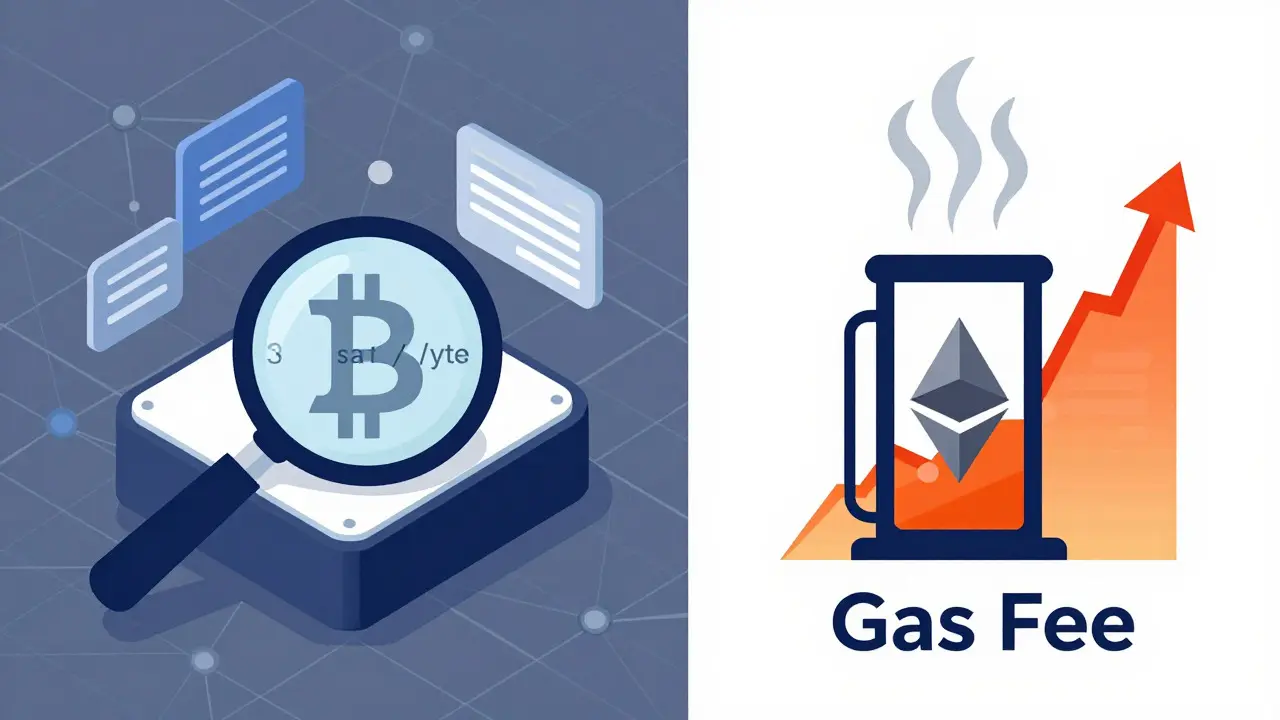
Ever looked at your wallet balance after a trade and wondered where the missing money went? It’s not just bad luck or market volatility. You are paying for two very different things when you move cryptocurrency: the immediate network fee to process the transfer, and the long-term cost basis that determines what you owe in taxes later.
Most people focus only on the upfront fee. They see $5 in Ethereum gas or $2 in Bitcoin network fees and think they’ve calculated their total cost. But if you’re trading regularly, holding multiple assets, or using DeFi protocols, ignoring the second part-cost basis-is how you end up with a surprise tax bill. Understanding both sides of this equation is the difference between casual speculation and serious portfolio management.
The Immediate Cost: Network Transaction Fees
When you click "send" on your wallet, you aren’t just moving digital numbers from one place to another. You are asking a decentralized network of computers to verify and record that change. Those computers need an incentive to do the work. That incentive is the network fee, often called a miner fee or validator reward.
These fees are not fixed. They fluctuate wildly based on supply and demand. If everyone wants to use the blockchain at the same time, the price goes up. If the network is quiet, the price drops. To calculate these fees accurately, you first need to understand which blockchain you are using, because each has its own pricing model.
Bitcoin: The Satoshis Per Byte Model
Bitcoin is the original cryptocurrency that uses a UTXO (Unspent Transaction Output) model where fees are determined by data size rather than value transferred. This means sending $10 worth of BTC costs the same as sending $10,000 worth of BTC, provided the transaction data is the same size.
The calculation formula is straightforward:
- Transaction Size: Measured in bytes. A simple send might be around 250 bytes. Complex transactions with many inputs can be larger.
- Fee Rate: Measured in satoshis per byte (sat/B). One satoshi is 0.00000001 BTC.
Total Fee = Transaction Size (bytes) × Fee Rate (sat/B)
For example, if the current network rate is 10 sat/B and your transaction is 250 bytes, you pay 2,500 satoshis. At current prices, that might be a few dollars. During peak congestion, rates can spike to 50 sat/B or higher, multiplying your cost five times over. Tools like mempool.space show you real-time fee estimates so you can choose between slow, medium, and fast confirmation speeds.
Ethereum and Polygon: The Gas System
Ethereum is a smart contract platform that measures computational effort using 'gas' units rather than data size. Here, the complexity of the action matters more than the amount sent. Sending ETH is cheap; interacting with a complex DeFi protocol is expensive.
The fee structure involves three components:
- Gas Limit: The maximum amount of gas you are willing to spend. A standard transfer uses 21,000 gas units.
- Base Fee: A dynamic fee set by the network that gets burned (destroyed). This changes with every block.
- Priority Fee (Tip): An optional extra tip to validators to prioritize your transaction.
Total Fee = Gas Used × (Base Fee + Priority Fee)
Let’s look at a concrete example from Polygon, a Layer 2 scaling solution for Ethereum that offers significantly lower transaction costs through its Proof-of-Stake consensus mechanism. Suppose Alice sends Bob 1 MATIC. The base fee is 100 gwei, and she adds a 10 gwei tip. The gas limit is 21,000 units.
Calculation: 21,000 × (100 + 10) = 2,310,000 gwei. Since 1 gwei is 0.000000001 MATIC, the fee is 0.00231 MATIC. Alice pays 1.00231 MATIC total. Bob receives exactly 1.0000 MATIC. The network burns the base fee portion, and validators keep the tip. This transparency allows you to predict costs precisely before confirming the transaction.
| Blockchain | Fee Metric | Primary Driver | Typical User Action Cost |
|---|---|---|---|
| Bitcoin | Satoshis per Byte | Data Size & Congestion | $1 - $10+ |
| Ethereum | Gas Units × Gwei | Computational Complexity | $5 - $50+ |
| Polygon | Gas Units × Gwei | Low Base Fee Structure | <$0.01 |
| Solana | Lamports | High Throughput Design | <$0.001 |
The Long-Term Cost: Calculating Cost Basis
Network fees are just the entry ticket. The real financial impact comes from cost basis. This is the original value of your asset for tax purposes. When you sell, trade, or spend crypto, you compare the sale price to your cost basis to determine capital gains or losses.
If you bought 10 AAVE tokens for $500 total, your cost basis is $50 per token ($500 ÷ 10). Simple enough. But most investors don’t buy all at once. They dollar-cost average, trade across exchanges, and interact with DeFi. Suddenly, tracking that $50 figure becomes a nightmare.
Accounting Methods Matter
You can’t just pick an average price unless you declare it. The IRS and other tax authorities allow specific identification methods. Choosing the right method can save you thousands in taxes.
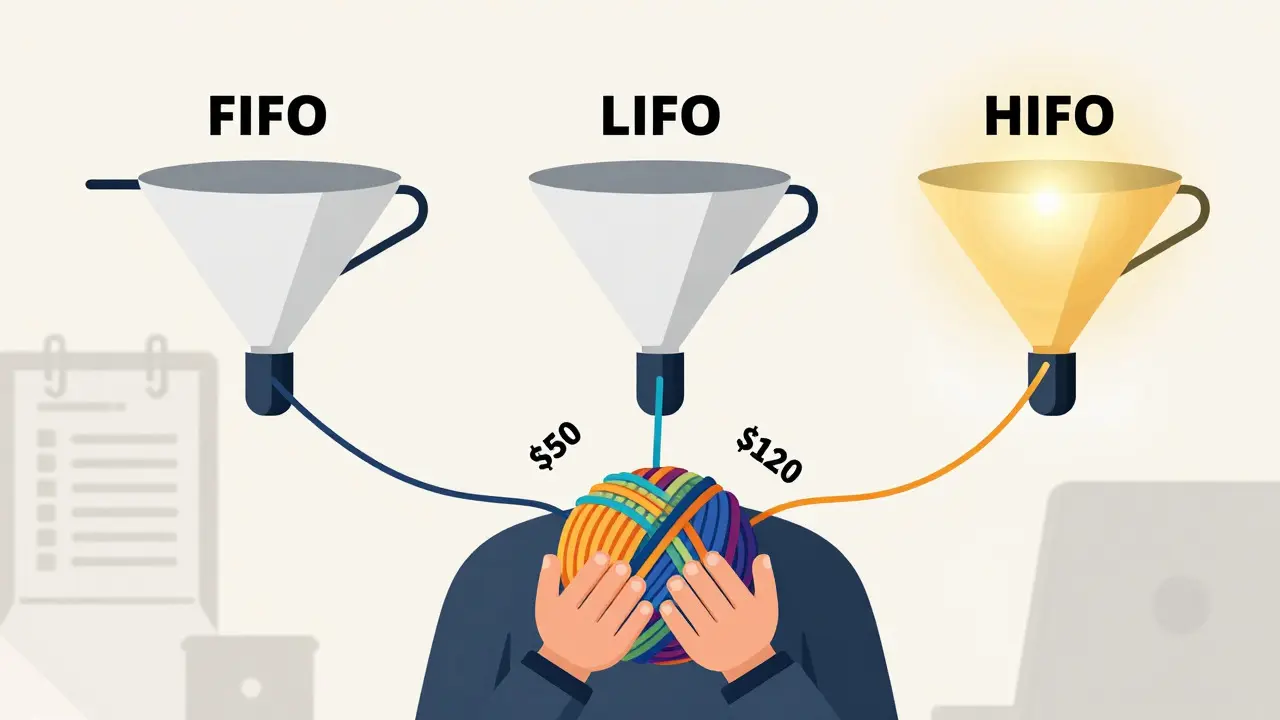
- FIFO (First In, First Out): You assume the first tokens you bought are the first ones you sold. This is the default for many platforms but often results in higher taxes if you bought early at low prices.
- LIFO (Last In, First Out): You assume the most recently purchased tokens are sold first. Useful if prices have risen sharply, allowing you to offset gains with recent, higher-cost purchases.
- HIFO (Highest In, First Out): You specifically identify and sell the tokens with the highest purchase price first. This minimizes taxable gain but requires meticulous record-keeping to prove which specific units were sold.
Gordon Law’s 2025 crypto tax guide highlights that manual calculation involves downloading history from every exchange, combining datasets, and tracing each token’s lineage. It’s like untangling 50,000 threads where each thread connects a buy order to a sell order. For active traders, software automation is not a luxury; it’s a necessity.
Hidden Costs and Platform Fees
Don’t forget the middlemen. Exchanges charge their own fees on top of network costs. These usually fall into two categories:
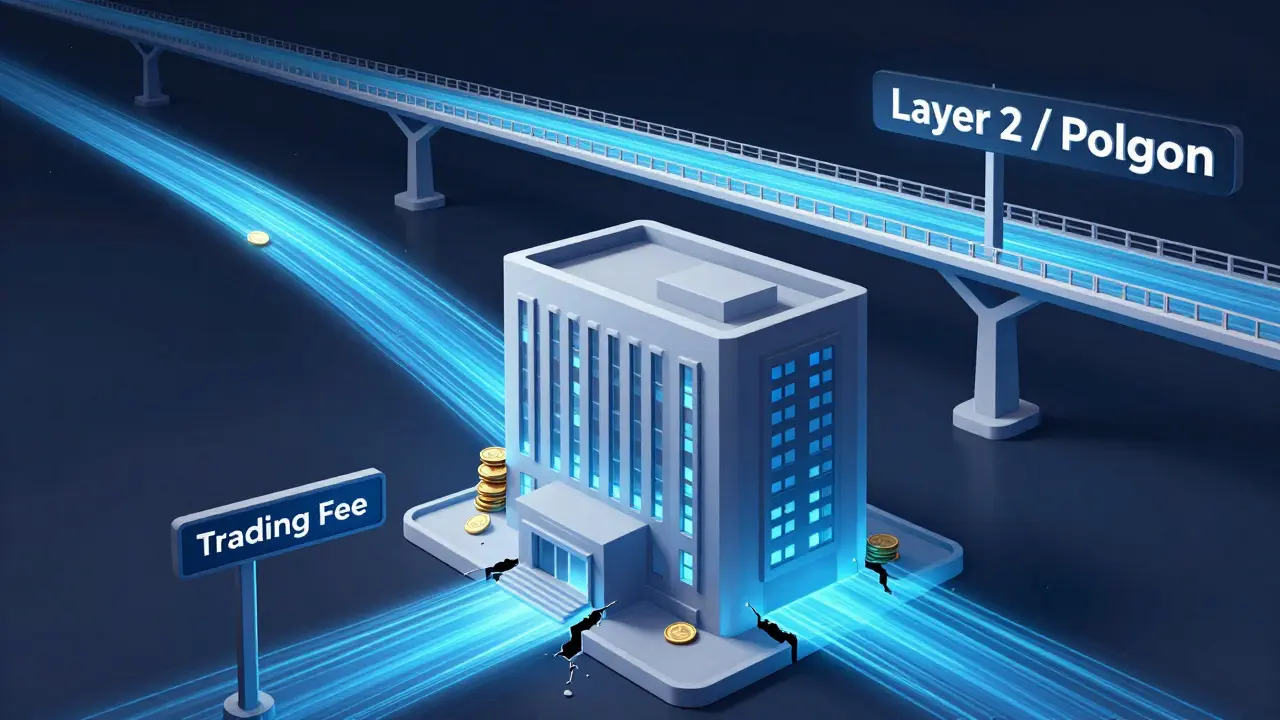
- Trading Fees: Typically 0.1% to 0.5% per trade on centralized exchanges. High-frequency traders negotiate lower rates, but retail users pay the standard markup.
- Withdrawal Fees: Fixed amounts charged when moving crypto off-platform. Sometimes these are flat rates that don’t reflect actual network conditions, meaning you might overpay during low-congestion periods.
Always check the "total cost" breakdown before confirming a trade. Some platforms hide the spread-the difference between the buy and sell price-which acts as an invisible fee. Institutional traders use APIs to track these costs programmatically, ensuring they never pay more than necessary.
Tools for Accurate Calculation
Trying to calculate these costs manually in Excel is error-prone. Use specialized tools:
- Blockchain Explorers: Sites like Etherscan or Mempool provide real-time gas trackers and historical fee data.
- Crypto Tax Software: Platforms like CoinLedger or Koinly import your API keys, categorize transactions, and apply FIFO/LIFO/HIFO rules automatically.
- Wallet Estimators: Modern wallets like MetaMask or Trust Wallet show estimated fees before you sign, allowing you to adjust tips based on urgency.
Remember, Layer 2 solutions like Polygon or Arbitrum can reduce network fees by 100x compared to mainnets. If cost efficiency is your priority, consider bridging assets to these networks for daily transactions while keeping long-term holdings on secure mainnets.
How do I calculate the exact fee for a Bitcoin transaction?
Multiply the transaction size in bytes by the current fee rate in satoshis per byte (sat/B). For example, a 250-byte transaction at 10 sat/B costs 2,500 satoshis. You can find current rates on sites like mempool.space.
What is the difference between gas limit and gas price?
Gas limit is the maximum computational effort you are willing to pay for (e.g., 21,000 units for a simple transfer). Gas price is the amount of native currency you pay per unit of gas. Total fee equals gas used multiplied by the sum of base fee and priority fee.
Which cost basis method saves the most taxes?
HIFO (Highest In, First Out) typically saves the most taxes because it matches sales against your most expensive purchases, minimizing capital gains. However, it requires strict record-keeping to justify to tax authorities.
Do I pay network fees when swapping tokens on an exchange?
Usually no. Centralized exchanges handle the network interaction internally. You only pay the exchange's trading fee. Network fees apply primarily when you withdraw funds to a personal wallet or interact directly with decentralized protocols.
Why are Ethereum fees so high during certain times?
Ethereum has limited block space. When many users try to transact simultaneously, they bid up the priority fee to get included in the next block. This creates a auction-like environment where fees surge during high congestion periods.