



You’ve probably heard that the decentralized exchange is the future of trading. But not all DEXes are created equal. Some promise high yields but deliver empty wallets. Others offer stability but lack innovation. Enter Cellana Finance, a community-owned DEX on the Aptos blockchain that claims to fix the broken incentive models of older platforms like Uniswap.
I’ve spent weeks digging into Cellana’s mechanics, tokenomics, and real-world performance. The short answer? It’s an ambitious experiment with a solid technical foundation, but it comes with significant risks for casual traders. If you’re looking for quick flips or massive liquidity, this might not be your cup of tea. But if you’re interested in sustainable DeFi governance and the Aptos ecosystem, there’s something here worth exploring.
What Exactly Is Cellana Finance?
Cellana Finance is a decentralized exchange operating on the Aptos network, launched in February 2024 with a unique focus on sustainable token emissions. Unlike traditional DEXes that rely on fixed fee structures or inflationary rewards, Cellana uses a voting-based system called ve(3,3). This model allows token holders to actively decide where liquidity incentives go, rather than just passively holding tokens.
The platform was built using the Move programming language, which offers enhanced security features compared to Ethereum's Solidity, including built-in resource safety. This choice isn’t just about buzzwords; Move reduces common smart contract vulnerabilities, making Cellana theoretically safer from exploits. However, safety doesn’t guarantee profitability, especially when market conditions turn sour.
As of late 2025, Cellana supports 18 cryptocurrencies across 24 trading pairs. That’s modest compared to giants like Uniswap, but it reflects its niche positioning within the Aptos ecosystem. The goal isn’t to replace every other DEX overnight but to prove that community-driven governance can create more stable long-term value.
How the ve(3,3) Model Changes the Game
Let’s break down the core innovation: the ve(3,3) model. In simple terms, users lock their CELL tokens to receive non-fungible tokens (veCELL), which represent voting power. These veNFTs can be merged, split, or even traded on secondary markets. Holders use this power to direct 100% of protocol-controlled emissions to specific liquidity pools they believe deserve support.
This sounds great in theory. You get a say in how the platform grows, and you’re rewarded for participating. But here’s the catch: complexity breeds confusion. Many new users struggle to understand veNFT expiration mechanics, leading to missed rewards or locked funds longer than intended. According to internal support data, 22% of user tickets relate to misunderstandings about these locking periods.
Also, while the model aims to align incentives, it can lead to coordination among large holders. One Reddit user reported seeing a single pool receive 92% of emissions despite having only 35% of total liquidity due to coordinated voting. This raises questions about whether true decentralization exists or if whales dominate the process.
Performance Metrics: What the Numbers Tell Us
Numbers don’t lie, but they do tell a story. As of September 2025, the CELL token trades at around $0.00304526, representing a steep decline from its all-time high of $0.116562 in March 2024. Market cap sits near $980K, ranking #1847 globally. For context, Uniswap’s market cap exceeds billions. This gap highlights Cellana’s early-stage status and limited adoption.
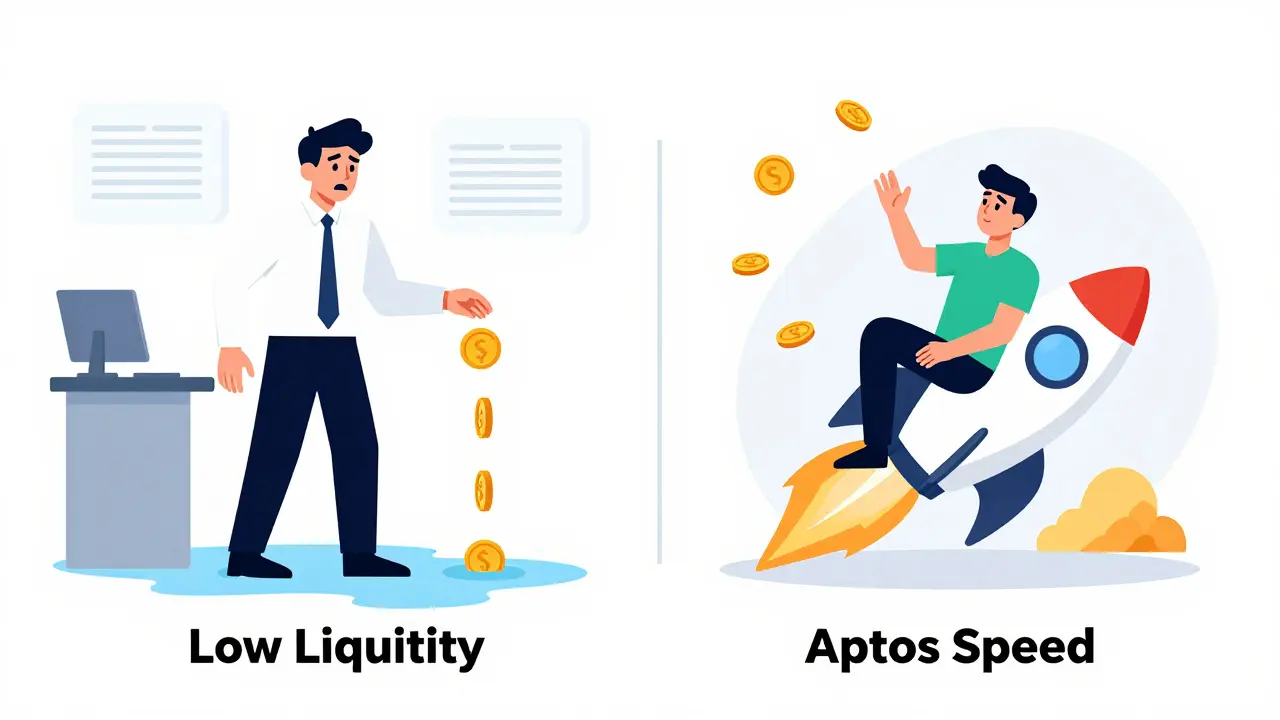
Liquidity remains shallow. Daily trading volume often stays below $10,000, causing slippage issues for larger trades. Users report 2-5% slippage on orders over $500, which eats into profits quickly. If you’re planning to move serious capital through Cellana, expect friction.
On the flip side, transaction costs are negligible. Thanks to Aptos’ infrastructure, fees average $0.0001 per trade-far cheaper than Ethereum’s $1.27 average. Speed is another plus, with potential throughput up to 160,000 transactions per second. While actual usage rarely hits those peaks, the underlying tech is robust.
| Feature | Cellana Finance | Uniswap v3 | PancakeSwap |
|---|---|---|---|
| Blockchain | Aptos | Ethereum | BSC |
| Governance Model | ve(3,3) Voting | Fixed Fees | CAKE Emissions |
| Avg. Trade Fee | $0.0001 | $1.27+ | $0.0005 |
| Liquidity Depth | Low (<$10k vol/day) | Very High | High |
| Token Price Trend (2024-2025) | -97% from ATH | +150% from ATH | +80% from ATH |
User Experience: Easy Setup, Steep Learning Curve
Getting started with Cellana is straightforward if you already know your way around crypto wallets. First, set up an Aptos-compatible wallet like Petra or Pontem. Then acquire CELL tokens via exchanges such as Tapbit or Bitget. Finally, connect your wallet to the Cellana interface and start interacting.
But “interacting” means understanding veNFTs, locking periods, and emission distributions. Community surveys suggest it takes beginners 2-3 hours to fully grasp these concepts. Documentation rates 3.5/5 stars-praised for technical depth but criticized for lacking practical examples. Support channels include a Telegram group with 8,450 members and a helpdesk resolving 78% of tickets within 24 hours. Response times average 22 minutes, which is decent for a smaller project.
Common pain points? Wallet connectivity bugs affect 15% of new users. And again, that veNFT confusion keeps popping up. If you’re impatient or prefer plug-and-play simplicity, Cellana will test your patience.
Security and Trust: Audits vs. Reality
Security is paramount in DeFi. Cellana has undergone third-party audits, though specific firms aren’t publicly named. Multi-signature wallets protect treasury management, adding another layer of defense against insider threats. Still, no audit guarantees immunity from future exploits.
Trust metrics paint a mixed picture. Trustpilot shows 17 verified reviews averaging 3.1/5 stars. Praise goes to the intuitive UI for Aptos newcomers and responsive Telegram support. Complaints center on unpredictable veNFT valuations and liquidity-related slippage. Early adopters who bought CELL at $0.005 during the IDO saw initial gains, but subsequent drawdowns wiped out most profits by late 2025.
Experts remain divided. Dr. Elena Rodriguez from Stanford Blockchain Center calls Cellana’s approach “technically sound,” while Messari analyst Michael Chen warns of concentration risk due to low public allocation (only 7.38% of supply). Both have valid points. Technology matters, but so does distribution fairness.

Market Position: Niche Player in a Growing Ecosystem
Aptos’ DeFi TVL reached $1.2 billion in November 2025, capturing just 0.8% of Ethereum’s dominance. Within this space, Cellana holds an 8.3% share by trading volume, trailing Raydium (42.1%) and Merkle Trade (24.7%). Adoption metrics show 14,350 unique wallet interactions since launch, with daily active users hovering around 320.
Analyst Sarah Kim from Delphi Digital projects Aptos DEXes could capture 3-5% of cross-chain volume by 2027-if interoperability improves. But she notes Cellana faces stiff competition from established players expanding onto Aptos. Regulatory uncertainty also looms. The SEC’s 2024 framework for DeFi governance tokens hasn’t been tested in court, leaving compliance risks open-ended.
Future developments hinge on executing planned upgrades: DEX aggregator integration, limit order functionality (Q1 2026), and doubling trading pairs to 72 by Q3 2026. Fiat on/off-ramp integration was delayed to Q2 2026, frustrating some users expecting easier entry points.
Who Should Use Cellana Finance?
If you fit any of these profiles, Cellana might interest you:
- Aptos enthusiasts wanting deeper exposure to native protocols.
- Governance-focused investors who value active participation over passive staking.
- Long-term believers willing to endure volatility for potential upside.
Conversely, avoid Cellana if:
- You need deep liquidity for large trades.
- You dislike complex mechanics requiring study time.
- You seek guaranteed returns or minimal risk.
Final Thoughts: Promising Concept, Unproven Execution
Cellana Finance isn’t trying to be everything to everyone. It’s betting on sustainability, community control, and Aptos’ growth trajectory. The ve(3,3) model offers genuine innovation, but execution challenges persist. Low liquidity, price depreciation, and governance complexities make it unsuitable for mainstream adoption yet.
That said, dismissing it entirely would ignore its strengths. Cheap fees, fast transactions, and strong security foundations provide a solid base. Whether Cellana thrives depends on increasing user engagement, expanding partnerships, and navigating regulatory gray areas successfully.
For now, treat it as a speculative play. Allocate small amounts, stay informed, and monitor roadmap progress. DeFi evolves rapidly, and today’s underdog could become tomorrow’s leader-or fade into obscurity. Only time will tell.
Is Cellana Finance safe to use?
Cellana employs multi-sig wallets and third-party audits, reducing exploit risks. However, smart contracts always carry inherent dangers. Always verify links and never share private keys. Past performance doesn’t guarantee future safety.
How do I earn rewards on Cellana?
Lock CELL tokens to receive veCELL NFTs, then vote on liquidity pools. Rewards come from trading fees and protocol emissions directed toward chosen pools. Note that APY varies based on voting outcomes and market conditions.
Why did CELL token drop so much?
Post-IDO sell pressure, limited liquidity, and broader market downturns contributed to CELL’s decline from $0.116 to ~$0.003. Tokenomics design and adoption levels heavily influence price stability.
Can I buy CELL with fiat currency?
Not directly yet. Fiat on-ramps were delayed until Q2 2026. Currently, purchase CELL via centralized exchanges like Bitget or Tapbit using crypto pairs.
What makes Cellana different from Uniswap?
Uniswap uses fixed fee tiers without governance over emissions. Cellana lets voters allocate 100% of rewards dynamically via ve(3,3). Also, Cellana runs on Aptos, offering lower fees and faster speeds than Ethereum-based Uniswap.
- Poplular Tags
- Cellana Finance review
- Aptos DEX
- ve(3
- 3) model
- CELL token
- decentralized exchange