

Imagine logging into your favorite trading platform, only to find the registration page broken, your withdrawals stuck in limbo, and a major financial regulator warning you to stay away. That is exactly where CoinFLEX stands today. If you are looking at this name because you saw an old tutorial or heard a rumor about high leverage, stop right here. The reality of this platform in 2026 is starkly different from its early days.
This review cuts through the noise. We will look at why the UK’s Financial Conduct Authority (FCA) flagged them, what happened to their unique "physically delivered" products, and most importantly, whether you should trust your hard-earned money with them. Spoiler alert: you shouldn’t. Instead, we’ll show you where to go instead.
The Current Status: Defunct and Blacklisted
Let’s get the bad news out of the way first. As of 2026, CoinFLEX is widely considered defunct and unsafe for new users. You cannot simply sign up and start trading like you would on Binance or Kraken. Independent watchdogs like Wallet Scrutiny classified the exchange as defunct back in October 2021 because their registration systems stopped working entirely. Users reported they couldn’t even verify their email addresses.
But it gets worse. In 2023, the UK Financial Conduct Authority (FCA) issued a formal warning about CoinFLEX. This wasn’t a minor glitch; it was a flag for potential fraudulent activity. Consequently, major review aggregators like Traders Union blacklisted the platform for 2024 and beyond. When a government regulator steps in to warn citizens about a specific company, that is not a risk you take lightly. It means the entity lacks proper licensing and oversight in key markets.
If you try to access their site today, you might find a shell of what used to be there, or perhaps nothing at all. For existing users who still have funds trapped inside, the outlook is grim. Reports of frozen accounts and unresponsive support teams have been consistent since late 2021. New users? There is no point in trying to join a party that ended years ago.
What Was CoinFLEX Promising?
To understand why people were drawn to it initially, we need to look at its pitch. Launched in 2019 as a spin-off from Coinfloor, CoinFLEX tried to carve out a niche in the crowded crypto market. They didn’t just offer standard spot trading. Their big selling point was something called physically delivered perpetual swaps.
Here is how that worked in theory: unlike cash-settled futures where you just get paid the difference in price, these contracts allowed for the actual delivery of the cryptocurrency. They supported assets like Bitcoin (XBT), Ethereum (ETH), and Bitcoin Cash (BCH). On paper, this sounded sophisticated. They also offered an AMM+ system, which combined automated market making with leveraged trading. This allowed traders to use different assets as collateral for liquidity pools while leveraging up to 10x.
They claimed to be beginner-friendly. Their marketing highlighted a simple interface and no KYC (Know Your Customer) requirements for transactions under $10,000. Who doesn’t want anonymity and ease of use? But remember: if something sounds too good to be true-especially when regulators are knocking on the door-it usually is.
The Fee Structure and Leverage Trap
When CoinFLEX was operational, their fee structure looked competitive on the surface. Spot trading fees were 0.05% for makers and 0.10% for takers. Contract trading was even cheaper, with makers receiving rebates (-0.02%). They also covered network fees for withdrawals of BTC, BCH, FLEX Coin, and DOT. That last part was rare. Most exchanges charge you every time you move money off-platform.
However, low fees often mask higher risks elsewhere. CoinFLEX offered insane leverage levels. While many reputable exchanges cap leverage at 10x or 20x for retail traders, CoinFLEX pushed up to 100x on perpetual contracts and a staggering 250x on spreads. Let me tell you why this is dangerous. With 250x leverage, a mere 0.4% move against your position wipes out your entire account. It is not trading; it is gambling with a house edge.
Traders Union noted accusations of market manipulation, including inflating trading volumes to make the platform look busier than it was. High leverage attracts reckless behavior, and without robust regulation, there is no one to protect you when the market turns.
Security Claims vs. Reality
CoinFLEX boasted a three-fold security approach. They claimed 99% of customer funds were stored in cold storage (offline wallets). They used Transport Layer Security (TLS) for data protection and encouraged two-factor authentication (2FA). These are standard industry practices, but claiming them does not make a platform safe if the business model itself is flawed.
The contradiction lies in the user experience versus the technical claims. How can you have "responsive customer support" and "robust security" if users cannot register, withdraw funds, or access their accounts? TrustFinance listed a 4.55 score based on 321 reviews, but dig deeper, and those positive reviews seem isolated. Meanwhile, Wallet Scrutiny and Traders Union documented systemic failures. One user reported losing access to $15,000 in assets without explanation. Another complained about sudden account blocks. When security fails, technical specs don’t matter. What matters is getting your money back. And on CoinFLEX, that path was blocked.
CoinFLEX vs. Reputable Alternatives
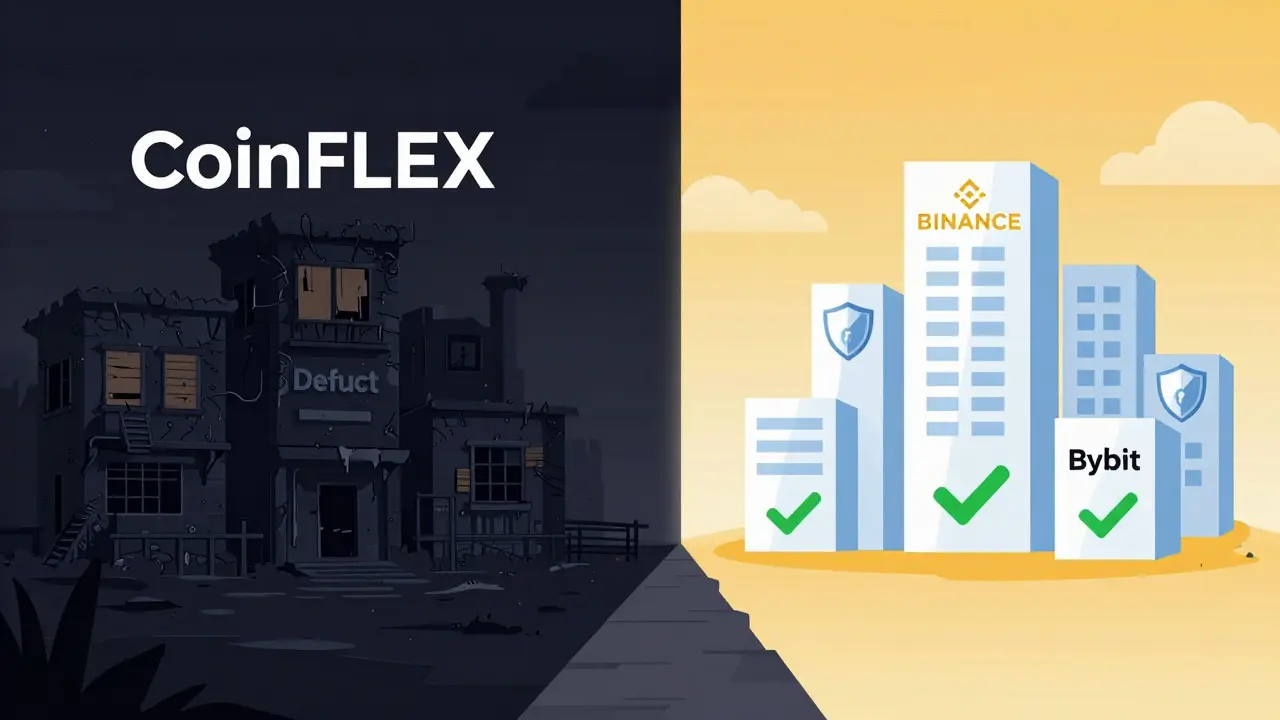
You do not need CoinFLEX to trade crypto. In fact, avoiding it protects you. Here is how it stacks up against legitimate, regulated competitors that are actually open for business in 2026.
| Feature | CoinFLEX | Binance | Kraken | Bybit |
|---|---|---|---|---|
| Status | Defunct / Blacklisted | Active / Global Leader | Active / Regulated | Active / Derivatives Focus |
| Regulation | FCA Warning (Fraud Risk) | Multiple Licenses | US/EU Compliant | Licensed in Key Jurisdictions |
| Assets Supported | ~40 Cryptos | 350+ Cryptos | 200+ Cryptos | 300+ Cryptos |
| Max Leverage | Up to 250x (Risky) | Up to 125x | Up to 500x (Pro Only) | Up to 100x |
| User Access | Registration Broken | Open | Open | Open |
Binance offers massive liquidity and hundreds of coins. Kraken is known for its strict security and regulatory compliance in the US and Europe. Bybit provides excellent derivatives tools without the shady reputation. All three have functional apps, responsive support, and clear withdrawal processes. Why risk your capital on a ghost platform when these options exist?
Red Flags Every Trader Should Know
If you are evaluating any crypto exchange, keep this checklist handy. CoinFLEX failed almost all of these tests:
- Regulatory Warnings: Did the FCA, SEC, or ASIC issue a warning? If yes, run. CoinFLEX had an FCA warning in 2023.
- Operational Continuity: Can you register? Can you withdraw? CoinFLEX’s registration broke in 2021.
- Transparency: Do they publish proof of reserves? CoinFLEX relied on vague claims of 99% cold storage without independent audits.
- Leverage Limits: Does the platform encourage reckless leverage? 250x is a trap for beginners.
- User Reviews: Look beyond the star rating. Read the complaints. Patterns of frozen funds are a dealbreaker.
Conclusion: Move On Safely
CoinFLEX started with some innovative ideas, like physically delivered perpetuals. But innovation means nothing without integrity and operational stability. Today, it is a cautionary tale. The combination of regulatory warnings, broken infrastructure, and user complaints makes it a non-starter for anyone serious about trading.
Do not fall for outdated guides praising its features. Those features are irrelevant if you cannot access your money. Stick to established, regulated exchanges that prioritize your security over flashy leverage promises. Your portfolio deserves better than a blacklisted platform.
Is CoinFLEX still operating in 2026?
No, CoinFLEX is considered defunct. Registration systems have been non-functional since late 2021, and the platform has been blacklisted by major review sites following an FCA warning in 2023.
Why did the FCA warn against CoinFLEX?
The UK Financial Conduct Authority warned that CoinFLEX lacked proper authorization to operate as a crypto asset business in the UK and cited concerns about fraudulent activities.
Can I recover my funds from CoinFLEX?
Recovery is highly unlikely. Users have reported frozen accounts and unresponsive support for years. Without regulatory intervention or a functioning legal entity, retrieving funds is nearly impossible.
What is a safer alternative to CoinFLEX?
Consider regulated exchanges like Kraken, Binance, or Bybit. They offer similar trading features, including derivatives and high leverage, but with transparent operations and regulatory compliance.
Did CoinFLEX really offer physically delivered perpetuals?
Yes, that was their unique selling point before shutting down. Unlike cash-settled futures, these contracts involved the actual delivery of the underlying cryptocurrency, though the high leverage made them extremely risky.