


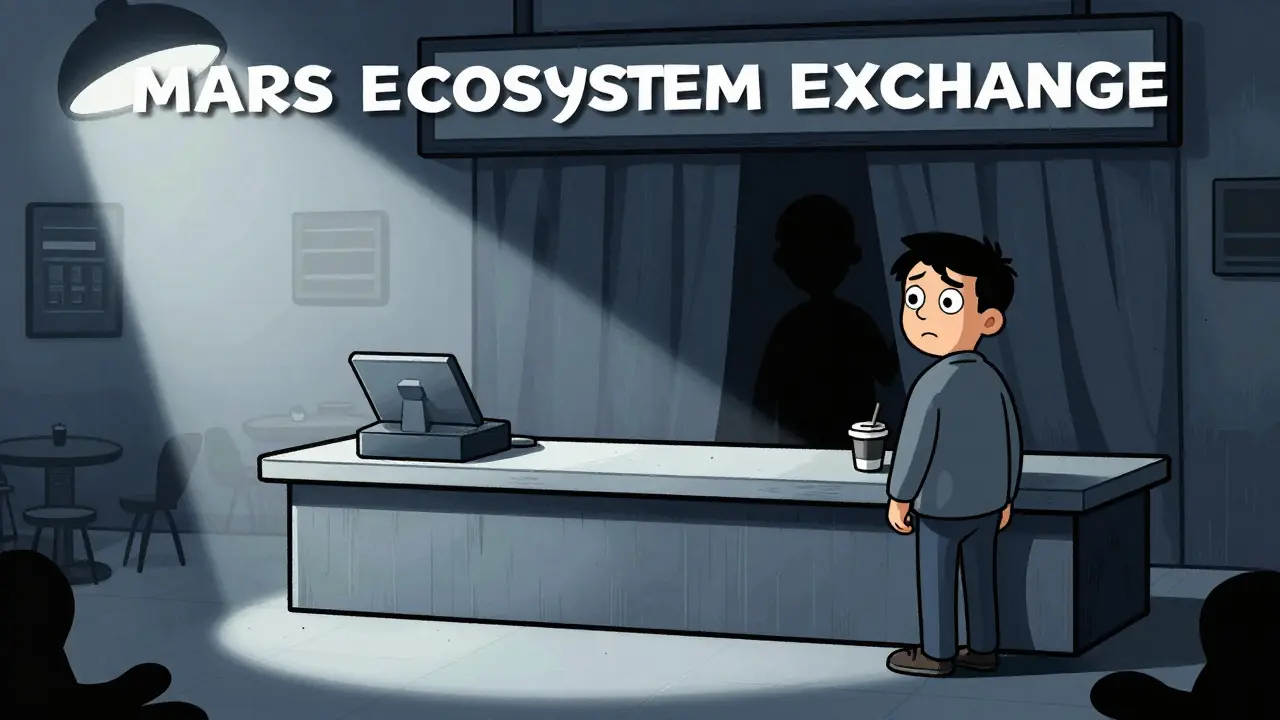
Imagine trying to buy a coffee at a shop that has no cash register, only one customer inside, and the owner is hiding behind a curtain. That is exactly what trading on Mars Ecosystem feels like in 2026. You might have seen the name pop up in a search result or heard about its native token, XMS, and wondered if it’s the next big thing in decentralized finance. The short answer? It is not. In fact, putting your money here is less of an investment strategy and more of a gamble with the odds stacked heavily against you.
We are going to look past the marketing buzzwords and examine the hard data. When you strip away the promises of "ideal mediums of exchange," what remains is a platform with virtually no users, almost zero liquidity, and no regulatory oversight. If you are holding XMS tokens or considering using Mars Swap for your trades, this review will help you understand why most serious traders steer clear.
The Hard Numbers: Volume and Liquidity Reality Check
In the world of cryptocurrency exchanges, volume is king. It tells you how many people are actually buying and selling. Without volume, you cannot move your money out without losing a significant portion of its value due to slippage. Let’s look at the metrics for Mars Ecosystem as reported by tracking services like CoinGecko and FxVerify.
The 24-hour trading volume sits at a staggering $744.13. To put that in perspective, major exchanges like Binance process billions of dollars daily. Even mid-tier exchanges handle millions. A volume of under $800 means that if you tried to sell $500 worth of assets, you could potentially wipe out the entire day’s activity. This isn’t just low; it is non-existent for any practical trading purpose.
| Metric | Mars Ecosystem | Average Mid-Tier DEX | Risk Level |
|---|---|---|---|
| Daily Volume | $744.13 | $10M - $100M+ | Critical |
| Trading Pairs | 7 | 100+ | High |
| Orderbook Depth Percentile | 13th | Top 50% | Critical |
| Monthly Website Visits | 81 | 100k+ | Critical |
Notice the orderbook depth percentile: 13th. This means that compared to other exchanges, Mars Ecosystem has some of the thinnest markets available. If you place an order, there likely won’t be anyone on the other side to match it. You are essentially shouting into a void. For a trader, this is a dealbreaker. You need liquidity to enter and exit positions efficiently. Here, you are stuck.
Who Is Using This Platform? (Spoiler: Almost No One)
You might think, "Surely someone is using it." But the traffic data suggests otherwise. According to SimilarWeb data analyzed by FxVerify, the website receives only 81 total visits per month. Eighty-one. Of those, 80 are organic searches and 1 is paid. That is fewer than three visitors a day.
Think about what that implies. There is no community. There are no active Telegram groups buzzing with trade signals. There are no Discord servers discussing price action. The average visit duration is effectively zero seconds, with a bounce rate of 40%. People land on the page, realize it looks empty or suspicious, and leave immediately. This lack of user engagement is a massive red flag. Legitimate projects, even small ones, build communities. They have advocates. Mars Ecosystem has silence.
The Tokenomics Trap: XMS and USDM
Mars Ecosystem operates around two main tokens: XMS and USDM. The project claims that USDM is the "ideal medium of exchange and store of value for DeFi." They promise that transaction fees from Mars Swap back the stability of this stablecoin. Sounds technical, right? But let’s break down why this model fails when there is no volume.
If the daily volume is $744, the fees generated are negligible. You cannot stabilize a currency with pennies. The primary trading pair is XMS/WBNB (Wrapped BNB), which accounts for over 50% of the platform's activity. The price of XMS hovers around fractions of a cent ($0.00036). This micro-cap status makes it highly susceptible to manipulation. A single person buying $100 worth of XMS could spike the price by hundreds of percent, creating a false sense of growth before dumping their holdings on unsuspecting buyers.
This is a classic pump-and-dump environment. Without deep liquidity pools provided by reputable investors or market makers, the token price is driven purely by speculation and insider activity. As a retail investor, you are always the last to know and the first to lose.

Regulatory Black Hole: No Oversight, No Protection
Perhaps the most concerning aspect of Mars Ecosystem is its complete lack of regulatory compliance. FxVerify explicitly states that this company does not appear to be regulated by any government authority. In 2026, the crypto landscape is increasingly dominated by regulations in the US, EU, and UK. Major exchanges comply with KYC (Know Your Customer) and AML (Anti-Money Laundering) laws to protect users and prevent fraud.
Mars Ecosystem operates in the shadows. This means:
- No Recourse: If you get hacked, scammed, or if the developers decide to pull the rug, you have nowhere to go. There is no insurance fund. There is no legal entity to sue.
- Security Risks: Unregulated platforms often cut corners on security audits. We have no record of formal security audits for Mars Ecosystem. Smart contract vulnerabilities are common in such projects, leading to drained funds.
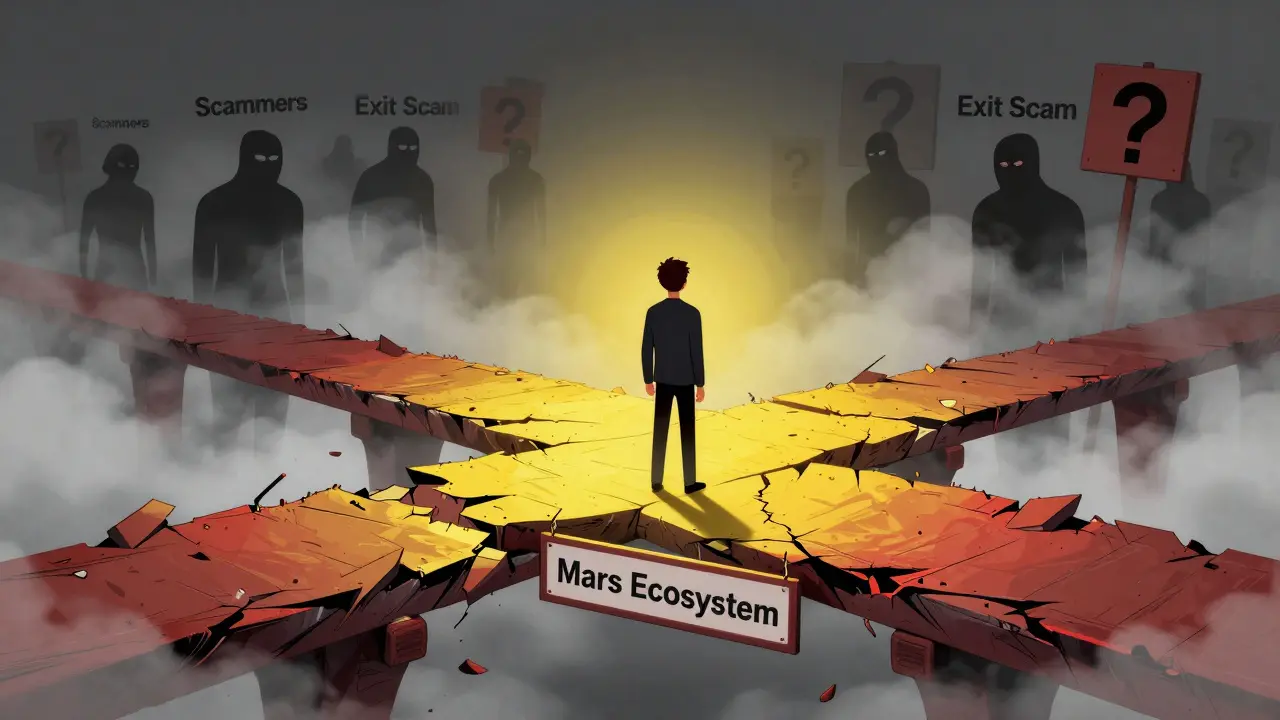
- Exit Scams: With no regulatory body monitoring their activities, the operators can disappear at any time. Given the low traffic and volume, they have little incentive to maintain long-term operations unless they are planning a quick exit.
Compare this to established decentralized exchanges like Uniswap or PancakeSwap. While also decentralized, they have undergone years of scrutiny, multiple security audits, and have massive community governance structures. Mars Ecosystem has none of these safeguards.
Technical Limitations and User Experience
Even if you ignore the financial risks, the user experience is practically non-existent. There is no comprehensive documentation. There are no API guides for developers. There are no video tutorials on YouTube explaining how to use Mars Swap. How do you expect users to trust a platform that doesn’t bother to teach them how to use it?
The interface itself is likely minimal, reflecting the low effort invested in development. The bid-ask spread averages 0.715%, which seems reasonable on paper but becomes disastrous when combined with low liquidity. Slippage-the difference between the expected price of a trade and the price at which the trade is executed-will eat into your profits. On a platform with 13th percentile depth, slippage can exceed 5% or 10% on modest trades.
Furthermore, the platform lacks advanced features found on modern DEXs. No margin trading. No limit orders with reliable execution. No staking rewards that are sustainable. It is a bare-bones swap mechanism designed primarily to facilitate the movement of its own native tokens rather than to serve the broader crypto community.
Confusion with Scams: The "Big Mars" Distraction
Adding to the confusion, there is a separate scam operation known as "The Big Mars" (thebigmars.com) documented by TechForing. This site runs advance-fee scams promising Bitcoin giveaways. While Mars Ecosystem (marsecosystem.com) appears to be a distinct entity, the similarity in names creates a halo effect of suspicion. Why would a legitimate project choose a name so close to a known scam? It suggests either negligence or an attempt to ride coattails of confusion. Either way, it adds another layer of risk for potential users who might mix up the two.
Alternatives That Actually Work
If you are looking for decentralized trading, there are dozens of better options. Here is why you should switch:
- Uniswap: The largest DEX by volume. Deep liquidity, audited contracts, and a massive ecosystem. Ideal for Ethereum-based tokens.
- PancakeSwap: Leading DEX on BNB Chain. Lower fees, high volume, and regular updates. Great for trading BNB and BEP-20 tokens.
- Curve Finance: Specialized in stablecoin swaps. Minimal slippage and high efficiency. Perfect if you want to trade USDT, USDC, or DAI without losing value.
- SushiSwap: Multi-chain support with a strong community focus. Offers additional yield farming opportunities.
These platforms have transparent teams, open-source code, and millions of daily users. They provide the liquidity and security you need to trade safely. Mars Ecosystem offers none of this.
Final Verdict: Avoid at All Costs
Mars Ecosystem is not a viable option for trading in 2026. It lacks the fundamental pillars of a successful exchange: volume, liquidity, regulation, and community. The data paints a clear picture of a dormant or abandoned project that poses significant financial risk to anyone who interacts with it. Whether you hold XMS tokens or were curious about USDM, the smart move is to stay away. Protect your capital by choosing established, audited, and regulated platforms where your money has a fighting chance.
Is Mars Ecosystem a scam?
While it may not be a direct "take your money and run" scam in the traditional sense, it exhibits all the characteristics of a high-risk, potentially fraudulent project. With no regulation, near-zero volume, and no transparency, it functions similarly to a scam because users are unlikely to recover their funds or achieve fair market value for their trades.
Can I withdraw my funds from Mars Ecosystem?
Technically, yes, if the smart contracts are still functional. However, due to extreme slippage and low liquidity, you will likely receive far less value than the market price. Additionally, if the platform shuts down or the developers revoke permissions, withdrawals could become impossible entirely.
What is the XMS token used for?
XMS is the native utility token of the Mars Ecosystem. It is primarily traded against WBNB. Its stated purpose is to facilitate transactions within the Mars Swap protocol. However, given the lack of real-world usage and volume, its value is speculative and highly volatile.
Is USDM a safe stablecoin?
No. A stablecoin needs robust backing and high transaction volume to maintain its peg. With Mars Ecosystem generating less than $1,000 in daily volume, there is insufficient fee revenue to back USDM’s stability. It is not comparable to trusted stablecoins like USDT or USDC.
Why is the trading volume so low?
Low volume indicates a lack of user trust and adoption. Traders avoid platforms with poor liquidity because they cannot execute trades efficiently. The absence of marketing, community building, and regulatory compliance further drives users away, creating a vicious cycle of declining activity.

People Comments
finally someone said it out loud instead of hiding behind vague marketing speak. this place is a ghost town and anyone putting money in here is basically donating to the devs wallet. wake up people.
i mean its kinda wild how they expect ppl to trust a platform with less traffic than my grandma's facebook page lol. the volume stats are just laughable at this point.
oh no i feel so sad for the people who lost money here. its really hard when you dont know better and just see shiny tokens everywhere. please be more careful next time ok
absolute garbage review if you ask me but honestly the data speaks for itself. these crypto grifters think we are stupid. zero liquidity means zero value. stay away from this trash before you lose your shirt.
my goodness that table is shocking! i cant believe the numbers are that low. it makes me so nervous just thinking about where my coins are safe. thank you for sharing this important info everyone
look i get why new projects fail but this is beyond failure this is negligence. if you are holding xms cut your losses now. do not wait for a miracle that will never come. protect yourself.
hey folks 🚀 just wanted to drop some knowledge bombs here. mars ecosystem is basically a digital black hole for your cash 💸. stick to uniswap or pancake swap where the real action is happening. don't let the fancy names fool ya! 🌟
the silence from the community is deafening. one must wonder what kind of philosophy drives a project with no users. it is a void. a hollow shell. avoid it.
i just checked the site myself. looks dead. no point in wasting time on it. thanks for the heads up though.
so let me get this straight. eighty one visits a month? really? that is pathetic. why is this even still online?
it is like trying to sell ice to a penguin in antarctica except there are no penguins and no ice just empty space. the metaphor writes itself honestly. terrible platform.
thanks for writing this. it helps a lot to have clear facts instead of hype. glad i read this before doing anything silly.
well i suppose one could argue that every great project starts small but when you look at the sheer lack of any meaningful activity or development updates over such an extended period of time it becomes increasingly difficult to justify any optimism whatsoever regarding the future viability of this particular exchange especially given the robust alternatives available in the current market landscape which offer significantly better security and liquidity profiles for traders seeking reliable execution environments.
yeah man same here. i saw this pop up on twitter once and almost clicked it. good thing i stopped to think. these scams are getting smarter with their branding but dumb with their fundamentals.
obviously this is a scam. the tokenomics are designed to enrich insiders. anyone who falls for this deserves to lose their money. basic financial literacy would prevent this.
i appreciate the detailed breakdown. it is scary how easy it is to get tricked by these sites. thanks for keeping us informed!
how tedious. another worthless coin review. i suppose some people enjoy losing money. pity the fools who engage with such inferior technology.
as someone who has traveled through many different crypto ecosystems across various chains i can confidently say that this one lacks the cultural foundation necessary for sustainable growth. without a community there is no soul to the project and thus no reason to invest your hard earned capital into something that offers nothing in return but risk and potential loss.
the regulatory implications of operating such a substandard financial instrument within the purview of international trade laws are profound and disturbing. it represents a failure of oversight and a breach of fiduciary duty to the hypothetical user base. cease operations immediately.
run dont walk away from this shit. total disaster zone. nobody is using it for a reason. stop being lazy and use a real exchange.
i feel exhausted just reading about this mess. why do these things keep popping up. it drains my energy knowing people are still falling for it. poor souls
lol yeah sure it is a 'medium of exchange' right after it exchanges your money for dust. classic rug pull vibes. smart contracts my ass.
wait so the volume is literally under a thousand dollars a day? thats insane. i thought all these new coins were supposed to be the next big thing. feels like a setup.