


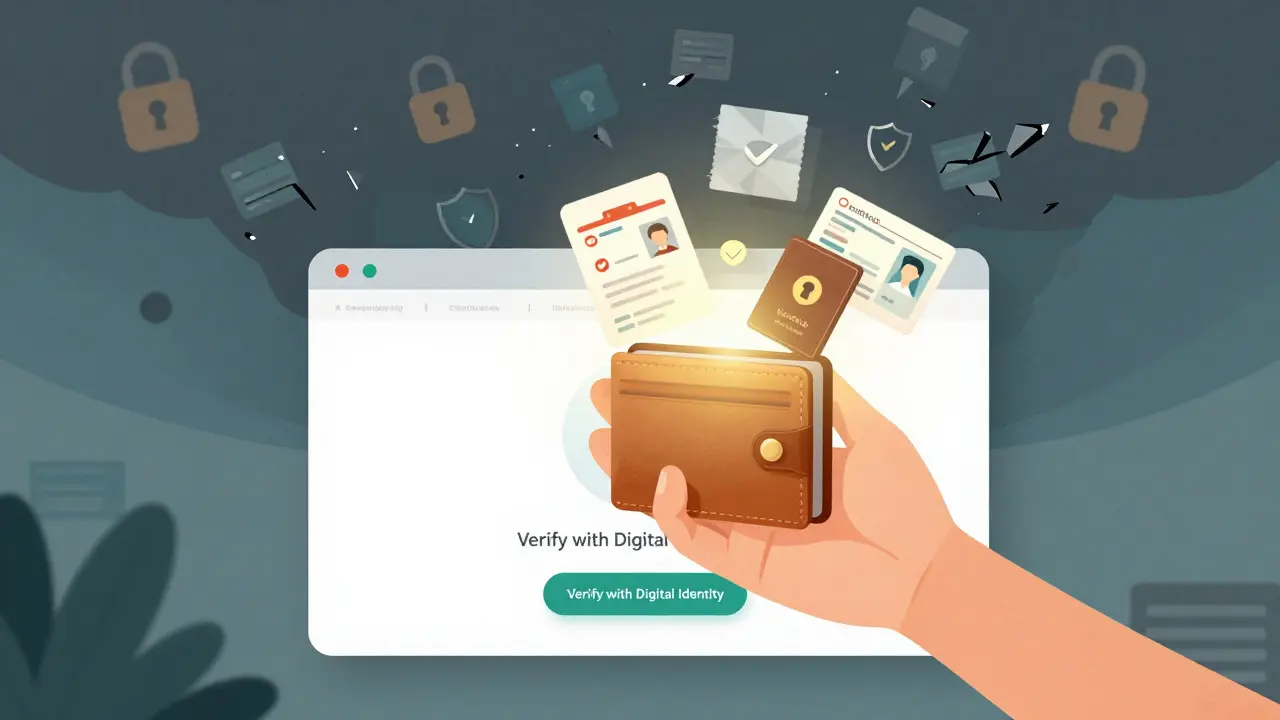
Think about how many passwords you’ve forgotten, how many accounts you’ve created with the same email, or how often you’ve handed over your driver’s license just to prove you’re over 18. Every time you sign up for a new service, you’re giving away pieces of your identity - and those pieces get stored in databases that hackers love to break into. What if you could control your own identity the same way you control your crypto wallet? That’s what decentralized identity management is for.
What Exactly Is Decentralized Identity?
Decentralized identity, or DCI, flips the script on how digital identity works. Instead of a company like Facebook, Google, or your bank holding your personal data, you hold it yourself - in a secure digital wallet. Your identity isn’t stored in one big database. It’s broken into pieces: unique identifiers you control, and digital certificates you earn from trusted sources. These identifiers are called Decentralized Identifiers (DIDs). A DID looks like a random string of letters and numbers - something likedid:ion:EiB9q4...vZ4w. It doesn’t contain your name, email, or birthdate. It’s just a key that points to a public document that says, “This is who I am, and here’s how to verify me.” That document lives on a blockchain, which makes it tamper-proof and always available.
The real magic happens with Verifiable Credentials (VCs). These are digital equivalents of your diploma, passport, or driver’s license - but encrypted and signed by the issuer. Your university issues you a VC proving you graduated. Your government issues one proving your age. You store them in your wallet. When you need to prove something, you don’t send the whole document. You send a cryptographic proof that says, “Yes, I have this credential, and it’s real.”
This is called selective disclosure. You can prove you’re 21 without showing your full birthdate. You can prove you’re a licensed electrician without revealing your home address. No one else gets to see more than you allow.
How It Works: Issuers, Holders, and Verifiers
Think of decentralized identity like a three-player game:- Issuers are trusted organizations: universities, governments, employers. They create and sign Verifiable Credentials.
- Holders are you - the person who receives and stores those credentials in their digital wallet.
- Verifiers are websites, apps, or services that ask you to prove something. They check the credential’s signature and confirm it’s real - without ever seeing your raw data.
Self-Sovereign Identity: The Gold Standard
Decentralized identity is the umbrella term. Self-Sovereign Identity (SSI) is the most user-focused version of it. SSI means you have full control - no one can freeze your identity, delete your credentials, or demand you hand over your data. SSI isn’t just about privacy. It’s about autonomy. If your bank shuts down your account, you lose access to your money. If your government revokes your digital ID, you can’t travel. With SSI, your identity belongs to you. Even if the issuer disappears, your credentials remain valid as long as you hold them - because they’re cryptographically signed and verifiable forever. Zero-knowledge proofs (ZKPs) make this even more powerful. Imagine proving you’re eligible for a discount without revealing your age, income, or name. ZKPs let you prove a statement is true without revealing the underlying data. It’s like showing a lock works without showing the key.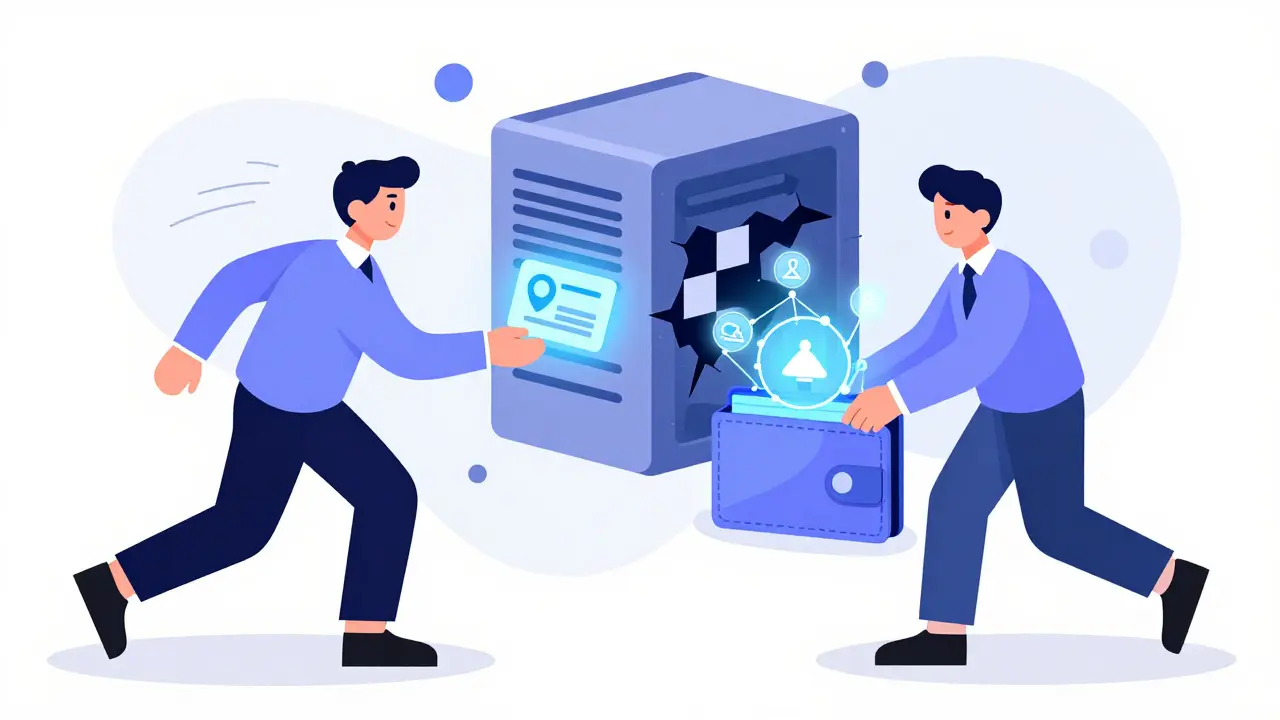
Why This Matters More Than Ever
In 2025, data breaches hit record numbers. The average cost of a breach? Over $4.5 million per incident. Companies hoard your data because it’s profitable - but also because they’re legally required to store it. And when they get hacked, you’re the one who suffers. Decentralized identity changes that. There’s no central database to hack. Your credentials live in your wallet. Even if a verifier gets breached, they only see a cryptographic proof - not your real name, address, or ID number. It also fixes the “identity fragmentation” problem. Right now, you have 10 different logins for 10 different services. With DCI, you have one wallet. One set of credentials. You use the same proof of education to get a job, apply for a loan, and enroll in a course. Big players are taking notice. Okta calls it “the future of digital identity.” Ping Identity says it reduces liability and builds trust. CrowdStrike says it fixes the root cause of identity fraud - centralized data hoarding.The Real-World Challenges
This isn’t magic. It’s new. And new things are hard. First, the learning curve. Most people don’t understand public-key cryptography. Losing your wallet means losing your identity - and there’s no “forgot password?” button. Recovery is possible, but it requires setting up backup keys or trusted contacts. It’s like securing your crypto wallet, but for your entire digital life. Second, adoption. If only 5% of websites accept verifiable credentials, what’s the point? Verifiers need to update their systems. Governments need to issue digital IDs. Universities need to stop printing paper diplomas. The ecosystem needs to grow together. Third, standards. The W3C has created the DID and VC standards, which is huge. But different blockchains use different DID methods. Ethereum, IOTA, and Sovrin all have their own flavors. That’s why interoperability is still a work in progress.Who’s Using This Right Now?
You might think this is all theoretical. But it’s already live. - The European Union is rolling out a digital wallet for citizens to store official documents like birth certificates and diplomas. - Canada’s province of British Columbia issued over 200,000 verifiable credentials for student transcripts and professional licenses. - The U.S. Department of Homeland Security is testing DCI for border crossing and visa verification. - Companies like Microsoft and IBM have built open-source DCI platforms used by governments and enterprises. In New Zealand, the government has started pilot programs with local universities to issue digital diplomas using decentralized identity. Students can share their credentials with employers without contacting the university.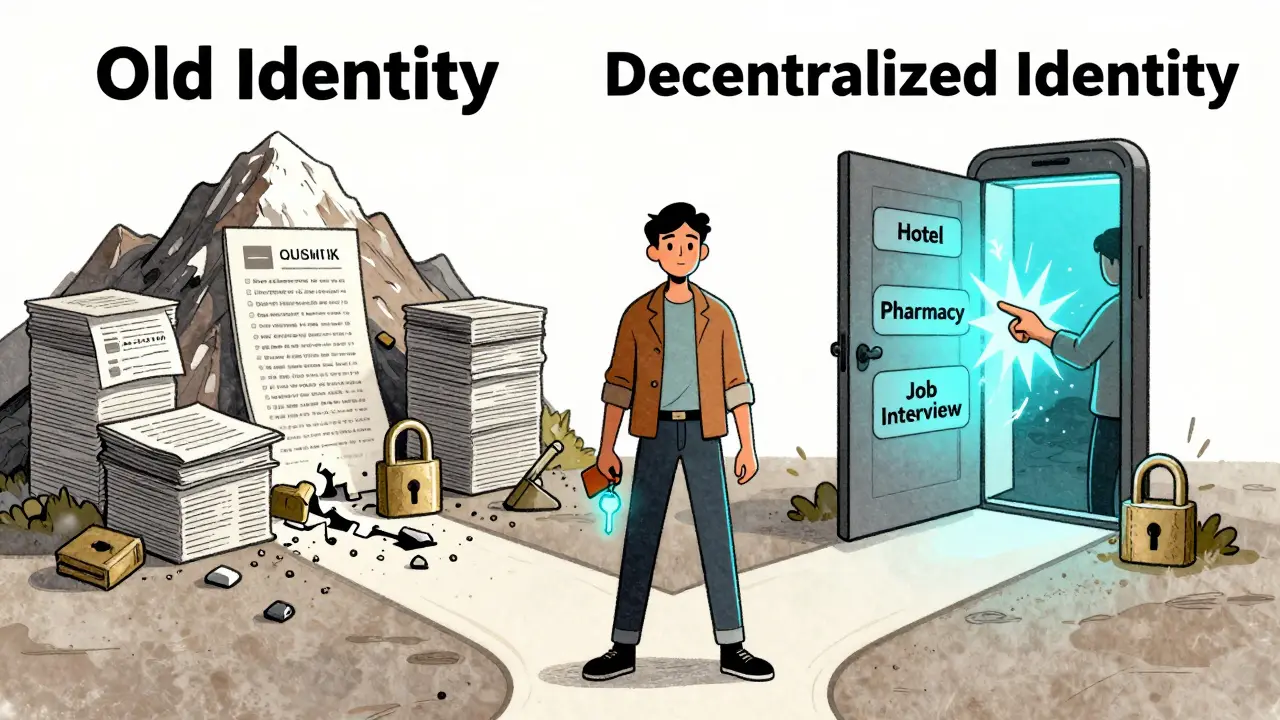
What’s Next?
The next five years will be about making DCI simple. Wallets will become as easy as Apple Wallet or Google Pay. You’ll tap your phone to prove your identity at a hotel check-in, a pharmacy, or a job interview. No forms. No scans. Just a quick cryptographic handshake. Regulations like GDPR and the EU’s Digital Identity Wallet are forcing companies to give users more control. Decentralized identity isn’t just a tech trend - it’s becoming a legal requirement. The goal isn’t to replace all identity systems overnight. It’s to give people a better option. One where you’re not a product. You’re the owner.How to Get Started
You don’t need to be a developer to start using decentralized identity. Here’s how:- Download a wallet that supports DIDs and VCs - like Microsoft’s ION, Sovrin, or the EU’s Digital Wallet app.
- Wait for an issuer to send you a credential - your university, employer, or local government might already be testing this.
- When a website asks for identity verification, look for the “Verify with Digital Identity” button. Choose your credential. Share only what’s needed.
- Back up your wallet. Write down your recovery phrase. Treat it like your crypto seed.

People Comments
This is just the government’s way of tracking us under the guise of ‘privacy’ lol 🤡
Blockchain? More like block-chaos. Who’s gonna verify the verifiers when the feds control the root keys? 😏
Oh wow, another tech bro fantasy where everyone magically learns crypto and nobody ever loses their seed phrase. You know what’s decentralized? My bank account after I get scammed because I trusted some app that said ‘verify with DID.’
Let me guess - this is just another Silicon Valley scheme to replace the IRS with a blockchain ledger so they can charge you crypto fees to prove you’re alive. We already have ID cards. Why do we need another layer of tech magic that only engineers understand?
And don’t get me started on ‘self-sovereign.’ You mean I’m sovereign until the government decides to blacklist my DID? Right. Like that’s ever gonna happen.
Meanwhile, my grandma still uses paper checks and she’s less vulnerable than anyone with a ‘digital wallet’ that’s just a phishing magnet.
Stop selling fear as innovation. We don’t need to be re-invented. We need better laws.
Also, who’s gonna fix my DID when I forget my password? Oh wait - there’s no password. Just a 24-word nightmare you’ll lose while cleaning your phone.
Imagine if you could finally stop giving your birthdate to every website that asks. This could be life-changing for people who’ve been scammed or abused. It’s not just tech - it’s safety. 💪
I like the idea. But what if you’re not tech-savvy? Or old? Or poor? Who helps you recover your identity if your phone dies and you don’t have a backup? It feels like we’re building a fancy door… but only giving keys to the rich.
Really appreciate how you laid this out. I’ve been nervous about digital IDs, but the selective disclosure part actually makes me feel safer. It’s like having a private room inside your identity - only open what you want. That’s huge.
Blockchain = scam. ZKP = buzzword. They’re just trying to make you trust a computer more than your neighbor
So you’re telling me the same people who sold us social media are now selling us digital identity? And we’re supposed to trust them because… they used ‘crypto’? 😂
They’ll just make a backdoor. They always do.
Remember when Facebook said ‘we won’t sell your data’? Then they sold it to Cambridge Analytica. Same playbook. Just with more jargon.
imagine losing your wallet and being locked out of your life forever no one cares about you anymore
your kids cant get into school your job fires you your doctor cant help you
youre not sovereign youre just abandoned
Decentralized identity is a game-changer, honestly. I’ve worked in compliance for 12 years and I’ve seen how broken the current system is. This isn’t just about tech - it’s about dignity. When you control your own data, you’re not a product anymore. You’re a person.
Yes, recovery is hard. Yes, adoption is slow. But we’ve seen this before with email, with HTTPS, with smartphones. People hate change until it’s everywhere.
Start small. Use it for one thing. Then you’ll wonder how you ever lived without it.
Most people don’t realize this already exists in Europe. My cousin got her digital EU ID last year - she used it to rent a car in Spain, sign a lease in Germany, and enroll in a course in Italy. All with one app. No paperwork. No scans. Just a tap.
And yes, she backed up her keys. And no, she didn’t lose them. It’s not magic - it’s responsibility. Like locking your house.
Stop treating this like sci-fi. It’s already here. The question is: are you ready to use it?
Bro this is the future but also kinda funny how we’re all gonna be walking around with digital ID wallets like they’re NFTs
imagine going to a bar and being like ‘yo can you scan my verifiable credential for age?’
then the bouncer’s like ‘hold on let me check your DID on the blockchain’
and you’re like ‘nah bro i just wanna drink’
For anyone scared of losing your keys - start with a trusted contact backup. Like your sibling or spouse. Set it up now, before you need it. It’s not hard. And it’s way better than calling customer service and begging them to ‘reset your identity.’
You don’t have to be a coder. Just be careful. And take it slow.
Identity isn’t just data - it’s memory. It’s history. It’s who you are when no one’s watching. If we hand that over to algorithms, even ‘decentralized’ ones, we’re trading soul for convenience.
Maybe the real question isn’t how to control identity - but whether we should control it at all.
As someone from a country where ID fraud is rampant and paper documents are forged daily, this feels like liberation. Not tech for tech’s sake - but justice. People in my community have been denied jobs, loans, even healthcare because they couldn’t prove who they were. This changes that.
It’s not perfect. But it’s honest. And that’s rare.
you think this is safe? they’ll track your every move through your credentials
you prove you’re 21 → they know you went to a bar
you prove you have a degree → they know you’re educated
you prove you’re employed → they know your salary
they don’t need your name. they don’t need your address. they just need patterns
and then they sell the pattern
wait so if i lose my phone i lose my life? no thanks i’ll stick with my passport and my dumb password123
One must consider the ontological implications of identity commodification within a neoliberal digital episteme. The DIDs, while ostensibly empowering, function as a neo-liberal apparatus that externalizes risk onto the individual while centralizing epistemic authority within the algorithmic infrastructure of verifiers. The illusion of sovereignty masks the structural hegemony of institutional verification protocols. One cannot be sovereign if one’s identity remains contingent upon cryptographic validation by a system whose governance remains opaque.
Actually, this is already working well in India with Aadhaar - but with centralized data. Decentralized version could fix the privacy issues. I hope they get the UX right.
Just saw someone say ‘I’ll stick with password123.’ That’s like saying ‘I’ll keep my house unlocked because I don’t trust locks.’ You’re not being clever - you’re being vulnerable.