


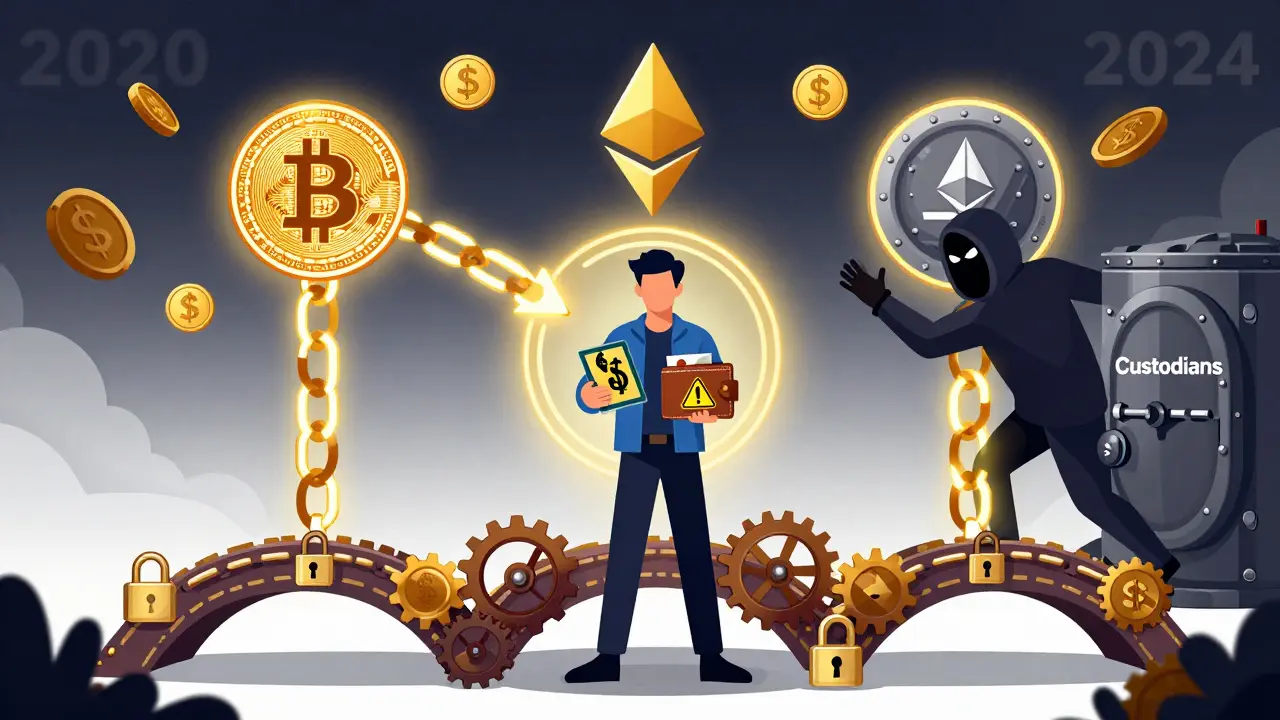
Before 2020, if you owned Bitcoin and wanted to earn interest on it in DeFi, you were stuck. You couldn’t use Bitcoin on Ethereum. You couldn’t swap it for a yield-bearing token. You had to sell it, buy Ethereum, and start over. That’s where cross-chain bridges changed everything. These aren’t just tools-they’re the plumbing behind today’s multi-chain crypto world. They let assets move between blockchains like Bitcoin, Ethereum, Solana, and Polygon without needing a centralized exchange. But they didn’t start out safe or simple. The evolution of cross-chain bridges has been messy, expensive, and full of lessons learned the hard way.
How Cross-Chain Bridges Work: The Three Main Models
Not all bridges are built the same. There are three dominant designs, each with trade-offs in security, cost, and complexity.
The most common type is the lock-and-mint bridge. It works like this: you send your Bitcoin to a smart contract on Bitcoin’s network. In return, an equivalent amount of Wrapped Bitcoin (WBTC) is created on Ethereum. This WBTC acts like Bitcoin but lives on Ethereum. It’s simple, fast, and widely supported. But here’s the catch: the Bitcoin is locked in a smart contract, often controlled by a group of trusted parties. If those parties get hacked or act maliciously, your Bitcoin is gone. As of September 2023, this model handled 68% of all value locked in bridges-making it the most popular, but also the most targeted.
The second model, burn-and-mint, is cleaner in theory. You burn your original asset on the source chain, and a new one is created on the destination chain. No wrapped tokens. No custodians holding your coins. But this model has a flaw: if the system that verifies the burn fails, you could end up with no coins on either chain. It’s used in about 17% of bridges, mostly for native token transfers.
The third, and most innovative, is the lock-and-unlock model. Instead of creating wrapped tokens, it uses liquidity pools on both chains. You deposit your asset into a pool on the source chain, and someone else withdraws an equivalent amount from the pool on the destination chain. This is how THORChain works. No custodians. No wrapped tokens. Just peer-to-peer swaps backed by economic incentives. It’s slower and more complex, but it’s also the most trustless. It handles 15% of TVL and is growing fast because it avoids the biggest weakness of lock-and-mint: centralized control.
Security: The Biggest Risk in Every Bridge
In 2022, bridges lost $2.1 billion to hacks. That’s not a typo. That’s more than half of all crypto thefts that year. And 73% of those losses came from lock-and-mint bridges. Why? Because they rely on centralized or semi-centralized actors to hold your assets.
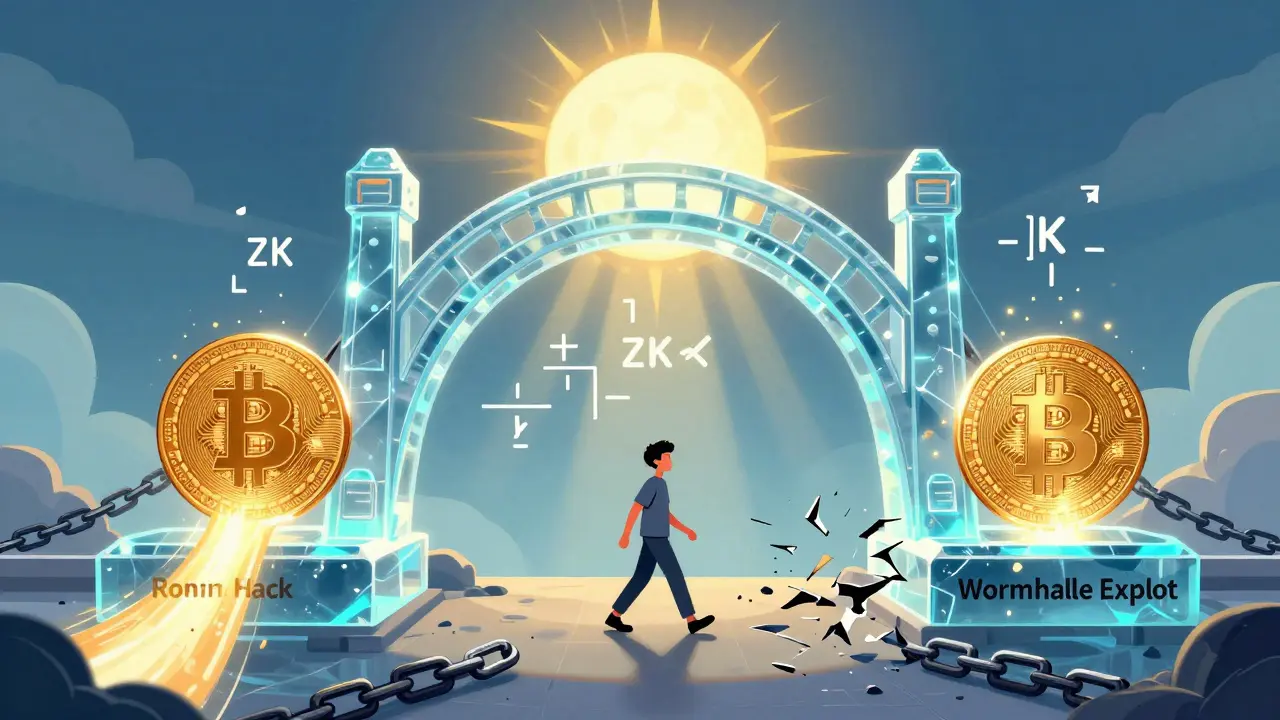
The Ronin Bridge hack in March 2022 stole $625 million from Axie Infinity users. The attackers compromised five out of nine validator nodes. The Wormhole hack in February 2022 drained $320 million by exploiting a flaw in the signature verification system. These weren’t random bugs-they were failures of trust assumptions. If a bridge says, “We trust a group of 10 validators,” and one of them gets hacked, the whole system collapses.
That’s why trust-minimized bridges are the future. These use cryptographic proofs-like ZK-SNARKs-to verify transactions without needing to trust any party. Gravity Bridge and LayerZero are examples. They don’t lock your Bitcoin. They don’t mint wrapped tokens. They prove, mathematically, that your Bitcoin was sent. This approach is 30-40% more expensive in gas fees, but it’s also 90% less likely to be hacked. By late 2023, trust-minimized bridges already controlled 57% of the market, and new projects are almost all built this way.
Real-World Use Cases: Why Users Don’t Care About the Tech
Most users don’t care how a bridge works. They care about two things: saving money and accessing better yields.
Take USDC. On Ethereum, you might earn 1.2% APY in a DeFi protocol. On Arbitrum, the same USDC earns 4.7%. That’s not a small difference-it’s four times more. A user who moves $10,000 from Ethereum to Arbitrum using the official bridge saves $350 in gas fees and earns $350 more in interest per year. That’s why over $18 billion has flowed through the Polygon Bridge since 2020.
Or consider Solana. Its transaction speed is 50,000 TPS. Ethereum does 15. If you’re trading NFTs or using a DeFi app that needs fast confirmations, you need Solana. But you might have your savings in Ethereum. A bridge lets you move funds quickly without selling. In September 2023, the Avalanche Bridge processed $500 million in transfers in a single week. Most users weren’t speculating. They were just trying to use apps that were faster and cheaper.
Even enterprises are using bridges. Forty-three of the Fortune 100 companies now use bridge technology to move tokenized assets between private and public blockchains. A bank might hold tokenized bonds on a permissioned chain and use a bridge to settle trades on a public chain. It’s not crypto hype-it’s infrastructure.
The Dark Side: What Goes Wrong
For every success story, there’s a nightmare.
The Nomad Bridge hack in August 2022 let anyone mint unlimited tokens. A single misconfigured smart contract led to $190 million stolen. Users lost life savings. Reddit threads filled with posts like “I lost $22,500 and the support team never replied.” That’s not rare. Trustpilot ratings for major bridges average just 3.2 out of 5. Common complaints? “Transaction failed with no explanation,” “I can’t redeem my wrapped tokens,” and “No customer support.”
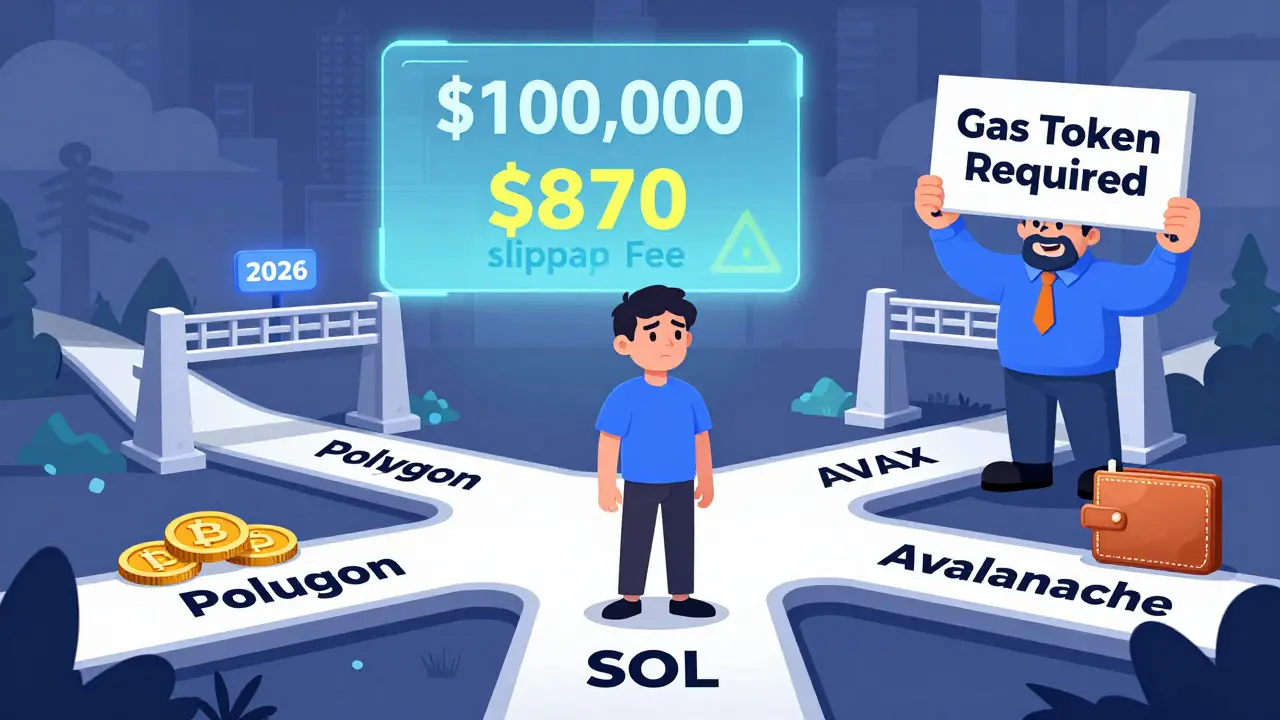
And then there’s the gas problem. You send ETH to Polygon. You think you’re done. But to claim your tokens on Polygon, you need MATIC. If you didn’t bring any, you’re stuck. Same with Solana-you need SOL. Most beginners don’t know this. A UC Berkeley study found 63% of new users got stuck because they didn’t have the right gas token on the destination chain.
Even the best bridges have flaws. THORChain has 99.98% uptime, but it charges a 0.87% slippage fee on every swap. That’s fine for $100, but if you’re moving $100,000, that’s $870 in fees. And Cosmos IBC? It’s the most secure bridge design ever built. But it only works with chains using Tendermint consensus. That rules out Bitcoin, Ethereum, and 82% of other networks.
What’s Next? The Shift to Trust-Minimized and Native Interoperability
By 2026, experts expect 75% of bridge traffic to run on trust-minimized systems. Chainlink’s CCIP, Polkadot’s XCM, and LayerZero’s ZK proofs are leading the way. These aren’t just upgrades-they’re paradigm shifts. They remove the need for trusted parties entirely.
But there’s a bigger shift coming. Ethereum co-founder Vitalik Buterin has said bridges are a “necessary evil.” He believes the future isn’t bridges-it’s shared sequencing. Imagine all blockchains running on the same data layer. No need to move assets. No need for bridges. Just one unified system. Projects like EigenLayer and Celestia are building that now.
Will bridges disappear? Probably not. But they’ll change. The lock-and-mint bridges of 2021 are already fading. The trust-minimized bridges of 2024 are becoming the standard. And by 2026, the most successful ones won’t be called “bridges” at all. They’ll be called “interoperability layers”-like DNS for the blockchain internet.
What Should You Do Today?
If you’re using a bridge right now:
- Check what model it uses. If it’s lock-and-mint, you’re taking on custodial risk.
- Always have gas tokens for the destination chain. Keep at least $5 worth of MATIC, SOL, AVAX, etc., in your wallet.
- Use only bridges with public audits and active developer communities. Avoid ones with no GitHub activity.
- Don’t move more than you can afford to lose. Even the safest bridges have unknown risks.
And if you’re thinking about using a bridge for the first time? Start small. Move $50. Watch the transaction. See how long it takes. Check the status. If it’s confusing, it’s not you-it’s the interface. The best bridges make this feel effortless. Most still don’t.
What is a cross-chain bridge?
A cross-chain bridge is a protocol that allows digital assets and data to move between separate blockchain networks. For example, it lets you send Bitcoin to Ethereum and receive Wrapped Bitcoin (WBTC) in return. Bridges solve the problem that blockchains can’t talk to each other natively.
Are cross-chain bridges safe?
Some are, many aren’t. Lock-and-mint bridges, which rely on centralized custodians, have been hacked for over $2 billion since 2021. Trust-minimized bridges that use cryptographic proofs-like ZK-SNARKs-are far safer. Always check the bridge’s security model before using it.
What’s the difference between Wrapped Bitcoin and native Bitcoin on a bridge?
Wrapped Bitcoin (WBTC) is a token on Ethereum that represents Bitcoin locked on Bitcoin’s network. It’s not Bitcoin-it’s a claim on Bitcoin. Native Bitcoin on a bridge means Bitcoin moves directly using a trust-minimized system like THORChain, without being wrapped. Native is safer but slower.
Why do I need gas tokens on the destination chain?
Every blockchain has its own native token for paying transaction fees. If you move ETH to Solana, you need SOL to claim your tokens on Solana. If you don’t have any, you’ll be stuck. Always check what gas token the destination chain uses before transferring.
Will bridges become obsolete?
Not anytime soon. But their design will change. Lock-and-mint bridges will fade as trust-minimized ones take over. Long-term, projects aiming for shared data layers-like EigenLayer-could make bridges unnecessary by letting all chains operate on the same foundation. But that’s years away. For now, bridges are essential infrastructure.



People Comments
This is so much info lol 🤯 I just wanted to move my ETH to Polygon and now I’m scared I need a PhD in cryptography just to not get hacked. 🙃
The lock-and-mint paradigm is a regulatory arbitrage play disguised as decentralization. It’s not a bridge-it’s a custodial wrapper with a thin veneer of smart contract aesthetics. The real innovation lies in trust-minimized verification layers leveraging ZK-Rollup composability and verifiable execution environments. Without formal verification, you’re not building infrastructure-you’re constructing a honeypot for MEV arbitrageurs and exploit bots.
I read this and just felt... sad. Like, people are risking their life savings on something that’s still so fragile. I know tech is supposed to be disruptive, but when someone loses $22k because a contract had a typo... that’s not progress. That’s a system that’s not ready for humans. We need to build for people, not just for code.
Oh wow, so you’re telling me the whole crypto world is just one giant game of 'trust the middleman'? And we call this innovation? LOL. I’ve seen better security in my bank’s 1997 ATM. 🤡
You’re right about gas tokens. So many newbies get stuck because no one tells them they need SOL to claim SOL tokens. That’s on the ecosystem, not the user. We need onboarding flows that auto-fund gas. Imagine if every bridge had a ‘gas tip’ button-$1 in ETH to cover your first transaction on the other chain. Simple. Human. Necessary.
The notion that trust-minimized bridges are 90% less likely to be hacked is statistically dubious. The attack surface hasn’t shrunk-it’s just moved from centralized validators to oracle manipulation, consensus liveness failures, and sequencer centralization. You’re trading one vector of risk for another, often more opaque one. And let’s not pretend ZK-SNARKs are immune to side-channel exploits. The math is elegant. The implementation? Not so much.
I work in fintech and this is actually kind of beautiful. We’ve been trying to get banks to interoperate for decades. Here we are-blockchains doing it with code, not SWIFT. It’s messy, yes. But imagine if every country’s payment system could talk like this? That’s the real win. Bridges aren’t the end-they’re the first real step toward global financial unification.
I find it profoundly disturbing that we have collectively decided that the solution to decentralized systems is to create more centralized points of failure. This is not innovation. This is regression dressed in blockchain-themed hoodies. The very notion of 'wrapped assets' is a betrayal of the original ethos. We are building a financial feudalism where the serfs pay gas fees and the lords hold the keys.
I’ve used THORChain for months. Yeah, the 0.87% fee stings on big moves-but I’ve never lost a satoshi. No freeze. No support ticket. No 'your funds are being audited.' It’s slow, yes. But it’s honest. And that’s worth more than 4% APY on a bridge that could vanish tomorrow. I’ll take reliability over hype any day.
I LOST MY ENTIRE LIFE SAVINGS ON NOMAD. I WASN’T EVEN TRYING TO BE SMART. I JUST CLICKED ‘BRIDGE’ AND IT SAID ‘CONFIRM’. I’M STILL IN THERAPY. 😭
If you’re scared of bridges, start with small amounts. Move $50. Watch the whole thing. See how long it takes. If you understand what happened, you’re ahead of 90% of users. Don’t wait for ‘perfect’-wait for ‘good enough’. And always, ALWAYS keep gas on the other side. It’s not a feature-it’s a requirement.
In India, many people are just discovering crypto through mobile apps. They don’t know what 'ZK-SNARKs' mean. They just want to send money to their cousin in Canada without paying 10% in fees. We need bridges that are invisible, not impressive. Simplicity over sophistication. That’s the real innovation.
So like... wrapped bitcoin is just a meme token with a blockchain sticker on it? And we call this progress? I thought crypto was supposed to be about ownership. Now I just own a piece of paper that says ‘I own bitcoin but not really’. Cool. 🤷♂️
I tried to bridge from eth to solana and got stuck because i didnt have sol. i thought the bridge would just give me some. it didnt. i spent 3 days on reddit asking for help. no one replied. i gave up. this system is broken. i dont even use crypto anymore.
The shift to trust-minimized is inevitable. But let’s not pretend it’s easy. Building a ZK bridge requires PhD-level cryptography, months of audits, and millions in funding. Most projects can’t afford it. That’s why we’re stuck with lock-and-mint for now. The solution isn’t to shame users-it’s to fund the infrastructure that makes trustless bridges accessible to everyone.
Gas tokens. Always. I learned this the hard way. Now I keep $5 of every major chain’s native token in my wallet. It’s not a feature. It’s a habit. Like brushing your teeth.
The assertion that 75% of bridge traffic will be trust-minimized by 2026 is a projection based on theoretical adoption curves, not empirical data. The cost of verification remains prohibitive for retail users. The inertia of existing infrastructure, coupled with user ignorance, will sustain lock-and-mint models for the foreseeable future. Optimism is not a business model.
Oh so now we’re supposed to trust math instead of people? How cute. Next you’ll tell me the moon landing was real and my dog understands me. 🤭
They say bridges are the plumbing... but what if the plumbing is rigged? What if the whole system is just a pyramid scheme with more block diagrams? Who really owns the validators? Who profits from the gas fees? Who controls the upgrade keys? We’re not building a new internet. We’re building a new bank. And it’s even more opaque.
I’ve audited 17 bridge protocols. The biggest issue isn’t the tech-it’s the UX. No one explains what ‘lock-and-mint’ means. No one tells you that WBTC is not Bitcoin. No one warns you that you need MATIC to claim MATIC. The tech is advanced. The onboarding is medieval. Fix the interface before you fix the cryptography. People don’t fail because they’re dumb. They fail because the system doesn’t care enough to help them.
This entire post is a corporate PR piece disguised as analysis. The ‘trust-minimized’ bridges are all funded by VCs who also control the validator sets. The ‘ZK proofs’ are centralized proving networks. The ‘interoperability layers’ are just new names for the same old custodial traps. This isn’t innovation-it’s rebranding. And you’re all just paying for the marketing.
The idea that bridges will evolve into 'interoperability layers' is pure fantasy. Blockchains are fundamentally incompatible. You can't unify them without sacrificing decentralization. The future isn't bridges. The future is fragmentation. Accept it. Stop pretending. Stop marketing. Stop lying to users.