


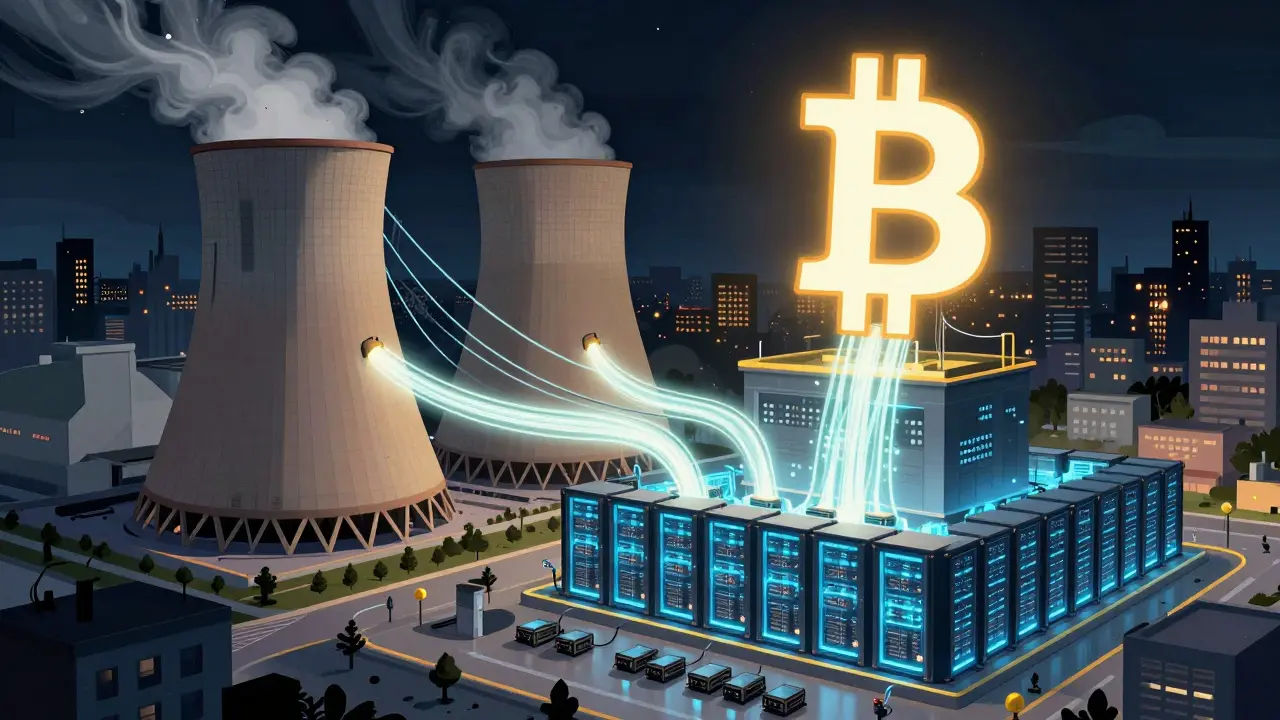
When Pakistan announced it would allocate 2,000 MW of electricity specifically for cryptocurrency mining and AI data centers, the world took notice. Not because it was another country trying to jump on the crypto bandwagon-but because it was doing something no other nation had dared to: turning its biggest energy problem into its biggest opportunity.
Pakistan has had surplus electricity for years. Not a little. Not a few hundred megawatts. A staggering 7,000 MW of unused power, mostly from coal plants running at just 15% capacity. Meanwhile, millions of households face rolling blackouts. The math didn’t add up-until now.
Why 2,000 MW? The Numbers Behind the Decision
The 2,000 MW allocation isn’t random. It’s about 28.5% of Pakistan’s total surplus. That’s enough to power a city the size of Lahore, but instead, it’s being directed to Bitcoin miners and AI servers. At this scale, experts estimate the country could mine up to 17,000 Bitcoin per year. At current prices, that’s roughly $1.8 billion in value.
But it’s not just about Bitcoin. The same power grid can run AI data centers, which are even more energy-hungry than mining rigs. That’s why the government bundled both under one initiative. It’s not just mining-it’s digital infrastructure.
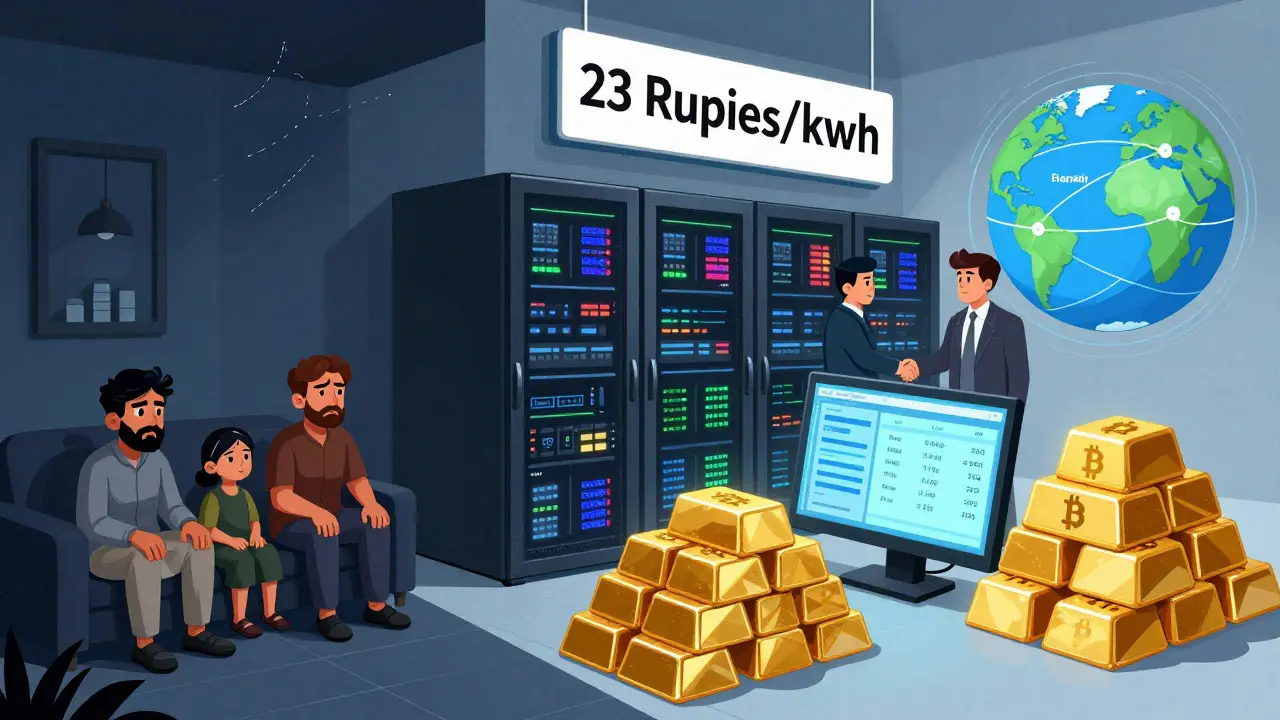
The electricity cost? A flat 23-24 Pakistani rupees per kWh, or about $0.08. That’s half the average cost in Texas and a third of what miners pay in Germany. Even in Kazakhstan, where mining is common, rates hover around $0.09-$0.12. Pakistan’s offer is a magnet for operators looking to slash operational costs.
The Players: Who’s Behind This?
This isn’t a grassroots movement. It’s a top-down government project led by the newly formed Pakistan Crypto Council (PCC), under Finance Minister Muhammad Aurangzeb and Special Assistant to the Prime Minister Bilal Bin Saqib. The PCC isn’t just a regulatory body-it’s a public-private engine. It coordinates with state-owned power companies, international mining firms, and telecom giants like PTCL and Multinet that already run 22 data centers across Lahore, Karachi, and Islamabad.
The biggest signal of credibility? Changpeng Zhao, co-founder of Binance, was brought on as a strategic adviser. That’s not a ceremonial title. He’s helping design the technical and compliance framework. If Binance is involved, this isn’t a gamble-it’s a calculated move.
How It Works: From Power Plant to Bitcoin Block
Here’s how it actually flows: surplus electricity from underused coal plants gets routed through dedicated grid lines to mining hubs. These hubs are built near existing transmission infrastructure to avoid costly upgrades. The mining rigs-thousands of them-are housed in climate-controlled facilities with liquid cooling systems to handle heat and efficiency. The Bitcoin mined isn’t sold immediately. Pakistan has already created its first government-backed Bitcoin reserve, announced at the Bitcoin 2025 conference in Las Vegas. Think of it like a national gold reserve, but digital.
Each mining operator must register with the PCC, prove they’re using clean power infrastructure, and comply with anti-money laundering rules. The government isn’t letting anyone plug in. This isn’t a free-for-all. It’s a controlled experiment with strict oversight.
Why the IMF Is Worried
Not everyone is cheering. The International Monetary Fund (IMF) has pushed back hard. Their main concern? Subsidies. The $0.08/kWh rate is far below what regular consumers pay. The IMF argues this distorts the market. They’ve seen this before-in Pakistan’s power sector, subsidies for fertilizer and fuel led to massive losses and corruption.
IMF officials asked: How will you phase this out? What happens when the price of Bitcoin drops? Who pays when the grid gets overloaded? Pakistan’s answer? We’re not giving subsidies forever. We’re using this as a bridge. The revenue from mining will fund grid upgrades, renewable projects, and eventually, we’ll transition to market rates. But that’s a promise. Not a plan.
Still, the IMF hasn’t blocked it. Both sides say they’re "in negotiations." That’s the diplomatic way of saying: we’re watching closely, but we haven’t pulled the plug.
What This Means for Pakistan’s Economy
Pakistan loses 2.8 trillion rupees ($10 billion) every year from idle power plants. That’s money burning in the dark. Crypto mining turns that loss into revenue. Analysts estimate the 2,000 MW project could generate $500 million annually in direct mining revenue alone-not counting jobs, tech investment, or tax revenue from crypto companies setting up offices.
It’s not just about money. It’s about brain gain. Young engineers in Karachi and Lahore are now learning blockchain, grid management, and smart contract security. Universities are launching new programs. The University of Turbat, for example, opened a 1MW solar-powered data center in 2023. That’s a prototype for what’s coming next.
And it’s attracting foreign capital. Mining firms from the U.S., Canada, and the UAE are scouting locations. One firm told Reuters they’re considering a 500 MW facility in Sialkot. That’s not a rumor-it’s a signed letter of intent.
Global Context: Why Pakistan Stands Out
China banned crypto mining in 2021. Kazakhstan cracked down after power shortages. Even the U.S. struggles with local opposition. But Pakistan? It’s the only country turning its energy surplus into a national strategy.
Its location is a hidden advantage. Sitting between Asia, the Middle East, and Europe, it’s a natural digital bridge. Latency to Dubai? 50ms. To Frankfurt? 80ms. To Singapore? 120ms. That’s better than many European hubs. For AI training and blockchain nodes, speed matters. Pakistan isn’t just selling power-it’s selling connectivity.
The Risks: What Could Go Wrong?
Let’s be real. This could fail.
First, the grid. Mining rigs run 24/7. If 2,000 MW gets pulled suddenly, it could destabilize local grids. The PCC is working with grid operators to install smart meters and dynamic load balancing, but it’s untested at this scale.
Second, regulation. Pakistan is trying to exit the FATF grey list. That means strict AML/KYC rules. If miners hide identities or use offshore wallets, the whole project could be flagged as risky. The government is building a digital identity system for crypto operators-but rollout is slow.
Third, public trust. Many Pakistanis still see crypto as a scam. If blackouts worsen while miners use "free" power, protests could grow. The government is trying to counter this by linking mining revenue to rural electrification projects. So far, it’s working-but only just.
What’s Next?
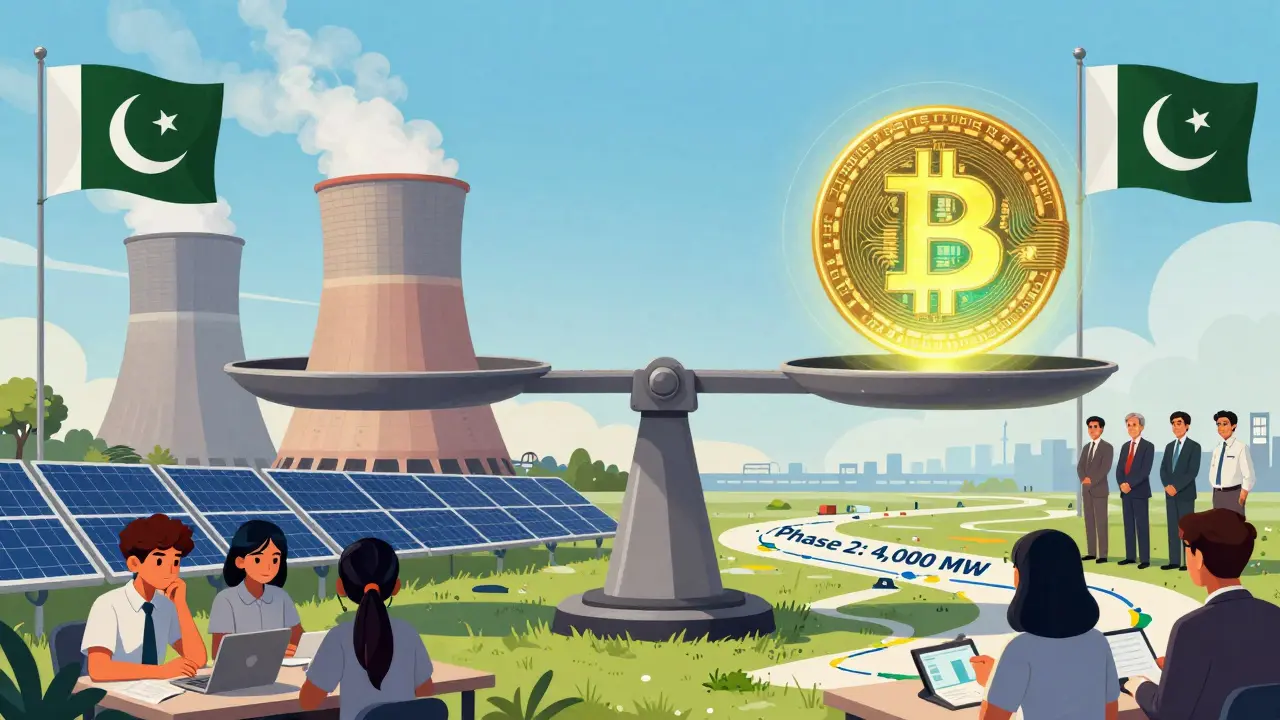
Phase 1 is live. The first 500 MW is already operational. The next 1,500 MW will come online over the next 18 months. Phase 2, expected in 2027, could double the allocation to 4,000 MW-if the IMF signs off and the grid holds up.
There’s talk of using mining revenue to fund solar farms. Imagine this: Bitcoin mining pays for the solar panels that replace coal plants. That’s not just sustainable. It’s revolutionary.
Other countries are watching. Nigeria, Egypt, and Indonesia have sent delegations to Islamabad. They’re not asking for advice. They’re asking for blueprints.
Final Thought: A New Model for the Global South
Pakistan’s 2,000 MW crypto mining project isn’t just about Bitcoin. It’s about rethinking how developing nations use their resources. Instead of begging for aid or taking loans, it’s using what it already has-unused power-to build a digital economy from the ground up.
If it works, it changes everything. It means countries with surplus energy, not just tech talent, can compete in the digital age. No more waiting for Silicon Valley to come to you. You bring the grid. You build the servers. You mine the coins. And you keep the value.
It’s bold. It’s risky. But in a world where energy is the new oil, Pakistan just turned its biggest weakness into its strongest asset.






People Comments
The 2,000 MW allocation is a textbook example of regulatory arbitrage masquerading as economic innovation. Pakistan is essentially offloading its stranded asset problem onto the global crypto mining market by offering subsidized power at 23 PKR/kWh-well below marginal cost. This isn’t a strategy; it’s a structural distortion with embedded systemic risk. The IMF’s concerns aren’t ideological-they’re actuarial.
At 17,000 BTC/year, the revenue stream is theoretically sound, but it’s predicated on perpetual price appreciation. If BTC drops below $80K, the entire model collapses into a negative NPV. And let’s not forget the grid instability: 2,000 MW of constant baseload demand from ASICs is a black swan event waiting to happen in a grid designed for diurnal residential load curves.
The claim that this funds grid modernization is circular logic. Revenue from mining doesn’t automatically translate into infrastructure investment-it gets siphoned into state coffers, then into opaque development funds. We’ve seen this playbook in Venezuela, Nigeria, and Iran. The outcome? Short-term cash infusion, long-term institutional decay.
Changpeng Zhao’s involvement is performative. Binance doesn’t build infrastructure; it extracts liquidity. His advisory role is a branding exercise to legitimize a regulatory loophole. If this were a genuine public-private partnership, there’d be transparency reports, third-party audits, and open data feeds. Instead, we get press releases and LinkedIn posts.
And the AI data center bundling? That’s a red herring. AI workloads are intermittent, bursty, and require low-latency fiber-not coal-powered baseload. The real goal here is crypto mining under the guise of diversification. The government is using AI as a Trojan horse.
Finally, the ‘digital bridge’ narrative is pure geopolitical theater. Latency to Dubai at 50ms? That’s irrelevant if your international bandwidth is throttled by PTCL’s legacy backbone. Pakistan’s fiber infrastructure is not competitive with Singapore or Frankfurt. This isn’t connectivity-it’s aspiration dressed as infrastructure.
Let’s cut through the hype. This isn’t innovation. It’s desperation with a blockchain sticker on it.
They’re burning subsidized coal to mine Bitcoin while people in Sindh can’t get electricity for 12 hours a day. The moral bankruptcy here is staggering.
And don’t give me that ‘revenue will fund upgrades’ nonsense. When has any developing nation ever reinvested windfall crypto profits into public infrastructure instead of private enrichment or political patronage?
The IMF isn’t worried about subsidies-they’re worried Pakistan is about to become the next El Salvador: a cautionary tale of crypto-enabled sovereign failure.
I know this sounds crazy, but I’m actually hopeful about this. 🌱
Pakistan has so much potential, and this might be the spark that turns unused power into real opportunity-not just for mining, but for tech education, jobs, and innovation.
Yes, there are risks. But every big leap starts with a risky step. I’m rooting for the engineers in Lahore and Karachi who are learning blockchain while fixing the grid. That’s the kind of hustle the world needs right now.
Let’s not judge before we see what’s possible. Sometimes, the most unlikely places become the most revolutionary.
this sounds like a scam but i kinda wanna believe it? like if they actually pull this off its gonna be wild. who even thought a country with blackouts could mine bitcoin? lol
Let me get this straight: Pakistan is using taxpayer-subsidized coal power to mine Bitcoin for billionaires while families sit in the dark?
This isn’t economic development. It’s environmental theft disguised as innovation.
And don’t tell me about ‘revenue funding upgrades’-that’s the same lie they told in Nigeria. The only thing getting upgraded is the offshore bank accounts of mining CEOs.
God help us if this becomes a model for other nations.
As someone from India, I find this fascinating. We have similar surplus power issues, especially in coal-heavy states like Jharkhand and Chhattisgarh.
What Pakistan is attempting is bold, but I wonder if they’ve considered the long-term maintenance costs of these mining hubs. ASICs degrade. Cooling systems fail. The grid needs constant tuning.
Maybe instead of just mining, they should partner with universities to train local technicians. That way, the value stays within the country-not just in Bitcoin, but in human capital.
Also, the AI angle is smart. If they can attract inference workloads, the demand becomes more stable than pure mining.
imagine if this works and suddenly pakistan becomes a tech hub instead of just a country with power problems
It’s not about Bitcoin. It’s about using what you have.
Pakistan didn’t wait for Silicon Valley. They didn’t beg for aid. They looked at their idle coal plants and said: ‘What if we turn this into something?’
That’s leadership. That’s creativity.
Yeah, the risks are real. But so are the rewards. And sometimes, you’ve got to move before the playbook is written.
This isn’t a gamble. It’s a blueprint.
Let’s be brutally honest-the entire premise is built on the assumption that Bitcoin’s price will remain stable or rise indefinitely, which is a fantasy rooted in 2021 market psychology. The notion that 2,000 MW of baseload demand can be seamlessly integrated into a grid designed for residential peak-load patterns is laughable. Grid operators don’t deal with 24/7 industrial loads unless they’re nuclear or hydro. Coal plants running at 15% capacity? That’s not surplus-that’s decay. And now they’re turning that decay into a Ponzi-like revenue stream.
The claim that Binance’s involvement lends credibility is absurd. CZ doesn’t care about Pakistan’s infrastructure-he cares about market access. This is a regulatory arbitrage play disguised as a national strategy. The fact that they’re calling it a ‘digital bridge’ while their international bandwidth is throttled by PTCL’s 1990s-era infrastructure speaks volumes. Latency to Dubai? Sure. But if your backbone can’t handle 10 Gbps, you’re not a bridge-you’re a dead end.
The IMF isn’t ‘in negotiations’-they’re waiting for Pakistan to implode so they can swoop in with another structural adjustment program. And when the mining revenue inevitably declines, the state will be left with a decaying hardware graveyard and no funds to decommission it. Welcome to the future of developing-world tech policy.
i think its kind of beautiful honestly like they took something broken and turned it into something that could actually help people if done right
Everyone’s acting like this is genius. But let’s remember: Pakistan has never successfully managed its own power grid. How is this any different?
If they can’t keep lights on in Karachi, how are they going to manage 2,000 MW of crypto mining?
Also, who’s to say this isn’t just a money laundering front for local elites?
I’m not against innovation. I’m against wishful thinking.
This is one of the most under-discussed but potentially transformative economic experiments in the Global South right now.
Let’s break it down: Pakistan has 7,000 MW of stranded power-mostly from coal plants that can’t run at full capacity because demand is too low. That’s not a bug, it’s a design flaw in their energy system. Instead of shutting them down or letting them rot, they’re repurposing them as digital infrastructure hubs.
The 23 PKR/kWh rate? It’s not a subsidy-it’s a price point based on opportunity cost. The coal is already mined. The plant is already built. The labor is already paid. The marginal cost of generating that extra power is near zero. Charging $0.08/kWh isn’t giving away power-it’s capturing value that was otherwise lost.
The real innovation isn’t the mining. It’s the bundling. By tying mining to AI data centers, they’re creating a demand base that’s more resilient than Bitcoin alone. AI workloads are sticky-they don’t move every time BTC dips. Plus, the grid is being retrofitted with smart meters and load-balancing tech. This isn’t just mining-it’s a pilot for modernizing an entire national grid using crypto as the funding engine.
The IMF’s objections are valid, but they’re coming from a place of rigid orthodoxy. Subsidies are bad? Fine. But what’s worse: a subsidy that funds grid upgrades, or a subsidy that keeps a coal plant running at 15% for 20 years while it decays and pollutes?
And yes, the brain gain is real. Universities in Lahore and Turbat are already training students in blockchain, grid cybersecurity, and thermal management. This isn’t just about money-it’s about building a new technical class in a country that’s been overlooked for decades.
If this works, it doesn’t just change Pakistan. It changes how every developing nation with surplus energy thinks about its future. No more waiting for foreign investors. No more begging for aid. You have the grid? You have the power? Then you have the leverage. And Pakistan just proved it.
It’s easy to call this reckless, but I think it’s one of the most pragmatic moves a developing country has made in years.
They’re not creating new energy-they’re using what they already have. That’s not magic. That’s math.
And if the revenue from mining helps electrify villages, train engineers, and upgrade transmission lines? Then this isn’t crypto-it’s infrastructure.
Let’s not forget: the world doesn’t need more idealism. It needs more real solutions.
There is no such thing as ‘stranded energy.’ Energy is not a commodity that can be stranded-it is a physical phenomenon governed by thermodynamics. To suggest that electricity, a flow of electrons, can be ‘unused’ is to misunderstand the very nature of energy systems.
Pakistan’s policy is not an innovation-it is an ontological error, a metaphysical misstep disguised as economic policy. The notion that Bitcoin, a volatile, non-commodity asset, can serve as a ‘reserve’ equivalent to gold is not merely misguided-it is a symptom of a civilization in decline.
The IMF’s hesitation is not bureaucratic obstruction. It is the last vestige of rational governance in a world increasingly governed by memes and mining rigs.
This is not progress. It is a surrender to the digital idolatry of a post-truth age.
So Pakistan took their ‘useless’ power, turned it into Bitcoin, and now everyone’s acting like they invented fire.
Meanwhile, in Australia, we’re still arguing whether solar panels are communist.
Respect. I’m jealous.
i dont know why but this gives me chills like its actually happening and its beautiful and terrifying at the same time
Carol, your optimism is touching. But optimism without structural safeguards is just wishful thinking.
What happens when the grid fails and 500,000 households lose power because a mining hub drew 300 MW too much?
Who gets blamed? The miners? The government? Or the people who already lost their jobs because the coal plant was ‘repurposed’?
Hope is not a policy.
Tony, I hear you.
But sometimes the first step to fixing a broken system is doing something radical.
What if this failure teaches them how to build a better grid? What if this ‘risk’ becomes the blueprint for other countries?
I’m not ignoring the dangers. I’m just choosing to believe in the possibility.