

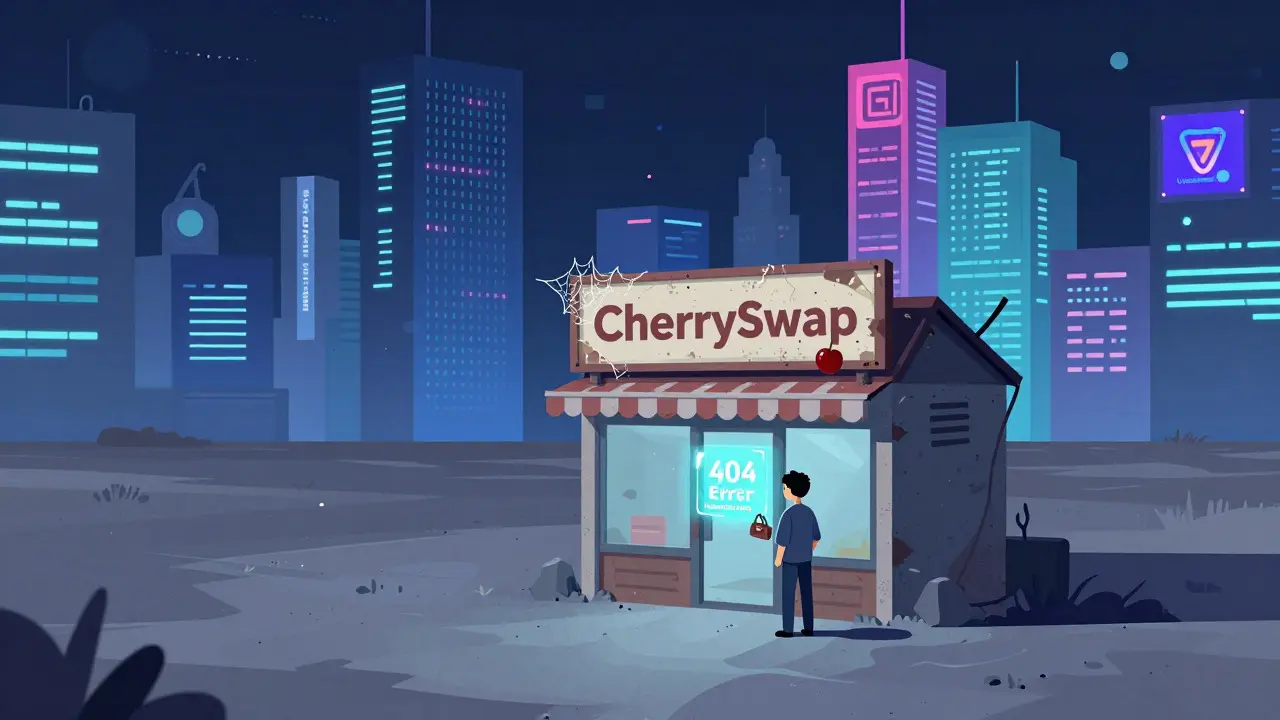
You find a shiny new token on a listing site. The name sounds friendly. The interface looks clean. You think, "Finally, a decentralized exchange that doesn't charge me an arm and a leg." Then you connect your wallet, try to swap a tiny amount, and... nothing happens. Or worse, the transaction fails with a cryptic error about liquidity.
This is the reality of CherrySwap. On paper, it looks like another player in the crowded decentralized finance (DeFi) space. In practice, as of mid-2026, it is a ghost town. This review isn't just about whether CherrySwap is good or bad; it’s about why platforms like this exist, how they disappear, and what you need to check before sending even one satoshi into the void.
The Illusion of Activity
If you scroll through older articles from 2021 or early 2023, you’ll see glowing reviews. CherrySwap was pitched as an automated market maker (AMM) built for speed and low fees. Promoters claimed it ran on Binance Smart Chain (BSC) or OKExChain (OEC), offering sub-cent transactions and near-instant finality. They touted features like yield farming, NFT mints, and Initial Farm Offerings (IFOs).
But here is the hard truth: data from October 2025 shows zero trading volume. CoinGecko lists $0.00 in 24-hour volume. There are no active trading pairs. When you look at blockchain explorers like Etherscan or OKLink, there are no recent transactions linked to CherrySwap’s smart contracts. A platform with zero volume is not a "quiet" exchange; it is a dead one.
Why does CherrySwap still appear on some websites?
Many aggregator sites scrape data automatically. If a token contract exists on the blockchain, it gets listed. However, existence on-chain does not mean operational viability. CherrySwap’s token may still be tradeable on minor legacy exchanges, but the core DEX protocol itself has no liquidity to facilitate swaps.
Technical Contradictions: A Red Flag Parade
In crypto, consistency matters. If a project says it runs on Ethereum, it should run on Ethereum. CherrySwap’s documentation is a mess of contradictions. Some sources claim it uses Binance Smart Chain. Others insist it’s built on OKExChain. Neither claim holds up under scrutiny because there is no activity on either chain associated with the protocol.
Let’s look at the numbers. Active competitors like Uniswap process over $1 billion daily. PancakeSwap handles hundreds of millions. CherrySwap handles nothing. Even if the fees were lower (claimed at 0.25% vs Uniswap’s 0.3%), who cares if there is no one to trade with? Liquidity is the lifeblood of any DEX. Without it, you cannot buy or sell anything without slipping your price by 90% or more.
| Platform | 24h Volume | Active Liquidity Pools | Audit Status | Last Code Update |
|---|---|---|---|---|
| CherrySwap | $0.00 | 0 | No public audits found | June 2022 |
| Uniswap | $1.24 Billion+ | Thousands | Multiple independent audits | Ongoing |
| PancakeSwap | $842 Million+ | Thousands | Regular security checks | Ongoing |
The "Zombie Protocol" Phenomenon
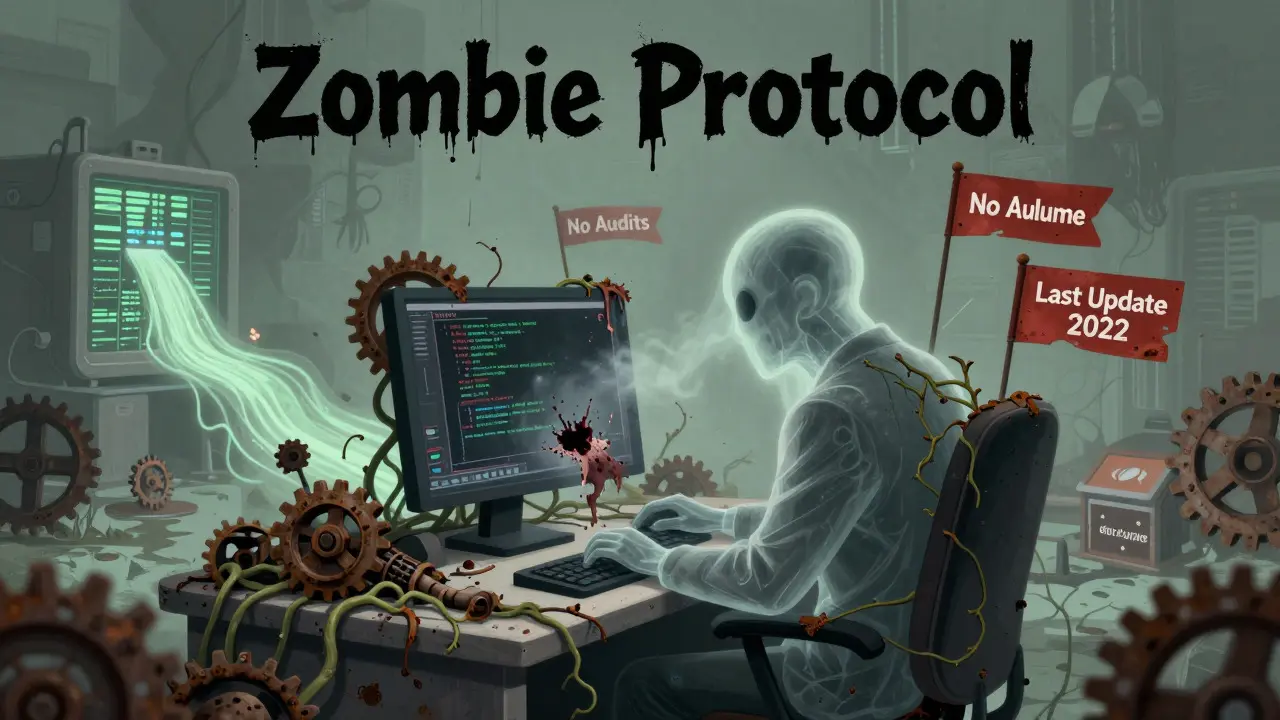
You might wonder, "If it’s dead, why is it still online?" This is known in the industry as a "zombie protocol." These are projects that launched during the hype cycles of 2020-2021, raised some attention, failed to gain traction, and then simply stopped updating. The website remains up. The Twitter account sits silent since 2022. The Telegram group has 200 members, mostly bots.
Dr. Alan Wong from Chainalysis noted in late 2025 that patterns matching CherrySwap-zero volume, missing audits, inactive socials-are present in 83% of identified zombie protocols. They aren’t necessarily scams in the sense that they stole money directly (though some do). They are failures of execution. Developers lose interest, funding dries up, and the code rots.
For you, the user, this is dangerous. Why? Because abandoned code is vulnerable code. Security patches stop coming. If a bug is discovered in the underlying fork (likely Uniswap V2 architecture), CherrySwap will never get fixed. Your funds could be drained by a hacker exploiting a known vulnerability that was patched years ago elsewhere.
Security Audits: The Missing Piece
Every serious DeFi project undergoes smart contract audits. Firms like CertiK, PeckShield, or OpenZeppelin review the code for backdoors. CherrySwap claims to have "robust security measures," but where are the reports? A search of public repositories yields nothing. Blockchain researcher Maria Rodriguez highlighted this absence as a critical red flag. In DeFi, if you can’t verify the audit, assume the code is unsafe.
Compare this to SushiSwap or Curve Finance, which publish their audit history transparently. Trust in crypto is not based on promises; it’s based on verifiable data. CherrySwap offers neither.
User Experience: A Ghost Town
Imagine trying to use CherrySwap today. You visit the URL. It might load, or it might return a 404 error. If it loads, you connect MetaMask. You select a token pair. You click swap. The result? "Insufficient liquidity." Or the transaction reverts. Reddit threads from 2025 show users complaining about exactly this. One user tried to swap 0.5 BNB and failed repeatedly despite the dashboard claiming $2 million in Total Value Locked (TVL). That TVL number was likely fake or stale.
Customer support? Non-existent. Email addresses bounce. Social media is silent. In contrast, Uniswap and PancakeSwap have massive communities, active Discord servers, and responsive teams. When things go wrong-and they always do in crypto-you need help. With CherrySwap, you are on your own.
Who Should Avoid CherrySwap?
Practically everyone. Whether you are a beginner looking for easy swaps or a pro seeking yield farming opportunities, CherrySwap offers nothing but risk. Here is why:
- No Liquidity: You cannot trade effectively.
- No Security Verification: Your funds are exposed to unpatched bugs.
- No Development: The project is stagnant since 2022.
- No Community: No peer support or governance participation.
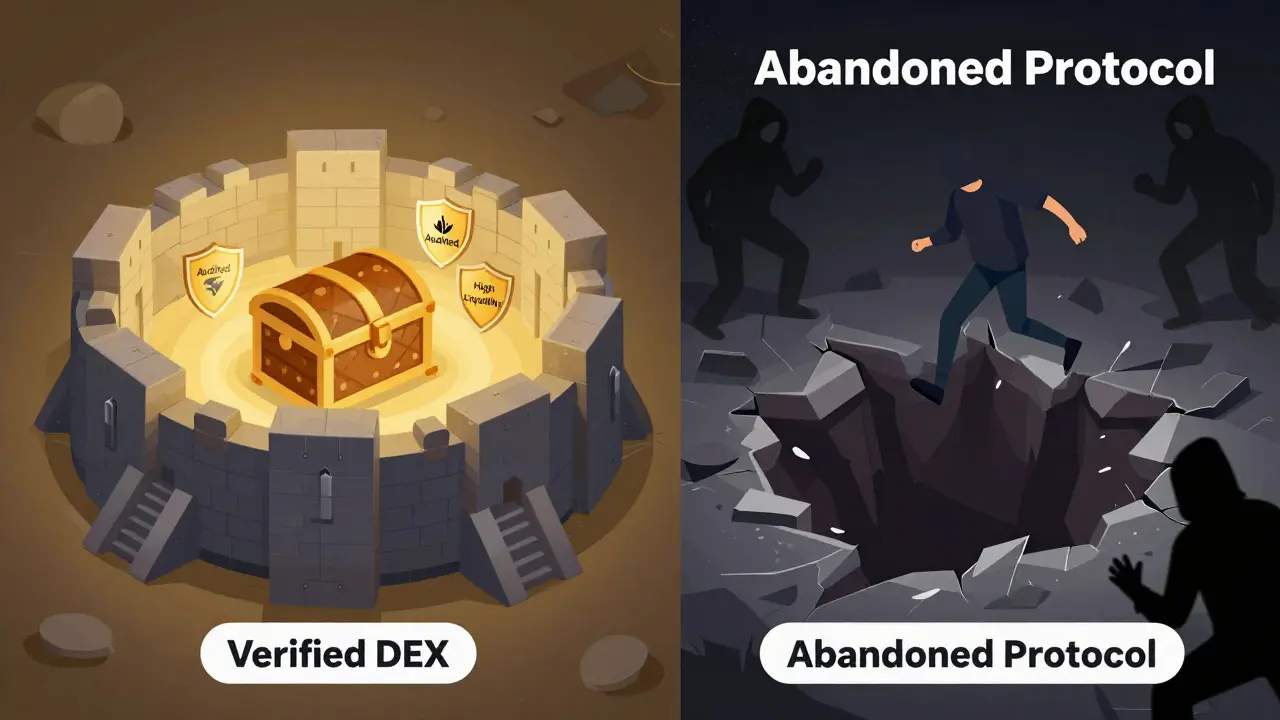
Better Alternatives for 2026
Don’t settle for dead ends. The DeFi space is robust, competitive, and safe-if you choose the right tools. Here are three alternatives that actually work:
- Uniswap: The gold standard for Ethereum-based swaps. High liquidity, extensive token support, and a proven track record. Use it for ERC-20 tokens.
- PancakeSwap: The best option for Binance Smart Chain (BSC) assets. Lower fees than Ethereum, fast transactions, and a huge ecosystem. Great for BNB and BEP-20 tokens.
- Curve Finance: Specialized for stablecoins. If you are swapping USDT for USDC or DAI, Curve offers the lowest slippage and highest efficiency.
These platforms have millions of users, billions in volume, and continuous development. They are not perfect, but they are alive.
How to Spot a Zombie Protocol Yourself
You don’t need to wait for a review to know if a DEX is dead. Check these three metrics before connecting your wallet:
- Volume: Look at DeFi Llama or CoinGecko. If 24h volume is near zero, walk away.
- GitHub Activity: Visit the project’s GitHub. If the last commit was over a year ago, the developers have left.
- Social Engagement: Check Twitter and Telegram. Are real people talking? Or is it just bots posting memes from 2021?
Applying this checklist to CherrySwap reveals a clear picture: zero volume, no code updates since June 2022, and a dead social presence. It is a textbook example of a project to avoid.
Final Thoughts
Crypto moves fast. Projects rise and fall. CherrySwap was once part of the narrative, but it failed to deliver value. Today, it serves as a cautionary tale. Don’t let outdated listings or vague promises lure you into a dead protocol. Stick to established platforms with verified data, active development, and real liquidity. Your funds are safer there, and your trading experience will be infinitely better.
Is CherrySwap a scam?
It is difficult to label it a direct "scam" in the legal sense if no funds were actively stolen via phishing, but it fits the profile of a "rug pull" or abandoned project. The lack of audits, contradictory technical claims, and zero activity suggest negligence or intentional abandonment. For the user, the outcome is the same: your capital is at risk with no recourse.
Can I still hold CHE tokens?
You can hold them, but their utility is near zero. Without a functioning DEX or active ecosystem, the token has no intrinsic demand. Liquidity on minor exchanges is negligible, meaning selling large amounts would crash the price instantly. Treat it as a sunk cost unless a revival occurs (highly unlikely given the 2022 stagnation).
Why did CherrySwap fail?
Likely due to intense competition. By 2021, Uniswap and PancakeSwap had already captured most market share. CherrySwap offered no significant technological advantage to justify switching costs for users. Combined with potential mismanagement and lack of marketing budget, it faded into obscurity.
What is the safest DEX for beginners?
Uniswap is generally considered the safest starting point due to its transparency, extensive documentation, and deep liquidity. For users on Binance Smart Chain, PancakeSwap is the equivalent leader. Both have user-friendly interfaces and strong community support.
How do I check if a DEX is active?
Use DeFi Llama to check Total Value Locked (TVL) and volume trends. Visit the project’s GitHub to see recent commits. Check their official Twitter and Discord for recent, non-bot interactions. If any of these are missing or stale, proceed with extreme caution.