



Imagine storing a document, a video, or even a full website - and knowing it will still be there in 200 years. Not just backed up. Not just copied. But permanently preserved, uncensored, and always accessible. That’s what Arweave does. Unlike cloud services that charge you every month, or even other blockchain storage projects that need recurring payments, Arweave asks for one payment - and then guarantees your data will last forever.
How Arweave Makes Data Last Forever
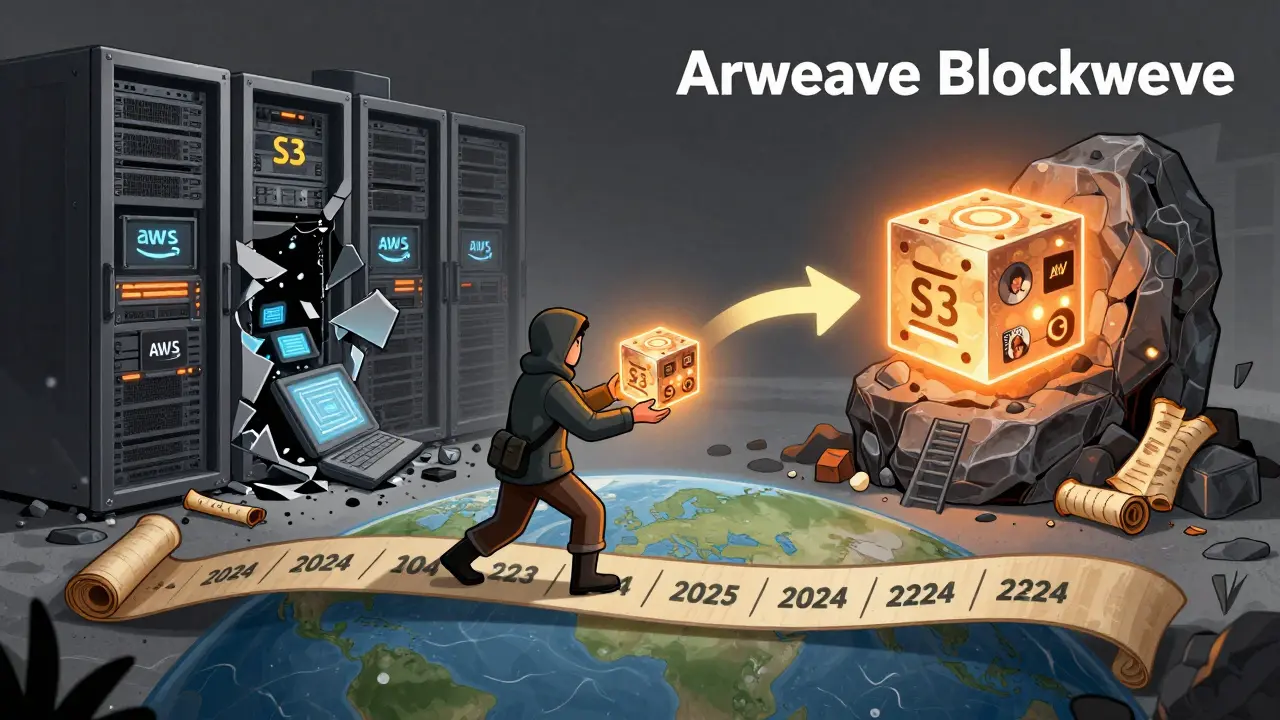
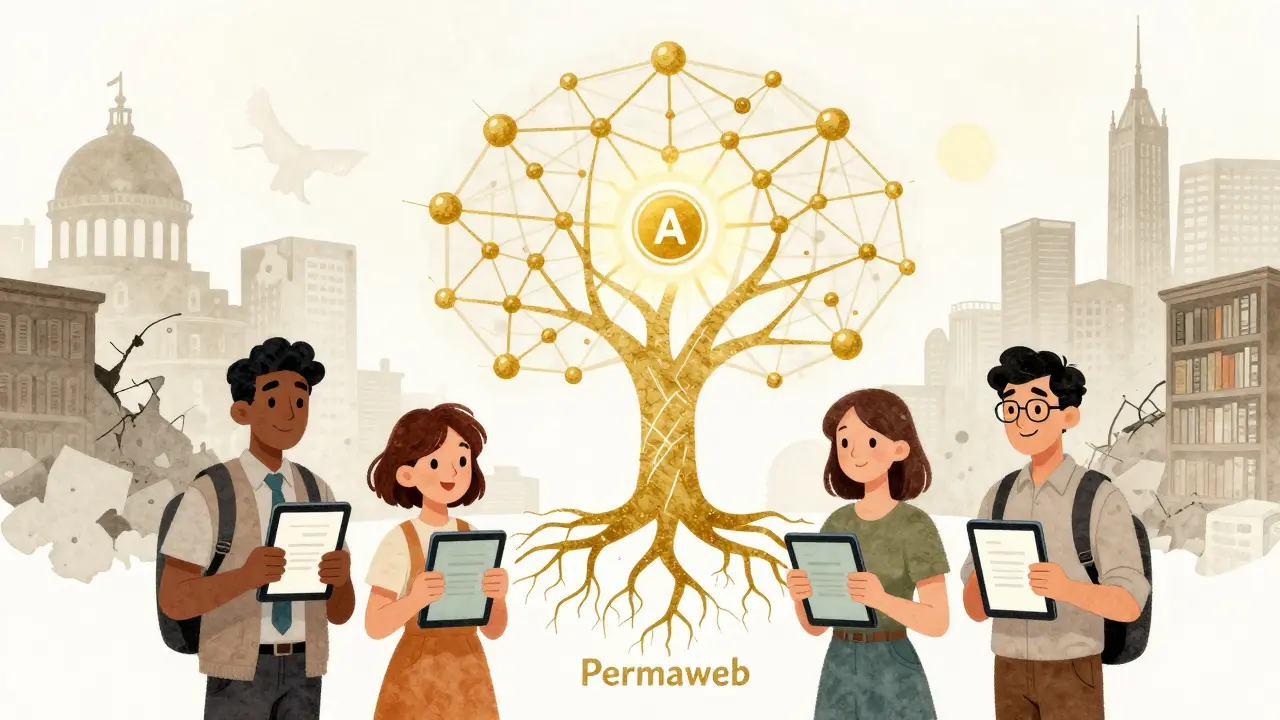
Most digital data disappears. Websites go offline. Hard drives fail. Companies shut down. Even big archives like the Wayback Machine can’t promise your data will survive decades. Arweave changes that. It doesn’t just back up data - it embeds it into a system designed to never stop working. At its core, Arweave uses something called the Blockweave a data structure that links each new block to both the previous block and a randomly chosen older block, forcing miners to keep historical data alive. This isn’t a regular blockchain. In Bitcoin or Ethereum, miners only need to keep recent blocks to validate new transactions. In Arweave, every time a miner adds a new block, they must also prove they have a piece of old data from somewhere in the past. If they don’t, they can’t mine. This creates a built-in incentive: to earn rewards, you must preserve history. This system turns storage into a self-sustaining loop. The more data gets added, the more miners are required to remember it. There’s no need to pay again. No subscription. No renewal. Once you pay, your data becomes part of the Permaweb the permanent, decentralized web built on top of Arweave where all uploaded content is permanently accessible.The One-Time Payment Model
Here’s the big shift: Arweave doesn’t charge monthly. It charges once. For example, storing 1 GB of data costs around $10-$15 in AR tokens today. That’s it. You pay once, and Arweave guarantees your data will be stored for at least 200 years. How? The payment isn’t just for storage. It’s split into two parts:- 15% goes directly to miners as payment for storing and serving your data over the next 200 years.
- 85% goes into a endowment a reserve fund designed to grow over time as storage hardware becomes cheaper, ensuring future miners are paid even as costs decline.
What Can You Store on Arweave?
You can store anything. Text. Images. Videos. Full websites. Apps. Archives. There are no file size limits. No format restrictions. As long as you can upload it, Arweave will keep it.- Historical records: The Internet Archive has partnered with Arweave to permanently store over 250,000 web pages that might otherwise vanish.
- Decentralized apps: Developers host entire dApps on the Permaweb. No servers. No hosting fees. Just a URL that never breaks.
- Journalism: Reporters in authoritarian countries upload investigations to Arweave so they can’t be erased.
- Blockchain data: Ethereum projects use Arweave to store transaction histories, smart contract logs, and NFT metadata - all permanently.
arweave.net. These are public servers that act like browsers for the Permaweb. You don’t need a wallet to view data - just a link. But only those who paid can upload.
How It Compares to Other Storage Solutions
Arweave isn’t trying to replace Dropbox or Google Drive. It’s not even trying to beat Filecoin or Sia. Those services are for short-term, active storage. Arweave is for history.| Feature | Arweave | Filecoin | IPFS | AWS S3 |
|---|---|---|---|---|
| Payment Model | One-time fee | Monthly rental | Free, but no guarantee | Monthly fee |
| Permanence | Guaranteed 200+ years | Only as long as you pay | Depends on peers | Only as long as you pay |
| Censorship Resistance | Yes - decentralized | Yes | Yes, but not permanent | No - corporate control |
| Best For | Archives, history, immutable records | Active data, backups | Content distribution | Active cloud storage |
| Data Updates | Write-once only | Can update | Can update | Can update |
Who’s Using It - And Why
The biggest users right now are developers and archivists.- Ethereum projects use it to store NFT art and metadata. If the blockchain breaks, the art lives on Arweave.
- Journalists upload sensitive documents to avoid deletion. One user uploaded a report on corruption in 2021 - it’s still live today.
- Open-source projects store documentation so future devs can always access it.
- Libraries and museums are starting to use it for digitized artifacts.
Challenges and Limitations
Arweave isn’t perfect. Here are the real problems people face:- Cost estimation is tricky. You need to know how big your data is and what the AR token price is. If AR’s price swings, your storage cost changes. There’s no simple calculator - yet.
- Not for frequent updates. Trying to update a blog every day? That’ll cost you a fortune. Arweave is for static content.
- Learning curve. If you’ve never used crypto wallets or blockchain tools, setting up takes time. The documentation is good for experts but overwhelming for beginners.
- Speed. Retrieving data isn’t instant. It takes 10-20 minutes for a new upload to be fully replicated. For archives? Fine. For streaming video? Not ideal.
How to Get Started
If you want to try it:- Get an Arweave wallet (like ArConnect a browser extension wallet for interacting with Arweave and the Permaweb).
- Buy AR tokens (around $8.50 each as of early 2026).
- Go to arweave.net and upload your file.
- Copy the unique URL it gives you - that’s your permanent link.
The Bigger Picture
Arweave isn’t just a storage tool. It’s a cultural experiment. It’s asking: What if we built a digital library that outlasts governments? What if we preserved every important moment - not because we’re forced to, but because we designed it to last? Right now, Arweave holds over 450 million pieces of data. That’s more than 100 million web pages, thousands of videos, and millions of documents. The growth is steady - up 18% in just one year. Future upgrades like Blockshadows a planned upgrade to Arweave that will improve data retrieval speeds by up to 400% by caching frequently accessed blocks (coming in 2024) will make it faster. More tools are being built to connect it to websites, apps, and even AI models. The goal? To become the foundation of human digital memory. Not just for crypto. For history.Final Thoughts
Arweave doesn’t solve every storage problem. But it solves one that matters deeply: permanence. In a world where data vanishes overnight, it offers something rare - true endurance. If you’re a developer, journalist, historian, or just someone who values truth and continuity - this is worth trying. Upload something today. Not because you need it tomorrow. But because you want it to still exist in 2126.Is Arweave really permanent, or is it just a marketing claim?
Arweave’s permanence is built into its economic and technical design. Unlike cloud services that rely on ongoing payments, Arweave uses a one-time fee with an endowment that grows as storage costs drop. Miners are financially incentivized to keep historical data because they must retrieve random old blocks to mine new ones. This creates a self-sustaining system. While no system can guarantee survival forever, Arweave’s model is mathematically designed to last 200+ years - and possibly much longer. Independent audits and real-world usage (like the Internet Archive’s partnership) confirm its reliability.
Can I edit or delete data after uploading to Arweave?
No. Once data is uploaded to Arweave, it becomes immutable. This is intentional. The system is built for permanent records, not dynamic content. You can’t delete or overwrite files. If you need to update something, you upload a new version with a new URL. This is a feature, not a bug - it ensures data can’t be censored or altered.
How much does it cost to store data on Arweave?
As of early 2026, storing 1 GB costs between $10 and $15 in AR tokens, depending on token price. This one-time fee covers storage for at least 200 years. For comparison, AWS S3 would cost over $550 for the same amount of data over the same period. The cost is calculated based on file size and current AR token value - tools like the Arweave calculator help estimate this before upload.
Do I need to understand blockchain to use Arweave?
You don’t need deep blockchain knowledge to upload files using the web interface at arweave.net. But if you’re building apps or automating uploads, you’ll need to understand wallets, tokens, and APIs. For beginners, using ArConnect (a browser extension) and the web uploader is enough. For developers, the ArweaveJS library and documentation make integration manageable, though there’s still a learning curve.
What happens if the AR token price crashes?
The endowment model is designed to handle this. When you pay for storage, 85% of your fee goes into a reserve that grows over time. Even if AR’s price drops, the endowment’s purchasing power increases as storage hardware gets cheaper. The system assumes storage costs will fall faster than token prices decline. This means the network can still pay miners adequately even if AR loses value - as long as hardware continues to improve.
Is Arweave legal? Can governments shut it down?
Arweave is decentralized and runs on thousands of independent nodes worldwide. No single company or server controls it. Governments can’t shut it down the way they shut down websites or cloud services. However, they can ban AR token trading or restrict access to gateways. This makes it ideal for preserving censored content - but users should be aware of local regulations around cryptocurrency use.
Can I use Arweave to store my personal photos and videos?
Yes - and many people do. It’s especially useful for irreplaceable memories like family videos, wedding photos, or childhood recordings. Since the data is permanent and uncensorable, it’s a powerful way to preserve personal history. Just remember: you can’t edit or delete it later. So only upload what you want to keep forever.
How does Arweave differ from IPFS?
IPFS is a peer-to-peer file system that lets you share files, but it doesn’t guarantee they’ll stay available. If no one is pinning your file, it disappears. Arweave pays miners to keep every file forever. IPFS is great for distributing content; Arweave is built to preserve it. Many projects use both: IPFS for fast access and Arweave for permanent backup.
- Poplular Tags
- Arweave
- permanent storage
- blockchain storage
- decentralized storage
- Permaweb





People Comments
This is literally the future 😍 I uploaded my grandma’s video diary last year and checked last week-still there. Perfect. No subscription. No panic. Just pure magic. 🚀❤️
OMG I’ve been waiting for something like this forever. I’ve lost so many family photos to hard drive crashes. Now I’m uploading everything-birth certificates, wedding videos, my toddler’s first steps. Forever is a vibe. 💫
It’s fascinating how Arweave turns storage into a cultural artifact rather than a service. The endowment model is essentially a bet on human progress-on the idea that technology will keep getting cheaper. It’s optimistic, almost poetic. What if we applied this logic to other systems? Education? Healthcare? Maybe permanence isn’t just about data-it’s about values.
I appreciate the clarity here. The one-time fee structure is brilliant. But I do want to note: the 85% endowment relies on historical trends in storage cost decline-which have been accelerating, yes, but not linearly. Also, token volatility isn’t fully addressed. If AR crashes 90%, and hardware costs plateau? The math gets shaky. Not a dealbreaker, but worth deeper scrutiny.
I’ve been using this for my open-source docs. No more worrying about GitHub vanishing or docs getting buried. The link just works. And the fact that I can’t delete it? Honestly? That’s the best part. Forces me to think before I post. Good discipline.
So basically it’s like a digital time capsule you pay for once. I like it. Not for my cat videos though. Too expensive for memes. But yeah, for stuff that matters? 100%.
Why pay once when you can just use google drive for free? This feels like crypto bro nonsense
I tried it. Took 17 mins to upload a 500mb video. Then I checked the link. Broken. 😑
i uploaded my poem last month and forgot about it. just checked today. its still there. wild. arweave is kinda chill
The Blockweave architecture leverages a verifiable proof-of-storage mechanism with recursive block referencing, which inherently creates an economic incentive alignment between miners and historical data retention. The endowment, as a forward-looking liquidity pool, amortizes future operational costs via deflationary storage economics. This is not merely a storage protocol-it’s a temporal commitment engine.
Oh wow, a 'permanent' blockchain storage solution. How very 2018. Let me guess-the whitepaper says 'decentralized' but the devs are all in Miami. And of course, it's only 'permanent' until the next bear market when everyone abandons their nodes. Classic.
I’m concerned about the ethical implications of permanent, unchangeable data. What if someone uploads private information, doxxing, or illegal content? There’s no recourse. This isn’t innovation-it’s a legal nightmare waiting to happen.
Let’s be real. You’re paying in crypto for a service that takes 20 minutes to load a photo. And you think this is better than AWS? You’re not preserving history-you’re just making your data slower and more expensive. This isn’t a revolution. It’s a glorified USB drive with a blockchain sticker.
America built the internet. Now we’re outsourcing our digital future to a token that’s worth less than my coffee? This is why the world hates us. Get your own storage. We don’t need your crypto weirdness.
I think this is a government tracking tool. They know if you upload something. The endowment? Fake. The whole thing is a front to collect metadata. They’re already storing your uploads. Trust no one.
I tried it... it didn't work... I paid... I'm so mad... I just want my money back... please... I just wanted to save my cat video...
I love how this lets people preserve things that matter. My dad passed last year. I uploaded his letters. I don’t need to check them every day. I just know they’re there. That’s peace.
I uploded a video of my dog and now i cant find the link again. i think i spelt the adress wrong. its so frustating. why cant it be easier