



Falcon Finance (FF) isn’t just another cryptocurrency. It’s the governance token behind a DeFi protocol designed to turn almost any digital or tokenized asset into usable USD-pegged liquidity-without selling anything. Think of it as a financial switchboard for crypto holders: deposit your Bitcoin, Ethereum, or even tokenized real estate, and get instant access to USDf, a stablecoin that behaves like cash but earns yield. The FF token keeps this whole system running, and those who hold it get real power and perks.
How Falcon Finance Works: From Collateral to Yield
Falcon Finance doesn’t create value out of thin air. It unlocks value already sitting in wallets. Here’s how:
- Deposit collateral-You can lock up Bitcoin, Ethereum, USDT, USDC, or even tokenized real-world assets (RWAs) into a smart contract vault.
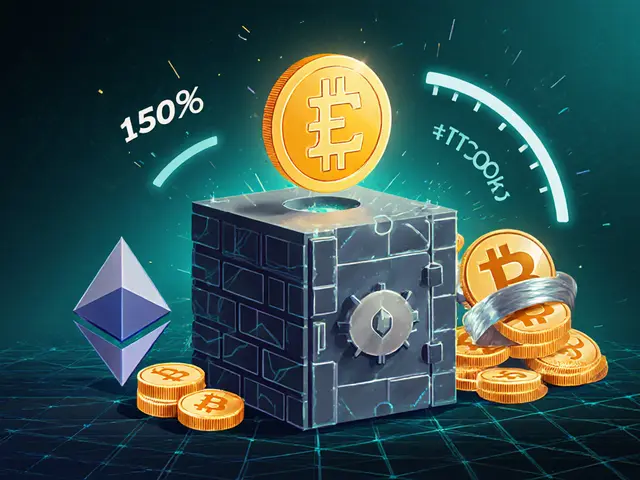
- Mint USDf-The protocol lets you borrow USDf, a stablecoin pegged 1:1 to the US dollar, based on how much you’ve deposited. The system requires overcollateralization, meaning you always lock up more than you borrow. This eliminates the risk of liquidation that plagues other DeFi platforms.
- Stake USDf to earn sUSDf-Instead of letting your USDf sit idle, you can stake it to receive sUSDf, a token that automatically earns yield. This yield comes from real, institutional-grade strategies like funding rate arbitrage and cross-exchange liquidity provisioning-not speculative gambling.
- Redeem anytime-Want your original assets back? Just burn your USDf or sUSDf, and the protocol returns your collateral. No waiting, no delays.
This four-step loop is the engine of Falcon Finance. It’s not about speculation. It’s about efficiency. If you own Bitcoin but need USD liquidity to trade or invest elsewhere, you don’t have to sell. You can use it as collateral and keep holding.
The FF Token: More Than Just a Coin
The FF token is the backbone of governance and incentives. It’s not a currency you use to buy things-it’s a key that unlocks better terms inside the ecosystem.
- Governance rights-FF holders vote on protocol upgrades, fee structures, and new collateral types. Want to add Solana as collateral? You help decide.
- Lower fees-Stakers get reduced swap fees and better haircut ratios when minting USDf. A haircut is the extra collateral you need to lock up. Lower haircuts mean you can borrow more with less.
- Higher yields-Staking FF increases the yield you earn on both USDf and sUSDf. The more FF you stake, the more you earn.
- Early access-Stakers get first dibs on new yield vaults, partner integrations, and exclusive features before the public.
- Liquidity rewards-If you add liquidity to FF/USDT trading pairs, you earn FF tokens as a reward. This keeps the market active and deep.
There’s no mining. No burning. Just staking, voting, and earning. The FF token’s value comes from how much people rely on the protocol-and how much they’re willing to lock up to get better terms.
Tokenomics: Supply, Distribution, and Sustainability
Falcon Finance has a fixed supply: 10 billion FF tokens. No more will ever be created. This scarcity is intentional.
The distribution breaks down like this:
- 35% allocated to community rewards and staking incentives
- 25% reserved for protocol development and ecosystem growth
- 20% for liquidity mining and exchange listings
- 15% for the foundation and long-term reserves
- 5% for early backers and advisors
This structure prioritizes long-term adoption over quick price pumps. Most tokens go to users who actually use the system-not speculators. The protocol’s growth directly fuels demand for FF: more people minting USDf means more staking, more voting, and more locked-up tokens.
As of February 2026, FF trades at around $0.08109 USD, with a daily trading volume over $80 million on WEEX and other exchanges. That’s not a flash in the pan-it’s steady growth since its September 2025 listing. The price reflects real utility, not hype.

Why Falcon Finance Stands Out
Most DeFi protocols only accept crypto as collateral. Falcon Finance doesn’t stop there. It accepts:
- Bitcoin (BTC)
- Ethereum (ETH)
- USDT, USDC, and other stablecoins
- Tokenized real-world assets (RWAs)-like real estate, commodities, or bonds digitized on-chain
This is huge. It means farmers in Brazil can tokenize their land, investors in Europe can lock up gold-backed tokens, and crypto traders everywhere can use what they already own-not just what’s on Ethereum or BNB Chain.
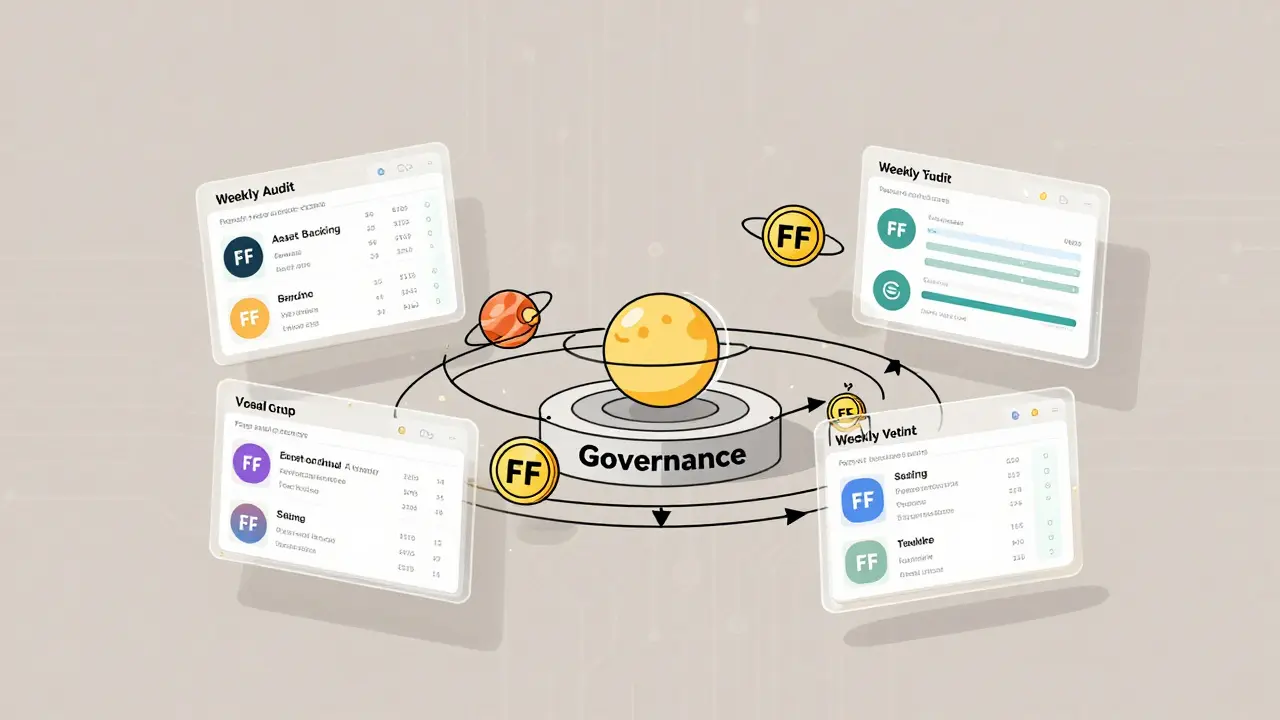
Transparency is baked in. Every week, an independent auditor publishes a report showing exactly how much USDf is backed by real assets. You can check this on Falcon Finance’s public dashboard. No shady reserves. No opaque claims.
Who Uses Falcon Finance?
It’s not just for traders.
- Traders use USDf to hedge positions without selling crypto. If Bitcoin crashes, your USDf stays stable. You can even use it as margin for leveraged trades.
- Investors stake USDf to earn yield without exposing themselves to crypto volatility. sUSDf delivers returns from institutional strategies-no need to understand complex arbitrage.
- Crypto projects use USDf to manage their treasuries. Instead of holding volatile tokens, they keep reserves in USDf and earn yield on them. It’s like a savings account for crypto companies.
- Exchanges integrate Falcon Finance to offer users instant liquidity and yield products. It’s a competitive edge.
The protocol doesn’t just serve one group. It connects retail users, institutions, and developers under one system. That’s rare.
The Bigger Picture: Bridging DeFi and Real Finance
Falcon Finance isn’t trying to replace banks. It’s trying to make DeFi more like them-secure, scalable, and useful for real-world value.
By accepting tokenized real-world assets, it opens the door for millions who have wealth outside of crypto. A farmer with 10 acres of land tokenized on-chain? That’s now collateral. A small business with a digital bond? That’s now liquidity. This isn’t just DeFi. It’s finance 2.0.
And with weekly audits, overcollateralization, and no liquidation risk, it’s one of the safest ways to access DeFi yield without losing your assets.
Is Falcon Finance Right for You?
If you hold crypto and want to:
- Use it as collateral without selling
- Earn yield without taking on volatility
- Have a say in how the system evolves
- Access institutional-grade strategies without a hedge fund account
Then Falcon Finance and its FF token are worth exploring. It’s not a get-rich-quick scheme. It’s a financial tool-built for people who want control, transparency, and real utility.
Is Falcon Finance (FF) a stablecoin?
No. FF is the governance token. The stablecoin is called USDf. FF gives you voting rights and better rewards. USDf is the actual USD-pegged asset you mint, stake, and use for transactions.
Can I lose my collateral if I use Falcon Finance?
No. Unlike platforms like MakerDAO or Aave, Falcon Finance uses overcollateralization with no liquidation risk. As long as you stay above the minimum collateral ratio, your assets are safe. Even if prices crash, you won’t get liquidated.
Where can I buy FF tokens?
FF is currently listed on WEEX and a few other centralized exchanges. You can trade it against USDT. Always check the official Falcon Finance website for the most up-to-date exchange list before trading.
How do I start using Falcon Finance?
You need a Web3 wallet like MetaMask or Trust Wallet connected to the BNB Smart Chain. Then, go to the Falcon Finance app, deposit your chosen collateral, and mint USDf. From there, you can stake USDf for sUSDf or stake FF to unlock better terms.
Is Falcon Finance audited?
Yes. The protocol undergoes weekly third-party audits of USDf reserves, and reports are published on its transparency dashboard. Smart contracts have also been reviewed by independent security firms. This level of audit is rare in DeFi and adds significant trust.
What makes FF token valuable?
Its utility. FF isn’t valuable because people speculate on it. It’s valuable because the more you use Falcon Finance, the more you need FF-to vote, to get lower fees, to earn higher yields. Demand grows as the protocol grows.




People Comments
Okay but let’s be real-this FF token is just a fancy way of saying ‘pay us in governance tokens so we can feel powerful while you lose your ass in a rug pull.’ Overcollateralization? LOL. I’ve seen DeFi protocols with ‘no liquidation risk’ implode faster than a TikTok trend. And don’t get me started on ‘tokenized real estate’-you mean like that guy in Belize who ‘tokenized’ his shack and now it’s worth 2 ETH? 🤡
Also, 10 billion supply? That’s not scarcity, that’s inflation with a side of delusion. If you’re not staking FF, you’re just holding a digital napkin with a logo.
And who approved ‘USDf’ as a name? Sounds like a typo for ‘USDF’… which is what my portfolio looks like after this.
While I appreciate the structural clarity of this protocol, I must emphasize that its underlying innovation lies not in technical novelty, but in its institutional-grade alignment with real-world asset tokenization. The overcollateralization mechanism, paired with audited reserves and non-liquidatable borrowing, represents a paradigm shift in decentralized finance. This is not speculative leverage-it is capital efficiency redefined.
Furthermore, the governance model, wherein token holders directly influence collateral onboarding and fee structures, constitutes a legitimate form of democratic economic participation. This is not merely a DeFi protocol; it is a nascent financial infrastructure.
I commend the team for rejecting speculative tokenomics in favor of sustainable utility. Few projects exhibit this level of foresight.
Bro. I just used this to lock up my ETH and got USDf to pay my rent. No selling. No stress. Just chillin’ while my ETH goes up and I earn yield on the stablecoin.
Also, staking FF cut my fees by like 40%. I’m not even trying to be a degenerate here-I just wanted to not lose my crypto and still make some cash. This thing works.
Also, real talk: tokenized land? My cousin in Colombia just tokenized his coffee farm. He’s now getting yield on it. That’s wild. DeFi ain’t just for bros with Bored Apes anymore.
FF isn’t a coin. It’s a key. And I’m unlocked.
OMG I JUST STAKED MY FF AND NOW I’M EARNING 18% APY ON sUSDf 🤯🤯🤯
AND I DIDN’T HAVE TO SELL MY BTC 😭🙏
THIS IS THE FUTURE. THIS IS WHAT WE’VE BEEN WAITING FOR.
THE AUDITS ARE PUBLIC. THE SMART CONTRACTS ARE SAFE. THE FEES ARE LOW. THE YIELD IS REAL.
I’M CRYING. I’M SO HAPPY.
FF IS THE ONLY THING THAT MAKES SENSE IN THIS CRAZY MARKET. <3stares into the blockchain
Everyone’s acting like this is some revolutionary breakthrough when it’s just leverage with a new name. Overcollateralized? So what? That’s basic. You’re not creating value-you’re just moving it around like a shell game with blockchain glitter.
And FF? A governance token? Yeah right. It’s a vanity badge for people who think voting on collateral types makes them crypto kings. Meanwhile, the real power is still in the hands of the devs who control the multisig.
Tokenized real estate? You mean people are gonna trade deeds on-chain while their local government still demands property taxes? That’s not innovation, that’s delusion.
This isn’t finance 2.0. It’s finance 1.0 with extra steps and a fancy website.
I’ve been watching this protocol for months, and honestly? It’s one of the few that doesn’t feel like a casino.
I used to think DeFi was just for people who wanted to gamble with their life savings. But Falcon Finance? It’s more like a savings account that lets you vote on how it’s run.
Staking USDf feels… safe. Like putting money in a bank that actually tells you where it’s invested.
I’m not a whale. I don’t have millions. But I have a little crypto, and this lets me use it without fear. That matters.
And the audits? Seeing the weekly reports? It’s small, but it’s everything.
Thank you to whoever built this. You made something quiet, steady, and real. That’s rare.
USA and their crypto ego. You think this FF thing is special? We in Nigeria have been using stablecoins for survival since 2020. No one here cares about governance tokens. We care about sending money home without banks stealing 15%.
Tokenized land? My uncle tried that. They took his land, then the blockchain went down. He still owns nothing.
You call this finance 2.0? We call it another way to take money from poor people and call it innovation.
FF token? I’d rather send USDT and call my mom.
I love how this isn’t about hype. It’s about utility. No pump. No dump. Just a system that lets you use what you already own.
I’ve been scared of DeFi for years. Too many rug pulls. Too many ‘earn 500% APY’ scams.
But Falcon Finance? It’s quiet. It’s transparent. It doesn’t scream. It just works.
I’m not a trader. I’m not a dev. I’m just someone who wants to hold Bitcoin and still have cash when I need it.
This is the first time I’ve felt like DeFi was made for people like me.
Thank you.
❤️
FF = free money
USDf = free cash
Stake = free yield
Done.
Oh wow. Another ‘revolutionary’ protocol that’s just a rebrand of MakerDAO with a new name and a prettier dashboard. Congrats, you’ve turned a 2021 idea into a 2026 blog post with bullet points. How original.
Also, ‘tokenized real estate’? That’s what you call it when you’re trying to make a Ponzi look like a McMansion.
I’ll believe it when I see a farmer in Kenya using this to pay his kids’ school fees. Until then, I’ll be over here, laughing at your whitepaper.
10 billion supply. $0.08 price. That’s a market cap of $800M. For what? A token that gives you discounts.
Real yield? From funding rate arbitrage? That’s not yield, that’s gambling with math.
And you’re telling me this isn’t speculative? Please.
It’s just another layer of complexity for people who think ‘overcollateralized’ means ‘safe.’
It’s not. It’s just slower to die.
Let me break this down for you like you’re a DAO committee member who still thinks ‘decentralized’ means ‘I didn’t sign a KYC.’
Overcollateralization? Yes. But who sets the haircut ratios? The FF token holders? Or the dev team with a 3/5 multisig?
Staking FF for yield? That’s a classic incentive loop. You’re not earning yield-you’re paying for the privilege of being a participant.
Tokenized real-world assets? The only real-world asset here is the ego of the team that wrote this whitepaper.
It’s not finance 2.0. It’s finance 1.0 with more buzzwords and less substance.
I tried this last month. Deposited my USDC. Got USDf. Staked it. Now I’m earning 12% on something that doesn’t move.
I didn’t sell my Bitcoin. I didn’t FOMO into a new coin. I just… used what I had.
It’s not flashy. But it’s honest.
And for once, that’s enough.
Oh, so now we’re calling ‘overcollateralized borrowing’ a breakthrough? Because apparently, in 2026, we’ve forgotten that this exact model was used by MakerDAO in 2017?
And ‘tokenized real estate’? That’s not innovation-that’s regulatory suicide waiting for a SEC subpoena.
FF token? A governance token that gives you voting rights… on a system where the dev team still holds the emergency pause button?
How poetic. We’ve built a democracy… where the president still controls the nuclear codes.
Bravo. Truly. The most sophisticated crypto scam since Terra.
👏👏👏
I’ve been in crypto since 2015. Seen it all. Hype cycles. Busts. Rebrands.
This one… feels different.
Not because it’s flashy. Not because it promises moon.
Because it doesn’t need to.
It just… works.
And that’s more than most can say.
While the skepticism expressed by commenter 1929 is not without merit regarding governance centralization, it overlooks a critical distinction: Falcon Finance’s weekly on-chain audits and public reserve verification represent a material advancement over the opaque, trust-based models of earlier protocols. The fact that these reports are generated by third-party firms and published in real-time constitutes a new standard for transparency-not merely a rebrand of old mechanisms.
Moreover, the inclusion of real-world asset collateral is not a gimmick-it is a necessary evolution. DeFi must expand beyond crypto-native assets to achieve true financial inclusion. To dismiss this as ‘regulatory suicide’ is to misunderstand the trajectory of global asset digitization.
It is not a revolution in isolation-it is a quiet, persistent convergence of technology, law, and economics. And that is far more powerful than any slogan.