


There’s no verified information about LionDEX as a live crypto exchange in 2026. No official website, no trading volume data, no user reviews on Trustpilot or Reddit, and no mentions in credible crypto databases like CoinMarketCap or CoinGecko. If you’ve heard of LionDEX, you’re likely hearing about something that doesn’t exist - or worse, something designed to look real so it can take your money.
Why You Can’t Find LionDEX Online
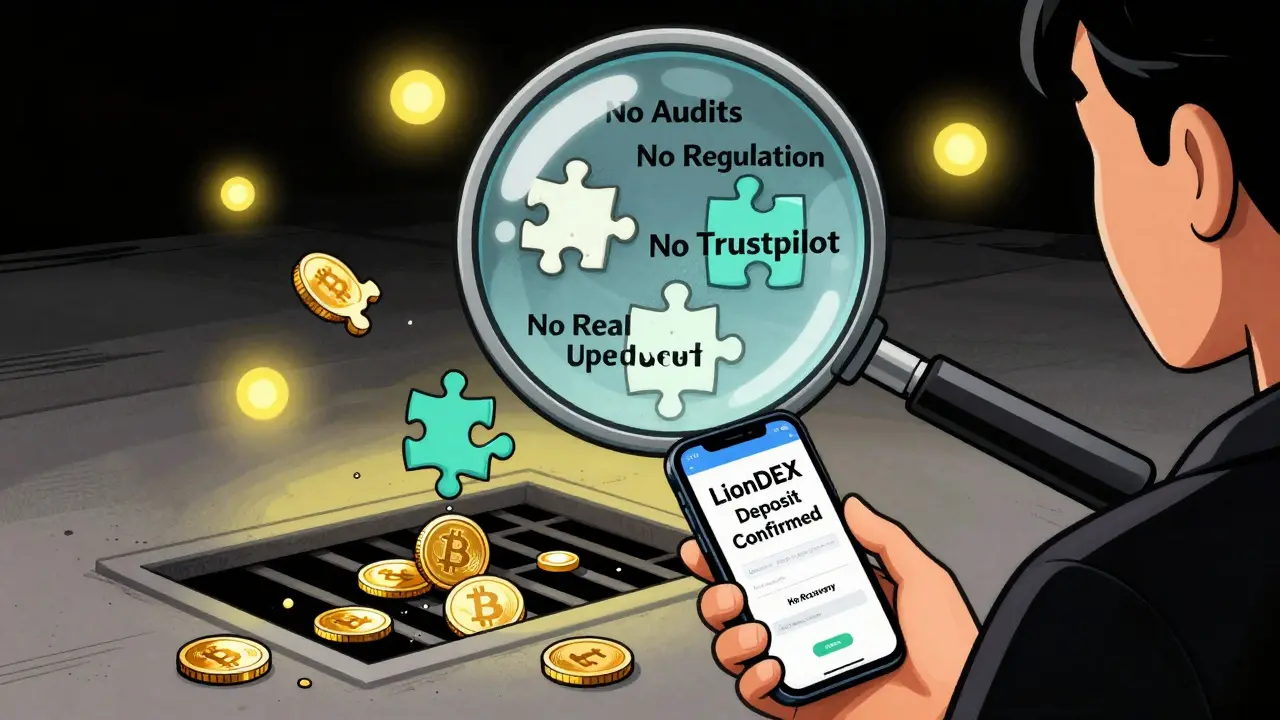
If a crypto exchange doesn’t show up on CoinMarketCap, doesn’t have a verified social media presence, and has zero mentions in major crypto news outlets like CoinDesk or The Block, that’s a red flag. Real exchanges don’t vanish from public records. They get listed, they get reviewed, they get scrutinized. LionDEX doesn’t appear anywhere in the public crypto ecosystem. Not in press releases. Not in GitHub repositories. Not in blockchain explorers tracking its smart contracts.Some fake exchanges copy names from real ones - like "LionDEX" sounding similar to "LBank" or "BitDEX" - hoping you’ll type it by accident. Others create fake websites with polished designs, fake testimonials, and fake customer support chats. These sites often promise low fees, high rewards, or exclusive tokens. But when you try to withdraw, you’re asked to pay more fees, verify your identity with impossible documents, or wait for "system maintenance" that never ends.
How to Spot a Fake Crypto Exchange
Here’s what real exchanges always have - and what LionDEX doesn’t:- A registered company - Look for legal entity names, registration numbers, and jurisdiction. Real exchanges register with financial authorities like the FCA (UK), FinCEN (US), or NZ’s FMA.
- Transparency in fees - You’ll see exact maker/taker fees, withdrawal costs, and deposit limits on their website. No hidden charges. No "contact support for pricing."
- Public security audits - Reputable exchanges publish proof of cold storage, multi-sig wallets, and third-party audit reports from firms like CertiK or Hacken.
- Active community - Thousands of users on Twitter, Telegram, and Reddit discussing trades, bugs, and updates. Fake exchanges have no real conversations - only bots and paid comments.
- Supported cryptocurrencies - Real exchanges list at least 50+ coins with live trading pairs. LionDEX shows no trading pairs, no order books, no price charts.
If you search for "LionDEX login" and end up on a site with a .xyz or .info domain, or one that asks you to download a desktop app before depositing - walk away. That’s not a platform. That’s a trap.
What Happens When You Deposit on a Fake Exchange
People lose money on fake exchanges every day. Here’s how it usually goes:- You sign up using an email and phone number - no KYC at first, to make it seem easy.
- You deposit crypto - usually BTC or ETH - because those are easy to send and hard to trace.
- You see your balance update instantly. The site shows fake profits. You’re told to "compound" your gains.
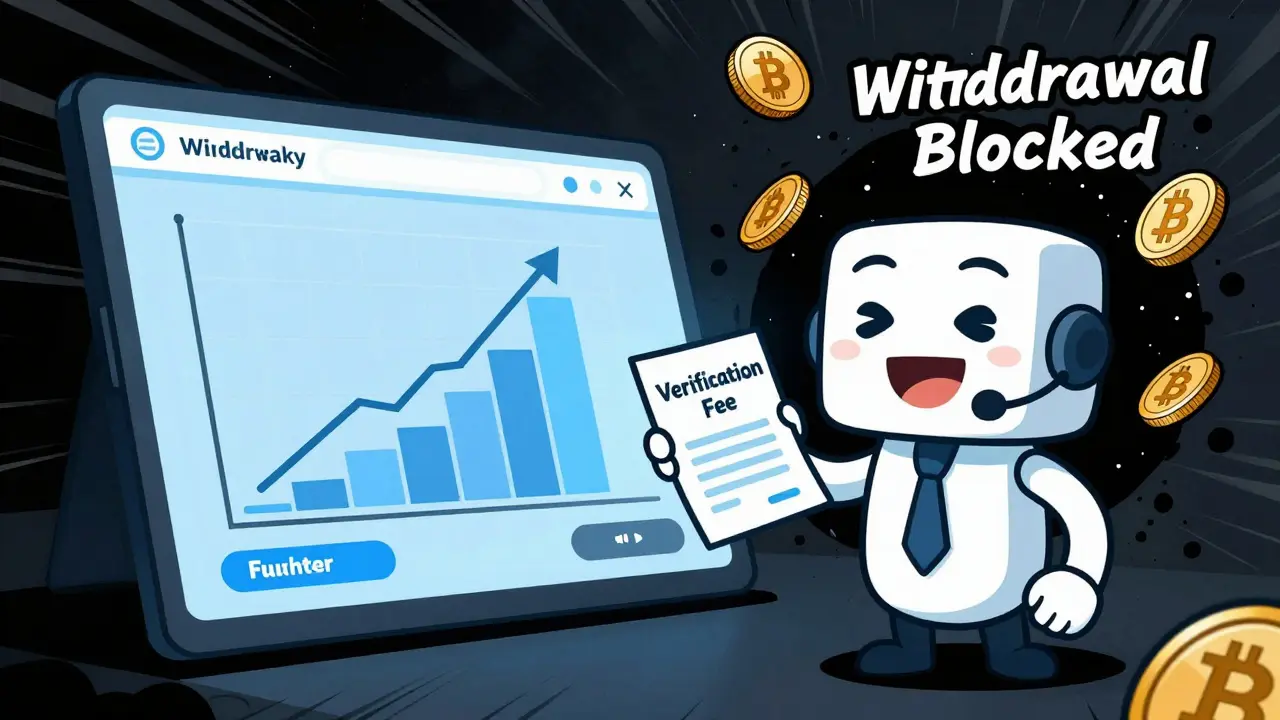
- You try to withdraw. You’re told there’s a "verification fee" of $200 in USDT. You pay it.
- Now they say your account is flagged. You need to deposit more to unlock it. Or your ID doesn’t match your selfie. Or your IP is from a "high-risk country."
- After you pay more, the site vanishes. The domain disappears. The Telegram group goes silent. Your crypto is gone.
No one gets their money back. No regulator will help you. These operations are often run from countries with no extradition treaties, using stolen identities and offshore bank accounts. By the time you realize it’s a scam, it’s too late.
Real Alternatives to LionDEX in 2026
If you’re looking for a trustworthy exchange, here are real options with verified track records:| Name | Founded | Trading Pairs | Security | Regulated In |
|---|---|---|---|---|
| OKX | 2017 | 314+ | Multi-sig cold storage, audit reports | Malta, Singapore, UAE |
| Bitpanda | 2014 | 600+ | ISO 27001 certified, EU-regulated | Austria, Germany, Spain |
| CoinEx | 2017 | 500+ | 98% cold storage, proof-of-reserves | Global (no license, but transparent) |
| dYdX | 2017 | 40+ (DeFi-focused) | On-chain, non-custodial | Decentralized (no central authority) |
These exchanges have been around for years. They publish monthly proof-of-reserves. They respond to user complaints publicly. You can find their team members on LinkedIn. Their apps are on the Apple App Store and Google Play. They don’t need you to guess if they’re real - they prove it.
What to Do If You Already Sent Crypto to LionDEX
If you’ve deposited funds to LionDEX or any similar site:- Stop sending more money. No amount will get your funds back.
- Take screenshots of the website, your transaction IDs, and any chat logs.
- Report it to your local financial regulator. In New Zealand, that’s the Financial Markets Authority (FMA). In the US, file with the FTC.
- Notify your crypto wallet provider. Some can trace the destination address.
- Share your story on Reddit (r/CryptoScams) or Twitter. Warn others.
There’s no magic tool to recover stolen crypto. Once it’s moved to an unknown wallet, it’s gone. But you can stop others from falling for the same trap.
Final Warning: Don’t Trust Names That Sound Like Real Ones
Crypto scams thrive on confusion. They pick names that sound like real exchanges: LionDEX, BitXO, CoinZee, BinancePro, CryptoBull. They use similar logos. They copy website layouts. They even fake customer service numbers.Always double-check. Go to CoinMarketCap. Search for the exchange. If it’s not there, it’s not real. If the website doesn’t have a clear legal disclaimer, a physical address, or a contact email with a corporate domain (like @okx.com or @bitpanda.com), it’s not safe.
LionDEX isn’t a new exchange. It’s a scam. And scams like this are getting smarter - but they’re still easy to spot if you know what to look for. Don’t be the next victim. Verify before you invest.






People Comments
Oh my god, another one of these fake exchanges? Seriously? People are STILL falling for this? I swear, if I had a dollar for every time someone asked me if LionDEX was legit, I’d be retired by now. This isn’t even clever - it’s lazy. They’re copying names like they’re playing Scrabble with a dictionary of real exchanges. LionDEX? More like Lion-SCAM. If you’re not checking CoinMarketCap before you deposit, you deserve to lose everything. And don’t even get me started on those .xyz domains - those are the crypto equivalent of a guy in a suit selling bottled air on the street.
It’s not just about the domain or the name - it’s about the ecosystem. Real exchanges have on-chain footprints: audit logs, wallet addresses tied to verified entities, public treasury reports. LionDEX has none. Zero. Nada. Even the most obscure altcoin exchange has at least a GitHub commit or a Discord archive. If you can’t find a single trace of its infrastructure, it’s not a startup - it’s a shell game. And the fact that they’re targeting people who don’t know how to verify legitimacy? That’s predatory.
Bro, I just had a client deposit $18k into something called 'LionDEX' last week. 😭 They thought it was a new feature on Binance. The fake UI was *scary* good - even had fake live chat with a guy named 'Alex' who sounded like a TikTok influencer. We traced the deposit to a mixer address that flipped it into Monero within 12 minutes. No chance of recovery. Just… please, if you’re new to crypto, bookmark this post. Print it. Tape it to your monitor. If it’s not on CoinGecko, it’s not real. Period. 🙏
I’ve seen this script play out too many times. First, the allure of 'exclusive access' or 'early investor rewards'. Then the fake dashboard with spinning charts. Then the 'verification fee' - always in USDT, always just enough to feel manageable. And then… silence. No one ever talks about the emotional toll. People feel stupid. Ashamed. They don’t tell their families. They delete their accounts. But you’re not dumb for falling for this. The scammers are just really good at psychology. You’re not alone. And sharing your story? That’s how we stop them.
i just found out my cousin sent 5 btc to some site called liondex last month and now shes in tears every night i told her to screenshot everything and report it but she thinks its her fault
It is imperative to underscore that the proliferation of such fraudulent entities reflects a systemic failure in digital financial literacy among novice participants in the cryptocurrency ecosystem. The absence of verifiable registration, coupled with the exploitation of phonetic similarity to legitimate platforms, constitutes a deliberate act of deception that undermines the integrity of decentralized finance. One must exercise due diligence by cross-referencing with authoritative registries such as CoinMarketCap and verifying domain ownership through WHOIS records.
Man, I saw this LionDEX thing pop up on a Facebook ad yesterday - looked just like Bitfinex, but the logo had a weird lion with 7 eyes? 😂 I clicked it just to see how bad it was. The 'support' chatbot replied with 'Welcome to LionDEX! Deposit now to get 200% bonus!' and the button said 'CLAIM NOW' in Comic Sans. Bro. COMIC SANS. That’s not a scam. That’s a parody. But people are actually sending money to this? I’m not even mad. I’m just… disappointed in humanity.
Don’t feel bad if you got caught. I did too. Back in 2021. Thought 'CoinZee' was a new Binance spinoff. Lost 3.2 ETH. Didn’t say a word for months. But I started posting about it. In forums. On Twitter. In my crypto group chat. Now I help newbies check exchanges before they deposit. It’s not about the money. It’s about not letting them win.
It is unconscionable that individuals continue to be victimized by such brazenly fraudulent schemes. The absence of regulatory compliance, the lack of transparent corporate structure, and the deliberate obfuscation of digital identity constitute criminal conduct. Those who engage in such activities should be prosecuted under international anti-fraud statutes. Furthermore, it is the moral duty of every informed participant in the crypto space to report these entities to the relevant authorities without delay.
I wonder if these scams are a kind of dark mirror - reflecting our collective hunger for easy wealth, for shortcuts in a world that rewards patience and rigor. We want to believe in the underdog platform, the hidden gem, the one that slipped through the cracks. But the truth is, real value doesn’t hide. It announces itself - with audits, with teams, with history. LionDEX doesn’t just lack legitimacy… it lacks the courage to be real. And maybe that’s the saddest part: it’s not even trying to be anything more than a shadow.
I saw this on Telegram last week. The group had 12k members. All bots. One guy kept saying 'LionDEX is the future' and sent the same link every 3 minutes. I reported it. Then I checked the domain - registered 3 days ago with privacy protection. No servers in US or EU. Just a VPS in Russia. Scam. 100%. 🚫
One thing I’ve learned from working in fintech compliance: fake exchanges always have the same tell - they avoid public documentation. No whitepaper? No legal team listed? No contact email beyond a Gmail? That’s not ‘startup chic’ - that’s evasion. Real platforms don’t fear scrutiny. They welcome it. They publish their legal counsel. They name their CTO. They answer questions on Reddit. LionDEX? It’s a ghost. And ghosts don’t trade crypto. They steal it.
I don’t know why I’m even surprised anymore. I had a friend lose $47k to something called ‘CryptoBull’ last year. She cried for three weeks. Then she started sending DMs to strangers on Twitter saying ‘I’m sorry I got scammed’ - like it was her fault. NO. IT’S NOT YOUR FAULT. It’s the fault of the cowards hiding behind .info domains and fake customer service bots. I’ve threatened to find them. I’ve tracked IP addresses. I’ve sent their fake websites to the FBI. And guess what? NOTHING HAPPENS. The system is broken. We’re just sitting here watching people get eaten alive. And we’re too polite to scream loud enough.
Wait - I just checked. Someone on r/CryptoScams posted a screenshot of a LionDEX ‘support agent’ using the same AI-generated avatar as the one from ‘BitXO’ last month. Same face. Same lighting. Same background. It’s the same scammer. They’re recycling assets. Like a horror movie villain with a new mask. We need a database of these fake avatars. And a bot that auto-reports them. This isn’t just fraud. It’s industrial-scale deception.