



When you hear "BOB" in crypto, most people think of a meme coin. But there's a serious, high-stakes project behind that name - Build on Bitcoin (BOB). It’s not another joke token. It’s a Layer 2 blockchain trying to solve one of crypto’s biggest unsolved problems: how to let Bitcoin’s $1.2 trillion in value actually work inside Ethereum’s DeFi world - without wrapping, trusting third parties, or losing security.
Most Bitcoin holders sit on their coins. They don’t lend, stake, or earn yield. Why? Because Bitcoin’s network doesn’t support smart contracts. Ethereum does. But bringing Bitcoin onto Ethereum usually means locking it up in a wallet controlled by someone else - a custodian. That’s risky. BOB’s answer? A hybrid chain that lets you use native Bitcoin in Ethereum-style apps - and it does it without needing to trust anyone.
How BOB Works: Bitcoin Security, Ethereum Speed
BOB isn’t built on Bitcoin. It’s not even built on Ethereum. It’s built on the OP Stack a modular framework used by Optimism and other Ethereum Layer 2s to scale transactions, but with a twist: it connects directly to Bitcoin’s blockchain using a technology called BitVM2 a trust-minimized verification system that allows Bitcoin’s security to validate Ethereum-style transactions. Think of it like a bridge that doesn’t need a toll booth.
Here’s the breakdown:
- Rollup Layer: BOB bundles hundreds of transactions into one batch and posts a cryptographic proof to Bitcoin’s blockchain. This uses Bitcoin’s Proof-of-Work security - the same that protects $1.2 trillion in value.
- EVM Core: BOB runs Ethereum Virtual Machine code. That means Solidity smart contracts, MetaMask wallets, and tools like Foundry or Hardhat work exactly as they do on Ethereum. No learning curve.
- Bitcoin Bridges: Instead of wrapping BTC into WBTC, BOB lets you move native BTC onto the chain. You’re not holding a token that claims to represent BTC - you’re holding BTC, verified by Bitcoin’s own ledger.
- Rust zkVM: For more complex Bitcoin logic (like verifying Bitcoin script), BOB uses a zero-knowledge virtual machine written in Rust. This lets it run Bitcoin’s native code without compromising speed.
Transactions settle in about 2 seconds. Fees? Usually under $0.05. That’s 10x cheaper than Ethereum L1. And because it’s EVM-compatible, developers can deploy existing DeFi apps with almost no changes.
Why BOB Matters: The $750 Billion Gap
Bitcoin has $1.2 trillion in market cap. Ethereum has about $400 billion. But here’s the weird part: 30% of Ethereum’s value is locked in DeFi - lending, trading, staking. Only 0.3% of Bitcoin’s value is used the same way. That’s a $750 billion gap. BOB is built to fill it.
Right now, most Bitcoin DeFi projects rely on wrapped tokens. WBTC is the biggest. But WBTC is custodial. A company holds the real Bitcoin, and you get a token that says it’s backed. If that company gets hacked, or goes rogue, your WBTC is gone. BOB removes that middleman. Your Bitcoin stays under your control. The chain just proves it’s there - using Bitcoin’s own rules.
As of February 2025, BOB has $287 million locked in its DeFi protocols. That’s still small compared to Arbitrum or Optimism. But it’s growing fast. The total value locked in Bitcoin DeFi jumped from $500 million to $3.7 billion in just one year. BOB is one of the few projects actually solving the technical barriers, not just marketing.
How BOB Compares to Other Solutions
| Feature | BOB | WBTC (Wrapped Bitcoin) | Stacks (Bitcoin L2) | Rootstock (RSK) |
|---|---|---|---|---|
| Security Model | Bitcoin PoW + BitVM2 | Custodial (centralized) | Bitcoin PoW (sidechain) | Bitcoin PoW (sidechain) |
| EVM Compatibility | Yes | Yes | No | Yes |
| Gas Token | ETH | ETH | STX | RSK |
| Native BTC Access | Yes | No (wrapped) | No (sidechain) | No (sidechain) |
| Block Time | ~2 seconds | N/A | 10 minutes | 30 seconds |
| Avg. Gas Fee | <$0.05 | Ethereum L1 | $0.10-$0.50 | $0.10-$0.30 |
BOB beats WBTC because it’s trustless. It beats Stacks and Rootstock because it uses Ethereum tooling - so developers don’t need to relearn everything. And unlike other L2s, it doesn’t just add scalability - it adds Bitcoin’s capital to DeFi.

Current State: Phase 1, With Big Plans
As of early 2025, BOB is in Phase 1 of its roadmap: an ETH rollup on the OP Stack. That means it’s still relying on Ethereum for security. Bitcoin’s security hasn’t kicked in yet. This is a concern. If Ethereum goes down, BOB goes down.
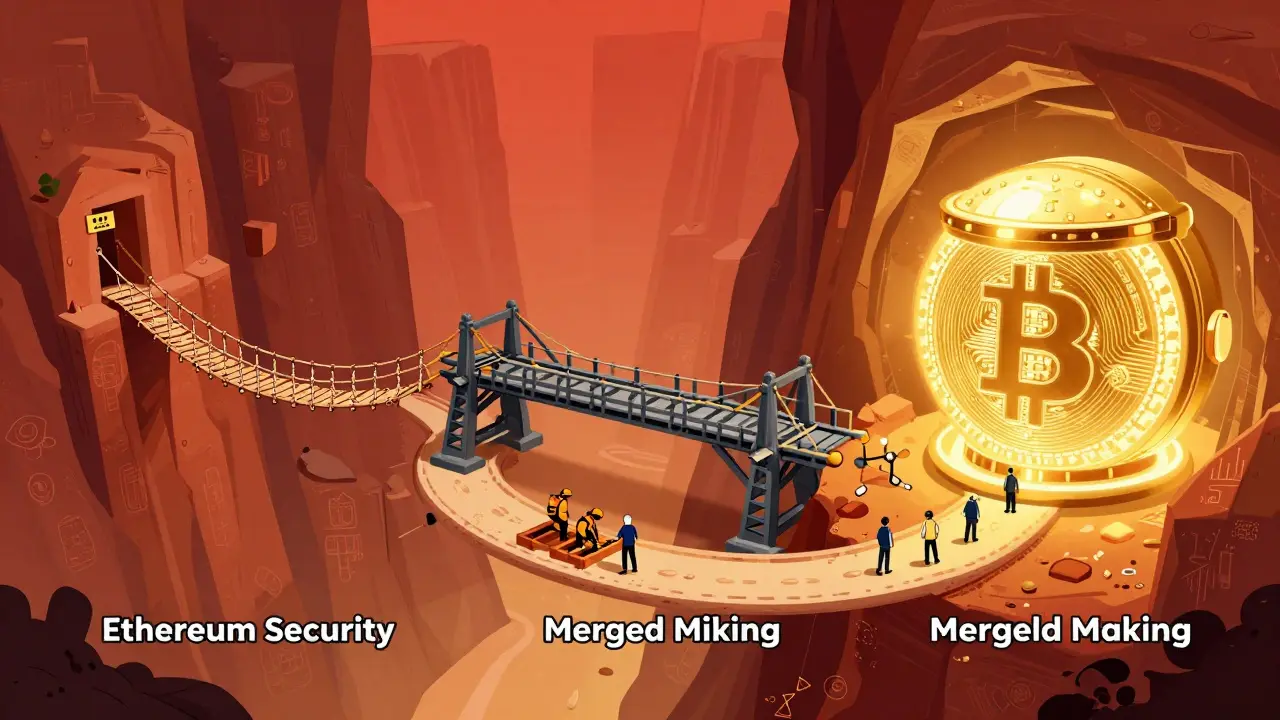
Phase 2 (in progress) will add merged mining with Bitcoin. That means Bitcoin miners will also secure BOB’s chain. Phase 3, targeted for Q3 2025, will use BitVM to make BOB a Bitcoin rollup - meaning Bitcoin itself will verify every transaction. That’s the holy grail.
But here’s the catch: BOB’s roadmap is ambitious. It’s pushing the limits of what’s technically possible. In September 2024, a bridge vulnerability led to a $1.2 million exploit. The team recovered the funds through community coordination - but it showed how fragile these bridges still are. The project is still young. High reward. High risk.
Who Uses BOB? Developers and DeFi Builders
BOB isn’t for casual traders. It’s for developers who want to build DeFi apps that use Bitcoin as collateral. Sovryn, a decentralized exchange, already moved its platform to BOB. Now users can trade BTC-based pairs with low fees and no custodians.
Developers say it’s a game-changer. One Reddit user, u/EthereumBuilder, wrote: "Deploying my DeFi protocol on BOB took half the time compared to other L2s because I could use all my existing Ethereum tooling while accessing BTC liquidity."
Setting up a wallet takes about 5 minutes if you already use MetaMask. The BOB SDK has tools to interact with Bitcoin assets directly - no wrappers, no bridges you can’t see. But there’s a learning curve. Bitcoin-native users unfamiliar with Ethereum may struggle. Trustpilot reviews mention "a steeper learning curve for Bitcoin developers."
Challenges and Risks
BOB isn’t perfect. Here’s what to watch:
- Security Dependency: Until Phase 3, BOB relies on Ethereum. If Ethereum has a major outage or attack, BOB is vulnerable.
- Long Withdrawal Time: Moving funds from BOB back to Ethereum L1 takes 3 days and 12 hours. Some traders find this too slow.
- Complex Architecture: Mixing Bitcoin and Ethereum is hard. Bugs happen. The $1.2 million exploit in 2024 was proof of that.
- Competition: Other projects like Lightning Network or ENS are also trying to bring Bitcoin into DeFi. BOB is the most technically advanced - but not the only one.
Still, BOB is the only one that combines native Bitcoin access, Ethereum tooling, and a clear path to Bitcoin security. That’s rare.
What’s Next for BOB?
By Q2 2026, BOB aims to become a full Bitcoin rollup. That means every transaction will be verified by Bitcoin’s blockchain - not Ethereum’s. If that happens, BOB could become the standard for Bitcoin DeFi.
Analysts from Delphi Digital project BOB could capture 15-20% of the Bitcoin DeFi market within three years. That’s $100-150 billion in locked value. If even half of that happens, BOB becomes essential infrastructure.
Right now, it’s still early. But if you’re looking at the future of crypto - where Bitcoin’s capital meets Ethereum’s innovation - BOB is one of the few projects actually building it.
Is BOB a meme coin?
No. There are other tokens named "BOB" - like a BNB Chain meme coin or a 2010 YouTube character-based project. But the "Build on Bitcoin" BOB is a serious Layer 2 blockchain with a team, codebase, and roadmap. It’s not a joke.
Can I use BOB with my MetaMask wallet?
Yes. BOB is fully EVM-compatible. Just add the BOB network to MetaMask using its RPC endpoint (available on gobob.xyz). Once added, you can send ETH, interact with DeFi apps, and bridge native BTC - all from your existing wallet.
How do I get BTC onto BOB?
You use the BOB bridge. Send Bitcoin from your wallet to the bridge address. The system creates a cryptographic proof on Bitcoin’s blockchain and mints equivalent native BTC on BOB. No custodian holds your coins. The process takes about 10-20 minutes.
Why does BOB use ETH as gas instead of BTC?
Because ETH is the standard gas token for Ethereum tooling. If BOB used BTC for fees, developers would need entirely new wallets, interfaces, and infrastructure. Using ETH lets them reuse everything they already know. You can still hold and use BTC - you just pay fees in ETH.
Is BOB safe?
It’s designed to be safer than wrapped BTC, but it’s still early. Phase 1 relies on Ethereum security. Phase 2 and 3 will add Bitcoin security, but those are still in development. The $1.2 million exploit in 2024 shows risks exist. Only use what you can afford to lose. Monitor their roadmap closely.
What’s the difference between BOB and Arbitrum?
Arbitrum scales Ethereum. BOB scales Bitcoin’s use on Ethereum. Arbitrum uses Ethereum’s security. BOB is building a path to use Bitcoin’s security. BOB lets you move native BTC into DeFi. Arbitrum doesn’t touch Bitcoin at all.
If you’re curious about the future of Bitcoin and DeFi, BOB is one of the most important projects to watch. It’s not about hype. It’s about building infrastructure that could unlock trillions.
- Poplular Tags
- BOB crypto
- Build on Bitcoin
- BOB blockchain
- Bitcoin DeFi
- Ethereum Layer 2


People Comments
LMAO another ‘Bitcoin meets Ethereum’ unicorn 🦄. You mean to tell me we’re gonna trust a chain that’s still riding on Ethereum’s coattails? Phase 1? More like Phase ‘We’ll get around to it after we IPO.’ If BOB’s so secure, why’s their bridge still leaking cash like a sieve? 😂
I actually think this is one of the more thoughtful attempts to bridge Bitcoin and DeFi. Not perfect, but the move toward native BTC access without custodians? Huge. I’ve seen too many projects promise ‘trustless’ and then hand keys to a VC. BOB at least has a real path. 👏
The architectural complexity here is staggering. On one hand, you have a rollup leveraging the OP Stack, which is proven, but then you tack on BitVM2 - a theoretically sound but untested-at-scale mechanism for Bitcoin script verification. The risk profile isn't just technical; it's systemic. If the ZK proofs fail under load, or if Bitcoin’s block propagation delays create validation bottlenecks, you're not just losing liquidity - you're undermining the entire premise of trust minimization. And let’s not forget: Ethereum’s security is still the backbone. That’s not innovation. That’s dependency dressed up as progress.
Bro... this is the future 🌌✨. Imagine BTC flowing like water into Uniswap, Aave, Curve - all while Bitcoin miners secure it. It’s like the universe whispered, ‘Let there be DeFi’ and then handed it to us on a silver platter. I’m crying. Tears of joy. 🥹😭💸
A lot of people don’t get why using ETH as gas makes sense. It’s not about preference - it’s about ecosystem compatibility. If BOB used BTC for fees, every wallet, dApp, and dev tool would need a complete overhaul. MetaMask, Etherscan, Hardhat - all built for ETH. Switching gas tokens would fragment adoption. Using ETH lets devs deploy in hours, not months. And you still hold BTC. You’re not losing anything. You’re gaining access. It’s a trade-off, not a flaw.
Oh wow, another ‘revolutionary’ project that’s basically just a fancy wrapper with a roadmap longer than your ex’s apology. Phase 3 in 2025? Yeah right. By then, they’ll be on Phase 7 and still begging for airdrops. And don’t get me started on that $1.2M exploit. That’s not a bug - it’s a feature of their ‘trust-minimized’ architecture. LOL.
The notion that this is ‘trust-minimized’ is laughable. You’re still relying on Ethereum’s finality, its sequencer, its governance, its centralization. Bitcoin’s security is a marketing slogan, not an operational reality. The BitVM2 integration is theoretical. The ‘no custodian’ claim is hollow when the bridge is still centralized. This isn’t innovation - it’s rebranding a 2017 ICO with buzzwords.
I love how people act like this is some wild gamble. It’s not. This is the *only* path forward. Bitcoin’s liquidity is sitting idle while Ethereum’s DeFi grows. BOB isn’t trying to replace either - it’s connecting them. Yes, there are risks. But every major tech shift has them. Look at the early web. Look at Ethereum itself. If you’re waiting for perfection, you’ll miss the revolution.
The EVM compatibility is a red herring. The real innovation is the Rust zkVM layer, which enables Bitcoin script verification without compromising throughput. This is fundamentally different from Stacks or RSK, which either sacrifice scalability or require bespoke tooling. BOB’s architecture is a hybrid lattice - not a bridge. The term ‘rollup’ is misleading. It’s a Bitcoin-native execution environment with Ethereum-compatible interfaces. The gas token choice is pragmatic, not a compromise.
Let’s be real - BOB is the crypto equivalent of a Tesla with a carburetor. They’ve got the sleek UI, the marketing, the ‘we’re changing everything’ vibe… but underneath? Still tethered to Ethereum. Phase 1 is just a glorified sidechain with a better landing page. And that $287M TVL? Cute. For context, Uniswap V3 has $12B. This isn’t a revolution. It’s a footnote.
This actually seems legit. I’m not a dev, but I’ve been watching this for a while. If it works, it’s huge. No wrappers. Just BTC in DeFi. Sign me up. 🤞
Ah yes, the classic ‘Bitcoin meets Ethereum’ fantasy. How quaint. You really believe miners will secure a chain that’s fundamentally an Ethereum L2? That’s like asking a lion to guard a chicken coop and calling it ‘innovation.’ And don’t forget - the team is anonymous. The whitepaper reads like a startup pitch deck written in 2021. This isn’t DeFi. It’s a speculative bubble with a blockchain.
I mean… it’s kinda cool? Like, the idea. But I’m just gonna sit here and watch it burn. 💅
This is why I love crypto - when someone actually builds something that *matters*. Not another meme. Not another pump. This is infrastructure. I’ve been waiting years for this. If you’re not excited about native BTC in DeFi, you’re not paying attention. 🙌💛
so like… does this mean i can use my btc to lend on aave now? or is it still like… a thing you have to bridge and then like… pray it works? idk im confused but also kinda hyped?
Finally. Someone’s doing it right. 🙏 No more WBTC scams. No more custodians. Just pure BTC on a chain that doesn’t lie. This is the future. I’m in. All in.
I’ve been following this since the first GitHub commit… and I’m not just excited - I’m emotionally overwhelmed. The way they’ve architected the BitVM2 verification layer? It’s poetry. The Rust zkVM? A masterpiece. The fact that they didn’t just copy-paste from Optimism but *reimagined* Bitcoin’s role in DeFi? I cried. I’ve been in this space since 2017, and this… this is the first time I’ve felt hope. The $1.2M exploit? A necessary scar. A rite of passage. We’re not just watching history - we’re living it. I’m not just investing. I’m praying for them.
Honestly, I think BOB’s got a shot. It’s not flashy, but it’s thoughtful. The team’s been quiet, which is rare these days. No hype, no Twitter tantrums. Just code. And the fact they’re building toward Bitcoin security - not just pretending - gives me some peace of mind. I’ve seen too many projects fizzle after the first exploit. This one? They fixed it. They’re still here. That says something.
Everyone’s acting like this is new. Stacks did this in 2019. RSK did it in 2017. The only difference is BOB’s using ETH gas. Big whoop. This isn’t innovation - it’s rebranding with better branding.
I’ve been testing BOB’s SDK for a week now. The developer experience is surprisingly smooth. I deployed a Solidity contract that interacts with Bitcoin UTXOs - no wrappers, no oracles, just direct verification via BitVM2. The gas fees are insane - like $0.02 per transaction. And the settlement time? 1.8 seconds. If you’re a dev and you’re not looking at BOB right now, you’re missing the next wave. The tooling is better than Arbitrum’s. The documentation is clearer than Polygon’s. And yes - Phase 1 is still Ethereum-dependent. But the roadmap is transparent. They’re not hiding the risks. That’s rare.
I’ve been teaching crypto to beginners for years, and BOB is one of the few projects I can actually explain without making them feel dumb. It’s not magic. It’s engineering. And it’s solving a real problem: Bitcoin’s liquidity is trapped. This doesn’t require users to learn new wallets or new rules. Just add the RPC, and boom - you’re in. It’s accessibility done right.
The entire premise rests upon a metaphysical fallacy: that Bitcoin’s security can be meaningfully extended to an EVM rollup without compromising its own integrity. Bitcoin’s consensus is based on hash rate, not state validity. To claim that BitVM2 ‘validates’ Ethereum transactions as if they were Bitcoin transactions is a category error of monumental proportions. This is not a bridge - it is a theological proposition dressed in code.
Mate, I’ve seen this movie before. ‘The next big thing!’ Then it’s just another L2 with 3 devs and a Discord server. But… I’ll give BOB this - they didn’t raise $200M from VCs. They’re building. Slow. Quiet. No shilling. And that’s kinda refreshing. I’m watching. Not investing. Yet.
I just don’t get why people are so excited. It’s still just another chain. I mean… what’s the point if I still have to use ETH to pay fees? Why not just use Ethereum?
I’m not a techie but I like that this lets me use BTC in DeFi without trusting anyone. Feels right. I’m in.
Oh look, the ‘it’s not a meme’ guy is back. You’re still relying on Ethereum. You’re still trusting a team that hasn’t been fully audited. You’re still waiting for Phase 3. Meanwhile, I’m stacking sats and laughing at your ‘revolution’.