


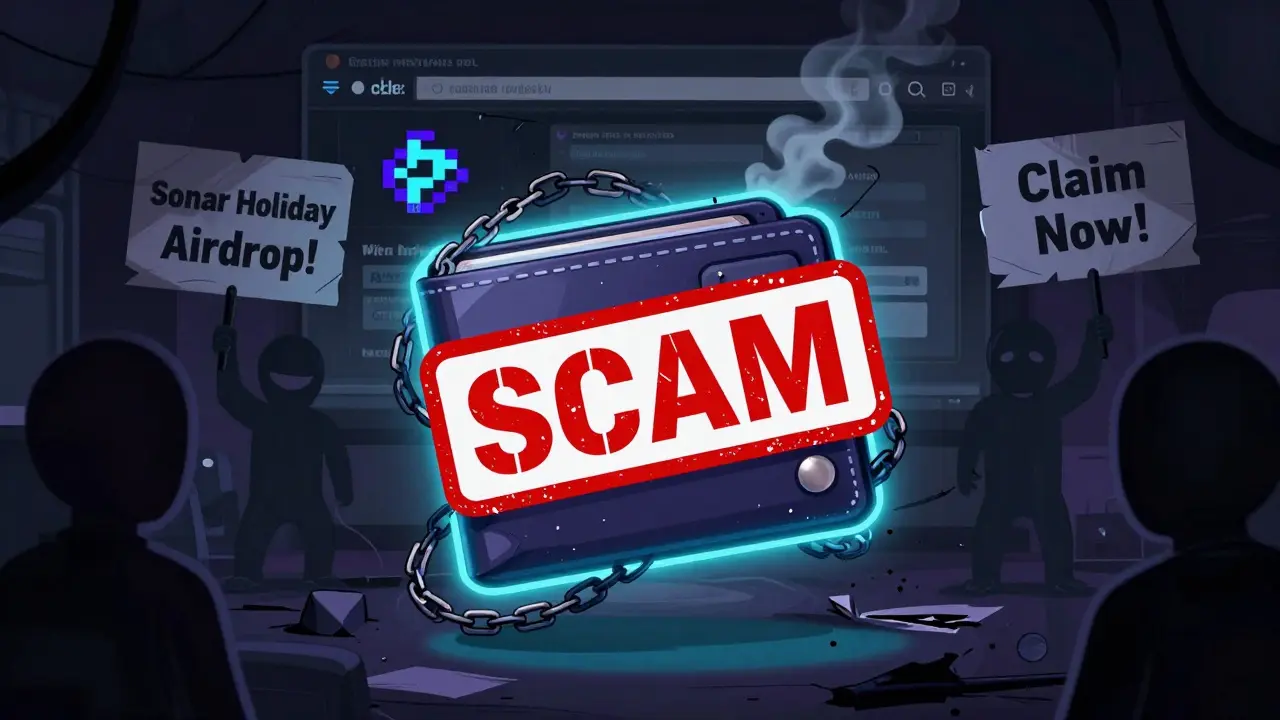
There’s no verified information about a Sonar Holiday airdrop. Not a single official tweet, whitepaper, or Discord announcement confirms its existence. If you’ve seen ads, Telegram groups, or YouTube videos pushing this as a real opportunity, you’re being targeted by a scam. This isn’t just a rumor-it’s likely a honeypot designed to steal your wallet keys or trick you into paying fake gas fees.
Let’s be clear: legitimate airdrops don’t ask you to send crypto to claim rewards. They don’t require you to connect your wallet to unknown websites. And they definitely don’t use vague names like "Sonar Holiday"-a phrase that sounds like it was pulled from a random word generator. There’s no project called Sonar Holiday on Solana, Ethereum, or any other major chain. No team. No website. No GitHub repo. No Twitter account with more than 50 followers. Nothing.
Why does this myth keep popping up? Because scammers rely on FOMO. When Solana had a string of big airdrops in late 2024 and early 2025-Magic Eden, Pudgy Penguins, Doodles-thousands of wallets got free tokens. People made money. That success created a wave of hope. Now, fraudsters are riding that wave, inventing fake projects with names that sound plausible. "Sonar Holiday"? It could be anything. Maybe it’s a play on "sonar" (sound waves) and "holiday" (seasonal bonus). But in crypto, names don’t matter if the project doesn’t exist.
What we do know is how real Solana airdrops work. Projects like SonicSVM, Sanctum, and Kamino Season 3 have clear eligibility rules: you had to use their DEX, hold a specific NFT, or interact with their smart contracts before a cutoff date. These projects published their criteria publicly. They showed their team. They had audits. They had roadmaps. Sonar Holiday has none of that.
Here’s how to spot a fake airdrop:
- No official website - Real projects have a clean, professional site with docs, team bios, and contact info. Sonar Holiday has none.
- Asks for wallet connection - If a site says "Connect your wallet to claim your airdrop," it’s a trap. Legit airdrops distribute tokens automatically to wallets that met the criteria.
- Urgency tactics - "Limited spots! Only 24 hours left!" is a classic scam trigger. Real airdrops run for weeks or months.
- No social proof - Check Twitter, Discord, Telegram. If the account was created last week and has no history, walk away.
- Spelling mistakes - "Sonar Holiday" sounds like a bot-generated name. Real projects invest in branding.
The Solana ecosystem in early 2025 was booming. SOL hit $208.48 in January. Fee volume spiked at the end of 2024. That’s when projects like DeBridge, Grass, and Drift launched their Season 2 airdrops. They had months of preparation. They tracked user activity across their platforms. They didn’t just throw a name into the ether and hope people would bite.
So what should you do if you’re looking for real airdrops in 2026? Stick to trusted sources. Follow the official channels of projects you already use. Check the Solana Foundation’s blog. Look at CoinGecko or CoinMarketCap’s airdrop calendars-they list only verified launches. Subscribe to newsletters like Solana Weekly or Bankless. These sources don’t promote mystery airdrops. They report on what’s real.
And if someone DMs you about Sonar Holiday? Block them. Report the account. Don’t even click the link. Even if it looks legit, even if it has a logo that matches Solana’s branding, even if it says "verified"-it’s not. The Solana ecosystem has had dozens of airdrops in the last year. None of them used a name like this. Not once.
There’s no such thing as Sonar Holiday. Not today. Not tomorrow. Not ever. It’s a ghost project built to empty wallets. Don’t be the one who falls for it.
What real Solana airdrops looked like in 2025
Compare Sonar Holiday to what actually happened. Magic Eden’s airdrop on December 10, 2024, went to over 1.2 million wallets. The criteria? You had to have traded NFTs on their platform before November 1, 2024. No wallet connection needed. No fees. Tokens arrived automatically.
Pudgy Penguins (PENGU) dropped on December 17, 2024. Eligibility was based on owning a Pudgy Penguin NFT. The team released a detailed guide. They even published a snapshot of eligible wallets on GitHub. The token launched on major exchanges. People got real value.
Doodles (DOOD) hit wallets on May 9, 2025. Again, no upfront payment. No "pay to claim." Just a straightforward distribution to holders of the Doodles NFT collection. The team held a live AMA. They answered questions. They were transparent.
These projects didn’t need to trick people. They had community trust. They had history. Sonar Holiday has nothing.
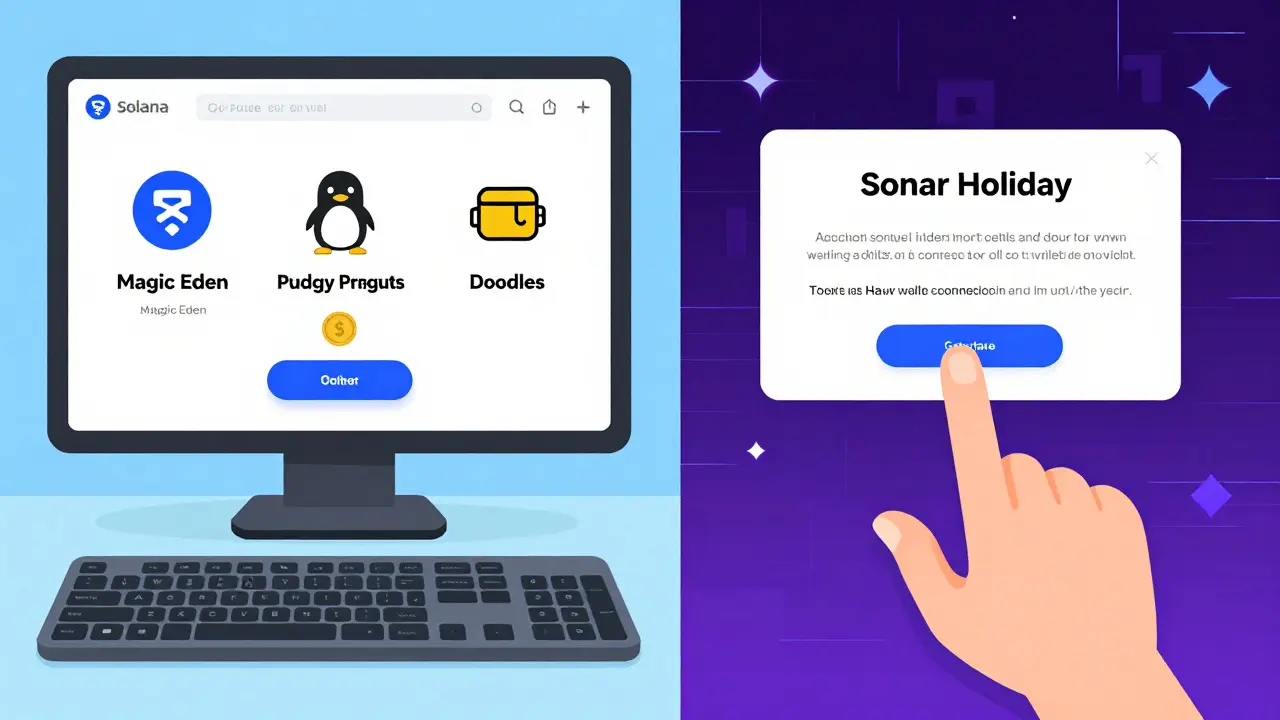
How to protect yourself from fake airdrops
- Never connect your main wallet to unknown sites. Use a separate, low-balance wallet for testing.
- Use a wallet like Phantom or Solflare that shows transaction details before you sign.
- Check the contract address. Real airdrops use verified, audited contracts. Fake ones use random, unverified addresses.
- Search the project name + "scam" on Google. If you see multiple reports, walk away.
- Join official Discord servers-not random Telegram groups.
Remember: if it sounds too good to be true, it is. If you didn’t interact with a project before the cutoff date, you won’t get an airdrop from it. Period.
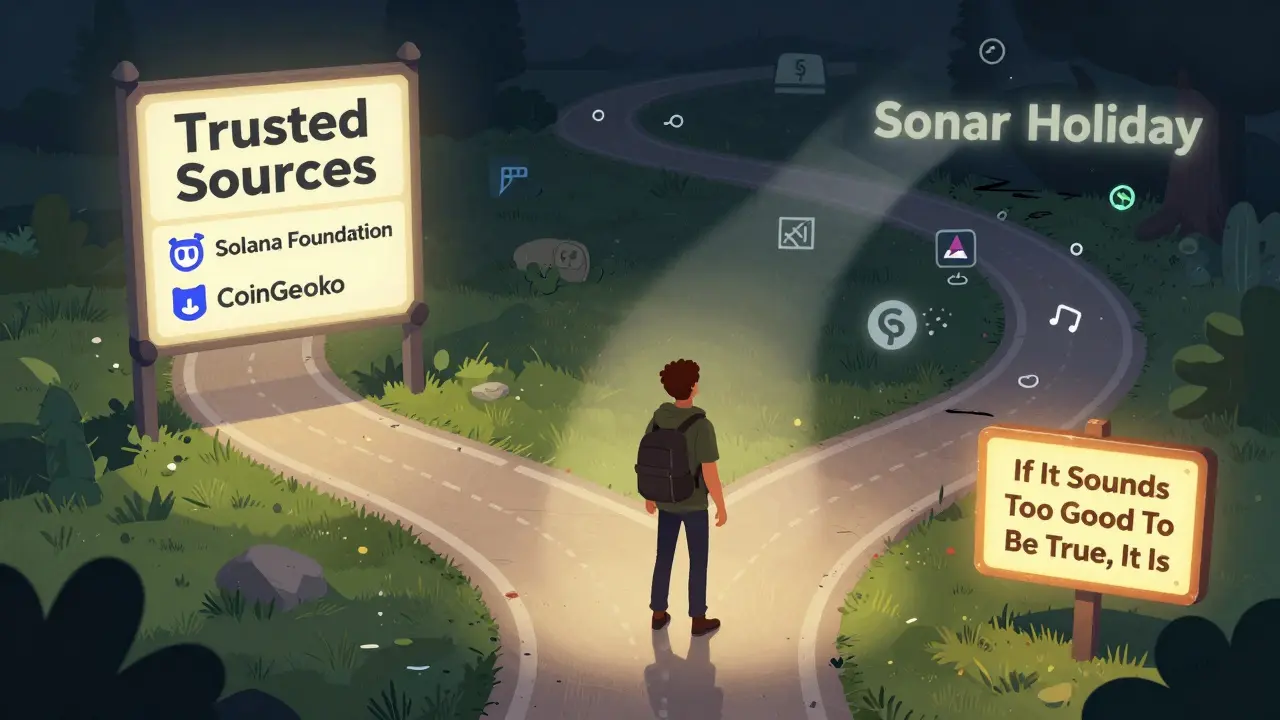
Where to find real airdrops in 2026
Keep an eye on these trusted sources:
- Solana Foundation - Official announcements
- CoinGecko Airdrop Calendar - Verified, updated listings
- DefiLlama - Tracks protocol activity and upcoming token launches
- Project Twitter/X accounts - Only follow verified profiles
- Reddit r/Solana - Community-driven updates
Real airdrops don’t need to scream for attention. They show up quietly in your wallet if you’ve done the work. Sonar Holiday? It’s screaming. And that’s your warning sign.


People Comments
This is spot on. I saw a Telegram group pushing 'Sonar Holiday' last week - looked legit with Solana-themed graphics. I didn’t click, but I screenshot it and reported it. Scammers are getting scarily good at mimicry. Stay sharp, fam.
If you connect your wallet to a site that says 'claim your Sonar Holiday tokens' you deserve to lose everything. No exceptions. No mercy. This isn't a mistake - it's a crime.
I appreciate how you laid out the red flags. I’ve been in crypto since 2021 and even I almost fell for a fake airdrop last year. Thanks for the clarity.
Ugh I hate how people still fall for this. You’re not 'smart' just because you clicked a link. You’re just another victim waiting to happen. Get your head out of your ass.
The structural integrity of legitimate airdrops lies in verifiable on-chain activity, not speculative branding. Sonar Holiday lacks any traceable interaction layer - no contract deployments, no event logs, no indexed events on SolanaScan or Etherscan. It’s not just unverified - it’s non-existent in the blockchain’s state tree.
While I appreciate the detailed breakdown, I must emphasize that the absence of evidence is not evidence of absence. Historically, some legitimate projects have launched with minimal visibility before gaining traction. Perhaps Sonar Holiday is in stealth mode - though admittedly, the naming convention is suspect.
I’ve been tracking Solana airdrops since last year and I can say with 100% certainty - if it doesn’t show up on DefiLlama or CoinGecko’s official calendar, it’s a trap. I’ve lost friends to fake airdrops. Don’t be one of them. I’m not mad, I’m just disappointed.
Bro this is the same scam as last year with 'Solana Fest' - same vibe, same fake logo, same 'connect wallet to claim' BS. They just swap the name. It’s like they’re using a scam generator bot. I reported 3 different Telegram groups yesterday. If you see this, DM me - I’ll send you the list.
So let me get this straight - we’ve got a project with no team, no code, no website, no Twitter history, and yet somehow it’s got a full-blown YouTube ad campaign? The only thing more absurd than Sonar Holiday is the fact that people still believe in it. I’m not even mad. I’m just… bored.
I just wanna say thank you for this post!! I shared it with my mom who’s new to crypto and she was about to click a link. Now she’s safe. You’re doing god’s work here. 🙏
I’ve been on the receiving end of a legit Solana airdrop last year - Kamino Season 3. Got 120 $KAMI without doing anything but using their DEX. No wallet connection. No gas fees. Just… poof. It’s wild how different the real ones feel. Sonar Holiday? Feels like a phishing page from 2017.
I’ve seen this exact scam pop up in three different countries now. The pattern’s identical: fake website, fake Discord, fake Twitter with 50 followers and 400 bot likes. It’s not even creative. It’s lazy. And it’s working because people want to believe.
I’ve been in crypto since 2018 and I’ve never seen a real airdrop ask for a wallet connection. Ever. If you’re doing that, you’re not claiming - you’re handing over your keys. That’s not a mistake. That’s suicide.
I don’t get why people keep falling for this. It’s like believing in a unicorn that steals your wallet. If it’s real, why not show the team? Why not show the code? Why not show anything?
Simple truth: if you didn’t interact with the protocol before the snapshot, you won’t get an airdrop. That’s how it works. No magic. No mystery.
The fact that 'Sonar Holiday' sounds like a corporate wellness retreat gone rogue says everything. If a project’s name was generated by a Markov chain trained on crypto buzzwords, it’s not a project - it’s a parody.
I’ve been researching this for weeks. I dug into domain registrations, contract deployments, and even checked the IP history of the fake site. It’s hosted on a VPS in Romania with zero history. The domain was registered 3 days ago. It’s not a project. It’s a pop-up ad with a blockchain theme.
I’ve been teaching crypto safety to seniors in my community. This post is now part of our curriculum. Thank you for giving us the language to explain why these scams are so dangerous - not just financially, but emotionally. People feel betrayed when they lose money this way.
I just clicked the link. I thought it was real. I lost $800. I’m so stupid. Can someone tell me how to get my wallet back? Please.
Oh honey, you really thought a project called 'Sonar Holiday' was real? Did you also believe the moon is made of cheese? This isn’t crypto. This is a cartoon. And you’re the punchline.
Lmao I saw this on TikTok. Some guy said 'just send 0.01 SOL and you get 100 SOL back'. I screenshot it and posted it in r/cryptoscam. 12k upvotes. 300 comments. Everyone’s like 'this is fake' but still, people are doing it.
This whole post is just fearmongering. Maybe Sonar Holiday is a stealth launch. Maybe it’s a private testnet. Maybe you’re just too narrow-minded to see the bigger picture. Not every unverified thing is a scam. Some things are just ahead of their time.