


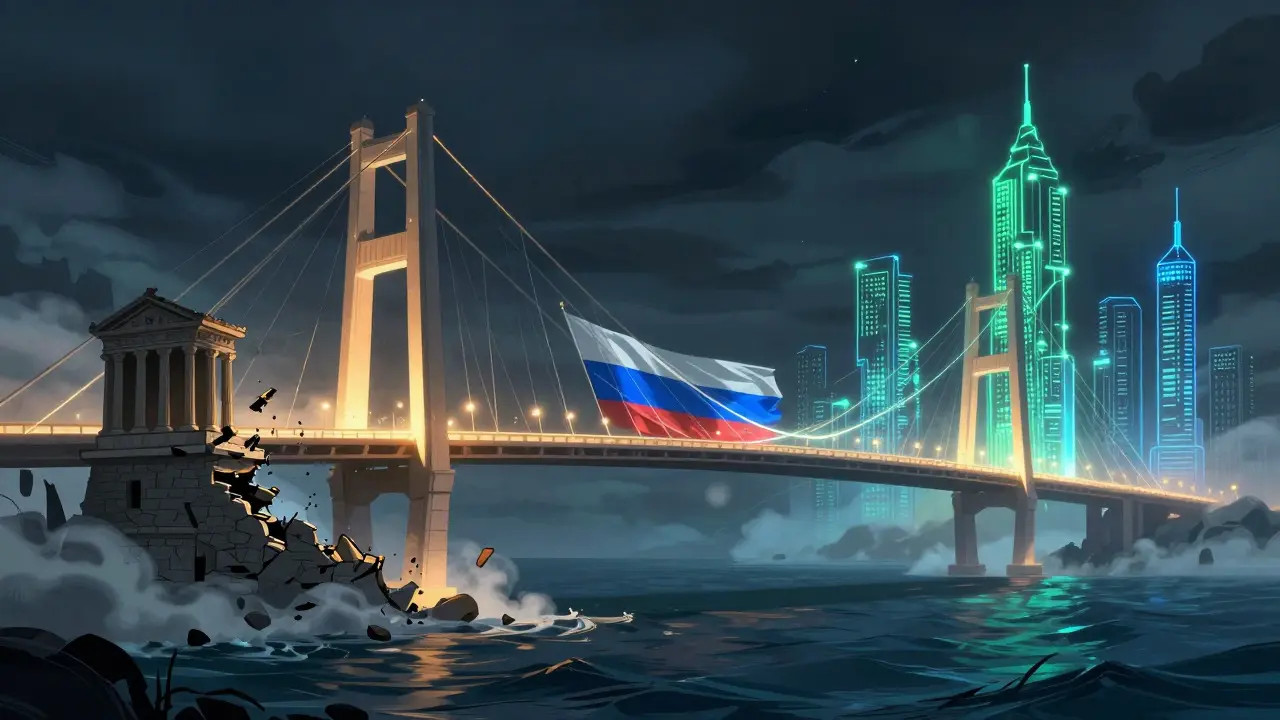
When you think of sanctions evasion, you probably picture shell companies in tax havens or cash shipments across borders. But the real action is happening on the blockchain. Russia has quietly flipped its script on digital assets, moving from a skeptical regulator to an active enabler. By legalizing cryptocurrency mining and pushing cross-border crypto payments, Moscow is building a parallel financial system designed to slip past Western oversight. It’s not just about holding Bitcoin; it’s about creating the infrastructure to move value where traditional banks can’t follow.
This shift isn’t accidental. Since the invasion of Ukraine in February 2022, Russia has faced heavy financial restrictions. To keep trade flowing, especially for energy and commodities, they needed a way to bypass the dollar-based system. Enter the "shadow crypto economy." It’s a network of exchanges, stablecoins, and miners that operates largely outside the view of standard banking compliance. If you’re tracking global finance, this is one of the most significant structural changes in how money moves today.
The A7A5 Stablecoin: A New Payment Rail
At the heart of this new strategy is a specific token called A7A5. Launched in February 2025, this ruble-backed stablecoin has already processed over $51 billion in transactions by July 2025. That’s a massive volume for a relatively new asset. It was issued by Old Vector, a company based in Kyrgyzstan but backed by Russia’s state-owned Promsvyazbank. The launch was spearheaded by Ilan Shor, a pro-Russian oligarch with deep ties to both Moldovan and Russian business circles.
Why does A7A5 matter? Because it solves the volatility problem that keeps many businesses away from Bitcoin. Companies don’t want their profit margins wiped out by a 10% price swing in a day. A7A5 offers stability while staying off the radar of major Western payment processors. Data shows clear patterns of business-day activity on the chain, suggesting it’s being used by commercial entities for actual trade settlements, not just speculative trading. In its first four months alone, it facilitated an estimated $9.3 billion in transfers, proving it’s a functional tool for moving money quickly and quietly.
Legalizing Mining: Building the Engine
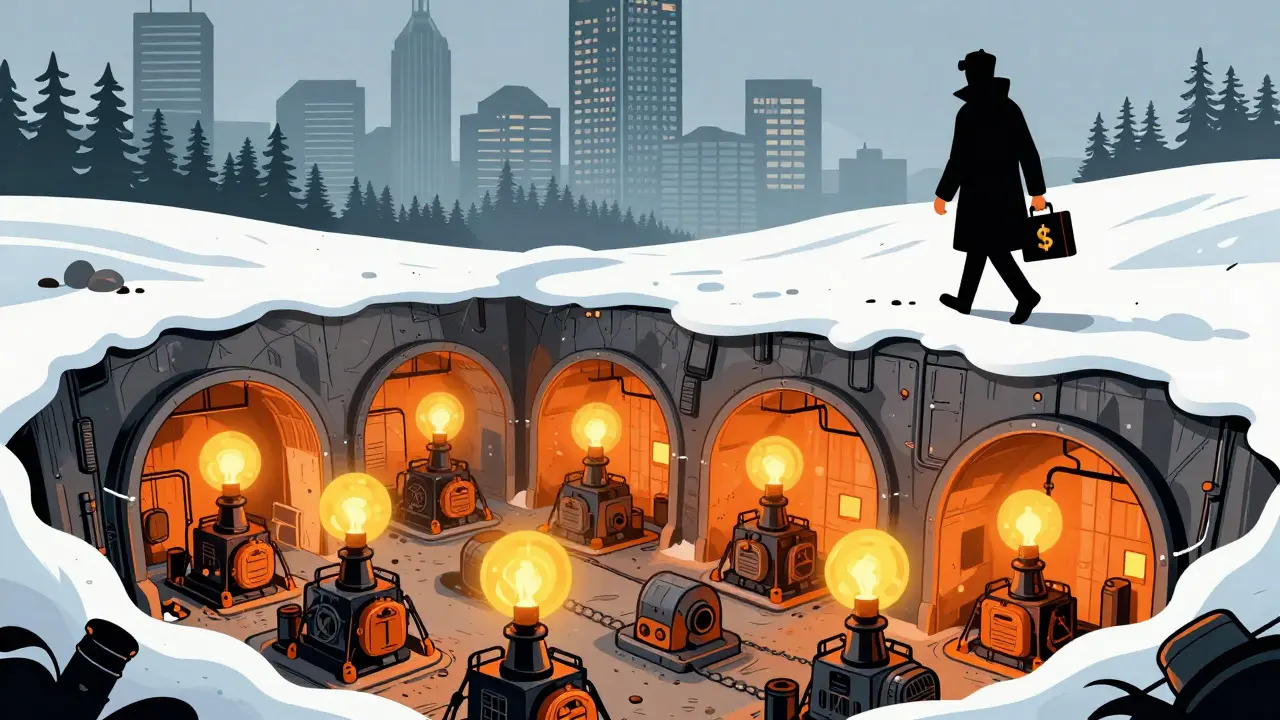
You can’t have a robust crypto ecosystem without the hardware to secure it. Russia now reportedly operates the world’s third-largest virtual currency mining industry. For years, mining existed in a gray area in Russia, often viewed with suspicion by regulators who saw it as a threat to the ruble’s dominance. Now, the government is actively legalizing and regulating these operations. Why? Because mining provides the liquidity and security that makes the network trustworthy for larger players.
By formalizing mining, Russia ensures a steady supply of newly minted coins and hash power to support its preferred networks. This also creates jobs and leverages the country’s abundant (and cheap) energy resources. It’s a strategic play: turn a potentially disruptive technology into a state-sanctioned utility. When the US Treasury’s Office of Foreign Assets Control (OFAC) designated a virtual currency mining company for the first time in August 2025, it sent a clear message. They know mining is no longer a hobby; it’s critical infrastructure for sanctions resistance.
The Shadow Network: Exchanges and Intermediaries
Stablecoins and miners are only part of the puzzle. You need places to swap fiat for crypto and vice versa. This is where sanctioned exchanges like Garantex and its successor, Grinex, come in. Garantex was hit with US sanctions in 2022, but the network didn’t die. In 2024, former employees launched Grinex specifically to continue operations, according to the US Treasury Department. By August 2025, Grinex was also sanctioned, showing how persistent these entities are.
These exchanges operate on a small, insular subset of platforms, many with notable ties to Russia. They create a closed loop where Russian exporters can sell oil or gas, receive payment in crypto, and convert it back to usable currency without touching SWIFT or correspondent banks in New York or London. The UK’s Office of Financial Sanctions Implementation (OFSI) has stepped in too, sanctioning eight individuals and entities linked to this infrastructure, including firms in Luxembourg and Kyrgyzstan. It’s a cat-and-mouse game, but the mouse is getting faster.
Western Countermeasures and Enforcement
How are the West responding? With targeted precision. On August 20, 2025, OFAC designated facilitators of Russian sanctions evasion, marking a pivotal moment in crypto enforcement. Brian E. Nelson, Under Secretary for Terrorism and Financial Intelligence, stated that Treasury would target anyone aiding evasion because they are supporting Putin’s war effort. This wasn’t just about punishing bad actors; it was about disrupting the plumbing of the shadow economy.
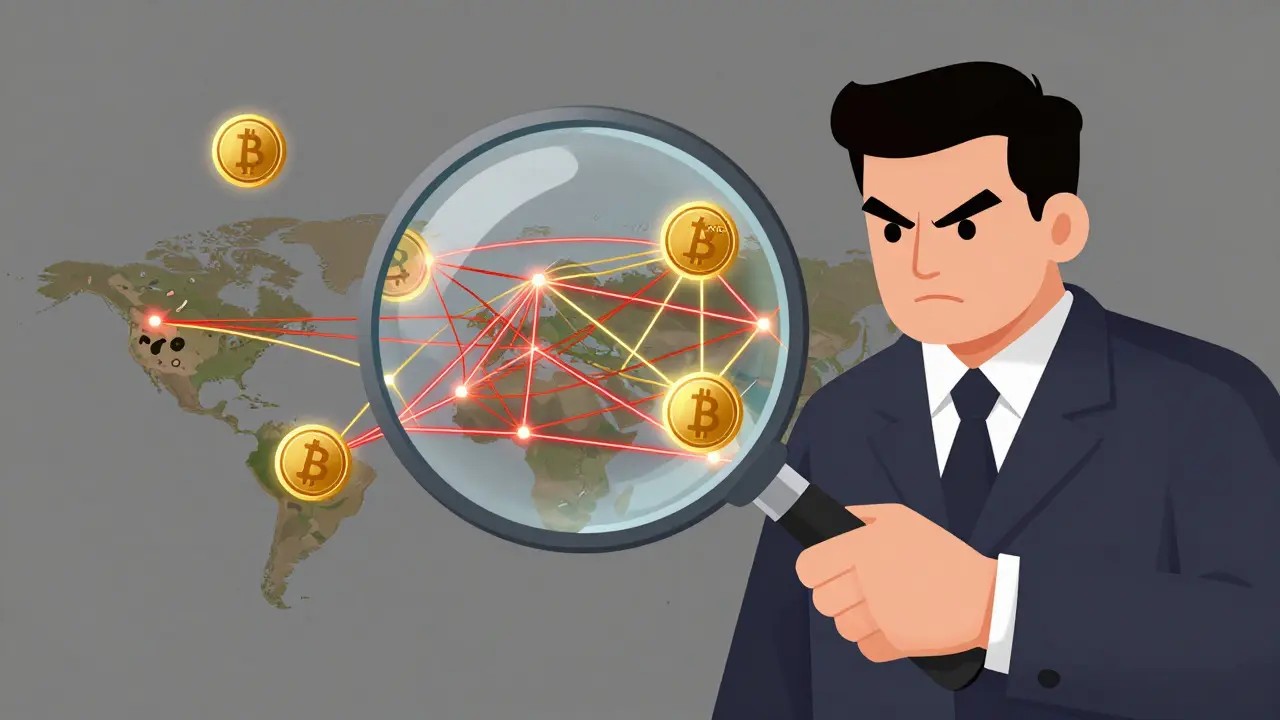
The enforcement actions target more than just exchanges. They include individuals linked to Kyrgyz banks used to pay for military goods and service providers supporting sanctioned institutions. Blockchain analytics firm Chainalysis has documented these flows, noting that while the networks are complex, the inherent transparency of blockchain allows authorities to trace connections. Every transaction is recorded on a public ledger. The challenge isn’t finding the data; it’s connecting the dots fast enough to stop the flow before it becomes entrenched.
Is Crypto Actually Effective for Evasion?
Here’s the reality check: crypto isn’t a magic bullet. The Bitcoin Policy Institute argues that Bitcoin is "ill-suited" to replace the dollar and euro as primary trade currencies. Russia’s pre-war exports totaled around $400 billion annually. That’s roughly 50% of Bitcoin’s entire market capitalization. Trying to settle that much trade in a volatile asset is impractical for large-scale commodity deals. Volatility remains the biggest hurdle for institutional adoption in trade settlement.
However, stablecoins like A7A5 mitigate this risk. They provide the stability of fiat with the speed of crypto. Academic research suggests that Russia isn’t alone in this strategy; North Korea and Venezuela are also leveraging similar tools. The effectiveness depends on scale and integration. While crypto may not replace the dollar entirely, it provides a crucial alternative lane for high-risk transactions that would otherwise be frozen or blocked by traditional banking systems.
| Feature | Traditional Banking (SWIFT) | Crypto-Enabled Networks (e.g., A7A5) |
|---|---|---|
| Speed | 1-5 days for cross-border | Minutes to hours |
| Visibility | High (via central clearing) | Pseudo-anonymous (public ledger) |
| Sanction Risk | High (easy to freeze accounts) | Medium (requires wallet address freezing) |
| Volatility | Low (pegged to fiat) | Variable (depends on asset type) |
| Infrastructure Cost | High (correspondent banks) | Lower (decentralized nodes) |
What This Means for Global Finance
Russia’s move signals a broader trend: the fragmentation of the global financial system. We are seeing the rise of alternative payment rails that operate independently of Western infrastructure. This isn’t just about Russia; it’s about any nation seeking sovereignty over its monetary policy. As more countries look at crypto as a tool for resilience rather than just speculation, the landscape will continue to shift.
For businesses, this means increased complexity in compliance. You can’t just assume that if a transaction doesn’t go through your bank, it’s invisible. For investors, it highlights the importance of understanding regulatory risks. The era of crypto being purely decentralized and ungoverned is ending. Governments are stepping in, whether to embrace it or control it. The key takeaway? Watch the stablecoins. They are the bridge between the old world of fiat and the new world of decentralized finance, and they are currently the most effective tool for bypassing traditional restrictions.
What is the A7A5 stablecoin?
A7A5 is a ruble-backed stablecoin launched in February 2025 by Old Vector, a Kyrgyzstan-based company backed by Russia's state-owned Promsvyazbank. It has processed over $51 billion in transactions and is primarily used for cross-border trade settlements to bypass Western banking controls.
Did Russia officially legalize all crypto mining?
Yes, Russia has moved to legalize and regulate cryptocurrency mining, recognizing it as a legitimate economic activity. This shift aims to build domestic infrastructure and provide liquidity for the emerging shadow crypto economy, making it easier for Russian entities to participate in global crypto markets.
How do US sanctions affect crypto exchanges like Garantex?
US sanctions designate specific exchanges and individuals as Specially Designated Nationals (SDNs). This makes it illegal for US persons to deal with them and encourages global partners to cut ties. However, because crypto is borderless, these exchanges often migrate jurisdictions or rebrand (like Garantex becoming Grinex) to continue operating, forcing regulators to adapt their enforcement strategies.
Is Bitcoin suitable for large-scale trade settlement?
Most experts argue Bitcoin is ill-suited for large-scale trade due to its volatility and limited market depth compared to fiat currencies. Russia's annual exports are roughly half of Bitcoin's market cap, making large transactions risky. Stablecoins like A7A5 are preferred for trade because they offer price stability while retaining the speed benefits of blockchain technology.
What role does blockchain analytics play in catching evaders?
Firms like Chainalysis use blockchain analytics to track transaction flows on public ledgers. Despite the pseudo-anonymity of crypto, every transaction is visible. By analyzing patterns, addresses, and timing, investigators can link wallets to real-world entities, exposing networks of sanctioned exchanges and intermediaries that try to hide behind technical complexity.





People Comments
FINALLY someone is saying it loud and clear! 🇺🇸🔥 These Russian commies are just trying to steal our way of life with their fake money! 😡 They think they can hide behind 'crypto' but we know the truth! 💪 It's all about war funding, plain and simple! 🛑 No more letting them cheat the system! 📉 We need to crush this shadow economy before it eats us alive! 🦅 America first always! 🚀
One must observe, quite painfully, that the narrative here is somewhat... reductive. The notion that a stablecoin is merely a tool for 'evasion' ignores the profound structural shifts in global liquidity pools. It is, frankly, tedious to watch the masses debate the surface-level implications while missing the deeper architectural changes in monetary policy. The ruble-backed nature of A7A5 is not just a convenience; it is a statement of intent regarding sovereign debt sustainability. One cannot help but feel that the discourse lacks the necessary nuance to appreciate the complexity of modern financial engineering.
The data on A7A5 volume is actually quite compelling when you look at the transaction timestamps. You see distinct peaks during European business hours, which suggests B2B usage rather than retail speculation. This aligns perfectly with the theory of commodity settlement. If you trace the wallet clusters linked to Promsvyazbank, you find direct correlations with oil export invoices from Q1 2025. It’s not magic; it’s just efficient plumbing that happens to bypass SWIFT. The latency reduction from days to minutes is the killer feature here, not the anonymity.
It is rather disappointing to see such a superficial analysis of what is essentially a geopolitical maneuver dressed up as technological innovation. The article fails to adequately address the regulatory arbitrage involved in using Kyrgyzstan as a jurisdictional shield. One would expect a more rigorous examination of the legal frameworks in place to enforce these sanctions, given the historical inefficacy of OFAC actions against non-cooperative jurisdictions. The reliance on blockchain analytics is also somewhat overstated, as the sheer volume of transactions makes manual verification nearly impossible without significant AI intervention, which brings its own set of privacy concerns.
They are watching you right now. The mining rigs aren't just for coins. They are signal boosters for the new grid. Look at the power consumption spikes in Siberia. It matches the hash rate exactly. Coincidence? No. The Fed knows. The ECB knows. Only we are still pretending this is about 'trade'. The A7A5 token is a digital leash. Every time you buy gas or oil, you are funding the machine. The mouse isn't getting faster. The cat is blind. Wake up people. The blockchain is a cage built by giants. 🕵️♂️👁️
Omg this is so fascinating!! I never realized how much crypto was being used for actual trade settlements, not just gambling on price swings! It’s wild to think that a stablecoin backed by the ruble could move $51 billion in just a few months. It really shows how adaptable businesses are when traditional banks close the doors. I guess we’re living in the future already, even if it feels a bit chaotic sometimes. Love seeing how different countries use tech to solve big problems! 🌍💸✨
From an Indian perspective, this is interesting because we also struggle with dollar dependency. But Russia has cheap energy which makes mining viable. For us, electricity costs are higher so it's harder to compete. Still, the shift to stablecoins for trade is a smart move. It reduces risk for exporters. I think other BRICS nations will follow suit soon. It's a positive step towards a multipolar financial world. Just need better infrastructure and trust though.
You know what's wrong with this whole setup? It's morally bankrupt. While normal people struggle with inflation, these oligarchs are moving billions in secret. It's like they think the rules don't apply to them. And let's not forget the environmental cost of all that mining. Burning fossil fuels to create digital money? That's just hypocrisy squared. We need to hold them accountable, not just sanction them. Sanctions just make them richer in the shadows. :(
The essence of currency is trust. When trust breaks between nations the medium of exchange must evolve. Crypto is not a tool it is a mirror reflecting the decay of old institutions. The Russians did not invent this they simply accepted the reality that the dollar hegemony is fracturing. To call it evasion is to misunderstand the nature of value itself. Value flows where friction is lowest. Friction is created by politics. Therefore crypto is political resistance in its purest form. Do not sleep on this.
I checked the Chainalysis report mentioned in the article. The flow from Garantex to Grinex wasn't just a rebrand; it was a full migration of user bases. About 60% of active wallets moved within 48 hours of the sanction announcement. That speed is insane for institutional players. It proves that the 'shadow network' is highly coordinated. You can't stop it by banning one entity. You have to ban the protocol layer, which no government wants to do because they want to control it too. So we're stuck in this weird limbo where everyone is playing by different rules.
Let me tell you something. This is a trap. They want us to accept crypto so they can track every single purchase we make. The A7A5 coin is just the tip of the iceberg. Once they get the ruble peg working globally, they can devalue the dollar overnight. It's all about control. The miners are just pawns. The real game is who controls the ledger. And right now, Moscow is winning that chess match. Don't be fooled by the 'freedom' narrative. It's centralization by another name. Stay vigilant.
It is imperative to note that the term 'sanctions evasion' is a misnomer. What is occurring is a parallel market emergence driven by necessity. The Western response is reactive and fragmented. By targeting individual entities like Grinex, OFAC creates a whack-a-mole scenario that benefits the very actors they seek to punish. The true threat is not the technology, but the erosion of the correspondent banking system's monopoly on cross-border payments. This fragmentation will likely lead to a bifurcated global financial architecture, with two distinct clearinghouses operating in separate spheres. The long-term implications for liquidity and exchange rate stability are profound and largely unaddressed in mainstream media.
This is a really well put together piece. I appreciate the comparison table at the end, it makes the differences very clear. I had heard about A7A5 but didn't realize the volume was that high. It does make sense why companies would prefer it over Bitcoin for settling large deals. Volatility is definitely a dealbreaker for most CFOs. I wonder if we'll see more Asian countries jumping on board with similar stablecoin initiatives in the next year. It seems like the momentum is building.