


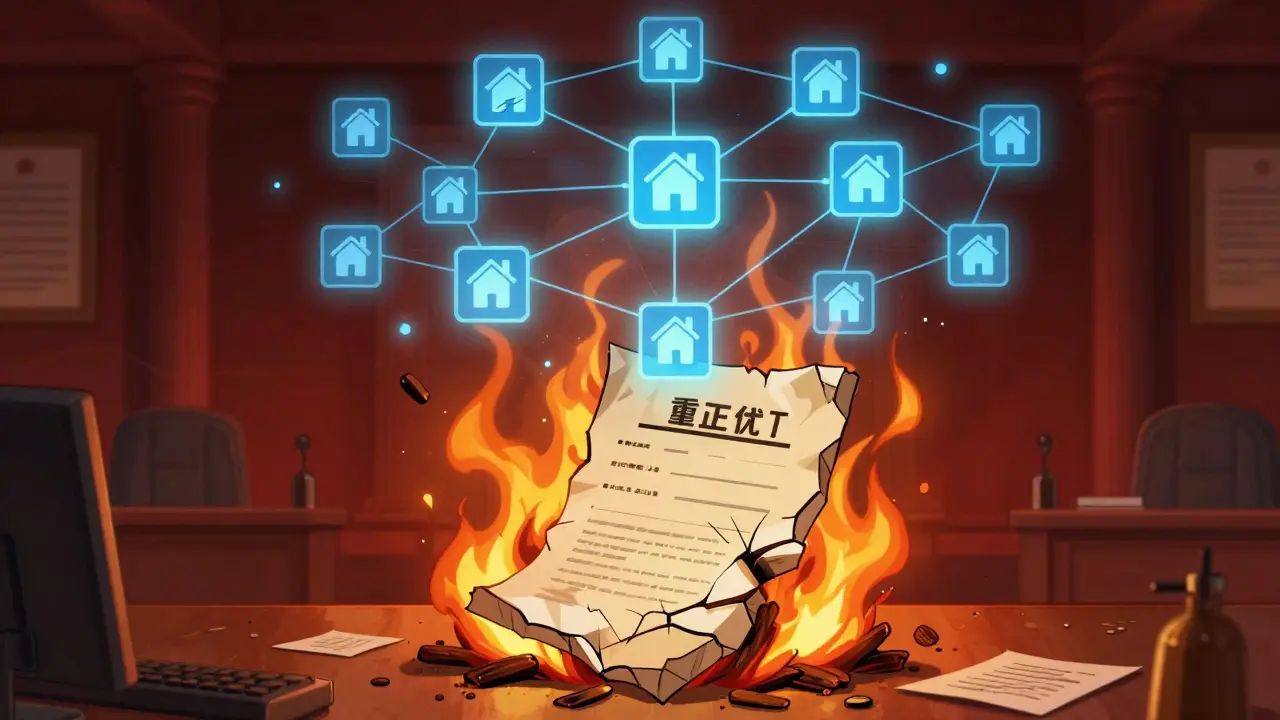
Imagine losing your home because a fire burned down the county office holding your property deed. That’s not science fiction - it happened in Haiti after the 2010 earthquake. Over a million people lost legal proof of ownership. No paper record, no claim. No recourse. This isn’t just a problem in developing countries. Even in places with modern systems, title fraud, slow transfers, and bureaucratic delays cost time, money, and trust. Now, blockchain is stepping in to fix it - not with better filing cabinets, but with a completely new system: blockchain property titles.
What Exactly Is a Blockchain Property Title?
A blockchain property title, sometimes called a blocktitle, is a digital record of ownership stored on a decentralized ledger. Unlike traditional titles that live in a single government database or a dusty file cabinet, blockchain titles exist across hundreds or thousands of computers worldwide. Every time ownership changes - whether through sale, inheritance, or mortgage - the transaction is verified by the network and permanently added to the chain. Once recorded, it can’t be deleted, altered, or lost.
Each title is tied to a unique cryptographic hash, like a digital fingerprint. If someone tries to tamper with it, the network instantly flags the change. No central authority approves it. No clerk signs off. Instead, the rules are built into code called smart contracts. These are self-executing agreements. For example, if a buyer sends the agreed-upon funds, the smart contract automatically transfers the title. No escrow agent needed. No waiting weeks for paperwork.
Think of it like a shared Google Doc that everyone can see but no one can secretly edit. Every change leaves a trace. Every owner is verified. And because it’s stored across the globe, it doesn’t matter if one server crashes - the record survives.
How It Works: From Paper to Blockchain
Switching from paper to blockchain isn’t as simple as scanning documents. It’s a three-phase process.
- Digitize the past: All existing paper titles and records are converted into digital format. This is messy. Some records are incomplete. Some are disputed. Some don’t exist at all. Governments must verify each one before it’s added to the blockchain.
- Run it parallel: New transactions happen on both the old system and the blockchain. This gives time for training, testing, and legal alignment. It also lets people get used to the new way.
- Migrate fully: Once confidence is high and laws catch up, the blockchain becomes the official record. The old system is retired.
Georgia’s national land registry did this in 2016. What used to take days now takes minutes. Sweden’s Lantmäteriet reduced a 3-4 month process to under two weeks. Ghana’s pilot cut title verification time by 70%. These aren’t theoretical gains. They’re real results from real pilots.
Why Blockchain Beats Traditional Systems
Traditional property systems have three big flaws: fragility, fraud, and friction.
- Fragility: Paper burns. Hard drives fail. Servers get hacked. In 2010, Haiti lost its entire land registry. In 2021, a cyberattack in the U.S. erased county records in Florida. Blockchain doesn’t have a single point of failure. If one node goes down, the rest keep running.
- Fraud: Fake deeds, forged signatures, duplicate sales - these happen far more often than people realize. The Nasdaq team calls blockchain “the ultimate defense against property title fraud.” Why? Because every transfer is cryptographically signed and verified by multiple parties. You can’t fake a signature that’s tied to a private key only the real owner holds.
- Friction: Title searches take days. Closing takes weeks. Lawyers, notaries, banks, and insurers all need to coordinate. Blockchain cuts out the middlemen. Smart contracts handle payments, transfers, and compliance automatically. One Reddit user said, “The title search took 30 seconds instead of 3 business days. It was revolutionary.”
And it’s not just faster. It’s cheaper. Fewer intermediaries mean lower fees. In countries where title insurance costs 1-3% of the property value, blockchain could slash that entirely.
The Dark Side: Challenges and Risks
Blockchain isn’t magic. It has real problems.
First: garbage in, garbage out. If a fake title gets added to the blockchain at the start, the system will forever treat it as real. Blockchain doesn’t verify the truth of the initial record - it only protects what’s already there. That’s why digitizing legacy records is the hardest part.
Second: legal recognition. Just because a title is on blockchain doesn’t mean courts accept it. Only 19 countries out of 195 legally recognize blockchain land records as valid. Even in places like Vermont and Wyoming, which passed blockchain-friendly laws in 2016 and 2019, courts still rely on traditional systems for disputes. You can’t just ignore the law.
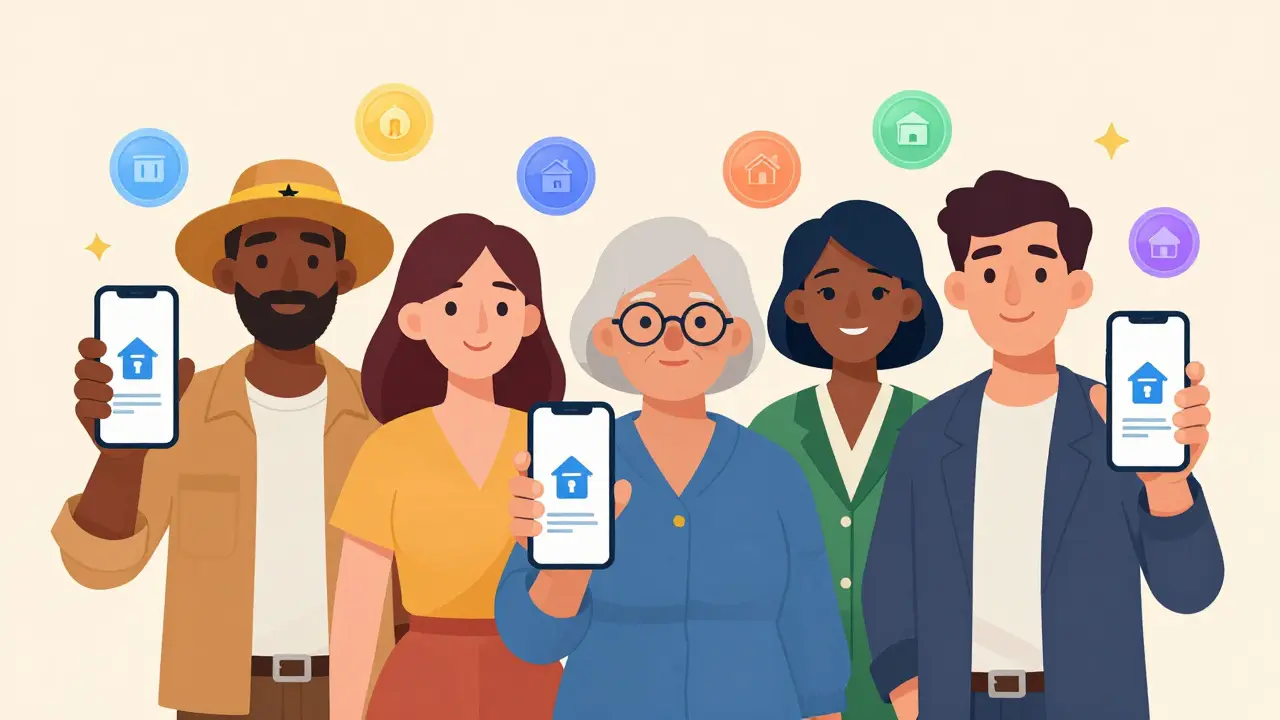
Third: access and literacy. Elderly homeowners in rural Ghana or Sweden struggled to understand how to verify their titles on a phone app. One pilot found 37% of users found the process confusing. Blockchain needs interfaces as simple as banking apps - not developer dashboards.
And fourth: resistance from incumbents. Title insurance companies, lawyers, and escrow agents make billions off the current system. They’re not going to vanish quietly. Some are already investing in blockchain to stay relevant. Others are lobbying to block it.
Tokenization: Owning a Piece of a House
One of the most exciting developments isn’t just about ownership - it’s about who can own.
Tokenization turns property into digital tokens. A $500,000 house becomes 500,000 tokens. You can buy one token for $1. Now you own 0.0002% of that house. This opens real estate to people who can’t afford a full home. J.P. Morgan says this could “open real estate to a broader audience.”
Imagine pooling money with neighbors to buy a rental property. Or investing $50 in a downtown office building in Chicago. Fractional ownership could turn real estate from a luxury into a liquid asset - like buying shares in Apple.
Platforms like RWA.io and Haus are building tools for this. The International Organization for Standardization even released a blockchain title protocol in October 2025 to make tokenized titles work across borders.
Who’s Using It Now?
Real-world adoption is still small, but growing fast.
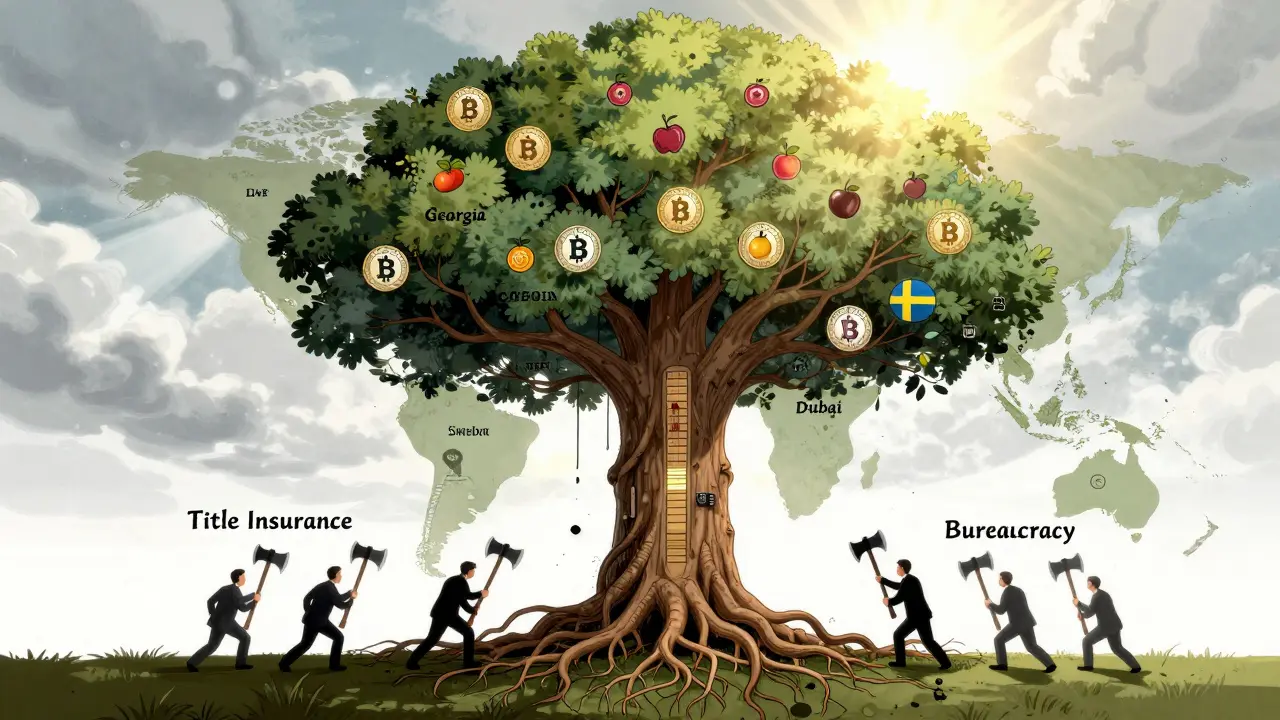
- Georgia: First country to fully launch a national blockchain land registry. Over 100,000 titles recorded.
- Sweden: Lantmäteriet (land registry) piloted blockchain for property transfers. Real estate agents gave it a 92% satisfaction rating.
- Ghana: Used blockchain to resolve decades-old land disputes in rural areas. Farmers who couldn’t prove ownership now have verifiable records.
- United States: California and Florida have local pilot programs. Private firms like Propy and TitleChain are offering blockchain closing services.
- United Arab Emirates: Dubai’s Land Department now accepts blockchain titles for commercial properties.
Adoption is strongest where the old system is broken. In places with weak governance or corruption, blockchain isn’t just convenient - it’s essential.
What’s Next?
The future of blockchain property titles isn’t just about recording ownership - it’s about automating it.
Imagine sensors on property boundaries that feed real-time data to the blockchain. If a neighbor builds a fence that crosses your line, the system flags it. AI checks the title history for fraud patterns. If someone tries to sell a property they don’t own, the system blocks it before the transaction even starts.
By 2030, Deloitte predicts 35% of commercial real estate deals will use blockchain titles. Residential adoption will lag - around 22% - because homes are bought by individuals, not corporations. But the trend is clear: blockchain will become the default, not the exception.
Legal frameworks will catch up. Interfaces will get simpler. Costs will drop. And the people who benefit most? Those who were locked out before - small investors, rural landowners, refugees, immigrants. For them, a blockchain title isn’t a tech upgrade. It’s a lifeline.
Should You Care?
If you own property - or want to - yes.
Blockchain won’t replace every title office tomorrow. But it’s already changing how deals happen. If you’re buying a home in 2026, you might get a blockchain title without even knowing it. If you’re investing in real estate, tokenization could let you own a slice of a building in New York with $100.
Don’t wait for the government to make the move. Ask your real estate agent: “Is this transaction using blockchain?” If they don’t know, it’s time to learn. The old system is slow, expensive, and risky. The new one is faster, cheaper, and secure. The question isn’t if blockchain titles will win. It’s when you’ll use one.
Can a blockchain property title be hacked?
Not the way people think. The blockchain itself is nearly impossible to hack because it’s spread across thousands of computers. But your private key - the digital password that gives you access to your title - can be stolen if you don’t secure it. Treat it like your house key. Use a hardware wallet. Never share it. If someone gets your key, they own your property. The system is secure. The user isn’t.
Are blockchain titles legally valid?
Only in certain places. As of 2025, only 19 countries legally recognize blockchain records for property titles. In the U.S., states like Wyoming and Vermont have passed laws allowing it. Elsewhere, courts still require traditional documentation. Always check your local laws before relying solely on a blockchain title.
Can I still get title insurance with a blockchain title?
Yes, but it’s becoming less necessary. Title insurance protects against fraud, errors, or hidden claims. Blockchain makes those risks nearly zero - because every transfer is traceable and verified. Some insurers still offer policies for blockchain titles, but premiums are dropping. In places like Georgia and Sweden, insurers are starting to phase out policies for blockchain-registered properties.
What happens if I lose my private key?
You lose access to your property. There’s no “forgot password” button on a blockchain. Unlike banks, there’s no central authority to reset your key. That’s why recovery options like multi-signature wallets and trusted custodians are critical. If you’re not tech-savvy, work with a professional who understands blockchain estate planning.
How much does it cost to use a blockchain property title?
Fees vary. In pilot programs, transaction costs are under $10 - far less than the $1,000-$5,000 typical for title searches and insurance. But initial setup costs for governments are high, often in the millions. For individual buyers, the cost is usually built into closing fees. The long-term savings, however, are massive: faster closings, fewer lawyers, no title insurance premiums.
Can I sell part of my house using blockchain?
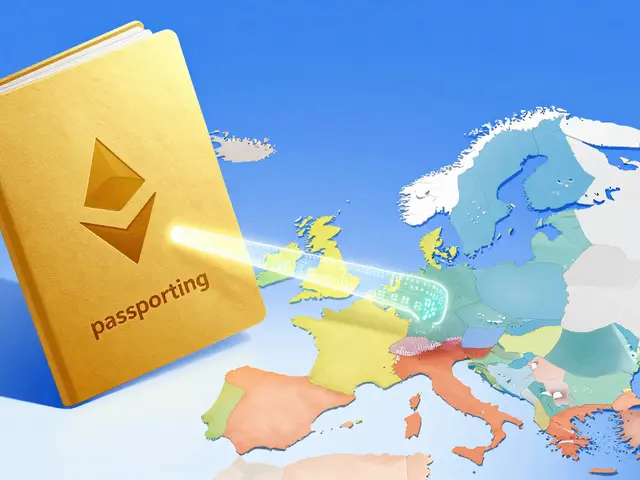
Yes - that’s called tokenization. You can split your property into digital tokens, each representing a fraction of ownership. You can sell 10% of your house to ten different people. Platforms like RWA.io and Propy already support this. It’s legal in jurisdictions that allow fractional ownership, which includes most developed countries. But check local zoning and tax laws - they may not yet account for this.

People Comments
Blockchain property titles represent a paradigm shift in spatial governance architecture - leveraging cryptographic immutability and distributed consensus to decouple land tenure from centralized bureaucratic entropy. The smart contract enforcement layer eliminates discretionary intermediation, which is structurally prone to rent-seeking. However, the ontological integrity of the system remains contingent on the veracity of the initial state transition - i.e., garbage in, garbage out remains a fundamental constraint. The digitization phase isn’t merely technical; it’s epistemological.
This is honestly one of the most hopeful things I’ve read all year. 💪 Imagine a farmer in Ghana finally having proof she owns the land her family has farmed for generations - no more bribes, no more stolen deeds. This isn’t just tech - it’s justice. And it’s happening NOW. If you’re not excited about this, you’re not paying attention. 🌍✨
Ownership is a social construct. Blockchain just makes it harder to deny.
I’ve seen the Georgia pilot firsthand. The speed alone is transformative. One client closed in 17 minutes. We used to wait six weeks for title insurance clearance. Now? It’s almost invisible. The real win is the peace of mind - knowing your record won’t vanish in a fire or a server crash.
While the technical merits of blockchain-based title systems are compelling, legal harmonization remains the most significant barrier. Jurisdictional recognition is fragmented, and courts are inherently conservative in their evidentiary standards. Until there is uniform statutory adoption - particularly in common law jurisdictions - adoption will remain piecemeal and subject to litigation risk. Caution is warranted.
Bro. I just bought my first house using Propy. Title transfer took 40 minutes. No escrow agent. No notary. No 3-hour closing meeting. I cried. 😭 I’m not even joking. This is the future and it’s here. You’re either on the train or getting left behind. #BlockchainRealEstate
Blockchain titles? More like blockchain scams waiting to happen. Who’s to say the ‘government’ running the ledger isn’t just another corporation with a fancy server farm? They’re not giving you ownership - they’re giving you a digital leash. And don’t get me started on private keys. You think some grandma in rural India is gonna remember her 24-word passphrase? Nah. This is just Wall Street’s new way to monetize your fear of paper.
Man, I’ve been waiting for this my whole life. I grew up watching my dad lose three years fighting over land his family owned since 1947. Paper records got lost, lawyers got rich, and we got nothing. If blockchain can stop that crap for even one person - it’s worth every byte.
Tokenization sounds cool - but what happens when someone buys 100 tokens and then demands to physically occupy their 0.02% of your house? Or when 500 people own a single apartment and one of them starts throwing parties every weekend? Who enforces the rules? The blockchain doesn’t care if your neighbor’s dog poops on your shared lawn.
Blockchain titles are just crypto bros trying to make rent payments look like a revolution. You think a farmer in Nigeria is gonna trust a digital hash more than his village elder? Nah. This is Silicon Valley arrogance dressed up as innovation. They don’t care about people - they care about exit strategies
Let’s be real - this only works if you’re already tech-literate and have a bank account. What about the elderly? The undocumented? The rural poor? Blockchain doesn’t fix inequality - it just hides it behind a sleek app interface. The real problem isn’t the paper - it’s the system that leaves people out in the first place.
So you’re telling me I can finally prove I own my backyard… by installing an app? And if I forget my password, I lose my house? Cool. Cool cool cool. I’ll just stick with my dusty deed and my trusty lawn gnome.
Of course the state wants to digitize titles - it’s the first step toward full asset surveillance. Once they own your property’s digital fingerprint, they can tax it, restrict it, or seize it without due process. This isn’t liberation - it’s the final phase of financial totalitarianism. Wake up. The blockchain is not your friend.
People are so obsessed with the tech they’re ignoring the human layer. The real innovation isn’t the ledger - it’s the community support networks being built around it. In Ghana, local NGOs are training elders to use tablet apps to verify titles. That’s the real story. Tech enables, but people make it stick.
It’s worth noting that the legal recognition of blockchain titles remains limited. While technical integrity is high, judicial acceptance requires statutory codification, which varies significantly across jurisdictions. Until uniform legal frameworks are established, blockchain titles function as de facto records, not de jure ones. Precision matters.
Why are we letting foreign tech companies dictate how Americans own property? This isn’t progress - it’s corporate colonization. The U.S. has the best title system in the world. We don’t need blockchain. We need to protect our sovereignty. This is just another way for Silicon Valley to profit off our land while we lose control.
One must consider the ontological implications of replacing physical, tactile, historically embedded documentation - which carries cultural and symbolic weight - with abstract, algorithmically generated digital artifacts. While functionally efficient, the epistemic rupture may erode the social contract surrounding property as a communal, generational inheritance. The elegance of the system must not obscure its existential cost.
I’ve spent years working with displaced communities in the American South. For them, a title isn’t just a legal document - it’s proof that their ancestors didn’t die in vain. When I saw the first blockchain title issued to a descendant of a freed slave who’d been denied land since 1865… I couldn’t speak. This isn’t about efficiency. It’s about healing. It’s about saying, ‘You were right to believe you belonged here.’ That’s worth more than any smart contract.