


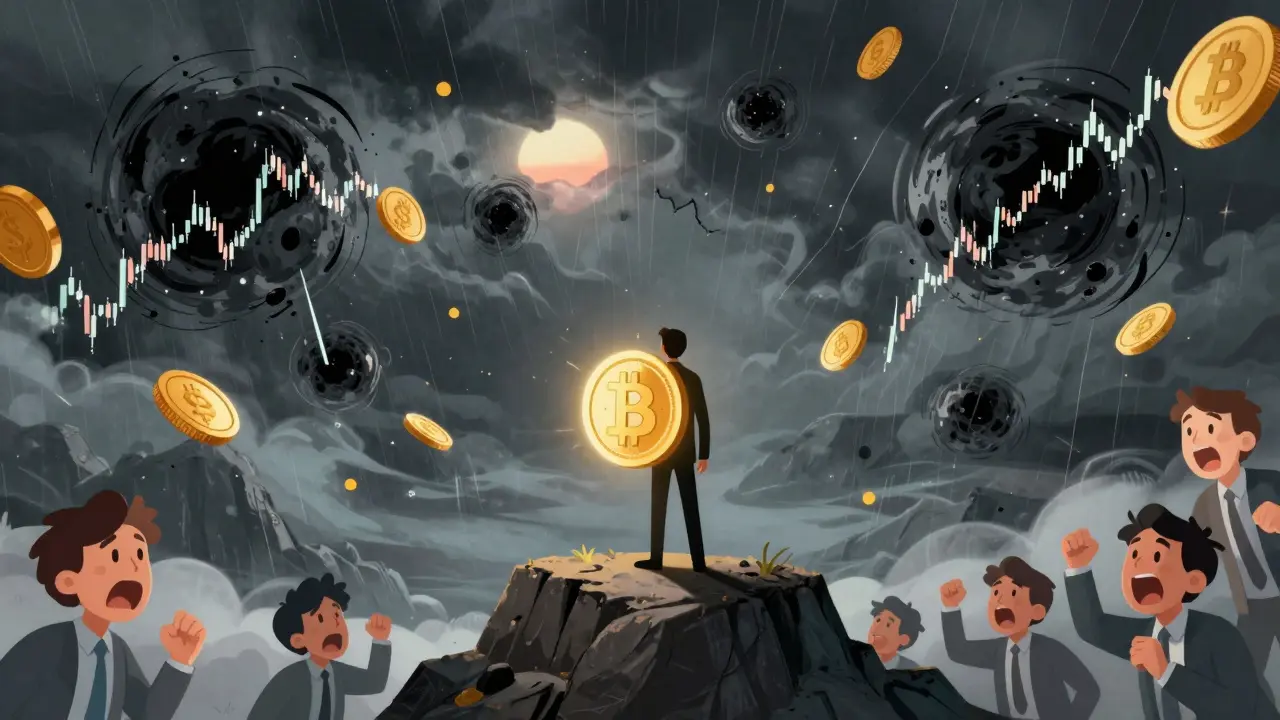
When Bitcoin crashed 50% in one day back in March 2020, most people panicked. They sold. But thousands of others didn’t. They typed one word into a forum: HODL. That typo from 2013 turned into a movement - a belief that if you just hold on, the market will come back. And for many, it did. But not for everyone. HODLing crypto isn’t just a strategy. It’s a psychological test, a financial gamble, and sometimes, a life-changing decision.
What HODLing Actually Means
HODL isn’t about waiting for the perfect moment to buy. It’s about refusing to sell, no matter what. Whether Bitcoin drops 30% in a week or Ethereum collapses after a protocol hack, HODLers keep their keys in cold storage and their eyes on the long game. This isn’t passive investing like buying an index fund. This is betting your money on something with no dividends, no earnings, and no historical track record longer than 15 years.
The Real Benefits of HODLing
One of the biggest reasons people HODL is because they avoid taxes. In the U.S., every time you sell crypto, you owe capital gains tax. If you bought Bitcoin at $5,000 and sold it at $50,000, you pay tax on the $45,000 gain. But if you just hold? You owe nothing. Not until you cash out. That’s a massive advantage over stocks, where dividends and sales trigger yearly tax events.
Then there’s the emotional relief. Crypto moves fast. Bitcoin had 10%+ daily swings on nearly 15% of trading days between 2013 and 2023. The S&P 500? Just 1.8%. Trying to time those moves is like surfing a tsunami with a paddle. HODLing removes the pressure. You stop watching charts at 3 a.m. You stop checking your phone every time your phone buzzes. You sleep.
And then there’s staking. After Ethereum switched to proof-of-stake in 2022, HODLers who kept their ETH on supported wallets started earning 3-5% annual returns just for holding. Cardano, Solana, and Polkadot offer similar yields. That’s free money - not from trading, not from speculation, but from simply keeping your coins locked up. It turns HODLing from a waiting game into a passive income stream.
The Hidden Risks You Can’t Ignore
But here’s the truth: HODLing isn’t magic. It’s risky. Bitcoin’s biggest drawdown? 83%. That’s what happened between its 2017 peak and its 2018 low. If you invested $10,000 in January 2018, you’d have been down to $1,700 by December. Meanwhile, the S&P 500 grew to over $10,900 in the same period. You’re not just betting on crypto. You’re betting it outperforms everything else.
And what if you lose your private key? Around 20% of all Bitcoin - roughly 3.7 million coins - is believed to be permanently lost. No one can recover it. No customer service. No reset button. Just gone. That’s not a remote risk. It’s a real one. People have lost life savings because they forgot a password or deleted a file.
Then there’s regulation. China banned crypto in 2021. The market dropped 30% overnight. The U.S. SEC has targeted exchanges, staking platforms, and even wallet providers. If your favorite coin gets classified as a security, its value could evaporate overnight. HODLing doesn’t protect you from government action. It just makes you wait longer while it happens.
And not all coins survive. Terra’s Luna token crashed from $80 to $0.0001 in seven days in 2022. HODLers who held it lost everything. No recovery. No second chance. Unlike stocks, where companies can restructure or get bought out, most crypto projects vanish without a trace.

What History Tells Us
Bitcoin’s price history shows a pattern: crash, recover, repeat. After the 2011 crash, it took two years to recover. After 2015, it took 18 months. After 2018? Three years. The 2022 bear market? It took about 18 months to get back to its peak. So if you HODL long enough, you’ve got a decent shot at breaking even - maybe even winning.
But here’s the catch: past performance doesn’t guarantee future results. Bitcoin has only existed since 2009. That’s less time than most people spend in college. There’s no way to know if it will last 50 years. Or 10. Or if it will be replaced by something better.
Who Should HODL? Who Shouldn’t?
If you’re young, have no debt, and can afford to lose your entire crypto investment without affecting your rent or groceries - HODLing might work for you. A small slice of your portfolio - say 2-5% - could pay off big if Bitcoin hits $100,000 or $250,000.
But if you’re saving for a house, planning retirement, or relying on this money for your kids’ education - don’t HODL. Crypto isn’t a safe asset. It’s a high-risk bet. Even experts are split. Michael Saylor says Bitcoin is digital gold. Paul Krugman calls it a greater fool theory. Cathie Wood predicts $1 million per Bitcoin. JPMorgan says $35,000 is fair value.
The truth? No one knows. That’s why HODLing works for some and destroys others.
How to HODL Smart
If you’re still considering HODLing, here’s how to do it without getting blindsided:
- Only invest what you can afford to lose completely.
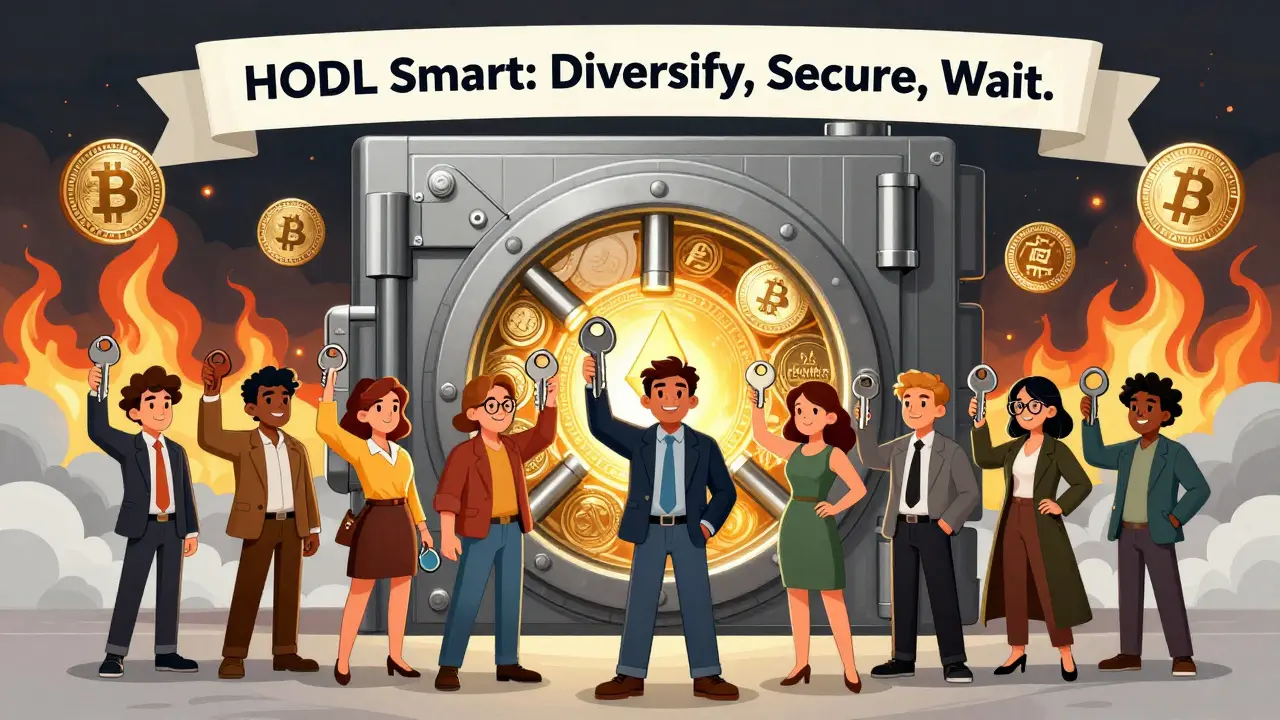
- Use a hardware wallet - not an exchange. Exchanges get hacked. Wallets you control don’t.
- Write down your recovery phrase. Keep it in a fireproof safe. Don’t store it digitally.
- Don’t HODL one coin. Spread across 3-5 proven ones. Bitcoin, Ethereum, maybe Litecoin or Solana. Diversify within crypto.
- Ignore the noise. No one can predict the next move. Not analysts. Not influencers. Not Elon Musk.
- Consider dollar-cost averaging. Buy a little every month. It smooths out the highs and lows.
HODLing isn’t about getting rich quick. It’s about staying in the game long enough to see what happens. Some will get lucky. Others will lose everything. The difference? Preparation.
What’s Next for HODLers?
The Bitcoin halving in April 2024 changed the game again. Historically, halvings - when block rewards drop by half - have preceded major bull runs. After the 2020 halving, Bitcoin went up 1,000% in 18 months. But this time, it’s different. More institutions are involved. More regulation is coming. The market isn’t just retail anymore.
And now, with Bitcoin spot ETFs approved in January 2024, institutional money is flowing in. That could mean more stability - or more volatility as big players move in and out. Either way, HODLers are no longer just a community of believers. They’re part of a growing financial system.
But the core truth hasn’t changed: if you HODL, you’re not investing in a company. You’re betting on a belief. That blockchain will change the world. That scarcity will drive value. That people will keep buying - even when the charts look terrible.
That’s why HODLing works. And why it fails.
Is HODLing crypto still a good strategy in 2026?
Yes - but only if you understand what you’re getting into. HODLing works best as a long-term bet on Bitcoin and Ethereum, not on random altcoins. With institutional adoption growing and Bitcoin ETFs now live, the market is more mature than in 2017. But volatility hasn’t gone away. If you can hold for 5-10 years and tolerate 50%+ drawdowns, it’s still a viable strategy. If you need your money next year, it’s not.
Can you lose all your money HODLing crypto?
Absolutely. Many people have. Projects like Terra/Luna, FTX, and Celsius collapsed completely. If you held those, you lost everything. Even Bitcoin could lose 90% of its value and take years to recover. HODLing doesn’t protect you from total failure - only from panic selling. You still need to pick projects with real use cases and strong teams.
Do you pay taxes if you HODL crypto?
No - not until you sell, trade, or spend it. The IRS treats crypto as property, so holding doesn’t trigger a taxable event. But if you buy a coffee with Bitcoin or trade ETH for SOL, that’s a taxable sale. HODLing lets you defer taxes indefinitely. That’s one of its biggest advantages over traditional investing.
What’s the difference between HODLing and dollar-cost averaging (DCA)?
HODLing means buying once and holding. DCA means buying small amounts regularly - say $100 every week. DCA reduces the risk of buying at the top. A 2022 River Financial study found DCA outperformed lump-sum buying in 63% of 3-year periods between 2013-2022. But if you timed the bottom, lump-sum (HODLing) won. Most people can’t time the bottom. So DCA is safer for most.
Should you HODL Bitcoin or diversify into other coins?
Most experts recommend starting with Bitcoin and Ethereum. They’re the most established, with the largest networks and the most institutional backing. Altcoins like Solana or Cardano can offer higher returns - but also much higher risk. A 2023 Coinbase report showed users who held 3+ coins outperformed single-coin HODLers. But don’t chase trends. Stick to projects with real technology and active development.
Is HODLing crypto better than investing in stocks?
It’s not better - it’s different. Stocks have earnings, dividends, and 100+ years of data. Crypto has none of that. HODLing crypto is pure speculation based on adoption and belief. Stocks are partial ownership in businesses. If you want steady growth, stick with index funds. If you want high risk and potentially massive returns, crypto HODLing might be for you - but never as your main investment.


People Comments
HODLing saved my sanity during the 2022 crash. I didn't check my portfolio for 6 months. When I finally did, I was up 3x. Sleep is overrated, but panic selling? That's just dumb.
The real advantage of HODLing isn't just tax deferral-it's avoiding behavioral finance traps. Most retail investors underperform because they buy high and sell low. HODLing forces discipline. Not perfect, but better than 80% of strategies.
People act like HODLing is some holy grail but let's be real-most of these coins are vaporware. I held Doge for 3 years. Lost 90%. Then I bought Tesla stock. Now I'm laughing. Crypto isn't investing. It's a casino with better graphics.
HODLing is for people who can't handle volatility 😅 I mean, if you're still checking your wallet every hour, you're not HODLing-you're just addicted. Go get a hobby. Or a therapist.
You think you HODL but you just got lucky. In Nigeria we know real HODLing-when your phone dies and you still have your seed phrase written on a napkin. That's commitment. Not just holding coins-holding hope.
I started HODLing after losing my job. Didn't know if I'd eat next month. But I kept my ETH. Now I'm not rich-but I'm not broke either. Sometimes just surviving is the win. 🙏
I don't HODL because I believe in crypto. I do it because I believe in myself. If I can sit through the noise, the fear, the memes, the FUD-then maybe I'm not as weak as I thought.
The fact that you're even considering HODLing as a strategy reveals a fundamental misunderstanding of asset allocation. Real wealth is built through dividend-paying equities, not speculative digital tokens with no intrinsic value.
HODL? More like HOLE. You're just digging your own grave with crypto. Why not just throw cash in a bonfire? At least you'd get warmth.
HODLing is the lazy man's version of investing. Real investors analyze fundamentals, tokenomics, team credibility, on-chain metrics. You? You just stare at a chart and hope. Pathetic.
I've been a financial advisor for 22 years. I've seen bubbles. I've seen crashes. I've seen people lose everything. HODLing isn't a strategy-it's a coping mechanism. But if you're going to do it, do it right: hardware wallet, 5-year horizon, max 5% of net worth. And never, ever use leverage.
So you're telling me the guy who bought Bitcoin at $300 and never sold is somehow smarter than the guy who bought Apple at $100 and never sold? Hmm. Maybe we just need to rename HODLing to 'I got lucky and refused to admit it'.
I HODLed LTC because I thought it was the 'silver to Bitcoin's gold'. It's now worth 2% of what I paid. I still have it. Not because I believe in it. Because I'm too proud to admit I was wrong.
I lost my whole life savings on a meme coin. Then I got a job at Walmart. Now I'm happy. HODLing isn't about wealth. It's about ego. And ego doesn't pay rent.
In my culture, patience is sacred. I HODL because it teaches me stillness. Not because I expect riches. But because in a world of noise, holding still is revolutionary.
HODLING ISN'T A STRATEGY IT'S A LIFESTYLE 🙌 I stopped checking prices after I bought. Now I meditate. I hike. I read. I sleep. My portfolio? Still growing. My peace? Infinite. 💫
The government is coming. They're already tracking wallet addresses. Your 'HODL' is just a temporary illusion. They'll tax it, regulate it, ban it. You think your private key is safe? Think again. They own the servers. They own the internet. You're just a data point.
I started HODLing because I didn't know how to invest. Now I'm reading whitepapers, learning about consensus mechanisms, helping friends set up wallets. HODLing didn't make me rich-but it made me smarter. And that's worth more than any coin.
You all talk about HODLing like it's noble. But let's be honest-you're just afraid to lose face. You bought at the top. You're too embarrassed to sell. So you call it 'long-term vision'. It's not wisdom. It's pride. And pride doesn't pay your bills.