

Imagine trying to send a letter to your neighbor. You could drop it in the mailbox (on-chain transaction), wait for the postal service to sort it, deliver it, and update their records. It’s secure, but slow and costs money every time. Now imagine you just walk over and hand them the cash directly. That’s instant, free, and private. This is the core problem blockchain scaling is trying to solve.
As blockchains like Bitcoin and Ethereum grow, they hit a wall. They can only process so many transactions per second. When too many people try to use the network at once, fees skyrocket, and confirmations take forever. To fix this, developers created Layer 2 solutions, which are protocols built on top of the main blockchain to handle transactions off-chain. Two of the most important types are payment channels and state channels. While they sound similar-and share some DNA-they serve different purposes. Understanding the difference is crucial if you want to build scalable apps or simply understand where crypto payments are heading.
What Are Payment Channels?
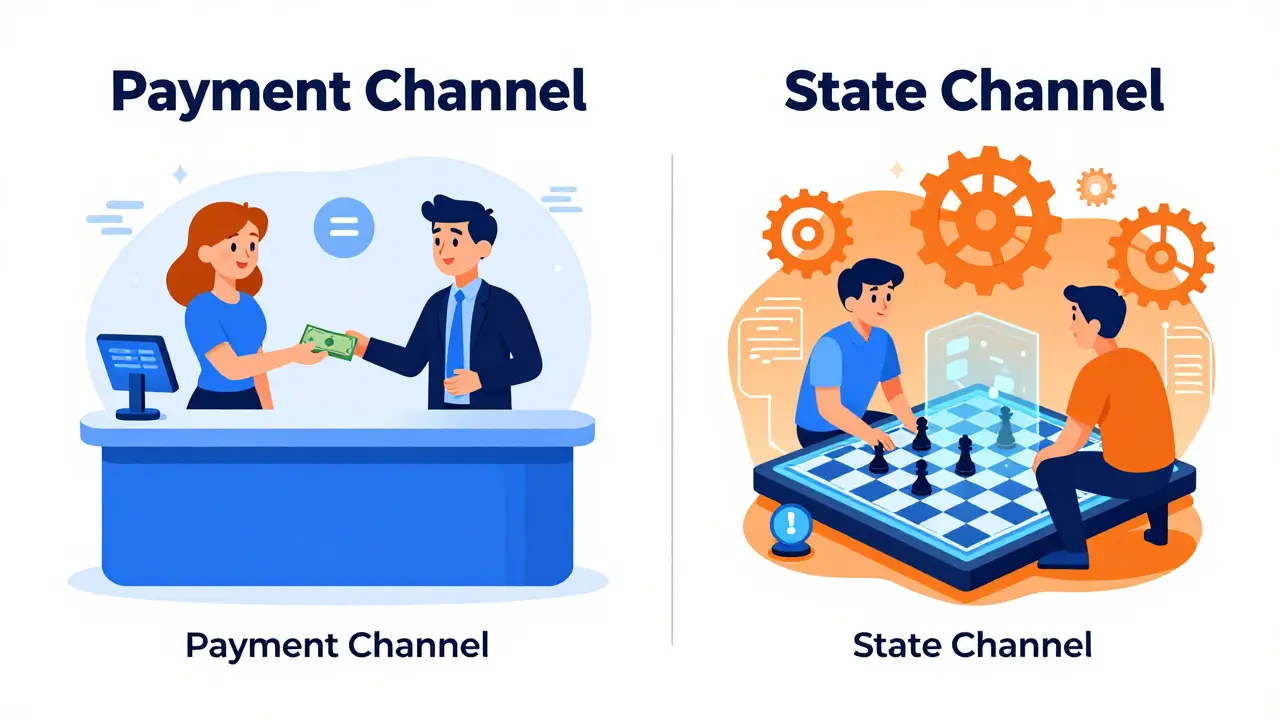
A payment channel is a specific type of Layer 2 solution designed exclusively for moving money between two parties quickly and cheaply. Think of it as a digital tab at a bar. You put down a deposit when you sit down, order drinks freely without paying each time, and then settle the final bill when you leave.
In the blockchain world, this works through a three-step process:
- Opening: Two parties lock funds into a multi-signature smart contract on the main blockchain. For example, Alice and Bob might each lock 1 BTC into a joint account controlled by both of them.
- Transacting Off-Chain: Alice and Bob now exchange signed messages that update their balances. If Alice pays Bob 0.1 BTC, they sign a new state saying Alice has 0.9 and Bob has 1.1. No data is sent to the blockchain yet. This happens instantly and costs nothing.
- Closing: When they’re done, one party broadcasts the latest signed balance to the blockchain. The smart contract releases the funds according to that final state.
The most famous example is the Lightning Network for Bitcoin. It uses Hashed Timelock Contracts (HTLCs) to ensure security. HTLCs act like an escrow with a timer: if the receiver doesn’t claim the payment within a set time, the sender can reclaim their funds. This prevents fraud if one party goes offline or tries to cheat.
Payment channels can be unidirectional (money flows one way, good for subscriptions) or bidirectional (money flows both ways, good for peer-to-peer trading). Their strength lies in simplicity and speed for monetary transfers.
What Are State Channels?
If payment channels are for money, state channels are for anything else. A state channel is a broader category of Layer 2 technology that allows participants to update any kind of blockchain state-not just balances-off-chain.
While a payment channel tracks who owns how much currency, a state channel can track complex game states, ownership of non-fungible tokens (NFTs), or even the status of a decentralized application (dApp). For instance, in a blockchain-based chess game, players don’t need to submit every move to the Ethereum mainnet. Instead, they open a state channel, make moves off-chain by signing the current board state, and only publish the final result when the game ends.
State channels work similarly to payment channels in terms of opening and closing, but the "state" being updated is more flexible. It might include:
- Token balances (like ERC-20 tokens)
- NFT ownership (like CryptoKitties)
- Domain name registrations (like ENS domains)
- Complex logic from smart contracts
Because state channels can handle arbitrary data, they require more sophisticated smart contracts to manage dispute resolution. If Alice and Bob disagree on the final state of a chess game, the contract needs rules to determine who wins based on the last valid signed state. This makes state channels more versatile but also more complex to develop and maintain.
Key Differences: Payment vs. State Channels
To see why these distinctions matter, let’s compare them side-by-side. The table below highlights the critical differences in scope, complexity, and use cases.
| Feature | Payment Channels | State Channels |
|---|---|---|
| Primary Function | Transfer of value (money/tokens) | Update of any blockchain state |
| Scope | Narrow (balances only) | Broad (balances, NFTs, logic, etc.) |
| Complexity | Lower (simple balance updates) | Higher (complex state management) |
| Dispute Resolution | Time-locked refunds (HTLCs) | Fraud proofs and slashing conditions |
| Best Use Case | Micropayments, retail, subscriptions | Gaming, dApps, enterprise workflows |
| Example | Lightning Network (Bitcoin) | Ethereum State Channels (e.g., Raiden, Connext) |
The key takeaway is that all payment channels are technically a subset of state channels, but not all state channels are payment channels. In practice, when people say "payment channel," they mean a simple money-transfer pipe. When they say "state channel," they mean a general-purpose off-chain execution environment.
How They Work Together: Networks and Routing
One major limitation of direct channels is that you need to know the other person beforehand. What if Alice wants to pay Charlie, but she only has a channel with Bob? This is where channel networks come in.
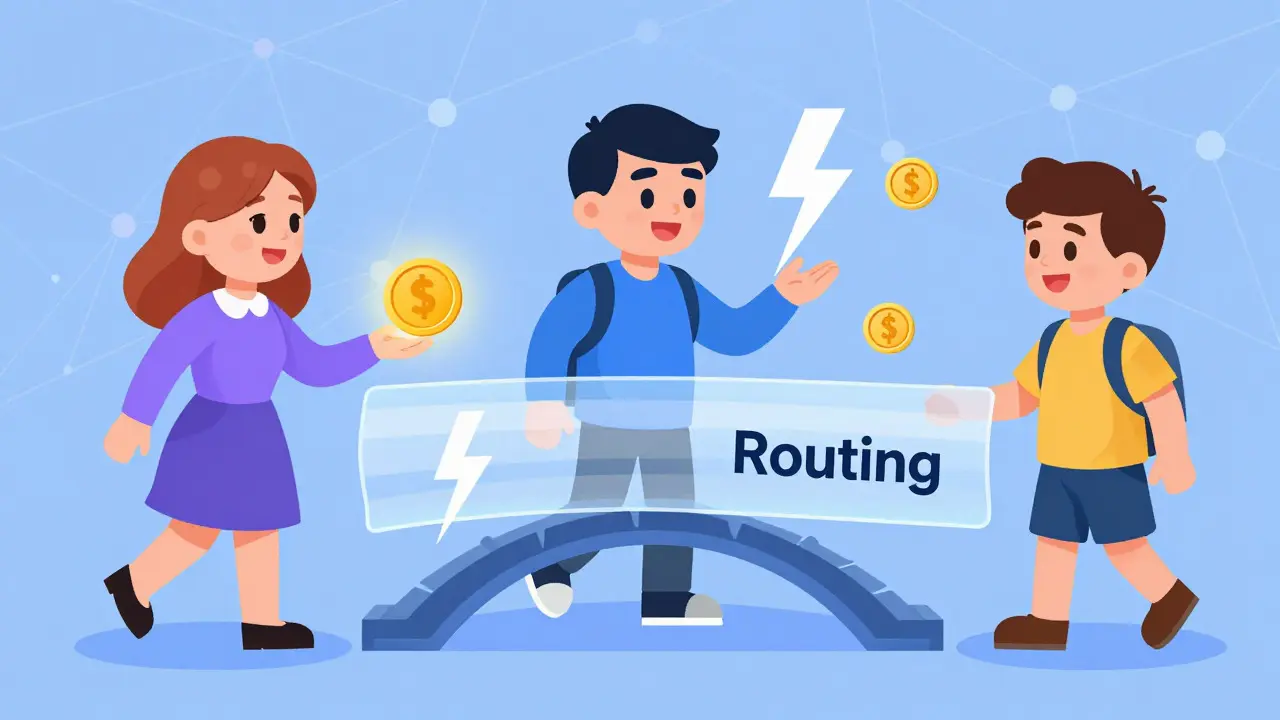
In a network like the Lightning Network, Alice can route her payment through Bob to reach Charlie. Bob acts as a middleman, forwarding the payment instantly. He earns a tiny fee for this service. This creates a mesh network where users can transact with anyone on the network, even without a direct channel.
State channels can also form networks, but routing is harder because the state isn’t always fungible. Routing a chess move or a complex contract state through a third party requires that third party to trust the logic, which adds friction. Therefore, payment channel networks are far more common and mature than state channel networks.
Pros and Cons: What You Need to Know
No technology is perfect. Both payment and state channels have significant advantages and drawbacks that affect user experience and developer adoption.
Advantages
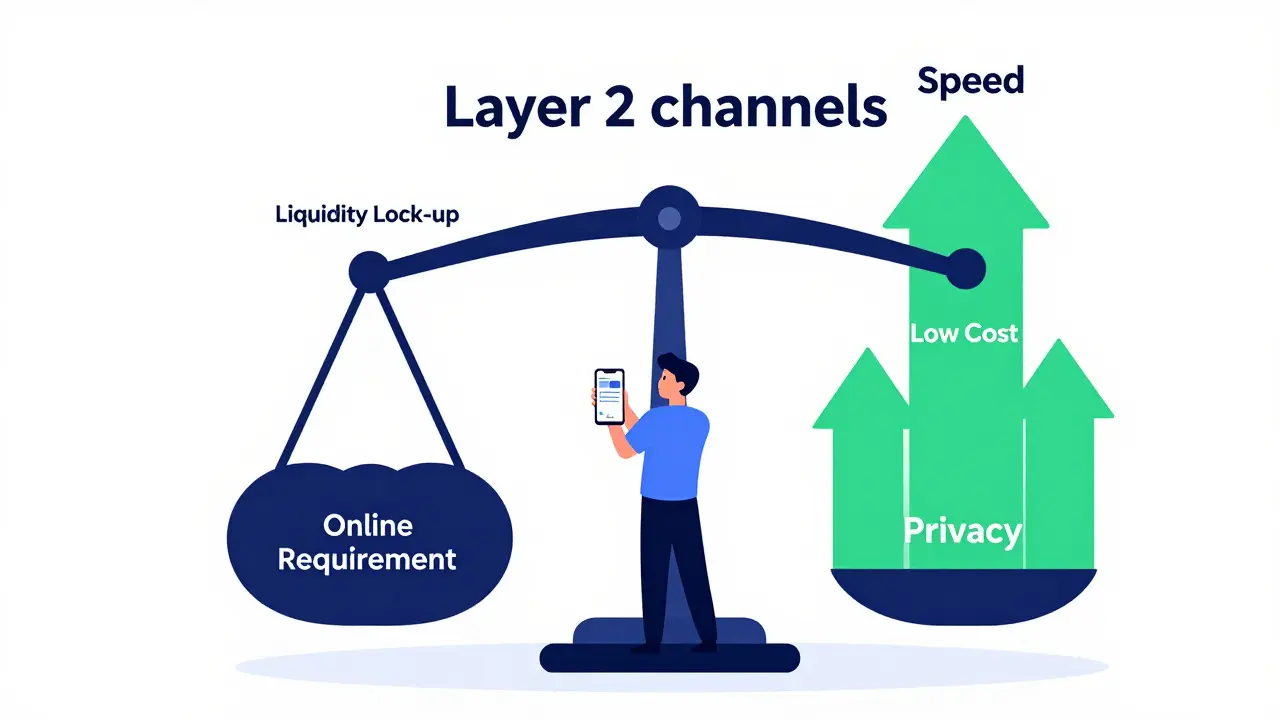
- Speed: Transactions are nearly instant because they don’t wait for block confirmations.
- Cost: Users avoid paying gas fees for every single interaction. Only opening and closing cost money.
- Privacy: Intermediate transactions happen off-chain, so the public ledger doesn’t see every small detail.
- Scalability: These solutions can theoretically handle thousands of transactions per second, bypassing base-layer limits (e.g., Bitcoin’s 7 TPS or Ethereum’s ~15-30 TPS).
Disadvantages
- Liquidity Lock-up: You must lock up funds to open a channel. That capital is stuck until you close it, which reduces your financial flexibility.
- Online Requirement: At least one party usually needs to be online to finalize settlements or challenge fraudulent closures. If you go offline for months, you risk losing funds if the counterparty cheats.
- Channel Management: Keeping track of multiple open channels is complex. Users need software to manage liquidity across different partners.
- Setup Friction: Opening a channel requires an on-chain transaction, which means waiting for confirmation and paying a fee before you can start using the fast lane.
Real-World Applications
So, where do we see these technologies today? Payment channels are already live and growing. The Lightning Network processes billions of dollars in volume, enabling merchants to accept Bitcoin tips, streaming services to charge per-second, and users to buy coffee without worrying about $5 transaction fees.
State channels are still emerging but hold huge potential for:
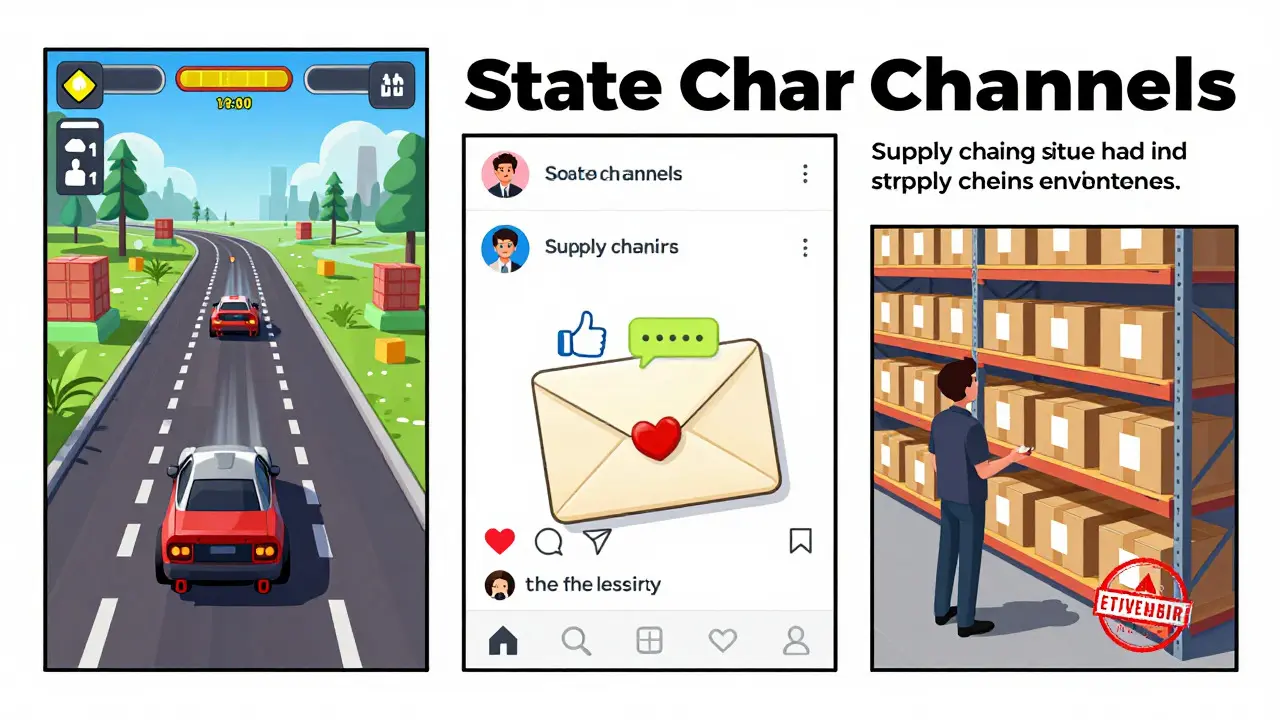
- Blockchain Gaming: Fast-paced games like poker or racing need sub-second updates. State channels allow smooth gameplay without clogging the main chain.
- Decentralized Social Media: Imagine liking or commenting on posts without triggering a blockchain transaction for each action. State channels can batch these interactions.
- Enterprise Supply Chains: Companies can update inventory states, ownership records, and logistics data privately and efficiently before settling final audits on-chain.
Future Outlook: Beyond Channels
While payment and state channels were pioneers in Layer 2 scaling, newer technologies like Rollups (Optimistic and ZK-Rollups) are gaining traction. Rollups bundle many transactions into one proof submitted to the main chain, offering scalability without requiring users to stay online or lock funds in pairs.
However, channels aren’t dead. They remain superior for scenarios requiring continuous, low-latency interaction between known parties. The future likely involves a hybrid ecosystem: rollups for general-purpose high-throughput applications, and channels for specialized, real-time interactions like gaming and micropayments.
Are payment channels safe?
Yes, payment channels are secure because they rely on cryptographic signatures and smart contracts on the main blockchain. If one party tries to cheat by broadcasting an old state, the other party can use a time-lock mechanism (like HTLCs) to punish the cheater and reclaim their funds. However, you must keep your private keys secure and monitor the channel during the dispute window.
Do I need to be online to use a state channel?
Generally, yes. At least one participant needs to be online to finalize the channel closure or respond to a fraud attempt. If both parties go offline indefinitely, the funds remain locked in the smart contract until someone returns to settle the state. This is a key difference from Rollups, which don't require constant user presence.
Can I use state channels for Bitcoin?
Bitcoin primarily supports payment channels via the Lightning Network. True "state channels" for complex non-monetary states are more native to programmable blockchains like Ethereum, which have robust smart contract capabilities. While Bitcoin Script can support basic state logic, it is limited compared to Ethereum's EVM.
How do I open a payment channel?
You typically use a wallet that supports Layer 2 features, such as a Lightning-compatible wallet (e.g., Muun, Phoenix, or BlueWallet). You fund the wallet with Bitcoin, then initiate a channel with another node or a service provider. The wallet handles the technical details of locking funds and creating the multi-signature contract.
What is the difference between a channel and a Rollup?
Channels are bilateral (between two parties) and require active participation and liquidity lock-up. Rollups are unilateral (anyone can transact) and batch transactions together for settlement. Rollups are better for general-purpose scaling, while channels excel in specific, high-frequency interactions between known entities.