


There’s no such thing as a crypto exchange called "Oasis." That’s the first thing you need to understand. If you’re searching for a centralized platform like Binance or Coinbase labeled "Oasis," you’re looking in the wrong place. But if you’re curious about Oasis Network-the privacy-focused blockchain powering a new wave of decentralized finance-you’re on the right track. This isn’t an exchange. It’s the infrastructure behind one.
What Is the Oasis Network?
Oasis Network isn’t a trading app. It’s a Layer 1 blockchain built from the ground up for privacy and scalability. Launched in 2020, it solves two big problems most blockchains struggle with: slow speeds and zero confidentiality. While Bitcoin and Ethereum handle transactions openly-everyone can see who sent what to whom-Oasis lets users run smart contracts without exposing data. That’s huge for healthcare records, private loans, or confidential trading strategies.
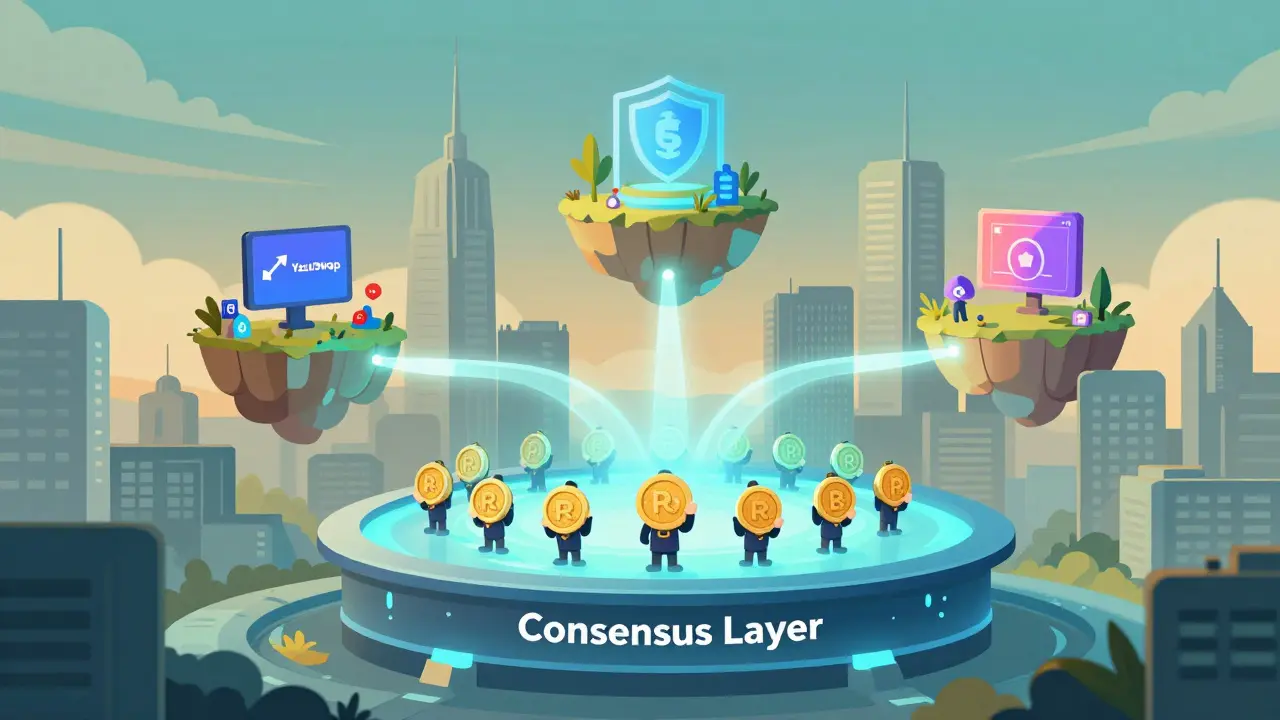
The secret? A two-layer design. The Consensus Layer handles security and validation using Proof of Stake (PoS). Validators stake ROSE tokens-the network’s native currency-to earn rewards and keep the chain running. The ParaTime Layer is where the magic happens. Think of it as a fleet of independent computers, each running its own smart contract environment. One ParaTime can handle NFTs, another can process medical data, and a third can run a DEX like YuzuSwap-all at the same time, without slowing each other down.
This separation isn’t just clever engineering. It’s what lets Oasis process over 10,000 transactions per second, with near-instant finality and gas fees under a penny. Most blockchains can’t match that without sacrificing decentralization. Oasis does both.
ROSE Token: The Engine of the Network
ROSE is the lifeblood of Oasis Network. It’s not just a trading asset-it’s a utility token with three core functions:
- Staking: Holders lock up ROSE to become validators or delegate to them. The more you stake, the higher your chance of earning rewards. As of 2025, annual staking yields hover between 6% and 9%, depending on network activity.
- Transaction Fees: Every swap, transfer, or contract interaction on Oasis uses ROSE to pay for gas. No other token works here.
- Governance: ROSE holders vote on upgrades, treasury allocations, and protocol changes. It’s one of the few blockchains where token holders actually influence development.
There’s a hard cap of 10 billion ROSE tokens. As of early 2026, around 6.8 billion are in circulation. That scarcity, combined with rising demand from DeFi users and privacy-focused developers, keeps ROSE in the top 50 cryptocurrencies by market cap. It’s not a meme coin. It’s a foundational asset for a growing ecosystem.
YuzuSwap: The First DEX on Oasis
If you want to trade crypto on Oasis, you don’t go to an exchange. You go to YuzuSwap. Built on Emerald-the EVM-compatible ParaTime of Oasis-YuzuSwap is the network’s first decentralized exchange. It works like Uniswap or SushiSwap, but with one major difference: your trades are private.
Here’s how it stands out:
- Low fees: Because Emerald runs on Oasis’s ParaTime Layer, gas costs are 90% lower than Ethereum.
- Instant trades: Transactions finalize in under 2 seconds. No waiting 10 minutes for confirmations.
- Privacy-first: Your trade history isn’t visible on a public blockchain explorer. Only you and the counterparty see the details.
- YUZU rewards: Provide liquidity to trading pairs and earn YUZU tokens. The platform distributed 50,000 YUZU in its initial airdrop, and ongoing rewards still flow to liquidity providers.
- Community governance: 20% of all trading fees are funneled into a community treasury, voted on by YUZU holders.
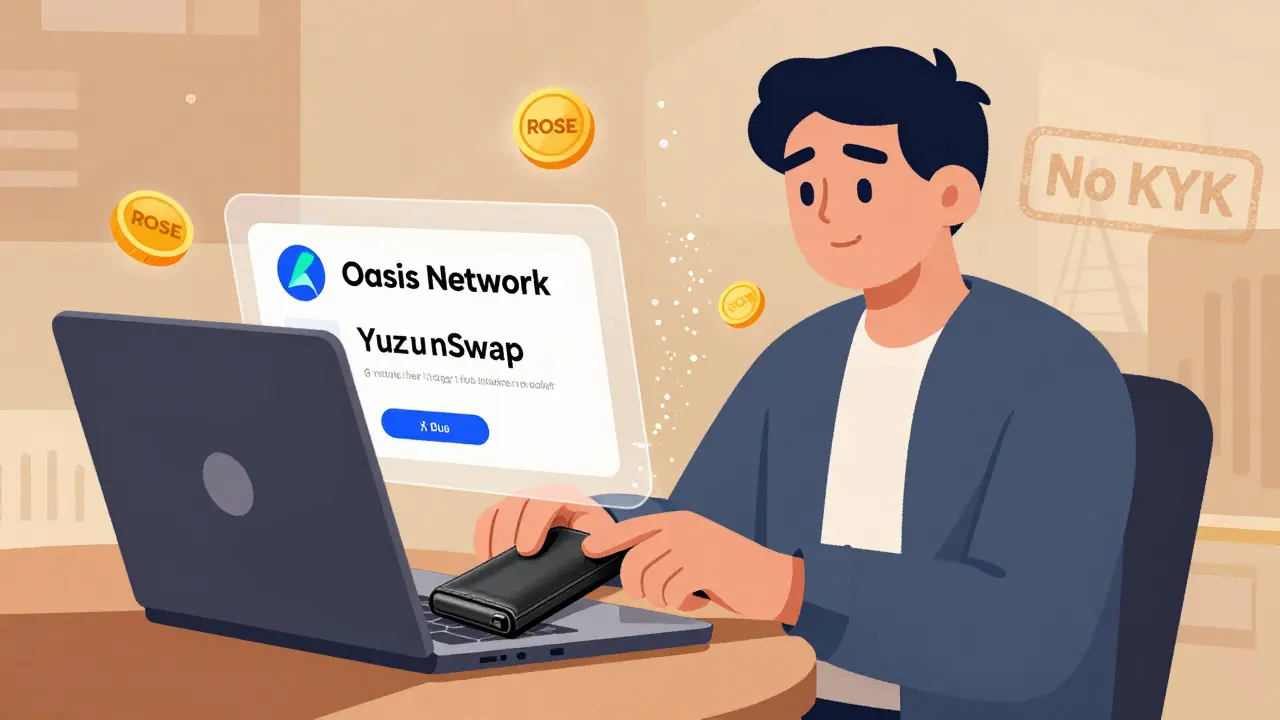
YuzuSwap supports both Oasis-native tokens and EVM-based assets like ETH, USDC, and WBTC. You can swap between them seamlessly. The interface is clean, mobile-friendly, and integrates with Oasis Web Wallet and Ledger hardware wallets. No KYC. No sign-ups. Just connect your wallet and trade.
How to Use Oasis Network: Wallets and Security
Using Oasis doesn’t require a centralized account. You control everything. Here’s how:
- Oasis Web Wallet: A non-custodial browser extension (available for Chrome and Brave). You generate your own seed phrase. Store it offline. This wallet lets you stake ROSE, send tokens, and interact with YuzuSwap-all in one place.
- Hardware wallets: Ledger Nano S and Nano X fully support Oasis Network. Connect via USB, sign transactions offline, and keep your private keys safe from hackers. This is the gold standard for security.
- Mobile apps: While there’s no official mobile app, third-party wallets like Trust Wallet and MetaMask can connect to Oasis via custom RPC settings. Just make sure you’re using the correct network ID (42274) and RPC endpoint.
Never use an exchange to store ROSE unless you’re actively trading. If you’re holding long-term, use a hardware wallet. Oasis has never been hacked. But that doesn’t mean your private keys are safe if you leave them on a centralized platform.
Why Privacy Matters in DeFi
Most DeFi platforms are transparent by default. That means anyone can track your wallet activity. They can see:
- How much you trade
- When you buy or sell
- Which tokens you hold
- Whether you’re a whale or a small investor
This isn’t just a privacy issue-it’s a financial risk. Smart traders use privacy tools to avoid front-running, where bots copy your trades and profit before you even see the result. Institutions need confidentiality to execute large orders without moving markets. And healthcare providers? They can’t risk leaking patient data on a public ledger.
Oasis solves this with confidential ParaTimes. Developers can build applications where inputs, outputs, and logic are encrypted during execution. No one-not even validators-can see what’s happening inside. This opens doors to:
- Undercollateralized loans based on private credit scores
- Private DAOs where voting records are hidden
- Data tokenization: Turn your anonymized health or fitness data into a stakable asset that earns ROSE rewards
Oasis isn’t just another blockchain. It’s the first one designed for real-world use cases where privacy isn’t optional-it’s mandatory.
Who Is Oasis For?
Not everyone needs this level of complexity. Here’s who benefits most:
- Privacy-focused traders: If you hate seeing your trades tracked on Etherscan, Oasis is your new home.
- DeFi developers: Building a DEX, lending protocol, or NFT marketplace? Oasis gives you scalability and confidentiality out of the box.
- Data owners: If you generate health, location, or behavioral data, you can now tokenize it and earn passive income without giving up control.
- Investors in blockchain infrastructure: ROSE isn’t a speculative gamble-it’s a bet on a scalable, privacy-first future for Web3.
If you’re just buying Bitcoin and holding it for a year, Oasis won’t change your life. But if you’re exploring the next generation of decentralized finance, this is one of the most important networks to watch.
Market Status and Future Outlook
As of March 2026, ROSE trades at around $0.18 USD, with a market cap of roughly $1.2 billion. Trading volume spikes during major ecosystem upgrades-like the launch of new ParaTimes or governance votes. MEXC and Gate.io are the most liquid exchanges for ROSE, offering deep order books and low spreads.
The network’s roadmap is aggressive:
- Two new confidential ParaTimes launching in Q2 2026 for enterprise data sharing
- Integration with Chainlink’s decentralized oracle network for private price feeds
- Partnerships with European healthcare providers to pilot patient data anonymization on-chain
- Mobile SDKs for developers to build privacy apps without deep blockchain knowledge
Analysts from CoinDesk and Messari now classify Oasis as a "core infrastructure play"-not a meme coin, not a hype cycle. It’s the plumbing behind the next wave of Web3 apps.
Is Oasis a crypto exchange?
No, Oasis is not a centralized exchange like Binance or Coinbase. It’s a blockchain network. You trade on its native DEX, YuzuSwap, which is decentralized and non-custodial. You connect your own wallet-there’s no sign-up or KYC.
Can I buy ROSE on Coinbase or Binance?
Not directly on Coinbase. Binance doesn’t list ROSE either. You can buy ROSE on MEXC, Gate.io, or KuCoin. For the best liquidity and lowest fees, use MEXC. Always transfer ROSE to a non-custodial wallet like Oasis Web Wallet or Ledger after purchase.
How do I stake ROSE tokens?
Use the Oasis Web Wallet. Connect it to your browser, send ROSE to the wallet, then click "Stake." You can delegate to any validator node. Your tokens remain in your control. Rewards are distributed automatically every 24 hours. Minimum stake is 1 ROSE.
Is YuzuSwap safe to use?
Yes, if you follow basic crypto safety rules. YuzuSwap is audited by CertiK and uses a non-custodial model. Never share your seed phrase. Only interact with the official site (yuzuswap.oasis.network). Beware of fake tokens-always check contract addresses before swapping.
What makes Oasis different from Ethereum?
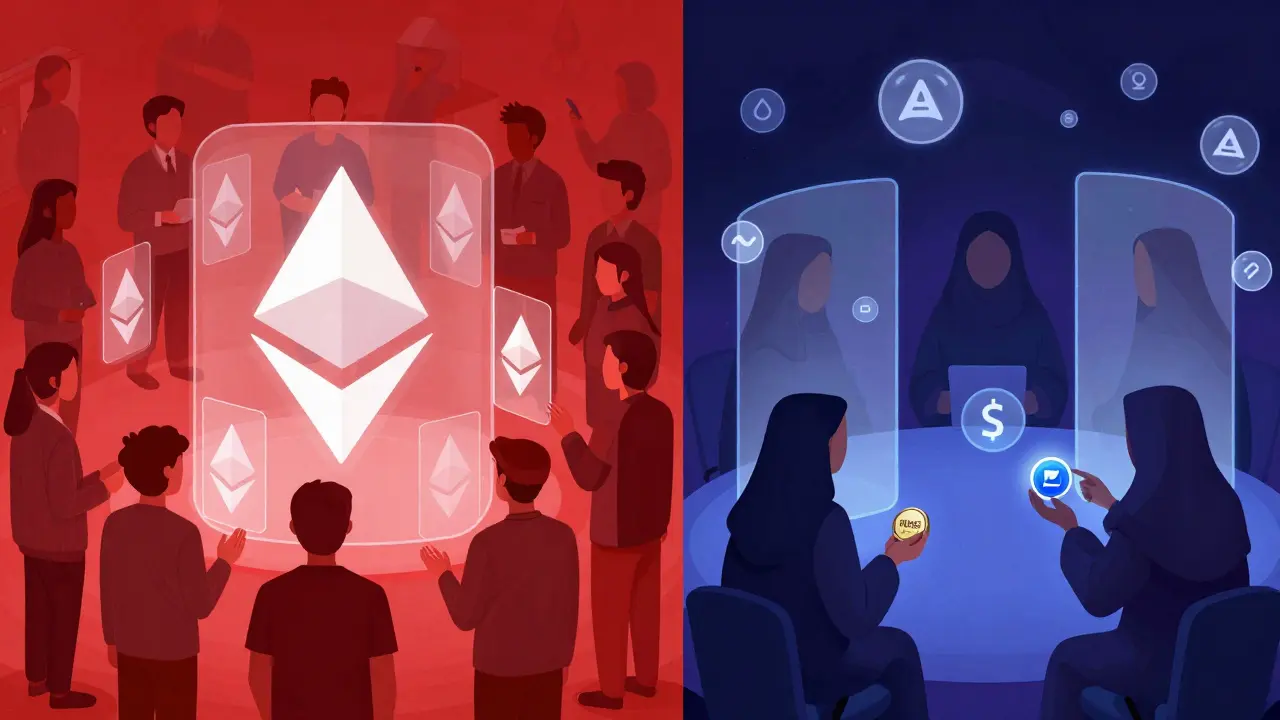
Ethereum is public by default. Every transaction is visible. Oasis separates consensus from execution, allowing confidential smart contracts. It’s faster, cheaper, and designed for privacy. Ethereum is great for open DeFi. Oasis is built for confidential DeFi-like private loans or secure medical data sharing.
Can I use Oasis for NFTs?
Yes. There are already NFT marketplaces on Oasis that use confidential ParaTimes. Artists can mint NFTs without revealing buyer identities. Royalties are enforced on-chain, and metadata can be encrypted. This is especially useful for high-value collectibles or licensed digital content.
Is the Oasis Network energy-efficient?
Yes. Unlike Bitcoin’s Proof of Work, Oasis uses Proof of Stake. Validators don’t mine-they stake ROSE tokens. This uses less than 0.01% of the energy Bitcoin does. It’s one of the most sustainable Layer 1 blockchains in the world.
What’s the future of ROSE token?
ROSE’s value is tied to network usage. As more developers build privacy apps on Oasis, demand for ROSE rises. With over 120 active dApps and growing institutional interest in confidential computing, ROSE is positioned as a core asset for the next phase of Web3-not just trading, but real-world data economy.
Final Thoughts
Oasis Network isn’t trying to be Bitcoin. It’s not trying to beat Ethereum in total value locked. It’s building something quieter, deeper, and more important: a blockchain where privacy isn’t an afterthought-it’s the foundation. If you care about financial confidentiality, data ownership, or the future of decentralized apps that handle sensitive information, this is the platform to watch. ROSE isn’t just a token. It’s the key to a new kind of internet-one where your data stays yours.
- Poplular Tags
- Oasis Network
- ROSE token
- YuzuSwap
- privacy crypto
- decentralized exchange



People Comments
oasis? more like oops-is. why do ppl keep calling it an exchange? its not even a dapp lmao
i tried to stake ROSE but my wallet crashed twice. still dont get why you need a whole second layer just to hide trades. why not just use monero?
YuzuSwap is a game-changer for privacy-first DeFi. The ParaTime architecture allows for atomic swaps with near-zero latency and gas fees under $0.01. Combine that with confidential smart contracts and you’ve got institutional-grade infrastructure without the KYC overhead. This isn’t just innovation-it’s a paradigm shift. If you’re not building on Emerald, you’re building on sand.
privacy isn’t optional. it’s the point.
i just moved all my ROSE to my ledger after reading this. never trusted exchanges to hold crypto anyway. yuzuswap is so clean to use too. just connect and go. no drama.
i just want to know if this is gonna make me rich or if i’m just another sucker buying into another "privacy blockchain" that’ll die in 6 months. anyone?
yuzu is lit 🚀 low fees + no KYC = my new home for swaps. staking ROSE gives me like 8% APY and i feel like i’m helping build the future. also the interface is smoother than my ex’s apology 😅
ohhhhh so OASIS isn’t a centralized exchange? i thought you just needed to sign up and deposit. how quaint. i guess i’ll go back to Binance where i can cry into my margarita while my trades get frontrun by bots.
The Oasis Network’s separation of consensus and execution layers is a critical architectural advancement. By decoupling validation from computation, it enables parallelizable, confidential smart contracts without compromising decentralization. This is not merely an improvement-it is a foundational evolution in blockchain design.
why do people think privacy is important when everyone knows your wallet address anyway. you can trace everything. this is just feel good tech for rich guys who dont want to pay taxes
staked 500 ROSE last week and got 42 ROSE in 24 hours. the rewards are real. yuzuswap is so fast i can swap usdc to wbtc before my coffee cools. this is what web3 should be
i’ve been using oasis for months. no drama. no ads. no fake influencers. just clean code and real utility. if you’re still on ethereum for privacy trades you’re doing it wrong
let’s be honest-this is just another layer 1 trying to be the next solana. the para time thing sounds cool but in practice it’s just a glorified sidechain with extra steps. why not just use zksync if you want privacy? the whole thing feels like overengineering for the sake of sounding revolutionary
i love how oasis lets you tokenize your health data. i gave my step count to a confidential para time and now i earn rose just for walking. its weird but also kinda beautiful
you say privacy matters but everyone still uses the same wallet. how is that private? also why is everyone so obsessed with rose? its just another token
if you’re new to oasis, start with the web wallet. it’s simple. stake 1 rose. try a swap on yuzuswap. feel the speed. then come back and tell me this isn’t the future. this isn’t hype. this is utility. you’re not late. you’re just getting started
you think you’re building a new internet? you’re just building a new playground for crypto bros who can’t handle transparency. privacy without accountability is just anonymity. and anonymity is a loophole, not a virtue.
i’ve been on both sides. ethereum was fun. now i’m on oasis. faster. cheaper. private. and honestly? less drama. the devs aren’t screaming on twitter. they’re just building. i respect that
i cried when i first saw yuzuswap. not because it was perfect. but because it finally felt like someone got it. no more waiting 10 minutes for a swap. no more $5 gas fees. just clean, quiet, private power. this is what i’ve been waiting for
I appreciate the technical depth of this overview. However, I must emphasize that the true value of Oasis Network lies not in speculative trading, but in its potential to empower individuals with sovereign data control. The confidential ParaTimes enable real-world applications-from private healthcare data exchange to secure financial modeling-that are not merely theoretical but are already being piloted in regulated environments. This is not a cryptocurrency. It is a protocol for dignity in the digital age.