


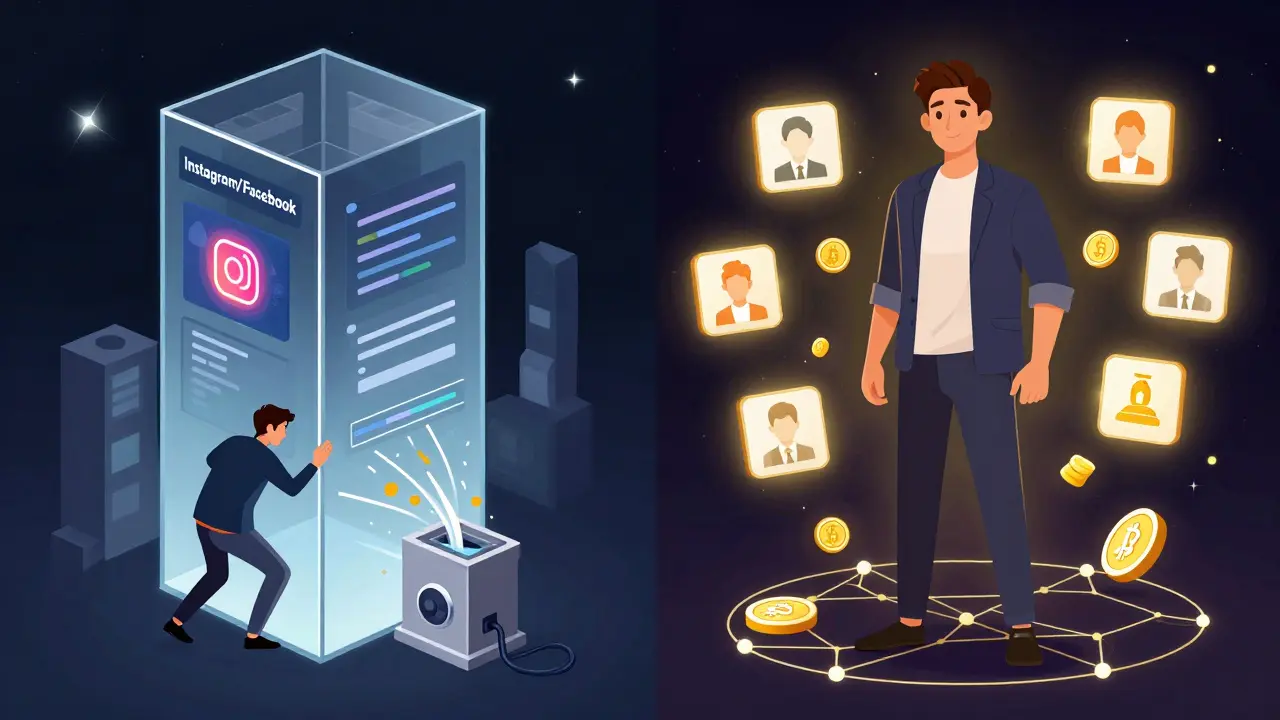
Think about the last time you posted something on Instagram or Twitter. Who really owns that post? Not you. The platform does. And they make money off it-through ads, data sales, and algorithms that keep you scrolling. Meanwhile, a quiet revolution is happening on blockchain-based social networks, where your content, your profile, and even your voice are yours to control. No middleman. No surprise bans. No hidden data mining. But here’s the catch: most people still don’t use them. Why? And does it even matter?
Who Owns Your Social Media?
Traditional platforms like Facebook, Instagram, and X (formerly Twitter) are built on one core idea: centralized control. Your profile lives on their servers. Your posts are stored in their databases. Their algorithms decide what you see. And when you violate a rule-whether it’s a misunderstood joke or a controversial opinion-you can get banned with no appeal. You don’t own your account. You’re a user, not a stakeholder.
Blockchain social media flips this. Platforms like Lens Protocol a decentralized social protocol on Polygon blockchain that uses NFTs for user profiles, enabling portability across apps, Farcaster a Web3 social network built on Optimism L2 Ethereum, allowing multiple client apps and user-owned profiles, and Mastodon a federated social network where users join independent servers, not owned by any single company let you own your identity. Your profile is tied to a crypto wallet, not an email. You can move it from one app to another. No platform can delete it. Not even if they wanted to.
How Monetization Really Works
On traditional platforms, creators earn money through brand deals, affiliate links, or YouTube ad revenue. But the platform takes 45% of YouTube’s ad earnings. Instagram doesn’t pay you a cent for viral posts. You’re trading attention for exposure.
On blockchain platforms, monetization is built into the system. Diamond App a blockchain social network on DeSo that lets users create and trade creator coins tied to their profile lets you issue your own digital coin. Followers can buy it. You earn when it rises. Steemit an early blockchain social platform rewarding content with Steem tokens and SBD stablecoins based on community upvotes pays users in cryptocurrency every time someone upvotes their post. Some users report earning $10 to $500 a month-depending on engagement.
Compare that to Facebook’s 2023 revenue: $134.9 billion, 97.5% from advertising. Not one dollar of that went to users. Blockchain platforms don’t have that kind of revenue yet-but they don’t need to. Their model is direct: creators earn from their audience, not from advertisers.
Content Moderation: Algorithms vs Community Rules
Ever wonder why your post got shadowbanned? Or why someone else’s hate speech stayed up for weeks? Traditional platforms use opaque, corporate-run moderation systems. One size fits all. And it’s often inconsistent.
Blockchain platforms handle this differently. Mastodon lets each server set its own rules. A server for artists might ban spam. A server for crypto traders might allow all discussion. You choose where to hang out. No central authority.
Others use token-based governance. On Lens Protocol, users who hold its native tokens can vote on moderation policies. No corporate board. No CEO deciding what’s acceptable. The community does.
It’s not perfect. Some servers become echo chambers. Others get flooded with bots. But at least you know the rules-and you can leave if you don’t like them.
The Usability Gap: Why Most People Still Stick to Facebook
Here’s the hard truth: blockchain social media is still hard to use.
Signing up for Instagram takes 90 seconds. You enter an email, pick a username, and you’re in. Done.
Signing up for Farcaster or Lens Protocol? You need a crypto wallet. You need to buy Ethereum or Polygon tokens to pay for gas fees. You need to understand what an NFT profile is. You need to trust a new app with your digital identity. That’s a 15- to 30-minute process for someone who knows crypto. For most people? It’s a wall.
And it shows. As of 2025, Mastodon has 15 million users. That’s impressive for a decentralized network. But Facebook has over 3 billion. Instagram? 2 billion. Twitter? 500 million daily active users.
Blockchain platforms are like early smartphones in 2007. Cool tech. Limited audience. Not ready for Grandma.
Performance and Scalability: Speed vs Decentralization
Try posting a video on Steemit or Diamond App. It might take 30 seconds to confirm. On Instagram? One tap. Done.
Why? Blockchain networks process transactions one by one. Every like, comment, or repost is recorded on a public ledger. That’s secure. That’s transparent. But it’s slow. Traditional platforms use centralized servers that handle millions of actions per second.
Some blockchain platforms are trying to fix this. Farcaster uses Optimism L2, a layer that cuts transaction costs and speeds things up. Lens Protocol simplified wallet interactions in 2024. But they’re still playing catch-up.
Traditional platforms win on speed. Blockchain platforms win on control.
The Real Trade-Off: Freedom vs Convenience
So which is better?
If you’re a content creator tired of being exploited by algorithms and ad networks, blockchain social media offers something revolutionary: ownership. You control your audience. You earn directly. You can’t be silenced by a corporate policy.
If you just want to share vacation photos, chat with friends, or follow influencers? Stick with Instagram or TikTok. They’re easier. Faster. Smoother.
Here’s the thing: blockchain social media isn’t trying to replace Facebook. It’s offering an alternative for people who’ve had enough. For artists, journalists, developers, and activists who need a space free from censorship. For crypto-native users who believe in digital ownership. For those who refuse to let a Silicon Valley company profit off their voice.
The future isn’t one or the other. It’s both. And more and more, traditional platforms are starting to borrow from blockchain. Facebook tried Libra. X (Twitter) experimented with crypto tips. Even Instagram is testing creator rewards. The pressure is real.
What’s Next? The Hybrid Future
By 2026, we’re seeing the first signs of convergence. Bluesky-built on the AT Protocol-gives users decentralized control without crypto. No wallets. No tokens. Just freedom from corporate control. Over 13 million users joined in less than two years.
That’s the path forward: not forcing everyone into crypto, but making decentralization seamless. Imagine logging into your social account with your Google or Apple ID-but your profile and data stay on a decentralized network. No one can take it down. You own it. That’s the dream.
For now, blockchain social media is still niche. But it’s growing. And for the first time, users have real power. Not just to post. But to own, earn, and decide what happens next.

People Comments
I've been using Lens Protocol for months now and honestly? It's the first time I feel like my content actually belongs to me. No more begging for algorithm love. No more shadowbans because some intern misread my post. I post what I want, when I want. My followers support me directly. I don't need a corporation to mediate my voice. It's raw. It's real. And yeah, it's still clunky sometimes but so was email in 1995.
BLOCKCHAIN IS JUST A SCAM FOR BROKE BOYS WHO THINK THEY'RE INVESTING IN THE FUTURE 🤡
I mean... I get it. The idea is cute. Like, 'oh let's build a social network on blockchain' as if that solves anything. But let's be real - most people don't care about ownership. They care about filters and memes and seeing their ex's vacation pics. Decentralization sounds noble until you have to pay gas fees just to say 'hi' to your cousin. And honestly? The UIs look like they were designed in 2017 by a guy who still uses MySpace.
the whole thing is just a fad. people are so desperate to feel like they're part of something revolutionary that they'll sign up for a platform that requires them to understand smart contracts just to post a cat pic. meanwhile, my feed on instagram is still the only place i can find memes about my dog being a drama queen. no thanks.
i just don't get why people are so obsessed with owning their data. like... who even cares? you think your 3am ramble about pineapple pizza is worth something? you're not a celebrity. you're just someone who posts too much. let the companies make money off you. it's easier. less stress. less crypto wallet drama. i'm happy where i am.
it's funny how we romanticize decentralization like it's some kind of spiritual awakening. but the truth? it's just capitalism with a different name. instead of ads, you get tokens. instead of influencers, you get coin holders. we're not escaping the system. we're just rebranding it. and honestly? that's more depressing than the original.
oh wow. another 'blockchain is the future' essay. let me guess - you also think NFTs are art, DAOs are governance, and gas fees are 'transaction costs' not 'extortion'. here's the truth: if your social network requires a crypto wallet to post a thought, it's not liberation. it's a cult. and if you're still using Farcaster in 2026, you're not a pioneer. you're a masochist.
i saw someone get banned on mastodon for saying 'i like dogs' and now i'm just over it. decentralized doesn't mean free. it means 500 different rulebooks and zero accountability. someone on a server in Estonia banned me for using the word 'basic'. i didn't even know that was a crime anymore. i miss when facebook just quietly shadowbanned you instead of letting a stranger from Latvia decide your fate.
The empirical data regarding user retention on blockchain-based social platforms remains statistically insignificant when compared to centralized alternatives. While theoretical frameworks of digital ownership are compelling, practical adoption curves demonstrate a persistent and substantial barrier to entry attributable to cognitive load, financial friction, and infrastructural immaturity. The notion that decentralization inherently equates to empowerment is a fallacy grounded in ideological optimism rather than behavioral economics.
i just want to post my cat videos without worrying about wallets or tokens. if i can do that on instagram and still feel heard, why complicate it? freedom shouldn't come with a blockchain tutorial.
the whole 'you own your data' thing is sooo last year. like yeah i own my profile on lens but now i have to remember which wallet i used for which app and why is there a 0.002 eth fee just to like a post? its not freedom its a tax on being online. also can we talk about how the ui looks like a 2014 android app? no thanks.
Let me just say - the entire premise of blockchain social media is fundamentally flawed. You're assuming that people want ownership. They don't. They want convenience. They want aesthetics. They want dopamine hits from likes. The moment you introduce complexity - wallets, gas fees, tokenomics - you're not empowering users; you're alienating them. And let's not pretend that Mastodon's server rules are somehow more ethical than Facebook's opaque policies. One is a corporate dictatorship. The other is a thousand tiny tyrannies. Neither is freedom. Both are just different flavors of exhaustion.
i work in tech and i still cant get my mom to use a crypto wallet. she just wants to see pictures of her grandkids. if blockchain social media cant solve the onboarding problem for non tech people then it will always be a niche. no amount of decentralization changes that. the tools need to be invisible. not revolutionary.
you call it ownership. i call it isolation. when you remove the middleman, you don't get freedom - you get silence. no algorithm means no reach. no ad revenue means no visibility. your 'community' is just 12 people who also own 0.05 ETH. you think you're free? you're just invisible. and that's not liberation. that's loneliness dressed up in crypto jargon.
i tried lens. spent 45 minutes. bought polygon. connected wallet. uploaded a photo. waited 3 minutes for it to confirm. then i realized: i forgot to set my profile name. so i had to go back. then i got a 'transaction failed' error. i gave up. went back to instagram. posted a selfie. got 200 likes in 5 minutes. i don't need to own my data. i just need to feel seen.
The economic model of blockchain social platforms is predicated on a flawed assumption: that individuals are rational actors capable of long-term value assessment. In practice, human behavior is governed by immediacy, social validation, and cognitive ease. The friction inherent in blockchain interfaces directly contradicts these psychological imperatives. Therefore, the continued dominance of centralized platforms is not a failure of technology - it is an affirmation of human nature.
i used to think blockchain was the answer. then i watched a guy on mastodon get banned because he said 'i prefer cats to dogs' and his entire profile got wiped. then he made another one. then he got banned again. then he made a third. then he gave up. i just want to post a picture of my lunch without becoming a blockchain martyr. why is this so hard? why do we have to fight just to be seen? i miss when the worst thing that happened was a weird comment from a stranger.
this whole thing is just a way for rich guys to feel like they're rebels while still making money. you think diamond app is for artists? nah. it's for crypto bros who bought a coin because they liked the logo. now they're 'supporting creators' by buying a coin that's worth 3 cents. it's performative activism with a blockchain tattoo. and the worst part? it's not even helping anyone. it's just another way to feel superior while doing literally nothing.
i don't get why people are so scared of big tech. they're not evil. they're just lazy. they don't want to pay creators. they want clicks. and honestly? i'm fine with that. i post for fun. not for money. if i get a few likes? cool. if i get zero? also cool. why does everything have to be a revolution? can't we just... chill?
in india, we have 1.4 billion people. most of them use whatsapp. some use instagram. none of them know what a blockchain is. and honestly? they don't need to. what matters is connection. not control. if blockchain helps a few artists in san francisco feel empowered? great. but don't pretend it's for everyone. the real revolution is making tech simple - not complex.
The convergence of decentralized identity protocols with OAuth 2.0 authentication mechanisms presents a viable pathway toward user-centric social architecture without the onerous burden of cryptographic key management. By abstracting the underlying blockchain layer while preserving data sovereignty, platforms like Bluesky demonstrate a pragmatic evolution toward post-centralized sociality - one that prioritizes usability without sacrificing autonomy.
i helped my cousin set up a lens profile last week. took us 2 hours. she cried. not because she hated it. because she realized she didn't want to be a crypto investor to post a photo of her dog. i think that's the real story here. it's not about tech. it's about how much we're willing to sacrifice just to feel like we're in control.
i don't care if it's blockchain or not. i just want a platform where i can talk about my art without being buried under ads or banned for being 'too political'. if blockchain is the only way to get that? then i'm all in. even if it's slow. even if it's weird. even if i have to pay 0.001 eth to comment. it's worth it.
I just saw someone say they got banned on Mastodon for saying 'I like dogs'. That's wild. But honestly? That's why I love it. You can leave. You can find a server where dogs are welcome. You don't have to live in a world where one CEO decides what's okay. That's freedom. Even if it's messy.