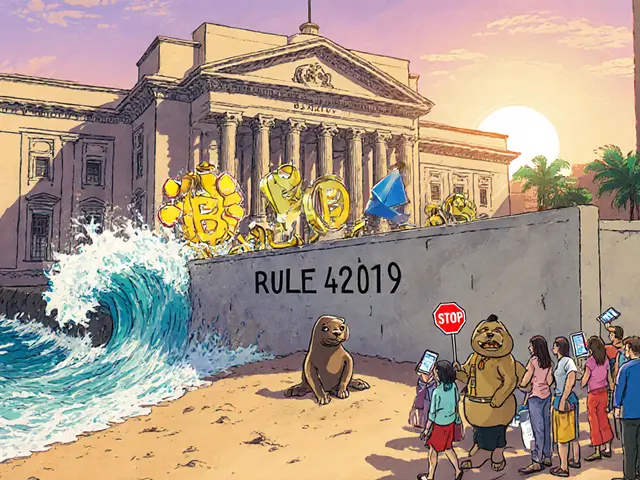



Imagine sending money across borders and having it arrive in seconds, not days. Now imagine that same transaction costing a fraction of what you pay today, with zero chance of hidden fees or lost paperwork. This isn't science fiction anymore. It is the reality for institutions using blockchain, a distributed ledger technology that records transactions securely and transparently without intermediaries. As we move through 2026, this technology has shifted from experimental hype to critical infrastructure. The financial sector is no longer just watching blockchain; it is building on it.
The transformation is massive. According to Gartner's market guide from late 2024, financial services account for over 36% of all enterprise blockchain implementations. By early 2025, Deloitte reported that 83 of the top 100 global banks were actively running blockchain solutions. We are seeing a fundamental shift in how value moves. The old system, built on siloed databases and manual reconciliation, is being replaced by shared, immutable ledgers. This change brings speed, cuts costs, and creates new types of financial products that were previously impossible.
Why Banks Are Finally Betting Big on Distributed Ledgers
For years, banks talked about blockchain but moved slowly. Why? Because legacy systems are hard to replace. But the pressure to change became undeniable as efficiency gaps widened. Traditional cross-border payments can take three to five days and involve multiple correspondent banks, each taking a cut. Blockchain collapses this timeline. The Bank for International Settlements (BIS) noted in their July 2025 report that unified ledger systems can reduce processing times to near real-time while cutting operational costs by 95%.
The core appeal is simple: trust without intermediaries. In traditional finance, you need lawyers, clearinghouses, and auditors to verify transactions. On a blockchain, the code verifies itself. Smart contracts-self-executing agreements with terms written directly into lines of code-automate these checks. If conditions are met, the payment happens instantly. No human intervention, no delay. This automation eliminates the "reconciliation" nightmare where two parties try to match their separate records at the end of the day. With a single source of truth, reconciliation becomes obsolete.
Security is another major driver. Enterprise blockchains now meet FIPS 140-2 Level 3 certification standards. They use cryptographic keys that are nearly impossible to hack. With quantum-resistant algorithms scheduled for implementation by late 2026, these systems are preparing for future threats before they even arrive. For institutions handling billions in daily transactions, this level of security is non-negotiable.
Real-World Impact: Trade Finance and Securities Settlement
Where does blockchain shine brightest? Two areas stand out: trade finance and securities settlement. Let's look at trade finance first. Traditionally, moving goods internationally involves mountains of paper: letters of credit, bills of lading, insurance certificates. Processing this takes five to ten days. PwC’s 2025 study shows that blockchain reduces this time to 24 hours and cuts costs by 80%. How? By digitizing documents into smart contracts that automatically release funds when shipment conditions are verified on-chain.
| Process | Traditional Timeline | Blockchain Timeline | Cost Reduction |
|---|---|---|---|
| Trade Finance Documentation | 5-10 Days | 24 Hours | 80% |
| Cross-Border Payments | 3-5 Days | Near Real-Time | 40-60% |
| Securities Settlement | T+2 (2 Business Days) | T+0 (Instant) | $5.6B Annual Risk Eliminated |
Securities settlement is undergoing a similar revolution. The standard model is T+2, meaning it takes two business days to settle a stock trade. This gap creates risk. If one party defaults during those two days, losses occur. DTCC’s Project Ion uses blockchain to achieve T+0 settlement. Instant settlement means instant finality. The BIS calculates this eliminates $5.6 billion in annual settlement risk exposure. That is real money saved from potential crashes or defaults.
The Rise of Tokenization: Unlocking Illiquid Assets
If faster payments are the entry drug, tokenization is the main event. Tokenization converts rights to an asset into a digital token on a blockchain. This sounds abstract, but its impact is concrete. It allows illiquid assets-things that are hard to sell quickly-to be traded easily. Think private equity, real estate, or fine art. Previously, buying into a private equity fund required millions in capital and months of paperwork. Now, JPMorgan’s Onyx platform has tokenized $2.1 billion in private equity funds by mid-2025.
This democratizes access. You don’t need to be a billionaire to invest in high-end assets. You can buy fractional shares represented by tokens. Boston Consulting Group projects the real-world asset tokenization market could reach $16 trillion by 2030. Fixed income leads this charge with $7.1 trillion in potential, followed by private equity at $4.2 trillion. The liquidity boost is significant because tokens can be traded 24/7 on secondary markets, unlike traditional assets tied to exchange hours.
However, tokenization has limits. It works best for digital representations. Physical commodities like gold or oil still require physical verification. Blockchain manages the ownership record, but someone must ensure the gold actually exists in the vault. This hybrid approach-digital ledger plus physical audit-is becoming the standard for commodity tokenization.

Choosing Your Platform: Permissioned vs. Public Chains
Not all blockchains are created equal. Financial institutions rarely use public chains like Bitcoin for core operations due to privacy concerns and lower throughput. Instead, they opt for permissioned enterprise platforms. The two leaders here are R3 Corda and Hyperledger Fabric.
R3 Corda is designed specifically for finance. It processes 1,500 transactions per second with a focus on privacy. Unlike public blockchains where every node sees every transaction, Corda only shares data with relevant parties. This makes it ideal for syndicated lending and trade finance where confidentiality is key. Hyperledger Fabric, backed by IBM, offers higher throughput at 3,500 transactions per second. Its modular architecture allows fine-grained access control, making it excellent for KYC/AML compliance and interbank payments.
Performance matters. Visa processes 65,000 transactions per second. While blockchain hasn't hit that scale yet, it doesn't need to for most institutional use cases. Interbank settlements and trade finance don't require retail-level volume. They require reliability and accuracy. Both Corda and Fabric offer 99.995% uptime in production environments, meeting the strict demands of global banking.
Regulatory Clarity and Global Adoption
Technology moves fast; regulation often lags. But 2025 and 2026 have seen a surge in clarity. The European Union fully implemented MiCA (Markets in Crypto-Assets) in July 2025, creating a comprehensive framework for digital assets. This gives institutions a clear rulebook to follow. In the US, President Biden’s January 2025 Executive Order signaled support for responsible growth in digital assets, aiming to position the US as a global leader. While regulation remains fragmented across agencies like the SEC and CFTC, the direction is supportive.
Global cooperation is also improving. The FATF (Financial Action Task Force) reports that 78 jurisdictions now have regulatory frameworks for virtual assets. Fifty-two are implementing Travel Rule compliance solutions, which track who sends and receives crypto assets to prevent money laundering. This harmonization reduces the risk for banks operating across borders. They no longer face a wild west of conflicting rules.
Despite progress, challenges remain. Dr. Markus K. Brunnermeier from Princeton University warns in the BIS report about new channels for risk spillover, especially regarding stablecoins on public blockchains without deposit insurance. Regulators are watching closely. Institutions must balance innovation with compliance, ensuring their blockchain implementations meet local laws while leveraging global efficiencies.
The Human Side: Implementation Challenges
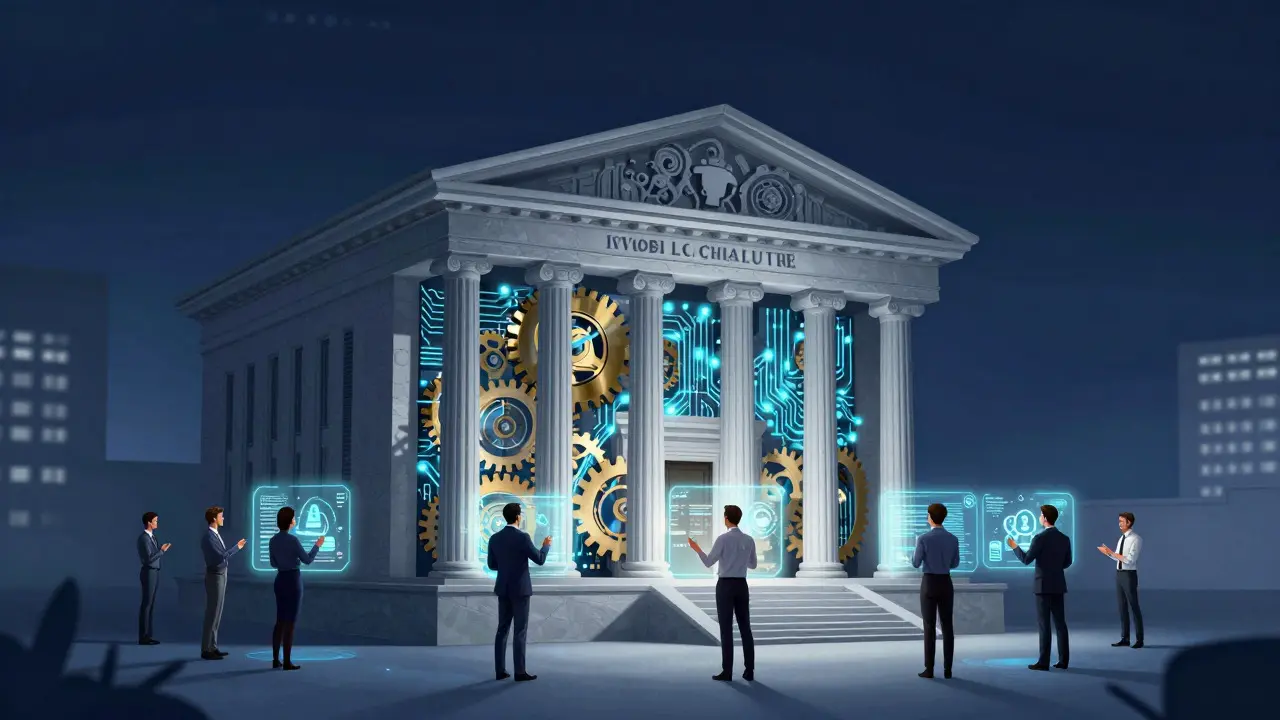
Adopting blockchain isn't just a tech upgrade; it's an organizational overhaul. A JPMorgan executive shared that while blockchain cut settlement time from 48 hours to 15 minutes, it required retraining over 200 operations staff. Connecting modern blockchain networks to 1980s-era mainframes is complex. Accenture estimates full integration takes 18-24 months. It’s not plug-and-play.
Talent is another bottleneck. Blockchain developers are scarce and expensive. Indeed reports average salaries of $185,000 annually in the US for Q2 2025. These professionals need expertise in cryptography, distributed systems, and financial workflows. IBM’s 2025 report notes it takes six to nine months for experienced technologists to become proficient. Companies are investing heavily in training and hiring to bridge this gap.
Debugging smart contracts adds another layer of difficulty. A Barclays developer noted on Reddit that while automation eliminated 75% of documentation errors, debugging multi-party transactions remains challenging. Code errors can lock funds or cause disputes. Rigorous testing and auditing are essential. Documentation quality varies too; Hyperledger scores well on technical docs, while Corda faces criticism for lacking real-world examples. Institutions must build internal knowledge bases to support their teams.
Looking Ahead: The Invisible Infrastructure
Where do we go from here? Gartner predicts blockchain will become "invisible infrastructure" embedded in 90% of financial transactions by 2030. Users won't think about blockchain any more than they think about TCP/IP when browsing the web. It will just work. The value will shift from the underlying ledger to the applications built on top-tokenized assets, automated derivatives, and programmable money.
We are already seeing this convergence. The Federal Reserve’s FedNow service integrated blockchain-based payment rails in Q3 2025. SWIFT connected 11,000 institutions via GPI blockchain integration. Singapore’s Project Guardian links institutional DeFi protocols with traditional finance. These initiatives show that blockchain is no longer a parallel universe to traditional finance; it is merging with it.
The future belongs to institutions that orchestrate cloud, AI, and blockchain holistically. Anuj Jaitly from TribalScale describes this as a "seismic re-architecture" of how value moves. Those who adapt will enjoy lower costs, faster speeds, and new revenue streams. Those who wait will find themselves left behind in a slower, more expensive world.
Is blockchain secure enough for large-scale banking?
Yes. Enterprise blockchains like R3 Corda and Hyperledger Fabric meet FIPS 140-2 Level 3 security standards. They use advanced cryptography and are designed for high availability (99.995% uptime). Additionally, quantum-resistant algorithms are being rolled out by late 2026 to future-proof these systems against emerging threats.
What is the difference between tokenization and cryptocurrency?
Cryptocurrency is a digital currency used for payment or speculation. Tokenization represents ownership of a real-world asset, such as real estate, stocks, or commodities, on a blockchain. While both use blockchain technology, tokenization focuses on unlocking liquidity and fractional ownership for traditional assets, whereas cryptocurrency operates primarily as a medium of exchange or store of value.
How long does it take to implement blockchain in a bank?
Full integration typically takes 18 to 24 months. This includes mapping business processes to smart contracts, achieving regulatory alignment, and connecting with legacy systems. Initial pilot projects may take 3-6 months, but scaling to production requires significant organizational change and staff training.
Which industries are adopting blockchain fastest?
Investment banks lead adoption, with 89% of the top 20 having active initiatives. Retail banks follow at 76%, then insurance companies at 68%, and asset managers at 63%. Within these sectors, back-office automation, trade finance, and securities settlement are the primary use cases driving implementation.
Will blockchain replace traditional banks?
Unlikely in the near term. Instead, blockchain is transforming banks from within. It acts as infrastructure that enhances efficiency and enables new products. Most institutions are integrating blockchain into existing operations rather than replacing them entirely. The goal is to create a hybrid system that combines the trust of traditional finance with the speed of distributed ledgers.