


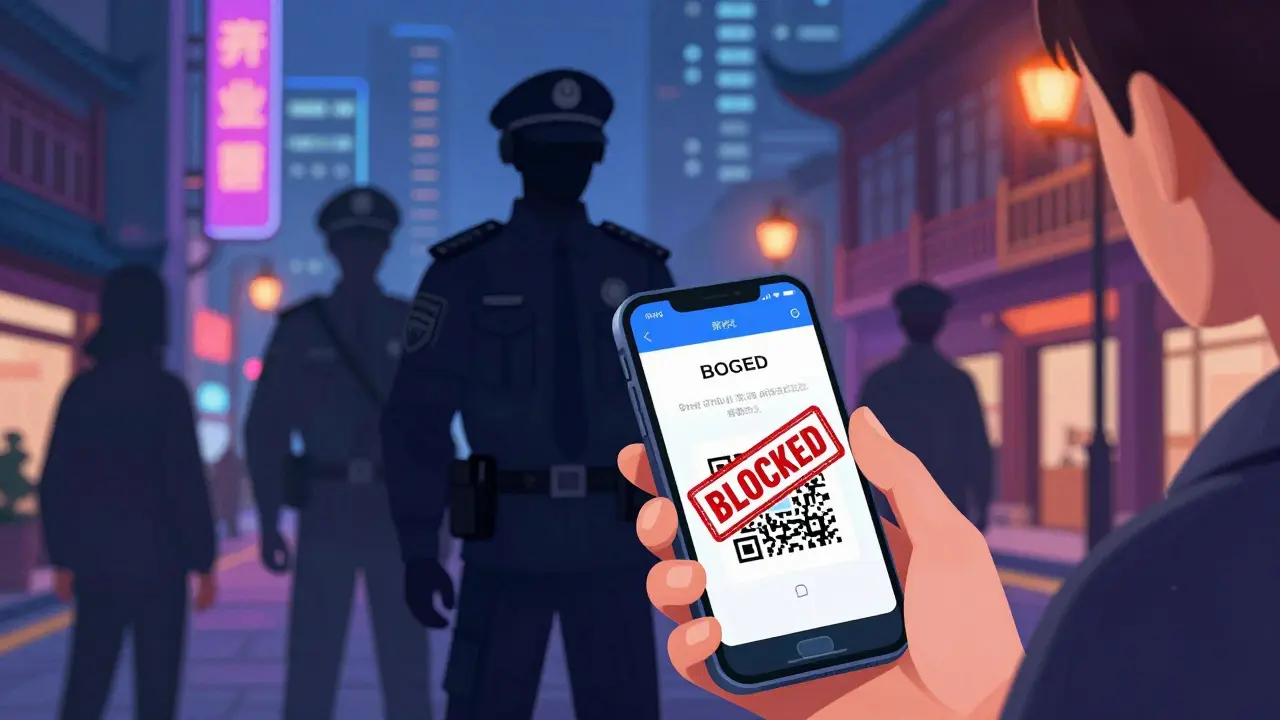
Imagine trying to buy a cup of coffee in Shanghai with Bitcoin. You pull out your phone, open your favorite payment app, and scan the QR code. Instantly, the transaction is blocked. Your account might even get flagged for suspicious activity. This isn't a glitch; it’s by design. In mainland China, Alipay and WeChat Pay act as the digital gatekeepers, enforcing one of the world’s strictest bans on private cryptocurrencies.
For anyone living in or doing business with China, understanding how these platforms police financial behavior is crucial. It’s not just about blocking a transaction here and there. It’s about a sophisticated, multi-layered surveillance system that integrates banking, messaging, and government oversight. As we move through 2026, this enforcement mechanism has only tightened, creating a unique landscape where digital payments are ubiquitous, but crypto is virtually invisible to the average user.
The Regulatory Iron Curtain: Who Pulls the Strings?
To understand why your crypto transaction gets rejected, you first need to know who is watching. The ban isn’t just a suggestion from Ant Group (Alipay) or Tencent (WeChat Pay). It is a mandate enforced by a coalition of powerful Chinese regulatory bodies. Since the comprehensive ban was solidified in 2021, the framework has evolved into a complex web of oversight.
The primary architects of this policy include:
- People's Bank of China (PBOC): The central bank that sets monetary policy and oversees the digital yuan (e-CNY).
- National Administration of Financial Regulation (NAFR): The body responsible for supervising financial institutions and ensuring stability.
- Cyberspace Administration of China (CAC): Monitors online content and data flows, ensuring no crypto-related propaganda or coordination occurs on digital platforms.
- State Administration of Foreign Exchange (SAFE): Strictly controls capital outflows, preventing citizens from moving money abroad via crypto.
In 2025, regulations were updated to require Alipay and WeChat Pay to go beyond simple keyword filtering. They must now conduct enhanced Know Your Customer (KYC) and Anti-Money Laundering (AML) checks. This means the platforms are legally obligated to monitor user behavior patterns. If your spending habits suddenly look like you’re funneling money to an offshore exchange, the algorithms flag it. It’s not just about what you pay for; it’s about who you pay and how often.
Technical Enforcement: How the Block Works
You might wonder, "How does an app know I’m buying Bitcoin?" The answer lies in sophisticated transaction monitoring systems. Alipay and WeChat Pay don’t just block known crypto exchange domains. They use machine learning models trained to identify the behavioral signatures of crypto trading.
Here is how the technical enforcement typically unfolds:
- Merchant Categorization: Every merchant registered on these platforms has a category code. Exchanges, mining pools, and OTC (over-the-counter) dealers are blacklisted. Attempting to pay them results in an immediate decline.
- Behavioral Analysis: If you send large sums to individuals who then immediately transfer those funds to known high-risk accounts, the system detects this "layering" technique common in money laundering.
- Cross-Border Scrutiny: Transactions involving foreign entities are subjected to higher scrutiny. If you try to pay a vendor in Thailand using a method linked to crypto arbitrage, SAFE protocols kick in.
These platforms serve as the primary choke points in China’s financial ecosystem. Because they process the vast majority of daily transactions-from street food stalls to luxury real estate-they have unparalleled visibility into cash flow. State-owned banks coordinate with Alipay and WeChat Pay to ensure that if a transaction is blocked at the app level, it’s also frozen at the bank level. This creates a double-lock system that makes it nearly impossible for residents to engage in crypto activities through traditional channels.
The WeChat Paradox: Messaging vs. Money
While Alipay is primarily a financial tool, WeChat Pay exists within WeChat, a super-app that combines payments with encrypted messaging. This dual nature creates a unique enforcement challenge. Criminal organizations and savvy traders have adapted by separating their communication from their payment methods.
Many users report that while they cannot *pay* for crypto directly on WeChat, they use the app to *coordinate* trades. Here’s the workaround:
- Off-Chain Coordination: Traders use WeChat’s encrypted chat features to share wallet addresses, negotiate prices, and agree on terms.
- QR Code Sharing: Instead of paying an exchange, a buyer scans a personal QR code sent via chat to pay a peer-to-peer seller.
- Hybrid Laundering: Sophisticated schemes involve sending fiat currency through WeChat Pay to a middleman, who then releases crypto from a cold wallet held elsewhere.
This creates a blind spot for regulators. While Alipay can easily block a transaction to Binance, it struggles to detect a conversation between two friends where one agrees to send cash for Bitcoin. However, experts note that Know Your Transaction (KYT) tools are evolving. Regulators are pressuring Tencent to improve cooperation with law enforcement, aiming to bridge the gap between encrypted messages and financial trails. The goal is to trace the blockchain activity back to the initial fiat transfer made on WeChat.
User Reality: Compliance vs. Circumvention
What does this mean for the average person? If you are a compliant user who never touches crypto, you likely notice nothing. Your payments work seamlessly. But if you attempt to circumvent the ban, the risks are severe.
Legitimate users report that any attempt to send money to a known crypto service results in an automatic rejection. More concerning is the potential for account restriction. Accounts flagged for suspicious activity may face temporary freezes or permanent bans. For many Chinese citizens, losing access to Alipay or WeChat Pay is equivalent to losing access to modern society. You can’t pay for groceries, take a taxi, or book a train ticket without them.
Despite these hurdles, some users still find ways around the ban. Over-the-counter (OTC) markets thrive in the shadows. People meet in person or use trusted networks to exchange cash for crypto. Offshore platforms are also used, though accessing them requires bypassing the Great Firewall and finding ways to fund them without triggering Alipay’s alerts. These methods carry significant legal risks. Authorities have cracked down on illegal fundraising and capital flight, with penalties ranging from heavy fines to criminal charges.
| Feature | Alipay | WeChat Pay |
|---|---|---|
| Primary Function | Financial Services & E-commerce | Social Messaging & Payments |
| Enforcement Focus | Direct transaction blocking, merchant vetting | Behavioral monitoring, cross-border scrutiny |
| Vulnerability | Lower (purely financial context) | Higher (encrypted chat enables off-chain planning) |
| Regulatory Pressure | High (Ant Group under strict PBOC oversight) | High (Tencent pressured by CAC and MPS) |

The Regional Contrast: China vs. Asia
China’s approach stands in stark contrast to its neighbors. While Singapore allows fully regulated crypto activities under the Monetary Authority of Singapore (MAS), and Hong Kong operates sandbox programs under the Securities and Futures Commission (SFC), mainland China maintains a hardline prohibition.
This divergence creates interesting dynamics for cross-border trade. Businesses operating in both jurisdictions must navigate two completely different regulatory environments. A company in Shenzhen cannot accept USDT from a client in Singapore using domestic payment rails. Instead, they rely on traditional banking channels or emerging state-controlled frameworks.
One such framework is the mBridge project. This multi-central bank digital currency (CBDC) initiative involves China, Hong Kong, Thailand, and the UAE. It tests cross-border blockchain transactions under strict state control. Unlike private cryptocurrencies, mBridge is designed to enhance trade efficiency while maintaining capital controls. It represents China’s vision of blockchain utility without the perceived risks of decentralized finance.
The Future: e-CNY and the End of Private Crypto?
As we look ahead, the role of Alipay and WeChat Pay will shift rather than disappear. The centerpiece of this future is the e-CNY, China’s Central Bank Digital Currency. Launched in pilot phases and expanding rapidly in 2025 and 2026, the e-CNY is not a cryptocurrency in the Bitcoin sense. It is a digital version of the Renminbi, issued directly by the PBOC.
Alipay and WeChat Pay are expected to become the primary distribution channels for the e-CNY. Imagine loading your digital yuan onto these apps and using them for all daily transactions. The key difference? The e-CNY is programmable and traceable. The government can enforce spending rules, expiration dates, and geographic restrictions directly at the code level.
For private cryptocurrencies, this signals further marginalization. Why would a user risk legal trouble and technical hassle to buy Bitcoin when they can use a state-backed digital currency that works everywhere? Industry experts anticipate that enforcement capabilities will become more sophisticated as regulatory technology advances. The fundamental prohibition on private crypto activities is expected to remain, focused on preventing financial risk, protecting investors, and maintaining capital controls.
In July 2025, the Shanghai State-owned Assets Supervision and Administration Commission hinted that the rapid evolution of digital assets might lead to a softening of China’s stance. However, no concrete policy changes have been implemented. For now, the ban holds firm, enforced by the very apps we use to buy our morning tea.
Can I use Alipay to buy Bitcoin in China?
No. Alipay explicitly blocks transactions to cryptocurrency exchanges and services. Attempting to do so will result in a declined transaction and may trigger an investigation into your account for suspicious activity.
Is WeChat Pay safer for crypto transactions than Alipay?
Not necessarily. While WeChat’s messaging features allow for off-chain coordination, its payment arm is equally strict in blocking direct crypto-related transfers. Both platforms are mandated by Chinese regulators to enforce the ban rigorously.
What happens if my Alipay account is flagged for crypto activity?
Your account may be temporarily frozen or permanently banned. Since Alipay is essential for daily life in China, this can severely disrupt your ability to make payments, travel, and access other services. You may also face legal scrutiny from authorities.
How does China’s crypto ban compare to Singapore’s?
Singapore allows regulated crypto activities under the MAS licensing system, fostering innovation and investment. Mainland China prohibits private crypto entirely, focusing instead on its own CBDC, the e-CNY, to maintain financial control and stability.
Will China ever legalize Bitcoin?
There is no current indication that China will legalize private cryptocurrencies like Bitcoin. The government’s focus remains on the e-CNY and controlling capital flows. Any relaxation of rules would likely apply only to state-approved blockchain technologies, not decentralized assets.




People Comments
The integration of KYC and AML protocols into everyday payment apps is a fascinating evolution of financial surveillance. It demonstrates how regulatory mandates can be seamlessly woven into the user experience without causing significant friction for compliant citizens. The distinction between Alipay's purely financial focus and WeChat's dual messaging-payment nature creates interesting vulnerabilities that regulators are actively trying to patch.
This is exactly what happens when you let a centralized authority control your money supply. They don't just want to block crypto; they want to eliminate any form of financial privacy that exists outside their direct oversight. The e-CNY isn't an innovation, it's a tracking device disguised as convenience. People in the West need to realize this is the endgame for all digital currencies if we allow these precedents to stand unchecked.
Oh please, spare me the libertarian fantasy about 'financial freedom.' Most people just want to buy coffee without getting flagged by an algorithm because they sent money to a cousin abroad. The system works for 99% of users who aren't trying to launder money or evade capital controls. If you're worried about privacy, maybe stop using platforms that are literally designed to report you to the state.
You are missing the point entirely. It is not about laundering money; it is about sovereignty over one's own assets. When the government can freeze your account for sending funds to a 'high-risk' entity, which could be defined arbitrarily at any moment, you do not own your money. You merely have permission to use it until the algorithm decides otherwise. This is the definition of serfdom in the digital age.
i mean think about it like this... if they can see every transaction why would they ever need taxes again? just take the cut right there at the source. scary stuff but also kind of efficient i guess? i dont really get the tech side but the idea that my phone knows im buying bitcoin before i even hit send is wild
The behavioral analysis aspect is particularly aggressive. It’s not enough to blacklist domains anymore. The machine learning models are trained to identify 'layering' techniques, which means even peer-to-peer transactions that look innocent on the surface can trigger alerts if the recipient has a history of moving funds to high-risk accounts. This effectively criminalizes normal social gifting or family support if the recipient is flagged. It’s a massive overreach that conflates suspicion with guilt.
lol yeah its so funny how they say its for security but really its just control 😂😂😂 like bro if u cant send ur mom money without getting frozen then something is wrong with the system not the user. typical corporate greed mixed with state oppression. #cryptoisfreedom 🚀🚀
While the frustration is understandable, characterizing it solely as 'corporate greed' ignores the complex regulatory pressure from bodies like the PBOC and SAFE. Ant Group and Tencent are acting under strict legal mandates. The issue isn't necessarily profit motive but rather compliance with state directives to prevent capital flight. That doesn't make it less intrusive, but it does clarify the incentive structure.
typical westerners complaining about things they dont understand. china has perfect order because of this. no scams no fraud just clean money flow. you guys with your chaotic free market are lucky you havent been hacked yet. alipay is superior technology period. wake up sheeple
I can’t help but feel a deep sense of sadness for anyone living under such constant scrutiny. Imagine the anxiety of knowing that a simple transaction could result in being locked out of society-unable to pay for groceries, transport, or housing. It’s a chilling prospect that highlights the fragility of our reliance on digital infrastructure. We must advocate for systems that prioritize human dignity over total surveillance.
It’s absolutely bananas how far they’ve taken this. One minute you’re buying lunch, the next you’re under investigation because the AI thought your friend was a crypto dealer. The drama king inside me is screaming at the sheer absurdity of it all. And don’t even get me started on the e-CNY-that’s just a digital leash with extra steps!
im just here trying to figure out if i can still use my old alipay account from when i lived in shanghai lol. seems like a nightmare now tho. hope everyone stays safe out there
Let us be clear: this is not a bug, it is a feature. The Chinese government has successfully created a closed-loop financial ecosystem that eliminates anonymity. For those who value privacy, this is a dystopian reality. For those who prioritize stability and ease of use, it may seem acceptable. However, the precedent set here is dangerous for global financial norms. We should be wary of adopting similar technologies in democracies.
🤔 Interesting read. But honestly, who cares? Most people aren't buying Bitcoin with Alipay anyway. It's a niche problem for a niche group. The average person just wants to scan a QR code and go home. Stop making everything about crypto conspiracy theories. It's just banking regulations evolving. 🙄
It matters because the technology used to enforce this ban-behavioral analysis, cross-border scrutiny, and programmable money-is exportable. Once perfected in China, these tools become available to other governments. The normalization of state-controlled digital currency undermines the very concept of private property. Ignoring it because it affects a 'niche group' is a grave error in judgment.
so basically theyre building a panopticon where every penny you spend is watched by big brother and if you blink wrong you lose access to food and transport? sounds like a bad sci-fi movie but apparently its real life now. great job humanity 👏👏👏
We need to focus on solutions rather than just fear. Supporting decentralized finance initiatives and advocating for strong data privacy laws in our own countries is crucial. Let’s empower each other to understand these technologies so we can protect our rights. Knowledge is power, and together we can ensure that financial inclusion doesn't come at the cost of liberty.
Good riddance. Crypto is a scam invented by criminals to steal from honest workers. China did the world a favor by shutting it down. These so-called 'innovations' are just ponzi schemes wrapped in tech jargon. Real wealth comes from hard work and tangible assets, not magic internet coins. Keep banning it everywhere.
i think its pretty cool how they manage to keep everything so organized though. sure its strict but at least theres no chaos. maybe thats just me being canadian but i appreciate efficiency. still scary tho lol
:) The philosophical implication here is profound. Money is not just a medium of exchange; it is a reflection of trust. By centralizing trust in the state via e-CNY, they remove the individual's agency to choose whom to trust. This shifts the social contract fundamentally. We must ask ourselves: what kind of society do we want to build? One based on coercion or consent?