


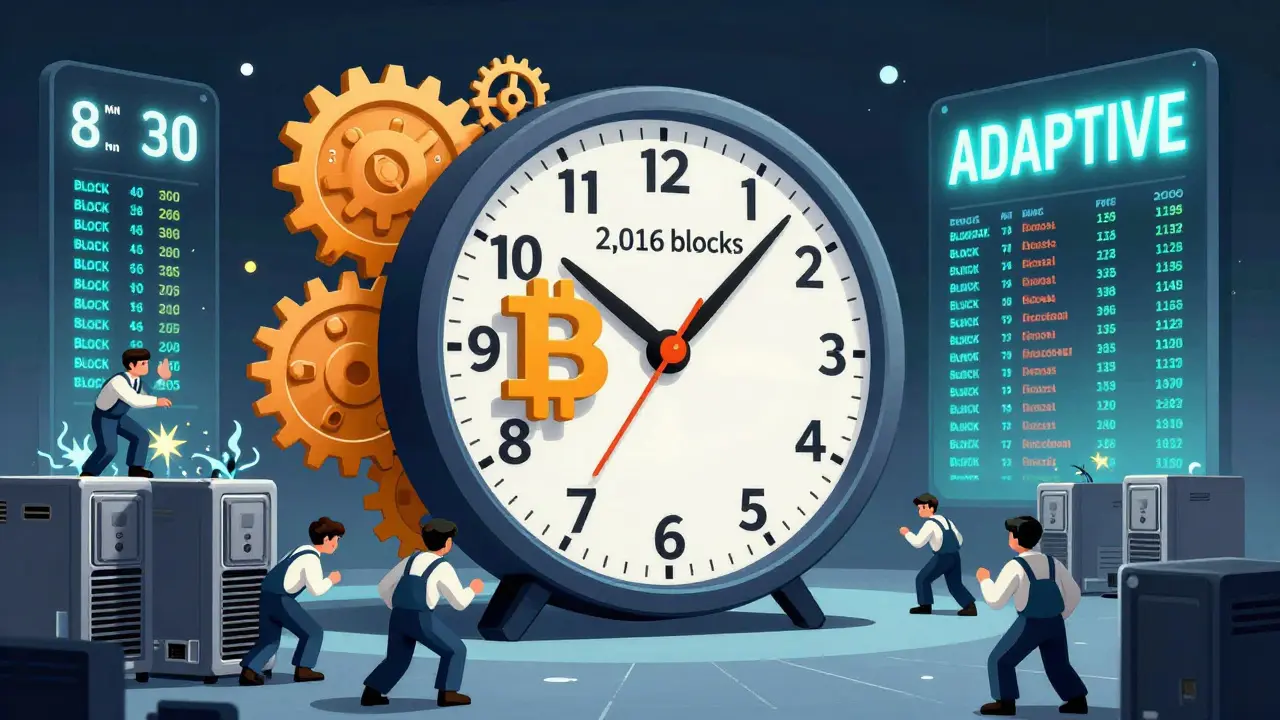
The blockchain world is at a turning point. For over a decade, Bitcoin and other Proof-of-Work networks have relied on a simple, predictable system: adjust mining difficulty every 2,016 blocks - roughly every two weeks - to keep block times at 10 minutes. But that model is cracking under pressure. In October 2024, Bitcoin’s mining difficulty hit a record 95.7 trillion, forcing miners to spend more on electricity just to break even. Meanwhile, sudden hash rate drops - like during the 2021 China mining ban - caused massive, delayed adjustments that left the network vulnerable. The truth is, waiting two weeks to react to a surge or drop in mining power is no longer good enough. The future belongs to adaptive mining difficulty: a system that tweaks difficulty in real time, not in chunks.
How Mining Difficulty Works Today
Right now, every blockchain using Proof of Work has to solve a math puzzle to add a block. The harder the puzzle, the more computing power you need. That’s where difficulty comes in. If blocks are being mined too fast - say, every 8 minutes instead of 10 - the network increases difficulty. If they’re too slow, it lowers it. Simple, right?But Bitcoin’s method is rigid. It waits for exactly 2,016 blocks, then compares the total time taken to the expected 20,160 minutes. If miners finished in 18,000 minutes, difficulty jumps. If it took 22,000 minutes, it drops. There’s a cap: no more than a 25% change per adjustment. That’s meant to prevent wild swings. But it also creates blind spots. During the 2021 China ban, the global hash rate dropped 50% overnight. Bitcoin took two weeks to catch up. In that window, block times stretched to 15, 20, even 30 minutes. Transactions piled up. Miners lost money. And attackers? They saw their chance.
Why Static Adjustments Are a Security Risk
One of the biggest dangers in today’s system is selfish mining. Imagine a miner or pool with 30% of the network’s power. They can hold back mined blocks, wait for the network to fall behind, then release multiple blocks at once - claiming all the rewards and leaving others with empty blocks. This only works during long adjustment windows. With Bitcoin’s two-week lag, there’s a 14-day window where this attack pays off. In 2023, researchers simulated this exact scenario. They found that under current rules, a 25% hash rate attacker could steal 15% more rewards than they should. That’s not theoretical. It’s math.Adaptive difficulty changes that. Instead of waiting for 2,016 blocks, the network checks every single block. If the last five blocks came in 4 minutes apart, difficulty ticks up slightly - maybe 0.5%. If the next block takes 15 minutes, it drops again. This removes the attack window. Why? Because the moment an attacker tries to hoard blocks, the network notices. Difficulty rises. Their advantage vanishes. Game theory models show this makes selfish mining not just harder - but unprofitable.
How Adaptive Difficulty Actually Works
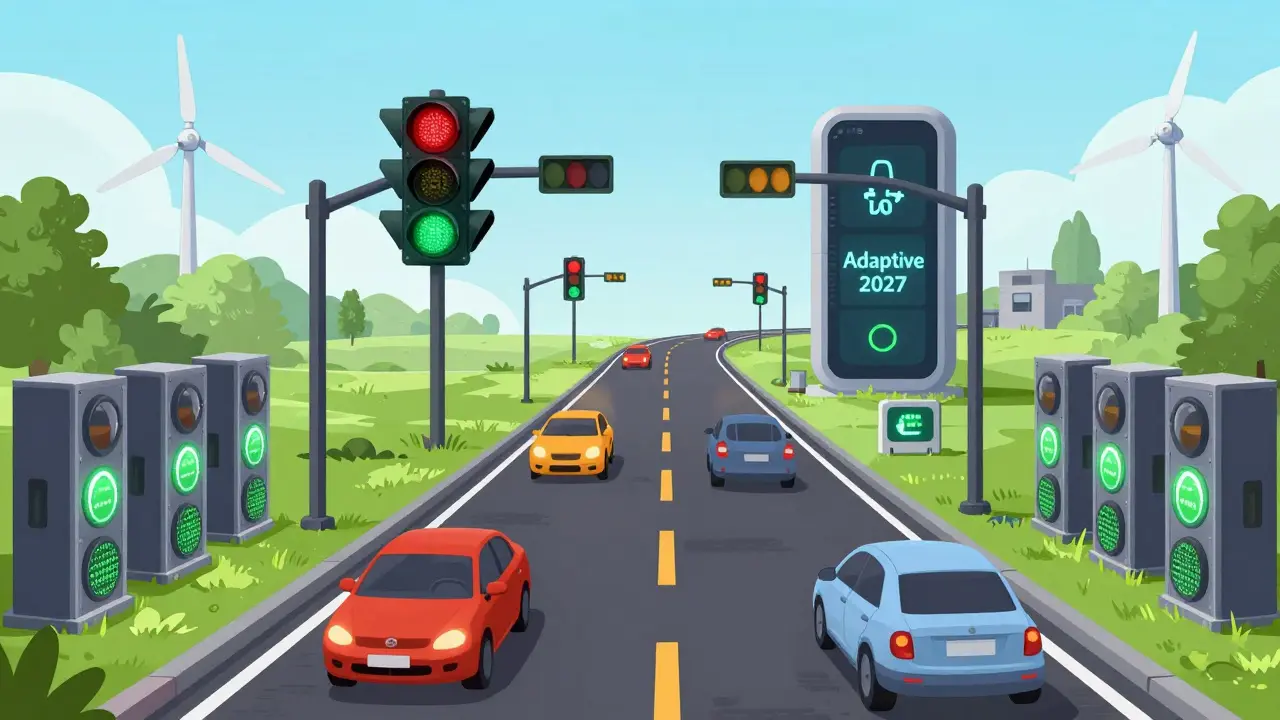
Adaptive systems don’t just look at time. They look at patterns. Think of it like traffic control. A regular traffic light changes every 90 seconds. An adaptive system watches how many cars are waiting, how fast they’re moving, and adjusts the green light in real time. Same idea.Modern adaptive protocols track:
- Block propagation time - how long it takes for a new block to reach 90% of nodes
- Hash rate distribution - is one pool dominating?
- Abandoned blocks - blocks that were mined but never confirmed
- Network latency - are miners in Europe lagging behind those in Asia?
Some proposals, like the one published in the Journal of Blockchain and Cryptocurrency, even let miners submit abandoned blocks as special transactions. The network uses this data to calculate difficulty more accurately. If lots of blocks are being abandoned because of slow propagation, it means the network is too congested - so difficulty drops. It’s not guesswork. It’s feedback.
Unlike Bitcoin’s rigid formula, adaptive systems use dynamic algorithms. Some use rolling averages over the last 100 blocks. Others use machine learning to predict future hash rate changes based on historical patterns, energy prices, or even hardware sales data. Ethereum’s post-merge research showed that even small, continuous adjustments - as small as 0.1% per block - can stabilize a network far better than a 25% swing every two weeks.

Real-World Testing: What We’ve Learned
Several altcoins have tested adaptive difficulty. Litecoin, for example, adjusts every 2.5 minutes - far more often than Bitcoin. But even that’s not real-time. A few testnets, like Zcash’s Sapling upgrade and Monero’s 2025 testnet, ran adaptive algorithms for over six months. Results? Block times stabilized within 1% of target, even when hash rate jumped 40% in a single day. Transaction confirmations became faster and more predictable.But it’s not all smooth. Miners hate uncertainty. If you run a mining farm in Kazakhstan, you buy ASICs based on predictable difficulty cycles. You calculate ROI over 14 days. If difficulty changes every hour, your profit model breaks. Reddit threads from testnet users show heated debates: “I can’t plan my electricity contract if difficulty jumps 3% tomorrow.” Some professional mining pools refused to join until they got better dashboards.
Another issue: storage. Full nodes now need to keep track of every abandoned block and every tiny difficulty tweak. That’s more data. But here’s the twist: fewer forks mean less wasted storage. In Bitcoin, abandoned blocks pile up as orphaned chains. Adaptive systems reduce orphaned blocks by 60-70% because they correct problems before they snowball. So while storage per node increases slightly, the total network storage burden drops.
Energy, Cost, and Sustainability
This isn’t just about speed. It’s about survival. Bitcoin’s energy use hit 140 terawatt-hours in 2024 - more than Argentina. That’s not sustainable. Adaptive difficulty cuts waste. When hash rate spikes, static systems crank difficulty up too late. Miners keep running old, inefficient machines. Adaptive systems detect the spike early, raise difficulty fast, and force out the old gear. Studies show this could reduce energy use by 15-25% over a year.It also helps with geographic imbalance. Right now, 70% of Bitcoin mining is in just three countries. If a new mining hub pops up in Iceland, the network doesn’t notice for weeks. Adaptive systems detect it immediately and adjust. That means less centralization. Less risk. Less pressure on the grid.
Challenges to Adoption
Adaptive difficulty sounds perfect - but it’s not easy to roll out. Bitcoin’s community is famously cautious. Any change requires near-unanimous consensus. Even small tweaks, like the Taproot upgrade, took years. An adaptive system? That’s a protocol-level rewrite. It needs:- New software for miners and full nodes
- Updated mining pool algorithms
- Tools for miners to forecast profitability
- Extensive testing on testnets for over a year
And then there’s the human factor. Most miners don’t want complexity. They want predictability. The industry has to build tools that translate real-time difficulty into simple forecasts: “Your next 10 days will be 8% harder than last cycle.” That’s not easy.
Meanwhile, newer blockchains are skipping the old model entirely. Networks like Algorand, Solana (in hybrid mode), and Polygon’s Proof-of-Stake derivatives use adaptive difficulty by default. They don’t have legacy baggage. They’re setting the standard.
The Road Ahead: Hybrid Systems Are the Bridge
Don’t expect Bitcoin to flip to adaptive difficulty tomorrow. But a hybrid model? That’s coming. Imagine this: Bitcoin keeps its 2,016-block adjustment, but adds micro-corrections after every 100 blocks. If the last 100 blocks came in 12 minutes on average, difficulty nudges up 1%. If they took 9 minutes, it drops. This gives you the stability miners want - with the responsiveness the network needs.That’s what the Ethereum Foundation is testing. That’s what Bitcoin Core developers are quietly evaluating. And it’s already live on private blockchains used by banks and enterprises. By 2027, every new blockchain will launch with adaptive difficulty. The question isn’t if - it’s when the old guard catches up.
The future isn’t about bigger ASICs or cheaper power. It’s about smarter networks. Networks that learn. Networks that adapt. That’s the real innovation.
What is adaptive mining difficulty?
Adaptive mining difficulty is a system that adjusts the complexity of blockchain mining puzzles in real time, based on network conditions like hash rate, block propagation speed, and mining behavior. Unlike traditional systems that change difficulty every two weeks, adaptive systems make small, continuous adjustments to maintain stable block times and improve security.
Why is Bitcoin’s current difficulty system outdated?
Bitcoin adjusts difficulty every 2,016 blocks (about two weeks), which creates vulnerability windows. During sudden hash rate changes - like the 2021 China mining ban - this delay caused block times to stretch to 20+ minutes, slowing transactions and enabling selfish mining attacks. The system can’t react fast enough to modern network volatility.
How does adaptive difficulty prevent selfish mining?
Selfish mining relies on long adjustment periods to exploit temporary advantages. Adaptive difficulty eliminates this by reacting within minutes - not weeks. If a miner tries to withhold blocks, the network detects the slowdown and lowers difficulty, or if they flood the network, it raises difficulty. This removes the profit incentive, making attacks unviable.
Will adaptive difficulty reduce Bitcoin’s energy use?
Yes. By quickly responding to hash rate spikes, adaptive systems force out outdated or inefficient mining hardware before it wastes power. Studies show this could cut Bitcoin’s energy consumption by 15-25% annually, while maintaining security and decentralization.
Why aren’t all blockchains using adaptive difficulty yet?
Legacy networks like Bitcoin face huge barriers: consensus requirements, miner resistance, and the complexity of upgrading core protocol code. Smaller, newer blockchains don’t have this baggage - they built adaptive systems from the start. Adoption is happening, but slowly, in established networks.
Do miners need new equipment for adaptive difficulty?
Not necessarily. The mining hardware (ASICs) stays the same. But miners need updated software - both on their rigs and in their mining pools - to handle real-time difficulty adjustments and new profitability forecasting tools. The change is in the protocol and software, not the machines.
What’s the biggest challenge to adopting adaptive difficulty?
The biggest challenge is trust. Miners rely on predictable cycles to plan investments and electricity contracts. Real-time adjustments introduce uncertainty. The industry must build transparent forecasting tools before widespread adoption can happen.




People Comments
This is just more tech bro nonsense. Miners don't care about 'adaptive' anything. They care about their electricity bill. Stop overcomplicating what works.
Adaptive difficulty is a fundamental violation of Nakamoto consensus. You're introducing centralized feedback loops into a decentralized system. The moment you start using machine learning to predict hash rate, you're inviting manipulation. This isn't innovation - it's surveillance capitalism with ASICs.
So let me get this straight - you're proposing we replace a simple, auditable, 10-year-old algorithm with a black box that 'learns' from abandoned blocks and latency data... and you think this is *more* secure? Bro. Just... bro.
I find it deeply tragic that we're still debating whether to optimize for efficiency when the real question is: why are we mining at all? The energy, the hardware waste, the psychological toll on miners trapped in Kazakhstan server farms - this isn't progress. It's a cult of computational worship. The real adaptive system is one that *stops*.
I don't care what the math says. If my rig starts losing money because difficulty jumps 3% overnight I'm shutting it down. No one asked for this. No one wanted this.
Oh wow. So now we're going to turn blockchain into a smart thermostat? Next they'll make it adjust difficulty based on how many people are watching cat videos on YouTube. The future is here. It's dumb.
I'm actually really excited about this. Imagine a world where transactions are fast, fees are low, and miners aren't stuck with outdated gear for months. This isn't just technical - it's ethical. We can do better than 15-minute block times while people wait to pay for coffee.
Ah yes. The 'hybrid model.' That's what they said about SegWit. Then Taproot. Then Lightning. And now? Now we're going to 'nudge' difficulty up by 1% after every 100 blocks... like a nudging algorithm from a 2023 crypto startup pitch deck. It's not innovation. It's vaporware with a whitepaper.
The notion that adaptive difficulty enhances security is a fallacy rooted in naive game theory. Real-world systems are not equilibrium machines. They are chaotic, emergent, and riddled with asymmetric information. To assume that micro-adjustments eliminate selfish mining is to ignore the fundamental asymmetry between the miner's local view and the global state. The attack surface doesn't vanish - it becomes more insidious. You don't prevent exploitation by adding complexity. You enable it.
Why are we even talking about this? Bitcoin's fine. People are still buying it. Miners are still getting paid. Block times are still around 10 minutes. You're solving a problem that doesn't exist. Just leave it alone.
I just want to say that I appreciate the effort that went into writing this. I'm not an expert. I don't understand all the math. But I read it. And I think it's important that someone is thinking about these things. Even if I don't agree. Even if I don't fully get it. It matters that people care enough to try.
Let me offer a constructive perspective: the core issue is not whether adaptive difficulty is technically superior - it clearly is - but whether the community possesses the institutional maturity to manage the transition. The solution is not to abandon Bitcoin's conservatism, but to build a phased, transparent, and educational rollout. This requires collaboration between developers, miners, pool operators, and even end-users. We must not mistake inertia for wisdom.
They say it's about efficiency. But I know the truth. This is a backdoor for the fed. The NSA. The IMF. They want to track every block, every hash, every miner's location. They want to disable ASICs remotely. They want to control the difficulty curve. This isn't progress. It's the beginning of the end. The blockchain was supposed to be unbreakable. Now they're turning it into a smart grid. Wake up.
I’ve been mining since 2017, and I’ve seen every hype cycle come and go. But this? This is the one that actually makes sense. I used to have to reboot my rigs every time a China ban hit. Now? I get a 0.2% adjustment every 10 minutes. My ROI model went from a wild guess to a spreadsheet with confidence intervals. The real win? My electricity provider finally gave me a bulk rate because my usage is predictable. This isn’t just tech - it’s economics. And it’s beautiful.
i think this is so cool 😍 like imagine your miner is basically a smart fridge that adjusts itself. why are people so mad? it's not like we're replacing bitcoin with ai robots. it's just a lil upgrade. 🤖⚡
In India, we have a saying: 'A river that changes its course too often drowns its own banks.' The blockchain is not a machine to be optimized. It is a social contract. To alter its rhythm so frequently is to erode trust - the only asset that matters in a decentralized system. We must not confuse agility with instability.
I've been following this for a while. The data supports adaptive difficulty. The resistance? That's cultural. The real challenge isn't technical. It's psychological. People fear what they can't predict. That's not a flaw in the system. It's a flaw in us.