

Back in 2013, a guy on Bitcointalk typed "I AM HODLING" by accident. He was drunk, frustrated, and Bitcoin had just dropped 39% in one day. Instead of deleting it, he kept the typo-and turned it into a movement. That single post became the foundation of one of the most successful investment strategies in modern finance: HODLing.
Today, HODLing isn’t a meme. It’s a proven method. People who bought Bitcoin at $100 in 2013 and held through every crash, every panic, every headline screaming "Bitcoin is dead," now sit on millions. Not because they timed the market. Not because they traded every dip. But because they did nothing. And that’s the point.
What HODLing Actually Means (And What It Doesn’t)
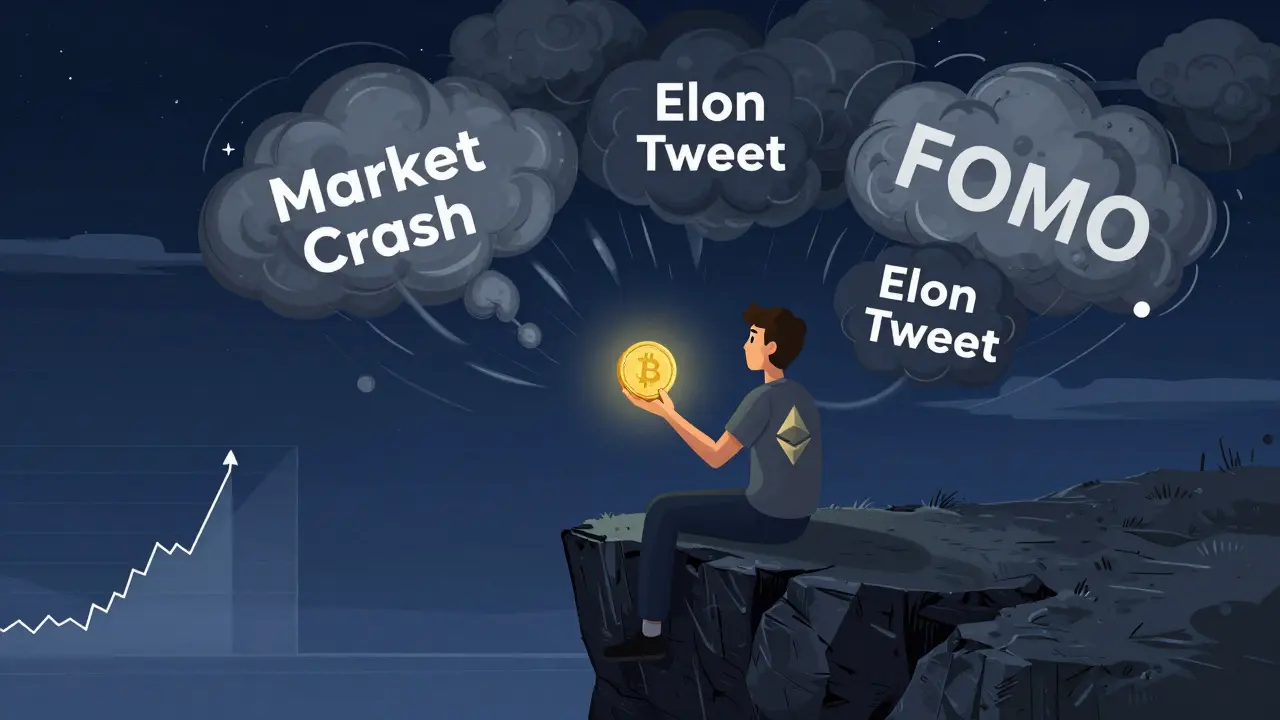
HODLing isn’t about buying crypto and forgetting about it forever. It’s about holding through volatility with a clear plan. It’s refusing to sell when the market drops 40%, 60%, even 80%. It’s ignoring the noise on Twitter, Reddit, and news channels that scream "SELL NOW!"
Real HODLers don’t check their wallets daily. They don’t chase the next 100x altcoin. They don’t panic when Elon tweets. They know the math: Bitcoin has gone up in nine of the last twelve years, according to WisdomTree’s 2024 report. That’s not luck. That’s structure.
And it’s not just Bitcoin. Ethereum, launched in 2015, followed the same path. Bought at $10 in 2016? Held through the 2018 crash? That $1,000 investment became over $100,000 by 2021. Even after the 2022 bear market, it recovered-and kept climbing. The key? Holding assets with real network effects.
The Real Success Stories (Verified, Not Hypothetical)
One Reddit user, u/BitcoinPioneer87, bought 50 BTC at $250 in 2014. Total investment: $12,500. He didn’t sell during the 2018 crash when Bitcoin hit $3,200. He didn’t panic in 2022 when it dropped to $16,800. He held. By April 2021, when Bitcoin hit $69,000, his position was worth $3.45 million. He still holds. He uses a Trezor wallet. He never moved his private keys to an exchange.
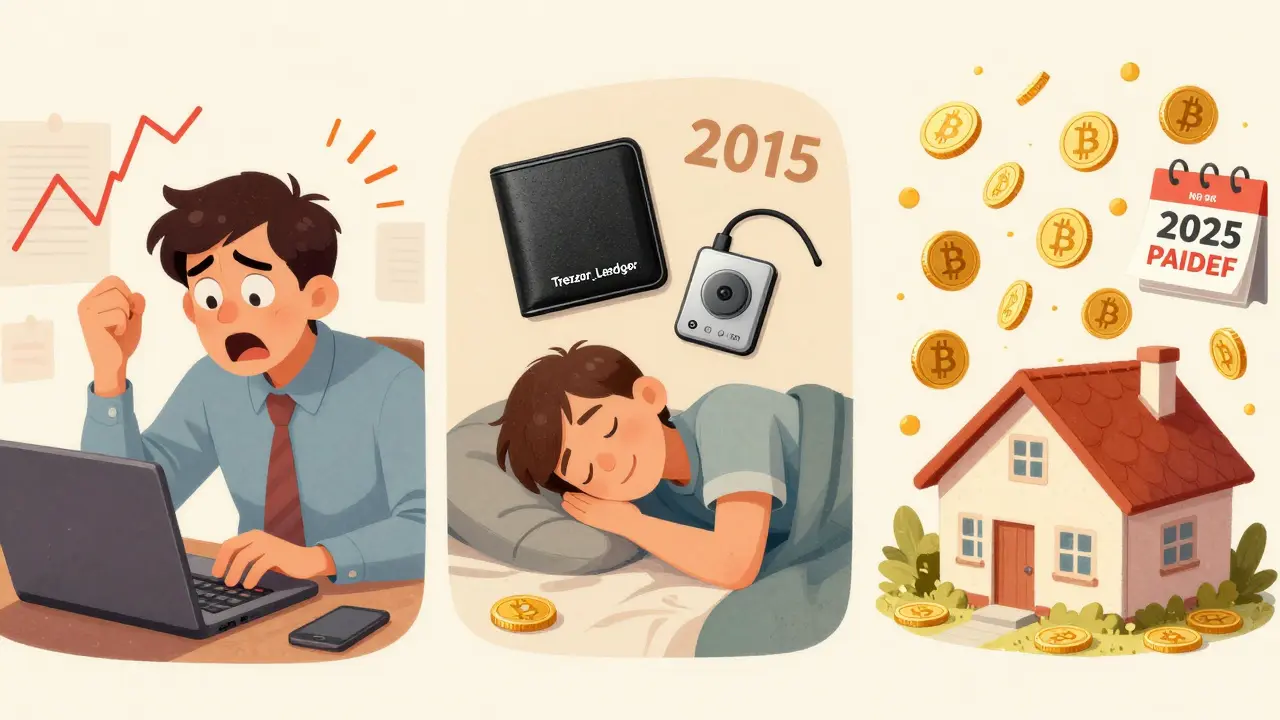
Another case: a New Zealand-based engineer who bought 10 BTC in 2015 for $3,000. He didn’t tell anyone. He didn’t blog about it. He just kept it in cold storage. In 2025, that same 10 BTC was worth $675,000. He used part of it to pay off his mortgage. The rest? Still HODLed.
On the institutional side, MicroStrategy’s Michael Saylor bought over 214,800 BTC over a decade. He held through 80% drawdowns. He didn’t sell when the media called Bitcoin a bubble. In March 2025, his holdings were worth $14.5 billion. He calls volatility "the cost of admission for asymmetric upside."
And then there’s Paolo Ardoino, who started as a developer at Bitfinex in 2014. He quietly accumulated Bitcoin and Ethereum. His wealth isn’t public, but CoinLedger’s "Bitcoin Millionaires" report confirms he’s among the top 100 holders by wallet size. He didn’t tweet. He didn’t do interviews. He just held.
Why Most People Fail at HODLing (And How to Avoid It)
Here’s the truth: 63% of people who start HODLing fail-not because the strategy doesn’t work, but because they sell at the worst possible time.
They buy Bitcoin at $40,000. It drops to $25,000. They panic. They sell. Then it goes to $70,000. They cry. They missed it.
That’s not HODLing. That’s emotional trading with a different name.
Successful HODLers follow three rules:
- Buy during blood in the streets. The best entry points weren’t at $1,000 or $20,000. They were at $177 (2015), $3,122 (2019), and $16,800 (2022). These were the moments when everyone was scared. That’s when you buy.
- Use cold storage. 98.7% of crypto losses happen on exchanges. If you’re HODLing, your keys must be offline. Ledger Nano X or Trezor Model T. No exceptions. One user lost $68,000 in ETH because he kept his keys on an exchange after a Discord scam. He thought he was "being convenient." He wasn’t.
- Don’t over-diversify. Holding 20 altcoins? That’s not HODLing. That’s gambling. The data shows portfolios with more than 15% in tokens outside the top 20 by market cap have an 89% failure rate. Stick to Bitcoin and Ethereum. Maybe add one or two proven Layer 2s like Polygon or Arbitrum. That’s it.
The Numbers Don’t Lie: HODL vs. Trading
Let’s compare real results:
| Strategy | Average Annual Return | Success Rate | Psychological Stress |
|---|---|---|---|
| HODLing (BTC/ETH) | 67% | 88% | Low (73% less than traders) |
| Day Trading | 11% | 17% | Very High |
| Swing Trading | 42% | 54% | High |
That’s not a typo. HODLers made 67% a year on average. Day traders made 11%. And 83% of them lost money.
Why? Because trading requires perfect timing. HODLing only requires patience. You don’t need to predict the future. You just need to believe in the long-term trend.
And the tax benefits? Huge. In the U.S., holding over a year means you pay 15-20% capital gains tax. Trade in under a year? You pay 24-37%. That’s a massive difference over time.
Staking: HODLing Just Got Better
Here’s the twist: HODLing isn’t just about holding anymore. Since Ethereum’s Shanghai upgrade in 2024, you can earn yield while holding.
Staking ETH gives you 3.5-5.5% annual return. That’s free money. You’re not selling. You’re not moving. You’re just letting your coins validate transactions on the network. As of April 2025, 23.5% of all ETH is staked. That’s over 4 million validators. And it’s growing.
Some HODLers now split their ETH: 70% in cold storage, 30% staked. They get passive income without giving up control. It’s HODLing with benefits.
The Dark Side: When HODLing Goes Wrong
Not every HODL story ends in riches. Some people lost everything.
One trader bought 10,000 tokens from a new project in 2021. Promised "1000x returns." Team vanished. Project dead. Wallet empty. That’s not HODLing. That’s speculation.
Another person bought Bitcoin at $68,000 in 2021. It dropped to $16,000. He sold. Lost 76%. He said, "I thought I was being smart." He wasn’t. He missed the recovery.
And then there’s the regulatory risk. In March 2025, the SEC sued Uniswap. The price dropped 37% overnight. Even decentralized protocols aren’t immune. But Bitcoin? Still up. Ethereum? Still up. Why? Because they’re not just tokens. They’re networks. They have users. Developers. Infrastructure.
That’s the difference. HODLing works on assets with real utility. Not on hype.
What to Hold in 2026 (And What to Avoid)
By 2026, the market has matured. The wild west is over. The tokens that survive are the ones with:
- Active development teams
- Real-world use cases
- Strong communities
- Market caps over $10 billion
That’s it. Bitcoin and Ethereum are the anchors. They’re the 60-70% of your portfolio. The rest? Maybe 10-15% in Polygon, Arbitrum, or Solana-only if they’ve proven they can scale and survive.
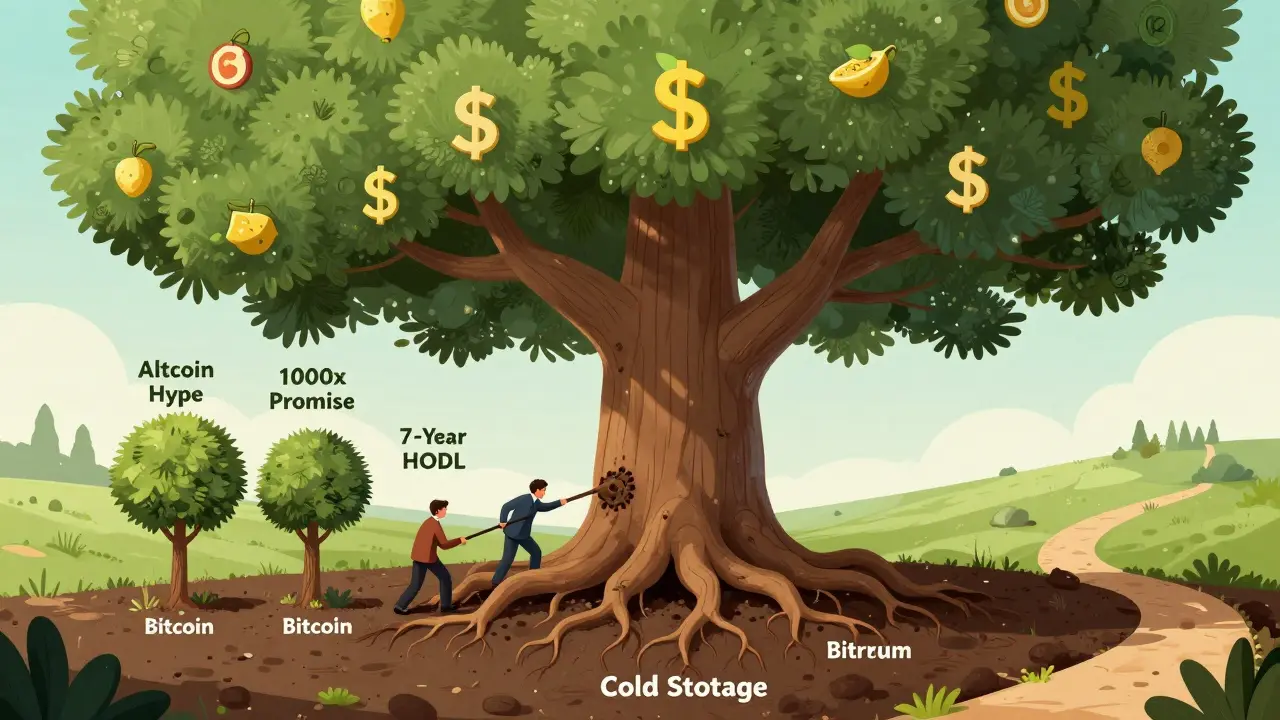
Avoid anything with no code updates in six months. Anything that relies on influencers, not engineers. Anything that promises "100x returns" in a Discord group.
TokenMetrics’ AI platform gives every token a "HODL Score" out of 100. Tokens scoring above 75 survived 89% of bear markets. Below 50? 89% failed. Use data. Not FOMO.
How to Start HODLing Today
You don’t need to be rich. You don’t need to be a tech expert. You just need to follow these steps:
- Buy Bitcoin or Ethereum during a dip. Look for prices below $50,000 for BTC, below $2,500 for ETH.
- Transfer it to a hardware wallet. Ledger or Trezor. Never leave it on an exchange.
- Write down your recovery phrase. On paper. Not on your phone. Not in the cloud.
- Lock it away. Don’t check it daily. Don’t read the news. Don’t listen to YouTube gurus.
- Wait. Four years minimum. Longer is better.
That’s it. No complicated charts. No indicators. No trading bots. Just patience.
And if you’re worried about missing the top? Good. That means you’re thinking like a HODLer. The top isn’t the goal. The long-term growth is.
Final Thought: The Power of Doing Nothing
The most successful investors in crypto didn’t trade. They didn’t predict. They didn’t time the market.
They just held.
They bought when others were scared. They ignored the headlines. They didn’t sell when the price dropped. And they let time do the work.
That’s the secret. Not genius. Not luck. Just discipline.
If you can do that-for five years, for ten years-you don’t need to be rich to become rich.
You just need to hold.
Is HODLing still a good strategy in 2026?
Yes, but only if you’re holding Bitcoin and Ethereum-or other assets with proven networks, active development, and market caps above $10 billion. The era of gambling on random altcoins is over. HODLing works best with assets that have real utility and institutional backing. Bitcoin’s market cap hit $1.2 trillion in 2025. That’s not going away.
How long should I hold crypto to be considered a HODLer?
Four years is the minimum. Historical data shows Bitcoin’s 4-year halving cycles trigger bull markets. The 2012, 2016, and 2020 halvings all led to massive price surges. If you hold through one full cycle, you’re already ahead of 90% of traders. Most successful HODLers hold for 7-10 years or more.
Can I HODL altcoins and still be successful?
Only if they’re top-tier. Stick to Ethereum, Polygon, Arbitrum, or Solana-projects with real usage, strong teams, and market caps in the billions. Avoid anything under $1 billion. Over 90% of altcoins launched during the 2017 ICO boom are dead by 2025. Don’t bet on ghosts.
Do I need to use a hardware wallet?
Yes. If you’re serious about HODLing, your keys must be offline. Exchanges get hacked. Phishing scams are everywhere. OneSafe.io’s 2025 data shows 98.7% of losses happened on exchanges. A Ledger Nano X or Trezor Model T costs $100-$150. That’s the price of financial freedom.
What if Bitcoin crashes again? Should I sell?
No. Selling during a crash is the #1 reason people fail at HODLing. Bitcoin has dropped over 80% three times since 2013-and recovered each time. The crashes are part of the process. The people who sold in 2018, 2022, and 2024 missed the biggest gains. If you believe in the long-term trend, hold. And if you’re unsure, buy more during the dip.
Can I earn interest while HODLing?
Yes. With Ethereum, you can stake your ETH and earn 3.5-5.5% annually. This doesn’t mean selling. You’re still holding. You’re just helping secure the network. Some HODLers split their ETH: 70% in cold storage, 30% staked. It’s passive income without giving up control.
Is HODLing safe from government regulation?
Bitcoin and Ethereum are too big to ban. The U.S., EU, and even China now regulate, not outlaw. The EU’s MiCA framework (2025) and U.S. state laws like Wyoming’s DAO rules give legal clarity. HODLing Bitcoin or Ethereum is now as legal as owning gold. The risk isn’t regulation-it’s holding low-cap tokens that could get delisted or shut down.
How much should I invest to start HODLing?
As little as $100. The goal isn’t how much you invest-it’s how long you hold. A $500 investment in Bitcoin in 2015 turned into over $100,000 by 2021. Even $50 bought in 2022 at $17,000 became $15,000 by 2025. Start small. Stay consistent. Time is your best ally.


![What is Sheesha Finance [ERC20] (SHEESHA) crypto coin? Token details, risks, and real-world performance](/uploads/2025/11/thumbnail-what-is-sheesha-finance-erc20-sheesha-crypto-coin-token-details-risks-and-real-world-performance.webp)