


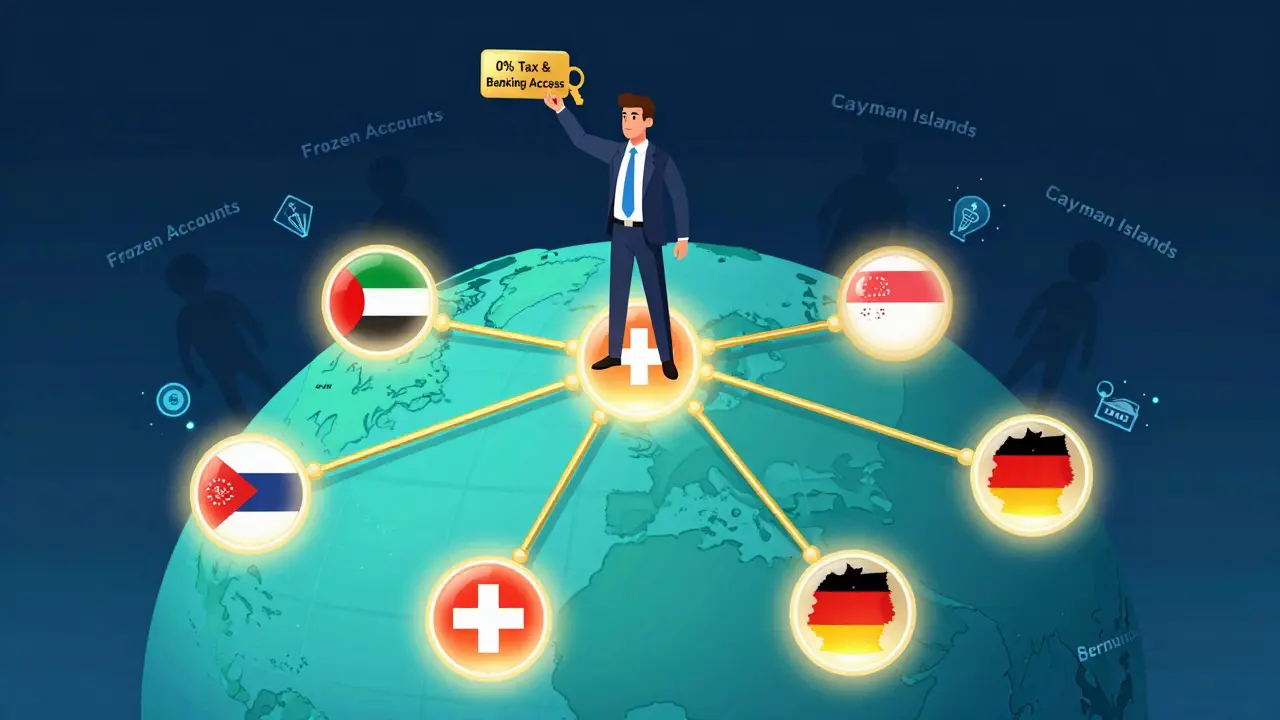
Why Your Blockchain Business Needs the Right Jurisdiction
If you're running a blockchain business in 2025, where you’re based isn’t just a detail-it’s make-or-break. A bad location can mean frozen bank accounts, surprise tax bills, or regulators shutting you down. A good one? It means clear rules, zero crypto taxes, and banks that actually want to work with you. This isn’t about offshore secrecy anymore. It’s about building a real, lasting business in a place that understands digital assets.
What Makes a Jurisdiction Truly Crypto-Friendly?
Not every country that says "we love crypto" actually makes it easy to operate. Real crypto-friendly jurisdictions have three things:
- Clear laws-not vague guidelines, but actual statutes that say exactly what you can and can’t do.
- Zero or near-zero taxes on crypto profits, capital gains, and corporate income from blockchain activities.
- Banking access-no more begging for a business account because your bank says crypto is "too risky."
Some places pretend to be crypto-friendly. They offer tax breaks but then demand impossible compliance paperwork. Others have great tax rules but no banks willing to touch you. The best jurisdictions solve both problems at once.
The Top 6 Jurisdictions for Blockchain Businesses in 2025
1. United Arab Emirates (UAE)
The UAE is the most complete package for international blockchain companies. Across Abu Dhabi, Dubai, and free zones like ADGM and DIFC, crypto businesses pay 0% corporate tax, 0% capital gains tax, and 0% income tax on crypto earnings. The regulatory framework is unified, clear, and enforced by the Securities and Commodities Authority (SCA) and the Central Bank. Banks in Dubai actively work with licensed crypto firms. Setup takes 2-4 weeks. If you’re building a global exchange, wallet provider, or DeFi protocol, the UAE is the default choice.
2. Switzerland
Switzerland has been the quiet leader since 2018. The "Crypto Valley" in Zug is home to over 1,000 blockchain firms. The Swiss Financial Market Supervisory Authority (FINMA) gives clear licensing paths for token issuers and VASPs. Banking is stable-Credit Suisse, UBS, and regional banks all serve crypto clients. Corporate tax rates vary by canton but hover around 12-15%. The real advantage? Long-term political stability and deep integration with European finance. If you need EU market access and a reputation for trust, Switzerland wins.
3. Singapore
Singapore offers one of the most sophisticated regulatory environments in Asia. The Monetary Authority of Singapore (MAS) requires Virtual Asset Service Provider (VASP) licenses, which are strict but transparent. Once licensed, you get access to global capital markets, top-tier talent, and English-speaking legal systems. Corporate tax is 17%, but crypto gains are not taxed if they’re not part of a trading business. The catch? Licensing takes 3-6 months. Best for institutional-grade exchanges, tokenization platforms, and fintechs targeting Asian markets.
4. Cayman Islands
If your business is a crypto hedge fund, private equity vehicle, or investment fund, the Cayman Islands is unmatched. Zero income tax. Zero capital gains tax. Zero corporate tax. No reporting requirements for foreign investors. The Cayman Islands Monetary Authority (CIMA) has clear rules for fund structures using digital assets. The downside? Banking is harder to secure. Many global banks avoid crypto funds here. But for asset managers and institutional investors, the tax savings outweigh the banking friction.
5. Germany
Germany is the only EU country with a true long-term crypto tax exemption. If you hold crypto for more than 12 months, you pay 0% capital gains tax-even if you sell for a $5 million profit. This applies to individuals and businesses. Corporate tax is 29.8%, but if your crypto activity is classified as private investment (not trading), you can avoid corporate tax entirely. The German government also recognizes crypto as a financial instrument under the Banking Act. This makes Germany ideal for European-based investors who want to stay inside the EU while avoiding crypto taxes.
6. Bermuda
Bermuda’s Digital Asset Business Act (DABA) is one of the most precise crypto laws in the world. The Bermuda Monetary Authority (BMA) issues licenses for exchanges, custodians, and token issuers with clear compliance standards. Corporate tax is 0%. No capital gains tax. No VAT. The island has banking relationships with major institutions like HSBC and Standard Chartered, specifically for licensed crypto firms. Setup takes 3-4 months. Bermuda is perfect for firms that need regulatory credibility without the scale of Singapore or the UAE.
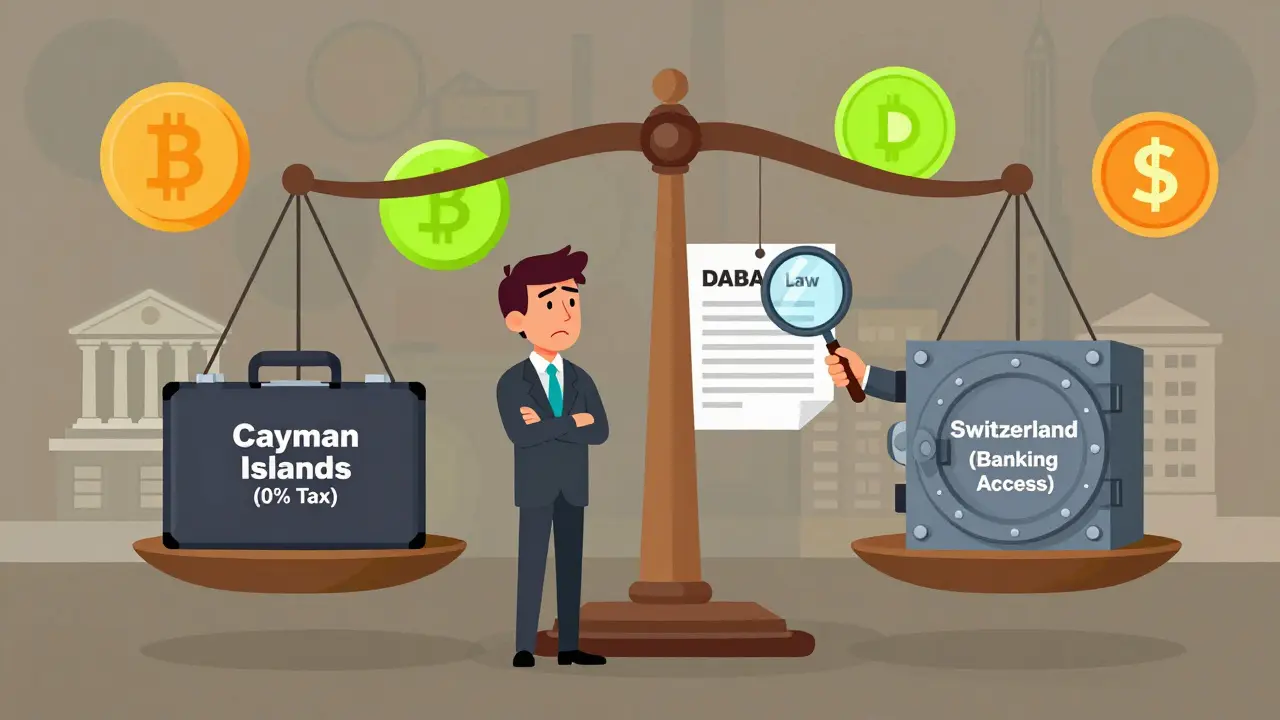
What About El Salvador and Belarus?
El Salvador made headlines by making Bitcoin legal tender. And yes, foreign investors pay zero capital gains tax on Bitcoin. But here’s the catch: banking is nearly impossible. The national bank doesn’t support crypto businesses. International banks avoid it. You can’t easily pay employees, rent office space, or get a merchant account. It’s great for speculators, terrible for operating a business.
Belarus had a fantastic 2018 law that exempted all crypto activities from tax until January 2025. That exemption has been extended-but the country lacks international banking ties, legal enforceability, and political stability. For a serious business, it’s a risky bet.
Comparing the Best Options
| Jurisdiction | Corporate Tax | Crypto Capital Gains Tax | Banking Access | Setup Time | Best For |
|---|---|---|---|---|---|
| United Arab Emirates | 0% | 0% | Excellent | 2-4 weeks | Global exchanges, DeFi platforms |
| Switzerland | 12-15% | 0% (if held >1 year) | Excellent | 6-8 weeks | Long-term institutional firms |
| Singapore | 17% | 0% (if not trading business) | Very Good | 3-6 months | Asian market entrants, fintech |
| Cayman Islands | 0% | 0% | Poor to Moderate | 4-6 weeks | Crypto investment funds |
| Germany | 29.8% | 0% (if held >12 months) | Good | 4-8 weeks | EU-based investors, long-term holders |
| Bermuda | 0% | 0% | Good (for licensed firms) | 3-4 months | Regulated token issuers, custodians |
What You Should Avoid
Don’t pick a jurisdiction just because it’s cheap or popular on social media. Countries like the UK, France, and Australia have heavy reporting rules and high taxes on crypto. Even the U.S. is a minefield-state-by-state rules, IRS tracking, and no federal clarity. If you’re not a U.S. citizen, avoid it unless you want to file Form 8949 every year and risk audits.
Also skip places with no banking access. You can’t pay developers, rent servers, or buy office supplies with Bitcoin alone. A business needs a bank account. Period.
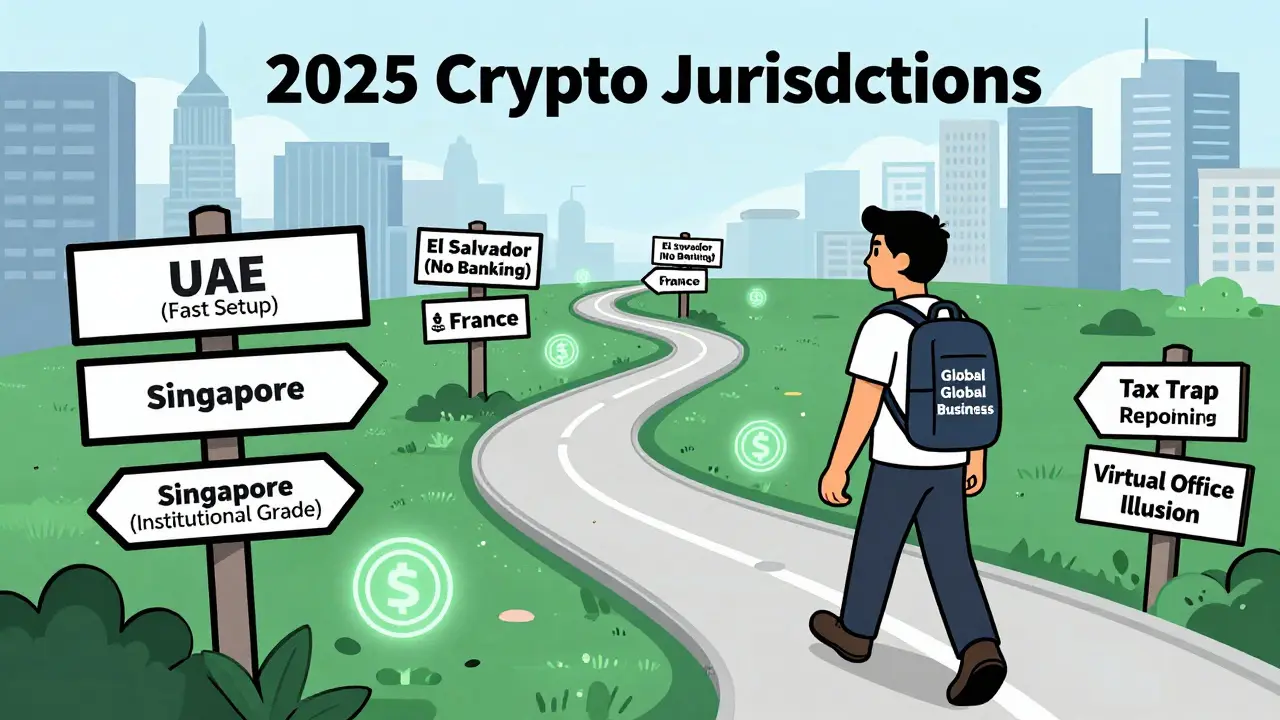
How to Actually Set Up in One of These Places
- Decide your business model-Are you a wallet provider? A fund? A mining operation? Each jurisdiction favors different types.
- Choose 2-3 top candidates based on your needs. Don’t try to do all of them.
- Consult a local legal firm-Don’t use online templates. Hire a lawyer in that country who specializes in crypto. In the UAE, firms like Al Tamimi & Company are standard. In Singapore, it’s Dentons or Rajah & Tann.
- Apply for licenses-Some places require them (Singapore, Bermuda, UAE). Others don’t (Cayman, Germany for private holdings).
- Open a business bank account-This is the hardest step. Start early. Bring your license, business plan, and proof of funding.
- Register your entity-Once you have banking, finalize incorporation.
What Happens If You Get It Wrong?
One client in 2024 set up a crypto exchange in Estonia without realizing their bank account was flagged. After six months, the bank froze all funds. The Estonian government said they couldn’t help. The business lost $1.2 million in trapped capital. Another company in Portugal thought their crypto gains were tax-free-until the Portuguese tax authority changed its stance and hit them with back taxes and penalties.
Getting the jurisdiction right isn’t about saving $10,000 in taxes. It’s about avoiding $10 million in legal and financial disaster.
Final Advice: Think Long-Term
Don’t chase the cheapest tax rate today. Look at where the world is heading. The UAE and Switzerland are building infrastructure for crypto banks, custody solutions, and institutional adoption. Singapore is integrating crypto into its global trade systems. Germany is setting an example for the EU.
If you’re building a company that lasts 10 years, pick a jurisdiction that will still be crypto-friendly in 2035-not just 2025.
Is it legal to run a blockchain business from any country?
No. Many countries ban or heavily restrict crypto businesses. China, Russia, and India have strict bans or licensing hurdles. Even in the EU, countries like France and Italy require complex registrations. Only a handful of jurisdictions offer clear, legal pathways. Operating in a non-friendly jurisdiction risks fines, asset seizures, or criminal charges.
Can I use a virtual office or remote setup?
Some places allow it. Estonia’s e-residency lets you manage a company remotely. The Cayman Islands and Bermuda let you register without local staff. But if you want banking access or a license, most jurisdictions require at least one local director or physical presence. You can’t run a regulated exchange from your living room in Brazil and expect a Swiss bank to work with you.
Do I need to be a citizen to set up a crypto business?
No. None of the top jurisdictions require citizenship. You can be from anywhere in the world. The UAE, Singapore, and Cayman Islands actively welcome foreign entrepreneurs. You’ll need a passport, proof of funds, and sometimes a business plan-but not a visa or residency. Citizenship is only needed if you plan to live there long-term.
What’s the cheapest crypto jurisdiction?
The cheapest in terms of fees and taxes is the Cayman Islands or Bermuda-both have zero corporate and capital gains taxes. But "cheapest" doesn’t mean easiest. Banking costs, legal fees, and compliance can add up. The UAE might cost more upfront but gives you banking, infrastructure, and global credibility. Pay a little more now to avoid paying a lot more later.
How do I know if a jurisdiction is really crypto-friendly?
Look for three things: 1) A law specifically written for digital assets (not just a press release), 2) A regulatory body that issues licenses to crypto firms, and 3) Banks that openly serve crypto businesses. If a country has no official crypto law, no licensed firms, and no banks working with crypto, it’s not friendly-no matter what blogs say.





People Comments
Oh wow, another ‘crypto paradise’ list that ignores the fact that 90% of these places require you to be a millionaire just to apply for a license. 🙄
UAE? Sure, zero taxes-until your bank asks for 17 forms of proof you didn’t launder money from a Nigerian prince. Good luck with that.
This is the most pathetic list I've ever seen!! Why no mention of Vietnam?? Why no India?? Why are you all just drinking the SWISS Kool-Aid?? This is FAKE NEWS!!
I’m literally crying right now 😭
UAE is the ONLY real answer. I moved there last year with my 3 devs and a laptop. We got a license in 18 days. Bank account? Opened in 48 hours. My landlord now accepts ETH for rent. I swear to god, this is the first time I’ve felt safe as a crypto founder since 2018.
Switzerland? Cute. But their banks still ask if your ‘crypto’ is a new kind of tea. Singapore? Ha. They’ll audit you for 14 months before letting you open a bank account. Cayman? Don’t even get me started on the banking nightmare.
This isn’t about taxes. It’s about not waking up to a frozen account and a subpoena. The UAE? They don’t just tolerate crypto. They throw parades for it.
I appreciate the effort, but I think you're missing a key point. Many of these jurisdictions are designed for institutional players, not small teams or bootstrapped founders. The compliance burden in Singapore and Bermuda, for example, is immense. And while Germany offers tax exemptions, the bureaucratic red tape is enough to make anyone want to quit the industry. Realistically, the only places where a small team can thrive are the UAE and maybe Switzerland-but even there, the cost of living and legal fees can be crushing. Maybe the real answer isn't jurisdiction, but waiting for clearer global standards.
So you’re telling me I should move to Dubai because they don’t tax crypto? Cool. So I’ll just fly there every year for a week and do nothing else? That’s not a business, that’s a tax evasion fantasy. Also, who’s gonna pay your devs in crypto? Your landlord? Your electricity bill? LOL.
The analysis is thorough and well-structured. It’s refreshing to see a clear distinction between regulatory appearance and actual operational viability. Many jurisdictions tout crypto-friendliness without enabling the infrastructure required for real business continuity. Banking access remains the true litmus test, and the author correctly prioritizes it above tax rates alone.
Let’s be real-this list is just a PR pamphlet for law firms that specialize in crypto incorporation. The UAE? Their ‘clear laws’ are written in Arabic and English, but the enforcement is entirely discretionary. And don’t get me started on the ‘banking access’-it’s only available if you’re already a client of a UAE-based family office with $50M+ in assets. This isn’t for startups. It’s for oligarchs with blockchain-shaped tax shelters.
The entire premise is flawed. You’re treating jurisdictions like interchangeable Lego blocks when in reality, crypto regulation is a geopolitical chess game. The UAE is a sandbox for Western capital with zero accountability. Switzerland is a museum of old-money finance pretending to be modern. Singapore is a corporate tax haven disguised as a tech hub. And Germany? The only country that understands crypto is still a liability to be managed, not a currency to be embraced. None of these places are ‘friendly.’ They’re just less hostile than the alternatives.
OMG YES to the UAE!! I just moved my team there last month and it’s been a dream 😊
Bank account opened in 3 days, my lawyer was actually helpful, and my landlord took USDC for rent!!
Also, the coffee is amazing. Like, really good. I didn’t think I’d say that about Dubai but here we are 🤍
The real takeaway here isn’t which country is best-it’s that you need to know what kind of business you’re building before picking a location. A hedge fund needs Cayman. A DeFi protocol needs UAE. A long-term holder needs Germany. Stop chasing tax rates. Build your model first, then find the place that fits.
The author’s analysis is superficial and dangerously misleading. One must consider not merely the statutory framework, but the sociopolitical undercurrents of each jurisdiction. The UAE’s regulatory apparatus is a performative construct designed to attract speculative capital, not to foster sustainable innovation. The Swiss model, while ostensibly stable, is tethered to an antiquated financial elite that views blockchain as a threat to their rent-seeking mechanisms. Singapore’s VASP regime is a labyrinth of bureaucratic obfuscation masquerading as compliance. And Germany? A paradox of progressive taxation policy and retrograde institutional inertia. To suggest any of these as ‘solutions’ is to misunderstand the fundamental nature of decentralized systems: they require regulatory vacuum, not regulation. The only truly crypto-friendly jurisdiction is one that does not exist.
I think the most important thing here isn’t the list-it’s the mindset. People treat jurisdiction like a cheat code. But crypto isn’t about avoiding taxes. It’s about building systems that work without permission. The best jurisdiction might be the one where you don’t need to ask anyone for approval. Maybe the real win is building something so useful that even the regulators can’t ignore it.
This is a very well-researched piece. As someone from Nigeria, I can attest that the lack of clear regulation in Africa makes it nearly impossible for blockchain businesses to scale. I appreciate the emphasis on banking access-it’s the silent killer of so many startups. I hope more African countries take note and develop frameworks that are both secure and supportive.
UAE? Please. They don’t care about crypto. They care about money. If you’re not a rich white guy with a Swiss passport, good luck getting a license. And don’t even think about bringing your Indian wife to Dubai and opening a wallet company. They’ll deport you faster than you can say ‘blockchain’
This is the most comprehensive, actionable guide to crypto jurisdiction I’ve ever read. The emphasis on banking access over tax rates is spot-on. The operational realities of running a blockchain business are rarely discussed, and this piece fills that gap with precision. I will be sharing this with every founder I mentor.
I love how this breaks it down. I’m a solo dev and I was torn between Switzerland and Singapore. Reading this made me realize I don’t need a giant office-I need a bank account and a clear path to license. I’m applying to the UAE next week. Fingers crossed 😅
You’re all missing the point. Crypto isn’t about jurisdictions. It’s about sovereignty. If you’re relying on a government to protect your assets, you’re already lost. The only real crypto-friendly place is a self-hosted node in the middle of nowhere with no internet censorship.
UAE is the only answer. But let’s be honest-it’s not for everyone. If you’re a small team without a legal budget, you’re screwed. The real winners here are the law firms and corporate service providers who charge $50K just to file your paperwork. This isn’t freedom. It’s capitalism with a fancy flag.
I just moved to Bermuda with my partner and our dog. We’re building a NFT studio. The weather’s perfect, the license took 11 weeks, and HSBC finally approved our account last week! 🐶🌴
Also, the local bakery accepts DOGE. I’m not kidding. That’s the future.
I’m a solo dev from Ohio. I read this and realized I’ve been thinking about this all wrong. I don’t need to move to Dubai. I just need to pick one place, get licensed, and focus on building. The rest? It’s noise. Thanks for the clarity.
I’m so excited!! I just got my UAE license and I’m hiring my first dev!! 🎉
Thank you for this guide!!
I think this is a great overview! I’m from India and I’m so glad someone finally pointed out that El Salvador isn’t practical for real business. I hope more people in my country start looking at real options instead of just following hype.
I’ve been in crypto since 2017. I’ve seen 5 different ‘best jurisdictions’ lists. Every single one was wrong. The truth? There is no perfect place. The best jurisdiction is the one where you can stay sane, pay your bills, and keep building. Pick the least awful option and get to work.