



There’s a lot of talk online about a Kalata (KALA) airdrop. You’ve probably seen posts promising free tokens if you sign up, join a Telegram group, or connect your wallet. But here’s the truth: Kalata has not officially announced any airdrop as of February 22, 2026. No snapshot dates. No eligibility rules. No smart contract address. Nothing.
That doesn’t mean an airdrop won’t happen. It just means you’re seeing rumors, not facts. And in crypto, rumors can cost you money.
Let’s cut through the noise. What do we actually know about Kalata? The token is trading at $0.00003217, down slightly from its 50-day average of $0.00003441. Its 200-day average is even higher at $0.00004097, which tells you it’s been on a downward trend. The 14-day RSI sits at 50.43 - neutral, not bullish, not bearish. It’s stuck. No big moves. No hype spikes. And if a major airdrop were about to drop, you’d see volume spike, social chatter explode, and wallets start moving. None of that is happening.
Most legitimate airdrops in 2025 follow a pattern. Projects like Phantom wallet or pump.fun on Solana announce their distributions weeks ahead. They list exact criteria: “Hold $100 in $SOL for 30 days,” “Complete 5 testnet transactions,” or “Stake tokens by March 1.” They post it on their website. They tweet it. They pin it in Discord. They even publish a step-by-step guide. Kalata? Nothing. Not even a hint.
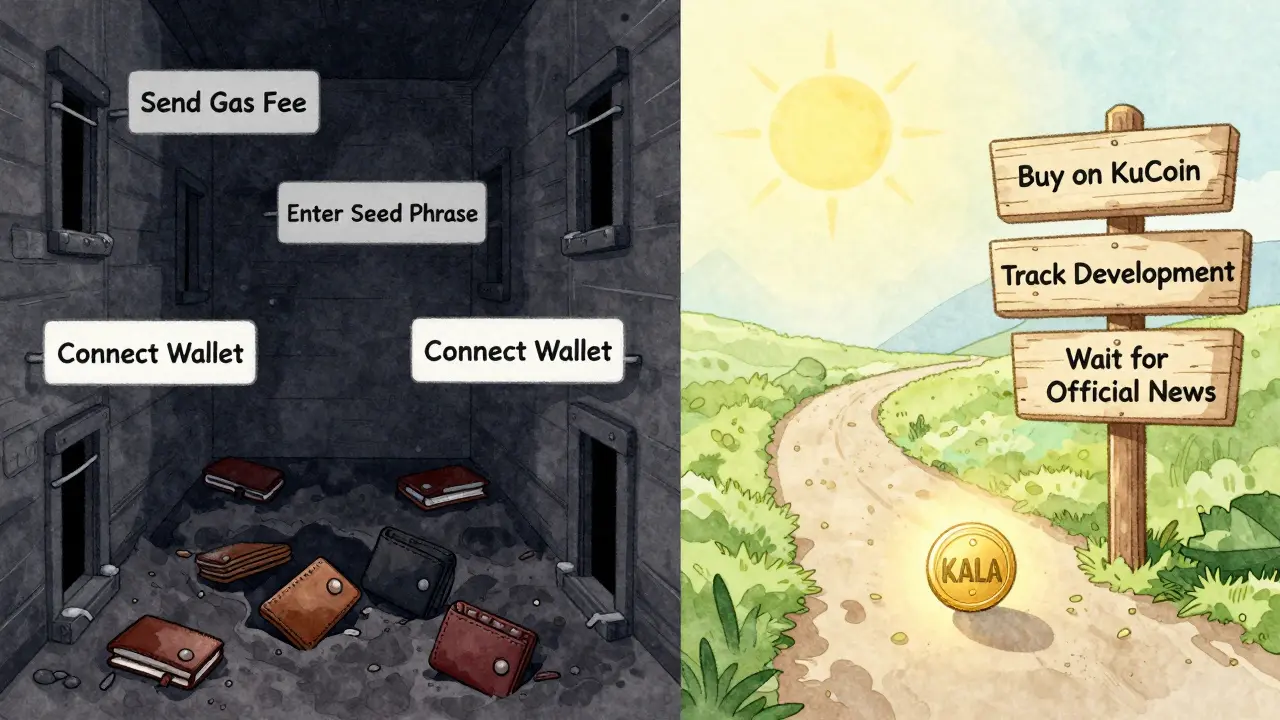
So why are people still talking about a KALA airdrop? Because it’s easy to fake. Scammers copy project names, create fake websites that look like the real one, and use bots to flood Twitter and Reddit with “I got my KALA tokens!” screenshots. They want you to click a link, connect your wallet, and - boom - your private keys are stolen. Or they’ll ask you to send a small fee to “unlock” your airdrop. That’s always a scam. Legit airdrops never ask you to pay to receive free tokens.
If you’re serious about finding out whether Kalata has an airdrop, here’s what to do. First, go to the official Kalata website. Not a Google result. Not a Telegram link. Not a CoinMarketCap page. The real site. Check the “News” section. Check the “Token” or “Community” tab. Look for any official blog post or announcement. If it’s not there, it doesn’t exist. Second, check their verified Twitter account. Search for “airdrop” or “KALA”. If there’s no tweet from their official handle, assume it’s not real. Third, look at major airdrop trackers like AirdropAlert, CoinGecko Airdrops, or CryptoAirdrop.io. Kalata isn’t listed on any of them. That’s not an accident.
Some people say, “But what if it’s coming soon?” Maybe. But waiting for a rumor isn’t a strategy. You can’t build a portfolio on guesses. If Kalata ever launches an airdrop, it will be documented. It will be public. It will have a clear timeline and a verifiable process. Until then, treat every claim like a red flag.
Here’s what you should do instead. If you believe in Kalata as a long-term project, buy the token on a reputable exchange like KuCoin or Gate.io. Hold it. Watch the price. Track their development updates. If they release a mainnet, a partnership, or a roadmap update - that’s your signal. That’s real progress. An airdrop is just a marketing tactic. Real value comes from utility, adoption, and team transparency.
And if you’re looking for real airdrops in 2026, focus on projects with clear track records. Projects like Phantom, Jupiter, or Jupiter’s recent Solana-based initiatives have public airdrop histories. They’ve distributed tokens before. They’ve rewarded users fairly. They’ve been transparent. That’s the kind of project you want to back.
Don’t fall for the hype. Don’t click random links. Don’t send crypto to strangers. Kalata might have an airdrop one day. But right now? It’s a ghost story.
How to Spot a Fake Airdrop
Fake airdrops are everywhere. Here’s how to tell the real ones from the scams:
- Asking for private keys? Never. Ever. A legitimate airdrop doesn’t need your seed phrase.
- Asking for gas fees? Red flag. You should never pay to receive free tokens.
- Too-good-to-be-true promises? “Get 10,000 KALA for 1 minute of work!” - that’s a trap.
- Unverified social accounts? Check the blue check. Look at the account’s history. Fake accounts often have no posts before the airdrop announcement.
- No official website link? If the airdrop page isn’t on the project’s main domain, it’s fake.
Always double-check. A quick Google search for “Kalata official website” should lead you to kalata.io or a similar domain. If you land on kalata-airdrop[dot]xyz - close the tab.
What Kalata Actually Is
Kalata (KALA) is a cryptocurrency built on the Solana blockchain. It’s not a stablecoin. It’s not a meme coin with a dog logo. It’s positioned as a utility token for decentralized finance tools, possibly tied to lending, staking, or governance. But there’s little public data on its use cases. No whitepaper is easily accessible. No team members are named. That’s a problem. Legit projects don’t hide their team. They don’t leave their roadmap vague.
As of now, KALA’s market cap is under $1 million. That’s tiny. Most tokens with active airdrops have at least $10 million in market value. Why? Because airdrops cost money. They require smart contract deployment, marketing, community management, and legal compliance. A $1M project isn’t likely to spend $500K on a token giveaway. It doesn’t make sense.

Where to Find Real Airdrops in 2026
If you’re serious about participating in legitimate airdrops, here’s where to look:
- Phantom Wallet - regularly rewards users who interact with Solana DeFi apps.
- pump.fun - has a history of distributing tokens to early users and creators.
- Galaxy - tracks on-chain activity and rewards users across multiple chains.
- CoinGecko Airdrops - updated daily with verified campaigns.
- Official project blogs - always the most reliable source.
Set up alerts. Bookmark trusted pages. Ignore the noise. Real opportunities don’t need to scream.
What Happens If You Participate in a Fake KALA Airdrop?
You lose money. Fast.
Most fake airdrops are phishing attacks. They trick you into connecting your wallet. Once you approve the connection, they drain your ETH, SOL, or any other token in your wallet. Some even deploy a malicious contract that steals future transactions. Others ask you to send a small amount to “verify your identity.” That money is gone forever.
There’s no recovery. No customer support. No refund. You’re on your own.
One user in Melbourne lost $8,200 in SOL last month after clicking a “KALA Airdrop” link. He thought he was getting 50,000 tokens. He got zero. His wallet was emptied in 12 seconds.
Don’t be that person.
Final Advice
Stop chasing free tokens. Start chasing real projects.
If Kalata ever launches an airdrop, you’ll know. You’ll see it on their website. You’ll hear it from their devs. You’ll find it on CoinGecko. You’ll see it in the official Discord. You won’t find it in a DM from someone claiming to be a “KALA team member.”
For now, the safest move is to ignore all KALA airdrop claims. Focus on learning. Focus on holding. Focus on projects that show real progress - not just promises.
Is there a real Kalata (KALA) airdrop happening in 2026?
No, there is no verified Kalata (KALA) airdrop as of February 22, 2026. No official announcement has been made by the Kalata team. No smart contract has been deployed. No snapshot dates or eligibility rules have been published. All claims of a KALA airdrop are either scams or unconfirmed rumors.
How can I check if a Kalata airdrop is real?
Go directly to the official Kalata website (likely kalata.io) and look for announcements under "News" or "Token" sections. Check their verified Twitter or Discord accounts. Search for "airdrop" in their official posts. If you can’t find it there, it’s not real. Never trust links from Telegram, Reddit, or unsolicited DMs.
Why is no one talking about a KALA airdrop on major platforms?
Major airdrop trackers like AirdropAlert, CoinGecko, and CryptoAirdrop.io list all verified campaigns. Kalata is not listed on any of them. If a legitimate airdrop were coming, it would be on these platforms days or weeks in advance. Its absence is a strong signal that no airdrop is planned.
Can I earn KALA tokens without an airdrop?
Yes. You can buy KALA on exchanges like KuCoin, Gate.io, or MEXC. You can also earn it by staking if the project introduces staking rewards. You can earn it by using Kalata’s services if they launch a dApp or protocol. But you cannot earn it through fake airdrops - those are scams.
What should I do if I already connected my wallet to a KALA airdrop site?
Immediately disconnect your wallet from all dApps. Use a tool like Etherscan (for Ethereum) or Solana Explorer (for Solana) to revoke permissions. Then, move all your funds to a new wallet. Never use the same wallet again. If you sent any funds, there’s no way to recover them. Report the scam to the platform where you found the link (e.g., Twitter, Telegram).




People Comments
Kalata’s RSI is at 50.43? That’s not neutral - it’s a death spiral in slow motion. The 200-day average is $0.00004097 and we’re at $0.00003217? That’s a 21% drop from the long-term mean. No airdrop announcement because there’s no liquidity to back it. Projects don’t airdrop when they’re this low - they’re trying to survive. If you’re holding KALA, you’re not investing, you’re gambling on a ghost. And yeah, every ‘I got my KALA’ screenshot is a bot. I’ve seen the scripts. They’re automated. They don’t even use real wallets. Just fake balances in screenshots with overlay text. It’s a carnival trick.
There’s something deeply human about how we chase free things in crypto. We’re wired to believe in the next big win - the lottery ticket that pays off. But the truth is, value doesn’t come from airdrops. It comes from utility, from people using something because it solves a problem. Kalata might be nothing. Or it might be something quietly building. We don’t know. But what we do know is this: if you’re waiting for a token to drop into your wallet, you’re not building wealth. You’re outsourcing your financial future to a rumor. That’s not a strategy. That’s a habit. And habits are hard to break when the dopamine hits just right.
Ignore the noise. If it’s not on the official site or verified social, it’s not real. Just move on.
Let’s be real - most people don’t even check the official website. They see a post on Twitter, click a link, connect their wallet, and boom - gone. I’ve helped three friends recover from this. One lost $12k. Another got locked into a malicious contract that drained their entire DeFi portfolio. The scammers are getting smarter. Fake sites now have SSL certs, real-looking UIs, even fake testimonials. But the red flags are still there: no team, no whitepaper, no roadmap. If Kalata had an airdrop, they’d be screaming it from the rooftops. They’re not. So why are you still looking?
I’ve been in crypto since 2017. Seen dozens of airdrops. The real ones feel different. They’re quiet. They don’t beg. They just show up on CoinGecko and your wallet. Kalata? Silent. And silence speaks volumes. I’m not mad. I’m just not clicking.
It’s funny how people get emotional about free tokens. Like, if you don’t claim KALA, you’re somehow missing out on destiny. But here’s the thing - real opportunities don’t need hype. They don’t need Telegram bots. They don’t need 1000 fake Reddit posts. They just need time. If Kalata has a future, it’ll prove itself through product, not promises. Until then, I’m holding my SOL, staking on Jupiter, and waiting for something that actually moves the needle. Free tokens are a trap. Real value is a marathon.
I used to think if I just joined enough Telegram groups, I’d get lucky. Then I lost $3k to a fake airdrop. Now I only trust what’s on the official site. No links. No DMs. No screenshots. Just the domain. And Kalata’s domain? Still silent. I’m okay with that. Silence is safer than noise.
RSI 50.43, market cap under $1M, zero official communication. That’s not a project on the verge of an airdrop. That’s a project that’s either dead or in stealth mode. And if it’s in stealth? Then the airdrop rumors are a smokescreen. Someone’s trying to pump before they dump. The fact that it’s not on AirdropAlert or CoinGecko tells me everything. If it were real, it’d be listed. Period.
What if this is all part of a government crypto suppression plan? I read somewhere that the Fed is working with blockchain analysts to identify early adopters. Maybe Kalata is a honeypot. Maybe the airdrop is bait to collect wallet addresses for surveillance. The lack of announcement? That’s not incompetence. That’s operational security. They’re letting the scammers do the work for them. Then when you connect your wallet? Boom - your data is in the system. I’ve been avoiding all crypto since 2024. I’m not clicking. I’m not even reading. I’m watching.
In my culture, we say: ‘A silent river carries the heaviest stones.’ Kalata may be quiet now, but that does not mean it is absent. The world moves in cycles. What seems dead today may rise tomorrow. But to chase whispers is to forget the foundation. Build your own wealth. Study the market. Trust no one’s promise. Only the blockchain records truth.
Someone just posted a KALA airdrop link on my feed. I reported it. Then I made a meme. ‘Me waiting for KALA airdrop while my wallet is empty’ - got 12k likes. Crypto is a circus. I’m just here for the clowns.
Oh wow, another ‘Kalata airdrop’ post. I’m so excited. Can I get 10 million KALA for sending 0.001 SOL? Please. I’ll even pay gas fees. I’m ready to lose my life savings. Again. Thank you, internet. You’re the best.
Why are you even reading this? Just buy Bitcoin and sleep.
This is textbook pump-and-dump. Kalata’s team is probably offshore. No KYC. No legal entity. No liability. They’re not even trying to hide it. The ‘no airdrop’ claim is the bait. They want you to think it’s safe so you buy low. Then they dump on the next 1000 fools who click the link. I’ve tracked this token for 6 months. Every spike is followed by a 70% crash. It’s not a project. It’s a feeding ground.
Let me tell you something beautiful - the most powerful move in crypto isn’t chasing free tokens. It’s walking away from the noise. It’s choosing to build your portfolio on projects that show up every week with updates, not hype. It’s trusting the slow, steady grind over the flashy promise. Kalata might be a ghost. Or it might be a seed. But you? You’re the gardener. Plant your time where it matters. Not where the bots are screaming.
Just saw someone reply saying ‘maybe it’s stealth mode.’ Nah. If Kalata was stealth, they wouldn’t have a $1M market cap. That’s not stealth - that’s abandonment. Stealth projects have $50M+ market caps and 50k holders before they whisper a word. This? This is a zombie coin. And the only thing it’s feeding on is your hope.