


![What is Sheesha Finance [ERC20] (SHEESHA) crypto coin? Token details, risks, and real-world performance](/uploads/2025/11/what-is-sheesha-finance-erc20-sheesha-crypto-coin-token-details-risks-and-real-world-performance.webp)
SHEESHA Liquidity & Slippage Calculator
WARNING: SHEESHA Token Liquidity Risk
According to the article, SHEESHA has extremely low liquidity with 24-hour trading volume under $100. This means even small trades can cause massive price swings and high slippage.
This calculator demonstrates how your trade would impact the price due to SHEESHA's minimal liquidity. The numbers are based on real-world trading data mentioned in the article.
Sheesha Finance (SHEESHA) is an ERC-20 token built on the Ethereum blockchain, marketed as a decentralized finance (DeFi) platform offering staking rewards across multiple crypto sectors like gaming, metaverse, and NFTs. But behind the glossy claims of "equal opportunities for all investors" lies a token with almost no market presence, negligible trading volume, and zero independent validation. This isn’t a next-gen DeFi project - it’s a high-risk, low-liquidity asset that most investors should avoid unless they fully understand what they’re getting into.
What is SHEESHA, really?
The SHEESHA token is an ERC-20 token with the contract address 0x232fb065d9d24c34708eedbf03724f2e95abe768, verified on Etherscan. It has a fixed total supply of 100,000 tokens, meaning no more will ever be created. That might sound like a good thing - limited supply equals scarcity - but in practice, it doesn’t matter if no one is buying or selling.
Sheesha Finance claims to be a multi-chain DeFi platform that lets users stake SHEESHA to earn passive income from other crypto projects. The idea sounds appealing: lock up your tokens, get rewarded in other coins, diversify your portfolio without managing dozens of wallets. But here’s the catch - there’s no public data showing anyone actually doing this. No staking dashboard. No TVL (Total Value Locked) tracked on DeFi Llama. No user testimonials. Just a website listing services like "whitepaper support" and "technical development" for other crypto startups.
How does SHEESHA actually work?
Technically, SHEESHA works like any other ERC-20 token. You need an Ethereum wallet - MetaMask, Trust Wallet, or similar - to hold it. You can buy it on decentralized exchanges like Uniswap, PancakeSwap, or Bancor. But you won’t find it on Coinbase, Kraken, or Binance. That alone tells you something.
According to CoinGecko and Kraken, the token’s price has swung wildly. As of late 2023, it traded around $2.44 to $3.00 per token. But here’s the problem: the 24-hour trading volume was under $100. On Bancor, the most active trading pair (SHEESHA/BNT) had just $51 in volume. That means if you tried to buy $1,000 worth of SHEESHA, you’d likely drag the price up by 50% or more just by placing the order. Sell the same amount? The price could crash. This is called slippage - and it’s extreme.
The platform says it helps launch other tokens, claiming the team has "successfully launched over 50 tokens." But they don’t name a single one. No links. No case studies. No public records. That’s not transparency - it’s a red flag.
Market performance: A ghost token
Sheesha Finance ranks #6,958 in market cap among all cryptocurrencies, according to RevenueBOT. Its market cap hovers around $150,000. Compare that to Aave ($1.2 billion), Uniswap ($3.5 billion), or even smaller DeFi tokens like Curve ($200 million). SHEESHA is a drop in the ocean.
The 1-year price change? Down 55%. The 7-day change? Up 20%. That’s not growth - that’s pump-and-dump behavior. When a token has such low liquidity, a few big wallets can move the price with tiny trades. There’s no institutional interest. No media coverage. No analyst reports from CoinDesk, Messari, or Delphi Digital. If a project this big (in theory) had real traction, someone would have written about it.
Even the price data is inconsistent. Kraken says $2.44. TradeSanta says $3.00. CoinGecko shows a different number. Why? Because no one is trading enough to create a reliable market price. These numbers are snapshots of tiny, isolated trades - not real market value.
Who is behind Sheesha Finance?
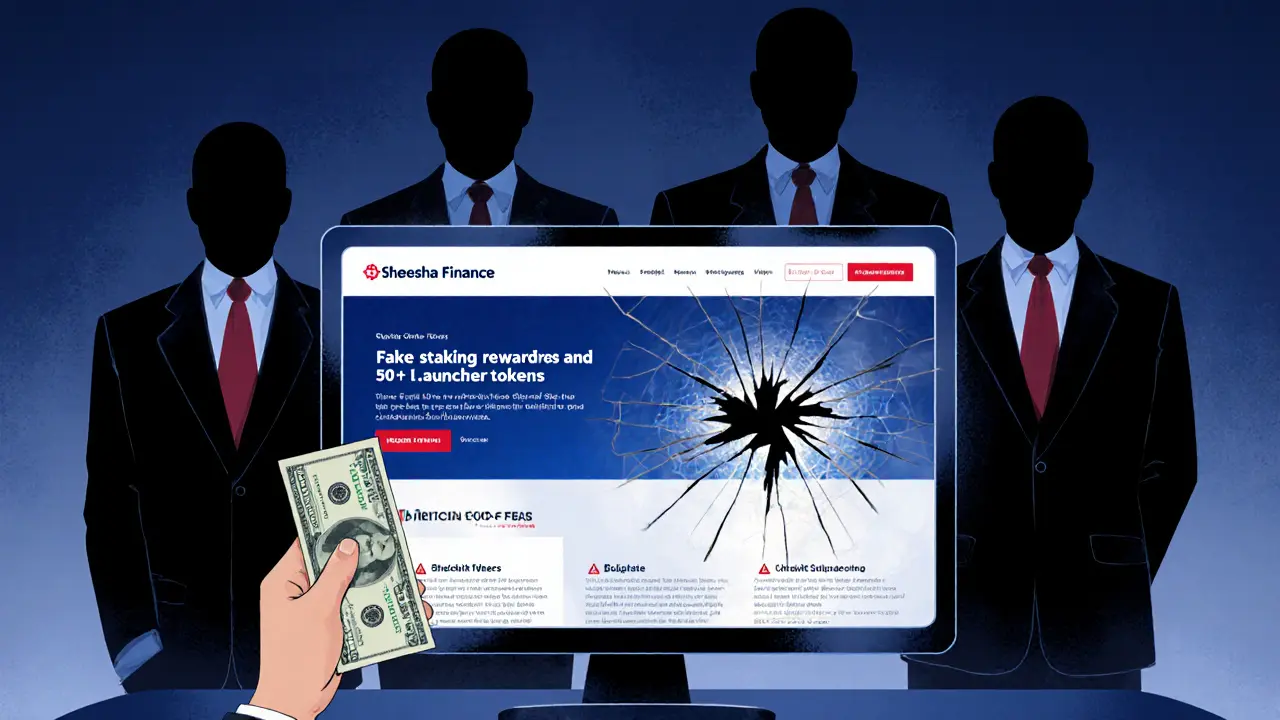
The team is described as "seasoned leaders in blockchain investments" with experience launching 50+ tokens. But names? Nothing. LinkedIn profiles? None listed. GitHub commits? No public code repositories. The website offers services like incubation, legal guidance, and tech development - but no evidence those services have been delivered.
This isn’t just anonymity - it’s opacity. Legitimate DeFi projects, even small ones, usually have at least one public founder or developer. Look at Yearn Finance, Aave, or SushiSwap. Even obscure tokens have Twitter accounts, Discord communities, or GitHub activity. Sheesha Finance has none of that.
Their business model seems to be less about building a token ecosystem and more about selling services to other crypto startups. That’s fine - if that’s what they do. But then why is the token even a thing? If SHEESHA isn’t driving usage or revenue, why should anyone hold it? The token feels like an afterthought - a way to raise money without building real product.
Can you stake SHEESHA? Should you?
The website says yes - stake SHEESHA, earn rewards from other projects. But there’s no staking portal. No contract address for staking. No rewards distribution logs. No user reports of earning anything.
Even if staking existed, the risks are enormous. With a market cap under $200,000 and trading volume under $100/day, you’re not investing in a platform - you’re betting on a lottery ticket. If the team disappears tomorrow, the token becomes worthless. There’s no insurance, no legal recourse, no community to rally behind.
Compare this to Lido or Rocket Pool - both have billions locked in staking, transparent governance, and years of track records. SHEESHA has none of that.
Where to buy SHEESHA - and why you shouldn’t
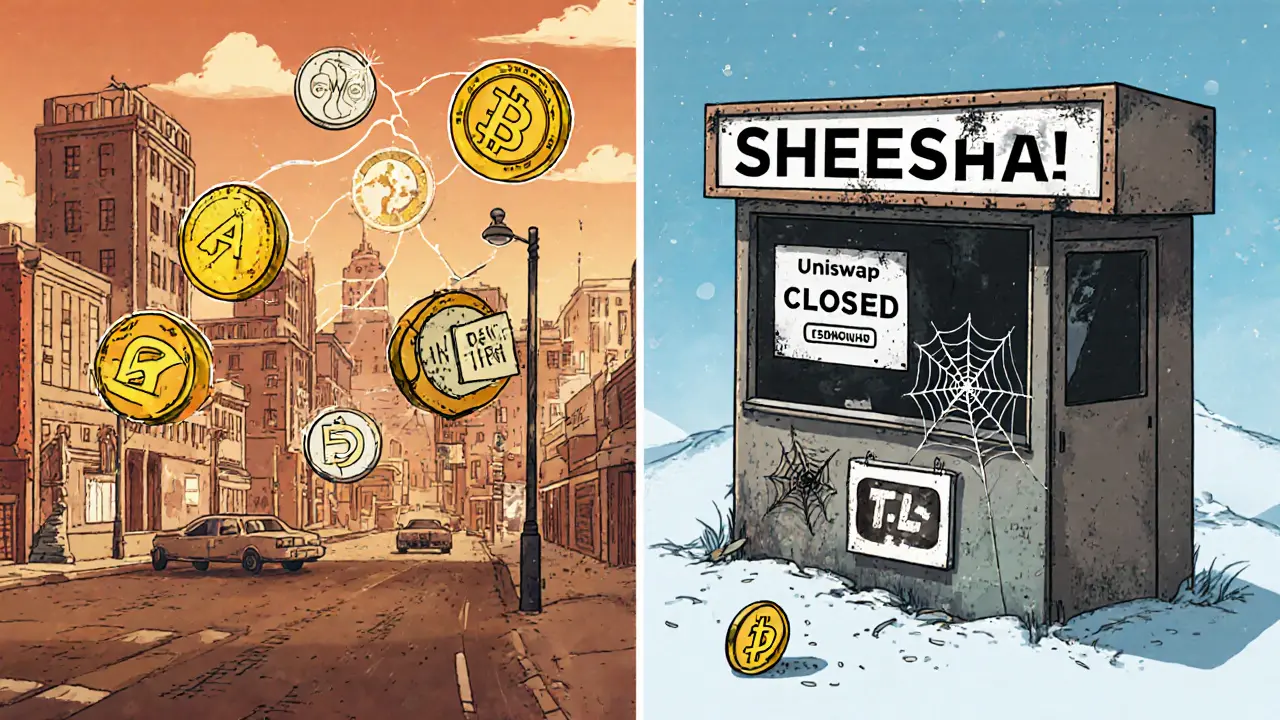
You can find SHEESHA on a handful of decentralized exchanges: Bancor, Uniswap, Quickswap, PancakeSwap, BitMart, and MEXC. But here’s the reality:
- Trading volume is so low, you’ll likely pay 10-30% more than the listed price just to buy.
- Selling will be even harder - you might have to wait days to find a buyer.
- Gas fees on Ethereum can cost $5-$20 per transaction. For a $100 investment, that’s a huge chunk.
There’s no reason to buy SHEESHA unless you’re speculating on a pump - and even then, the odds are stacked against you. There’s no utility. No demand. No future roadmap. Just a token with a name and a contract address.
The bottom line: Is SHEESHA worth it?
No.
Sheesha Finance (SHEESHA) is not a cryptocurrency you should hold as part of a portfolio. It’s not a DeFi innovation. It’s not a community-driven project. It’s a low-liquidity, low-trust asset with no verifiable track record, no user base, and no market relevance.
There’s a difference between a risky crypto project and a dead one. SHEESHA isn’t risky - it’s inactive. The team may be real. The token may be technically functional. But without adoption, without volume, without transparency, it’s just digital noise.
If you’re looking for DeFi staking rewards, go to Aave, Curve, or even smaller but legitimate projects with real TVL and community activity. Don’t waste your time - or your money - on a token that doesn’t exist in any meaningful way.
What to do instead
If you want exposure to DeFi staking:
- Look at tokens with over $100 million in market cap and real TVL.
- Check DeFi Llama for platforms with active users and transparent governance.
- Use exchanges like Coinbase or Kraken for tokens with liquidity and regulatory compliance.
- Never invest more than you can afford to lose - especially in tokens with no trading volume.
SHEESHA isn’t a coin you buy to grow wealth. It’s a coin you buy if you want to test your luck - and you’re okay with losing it all.
Is Sheesha Finance (SHEESHA) a legitimate crypto project?
Sheesha Finance has a working ERC-20 token and a website, but it lacks transparency, community, and verifiable track record. No major crypto analysts cover it, no staking activity is visible, and trading volume is negligible. While not necessarily a scam, it shows all the signs of a low-effort project with little to no future viability.
Can I stake SHEESHA tokens to earn rewards?
The project claims you can stake SHEESHA to earn rewards from other DeFi projects, but there is no public staking interface, no on-chain evidence of rewards being distributed, and no user reports confirming this works. Without verifiable proof, staking is speculative at best and likely non-functional.
Where can I buy SHEESHA tokens?
SHEESHA is available on decentralized exchanges like Uniswap, PancakeSwap, Bancor, and MEXC. However, trading volume is extremely low - often under $100 per day. This makes buying or selling difficult and expensive due to high slippage and gas fees. It is not listed on any major centralized exchanges like Coinbase or Kraken.
What is the current price of SHEESHA?
As of late 2023, SHEESHA traded between $2.44 and $3.00 across different exchanges. However, these prices are unreliable due to minimal trading volume. A single small trade can drastically change the price, making the listed value meaningless for real-world use.
Why is SHEESHA’s market cap so low?
SHEESHA’s market cap is low because there is almost no demand. With a 24-hour trading volume under $100 and no institutional or retail interest, the token lacks liquidity. It ranks #6,958 among all cryptocurrencies - meaning over 6,950 other tokens have more value and activity. Without adoption, even a fixed supply doesn’t create value.
Is SHEESHA a good long-term investment?
No. With a 55% price drop over one year, no community, no roadmap, and no verifiable team, SHEESHA has no foundation for long-term growth. It does not offer utility, governance, or reliable returns. Investing in it is pure speculation with a very high chance of total loss.
Does SHEESHA have a whitepaper or technical documentation?
The project website mentions whitepaper and tokenomics support as services they offer to other projects - not as documentation they’ve published for SHEESHA. There is no publicly available whitepaper, technical spec, or developer guide for the SHEESHA token itself. This lack of documentation is a major red flag for any crypto project.
What happened to SHEESHA’s price in the last year?
SHEESHA’s price has declined by approximately 55% over the past year, according to Kraken. This reflects a complete lack of market confidence. Even during broader crypto bull markets, SHEESHA showed no meaningful recovery, indicating it’s not tied to market trends - just speculative noise.
- Poplular Tags
- Sheesha Finance
- SHEESHA coin
- ERC20 token
- DeFi staking
- SHEESHA price


People Comments
Been watching this token for months. Zero volume, zero community, zero reason to care. If you're holding SHEESHA hoping for a miracle, you're already in the wrong game.
Just move on.
so like… is this a scam or just a dead project? i mean the website looks legit but then again so did ftx before the whole thing went up in smoke. i keep seeing ‘no team’ but maybe they’re just super chill? idk lol
also why is the price different on every site? is that even legal??
Let’s be precise: SHEESHA is a non-liquid, non-governed, non-audited ERC-20 token with a fixed supply of 100,000 units, trading at sub-$3 prices with a 24h volume under $100 - that’s not ‘high risk,’ it’s ‘zero liquidity risk.’
There’s no TVL on DeFiLlama, no on-chain staking contracts, no GitHub activity, no verified team - this isn’t DeFi. It’s a ghost ledger with a website. The fact that it’s listed on Bancor and PancakeSwap doesn’t make it legitimate - it just means someone’s willing to list it.
And yes, the 55% year-over-year drop isn’t a correction - it’s the market screaming. If you’re still considering this, you’re either deeply misinformed or gambling on a tombstone.
Also, the ‘launched 50+ tokens’ claim? Without naming one? That’s not a track record - it’s a rhetorical flourish with zero forensic backing. This is textbook vaporware.
You think this is bad? I saw a token called ‘BANANA COIN’ that had more real utility. At least bananas are edible. SHEESHA? It’s just smoke, mirrors, and a fancy contract address.
People still buy this? The crypto world is a circus.
Every time I see a project like this, I wonder - is the team even real? Or are they just typing away in a basement somewhere, pretending to build something while sipping energy drinks and waiting for the next sucker to buy in?
It’s not about the token. It’s about the silence. No Discord. No Twitter. No GitHub. No one saying ‘I staked and got rewarded.’ Just… nothing.
That’s the real red flag. Not the price. Not the volume. The silence.
While the author's analysis is thorough and well-reasoned, I must emphasize that the absence of verifiable data does not, in itself, constitute fraud - merely extreme risk. However, the complete lack of transparency, community engagement, or third-party validation renders this asset unsuitable for any rational investment strategy.
Investors must prioritize projects with demonstrable utility, auditable infrastructure, and active governance - not speculative artifacts with no discernible economic function.
my cousin bought this last year for $2.50… now it’s at $1.80 and he still says ‘it’s gonna pump soon.’
bro i told him to sell but he’s like ‘it’s got potential’
potential for what? to sit in his wallet forever?
Wait… did you notice how the ‘team’ is ‘seasoned blockchain leaders’ but has zero LinkedIn? And the ‘50+ tokens launched’? No names? No links? No screenshots?
That’s not incompetence - that’s a cover-up.
They’re using SHEESHA to launder money from other scams. Look at the contract - it’s probably minting more tokens secretly. The ‘fixed supply’ is a lie. I’ve seen this before. They’ll dump it all next week and vanish.
Don’t touch this with a 10-foot pole.
They’re not even trying. No whitepaper. No roadmap. No community. Just a website that looks like it was built in 2018 with Wix.
And people still send ETH to this? I feel sick.
Let me break this down for the crypto newbies: This isn’t ‘risky’ - it’s ‘dead on arrival.’
TVL? $0. Volume? $100/day. Team? Ghosts. Staking? Fiction.
And yet, somehow, people still think they’re ‘early’ - like this is 2017 and they’re gonna buy Bitcoin at $500.
It’s not. This is the digital equivalent of buying a lottery ticket from a guy who just walked out of a back alley.
Stop romanticizing garbage. It’s not ‘DeFi innovation.’ It’s a dumpster fire with a token contract.
Why are we even talking about this? America’s got real crypto projects - this is just some Indian guy with a website and a dream.
Real DeFi is on Ethereum, not some random token with $50 in volume.
Get a real coin. Get a real wallet. Stop wasting time on this nonsense.
I’ve been in crypto since 2017. I’ve seen projects rise and fall. Some were scams. Some were just bad ideas.
This one? It’s not even a bad idea - it’s an idea that never got off the ground.
But here’s the thing: the person who wrote this post? They didn’t just tear it apart - they gave people a path forward. They didn’t just say ‘don’t buy it.’ They said ‘here’s what to do instead.’
That’s rare. That’s valuable.
Thank you for the clarity. I wish more people wrote like this.
Man, I saw this token pop up on my Uniswap watchlist last month and just scrolled past it. Didn’t even click. I’ve learned the hard way - if it doesn’t have a Discord with 10k people, a GitHub with daily commits, and a TVL over $10M, it’s not worth my gas fees.
Good call on the alternatives too - Aave and Curve are way safer bets.
Also, gas fees alone would eat your $100 investment. Oof.
From a systems-theory perspective, SHEESHA represents a failed feedback loop: no user input → no value generation → no liquidity → no price discovery → no network effects → collapse. The token’s fixed supply is irrelevant in the absence of demand elasticity.
Furthermore, the absence of on-chain staking contracts implies the claimed reward mechanism is either non-functional or deliberately obfuscated - a violation of the fundamental DeFi principle of verifiable execution.
This is not a failure of marketing - it is a failure of economic design. The token has no embedded incentive structure beyond speculative arbitrage, which is inherently unstable in low-liquidity environments.
Conclusion: SHEESHA is not a financial instrument. It is a statistical anomaly.
I read this carefully. You’re right. This isn’t even risky - it’s invisible. No one talks about it. No one uses it. No one cares.
I’ve seen projects like this in Nigeria - they launch, get a few buys, then vanish. No one ever gets their rewards. No one ever gets their money back.
Just walk away. Save your ETH for something real.
Just want to say thanks for laying this out so clearly.
People need to hear this. Not just the warning - but the alternatives.
DeFi doesn’t have to be a gamble. There are real projects out there. You just have to know where to look.
Appreciate the work.