


Buying cryptocurrency in South Korea feels different than anywhere else. You can’t just sign up with an email and a passport photo. To trade digital assets here, you need something stricter: a real-name bank account linked directly to your crypto exchange. This system is the backbone of South Korea’s crypto regulation, which aims to stop money laundering while keeping the market transparent. For locals, it’s a standard part of life. For foreigners, it’s often a wall that seems impossible to climb.
If you are trying to navigate this landscape in 2026, understanding how these accounts work is not just helpful-it is mandatory. The rules have tightened since the initial rollout in 2018, and with new tax laws kicking in for 2027, knowing the ins and outs of your banking relationship with exchanges like Upbit or Bithumb is crucial.
How the Real-Name System Works
The core idea behind the real-name system is simple but rigid. Every transaction must trace back to a verified individual. In most countries, you might use a credit card or a third-party payment processor. In South Korea, you must move money between a specific bank account and a specific crypto exchange account, and both must be under your exact legal name.
This isn't just about identity verification; it is about creating a closed loop. When you deposit Korean Won (KRW) into an exchange, the money comes from your partner bank. When you withdraw, it goes back to that same bank. There are no external transfers allowed during the trading process. This setup allows the Financial Intelligence Unit (FIU) to monitor flows easily. If an exchange refuses to share user data with its partner bank, the bank is expected to halt anonymous transactions immediately.
The technical implementation relies on strict partnerships. As of April 2025, only five major exchanges had secured full verified real-name bank account status from the FIU. While 28 Virtual Asset Service Providers (VASPs) had completed registration filings, only those with full approval could offer the seamless KRW trading experience that users expect. This scarcity means that if your preferred exchange doesn't have a bank partner, you likely cannot trade with fiat currency legally within the system.
| Cryptocurrency Exchange | Partner Bank | Status (as of 2025) |
|---|---|---|
| Upbit | K-Bank | Verified & Operational |
| Bithumb | Kookmin Bank | Verified & Operational |
| Korbit | Shinhan Bank | Verified & Operational |
| Coinone | Kakao Bank | Verified & Operational |
The Barrier for Foreigners
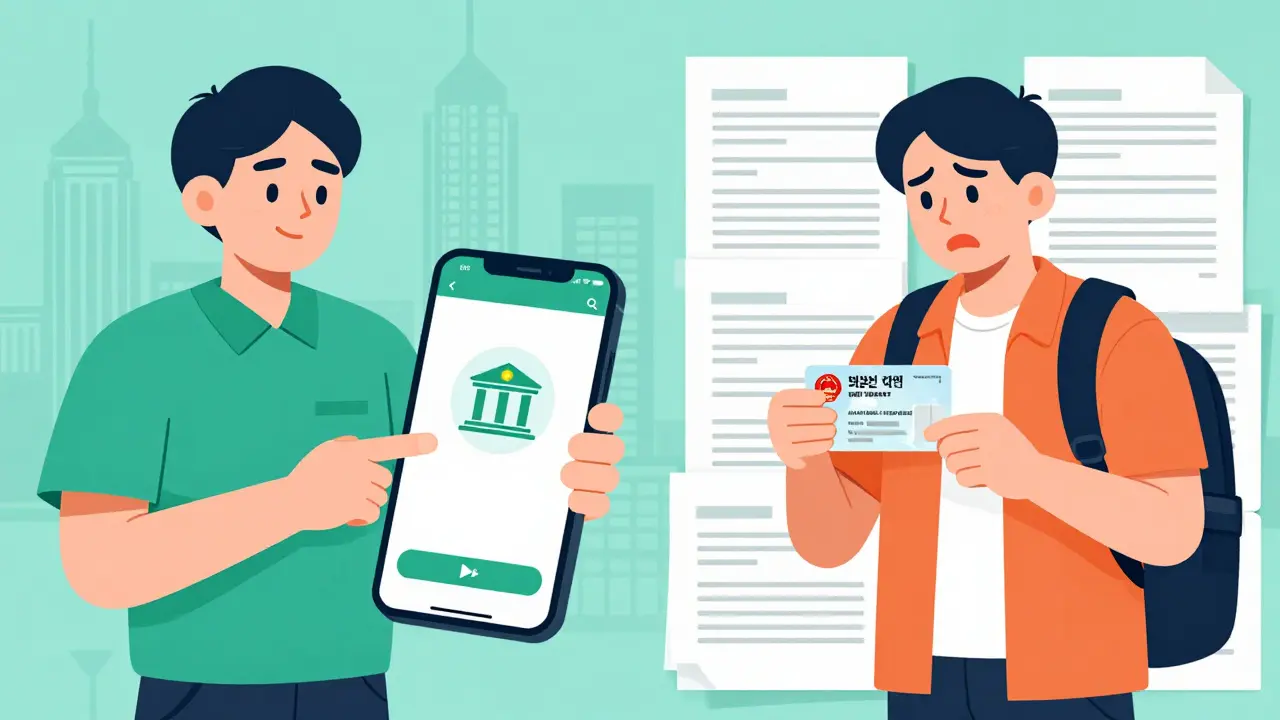
Here is where things get tricky for non-residents. The real-name system was designed for South Korean citizens, and it shows. To open the necessary bank account, you generally need more than just a passport. Banks typically require:
- A permanent residency visa or a long-term stay permit (usually D-series or F-series visas).
- An Alien Registration Card (ARC), which proves your legal status in the country.
- A local mobile phone number registered in your name.
- Proof of address in South Korea.
Without these documents, opening a bank account that qualifies for crypto trading is nearly impossible. International exchanges operating outside of South Korea cannot integrate with KRW or Korean credit cards. This forces foreign users who do not meet residency requirements to rely on international banking systems, effectively locking them out of the domestic market.
Even if you manage to get a bank account, some institutions may still block crypto-related transactions due to internal risk policies. It is not uncommon for expats to find that their account works for daily expenses but gets flagged when they try to transfer funds to a VASP. Always check with your specific branch before attempting large deposits.
Why the Rules Are So Strict
You might wonder why the government went so far. The answer lies in history. In early 2018, Justice Minister Park Sang-ki threatened a complete ban on cryptocurrency trading. However, over 220,000 South Koreans signed a petition demanding a response instead of a prohibition. The result was the compromise we see today: no ban, but total transparency.
The Financial Services Commission (FSC) confirmed this approach in January 2018. The goal was to implement Know Your Customer (KYC) standards similar to those in the United States but adapted to the local banking infrastructure. By tying crypto trades to real-name accounts, the government aimed to:
- Prevent money laundering and illicit financing.
- Protect retail investors from fraud by ensuring platforms are accountable.
- Strengthen trust in the digital asset market through operational transparency.
This regulatory framework has made South Korea one of the most active crypto markets globally, with projections showing over 12 million users by 2025. However, it has also created a unique barrier to entry that limits accessibility for casual or foreign traders.
Upcoming Changes: Taxation in 2027
The landscape is shifting again. From 2027, the Income Tax Act will change significantly for crypto traders. Currently, capital gains from individual crypto trading are largely untaxed, which has fueled massive adoption. Starting next year, income earned by individuals from trading digital assets will be subject to taxation.
This change is part of a broader effort to align crypto with traditional financial assets. The Corporate Tax Act has also been amended to categorize income earned by foreign corporations as domestic source income if generated within South Korea. These moves signal that the government views crypto not as a speculative novelty, but as a serious financial instrument requiring oversight.
For users, this means keeping better records. Since every transaction is already tied to your real-name bank account, the tax authorities will have a clear audit trail. Expect higher compliance costs and potentially more conservative trading strategies as users adjust to the new fiscal reality.

Practical Steps for Local Users
If you are a resident with the right documents, the process is straightforward but requires attention to detail. Here is how you typically proceed:
- Choose Your Exchange: Select a platform like Upbit, Bithumb, Korbit, or Coinone. Check which bank partners with them.
- Verify Your Identity: Complete the KYC process on the exchange app. This usually involves uploading your ID and taking a selfie.
- Link Your Bank Account: Ensure your bank account matches the exchange’s partner bank. If you use Shinhan Bank, you should use Korbit. If you use K-Bank, use Upbit.
- Deposit Funds: Select KRW as your currency. The exchange will provide specific account details. Transfer the funds via your banking app.
- Wait for Confirmation: Deposits typically credit within 30 minutes. Withdrawals follow the same path back to your bank.
Support quality varies by exchange. Major platforms provide comprehensive Korean-language documentation, but English support remains limited. If you are not fluent in Korean, consider using community resources or translation tools to navigate the interface.
Risks and Pitfalls to Avoid
While the system is secure, it is not without risks. One major pitfall is assuming all registered VASPs are equal. Just because a service provider has filed for registration does not mean they have full real-name bank access. Always verify the current status of an exchange with the FIU before depositing significant funds.
Another risk is account freezing. If you engage in suspicious activity-such as rapid large transfers or trading patterns that resemble money laundering-both your bank and the exchange may freeze your assets pending investigation. Because the data sharing between banks and exchanges is mandatory, there is little room for anonymity or dispute.
Finally, be aware of the high corporate taxes. Local exchanges pay up to 24.2% in combined corporate and local income taxes. These costs are often passed down to users in the form of higher trading fees. Compare fee structures carefully before choosing a platform.
Can I trade crypto in Korea without a real-name bank account?
No. Under current regulations, all cryptocurrency trades involving Korean Won (KRW) must be linked to a verified real-name bank account. Exchanges are required to share transaction data with partner banks, and anonymous transactions are prohibited.
What documents do foreigners need to open a crypto-compatible bank account?
Foreigners typically need a long-term visa (D or F series), an Alien Registration Card (ARC), a local mobile number, and proof of residence. Tourist visas are generally insufficient for opening accounts that support crypto trading.
Which exchanges have verified real-name bank accounts?
As of 2025, major exchanges with verified status include Upbit (partnered with K-Bank), Bithumb (Kookmin Bank), Korbit (Shinhan Bank), and Coinone (Kakao Bank). Always check the latest FIU list for updates.
Will crypto trading be taxed in South Korea starting in 2027?
Yes. From 2027, income earned by individuals from trading digital assets will be subject to taxation under the amended Income Tax Act. This marks a significant shift from previous untaxed capital gains.
How long does it take to deposit KRW into a crypto exchange?
Deposits typically credit within 30 minutes after the transfer is initiated through your partner bank's app or online banking service. Withdrawals follow a similar timeline.