



For nearly a decade, Bolivia stood out in Latin America as one of the strictest countries when it came to cryptocurrency. In 2014, the Central Bank of Bolivia (BCB) issued a blanket ban on all digital asset transactions. No exchanges. No mining. No wallets. No trading. It didn’t matter if you were sending Bitcoin to a friend or using Ethereum to pay for services online - it was all illegal. The government claimed it was protecting citizens from fraud, volatility, and financial instability. But behind the scenes, people were already finding ways around the ban. Cash transfers, peer-to-peer trades, and hidden online wallets became common. The ban didn’t stop crypto - it just pushed it underground.
When the Ban Was Officially Lifted
The turning point came on June 26, 2024, when Bolivia issued Resolution No. 82/2024. This wasn’t a softening of policy - it was a full reversal. The Central Bank of Bolivia officially lifted the decade-long cryptocurrency prohibition. Overnight, what was once a criminal offense became a legal financial activity. This move didn’t come out of nowhere. By early 2024, reports showed that Bolivians were already using crypto at levels far beyond what the ban could contain. Remittances from abroad, inflation hedging, and cross-border trade were all being handled through digital assets - quietly, but consistently.Just months after lifting the ban, the government moved fast to build a legal framework. On April 16, 2025, Resolution No. 019/2025 formally recognized virtual assets and virtual asset service providers (VASPs). Then, in May 2025, Supreme Decree No. 5384 gave regulators the power to license crypto companies. Suddenly, businesses could apply for legal status. Exchanges, wallet providers, and trading platforms could operate openly. The government didn’t just remove the ban - it created a new financial ecosystem.
Why Bolivia Changed Its Mind
Bolivia’s economy has long struggled with currency instability. The boliviano has lost value against the U.S. dollar for years. Inflation hit double digits in 2023. Many families relied on remittances from relatives working abroad - but traditional banking channels were slow, expensive, and often unreliable. Crypto offered a faster, cheaper alternative. People started using USDT (Tether) and USDC to receive money from the U.S., Spain, and Argentina. These stablecoins held their value. They didn’t swing wildly like the boliviano. And they could be sent in minutes, not days.The Central Bank noticed. In March 2025, it began using USD-pegged stablecoins for its own cross-border payments. That’s significant. Governments don’t adopt digital assets unless they see real utility. The BCB wasn’t just watching - it was using crypto to solve real problems. This institutional shift signaled to the public: if the central bank is using it, maybe it’s not as risky as they thought.
Another big factor was pressure from citizens. Surveys conducted by local universities in late 2023 showed over 68% of Bolivians under 35 had used or tried to use cryptocurrency, despite the ban. A growing number of young entrepreneurs were building businesses around crypto - even if they had to operate in the shadows. When the government finally lifted the ban, it wasn’t surrendering to public demand - it was acknowledging reality.

How Fast Did Adoption Grow?
The numbers speak for themselves. In the first half of 2025, Bolivians conducted $294 million worth of virtual asset transactions - according to official data from the Central Bank. That’s more than the entire country’s crypto volume in the previous decade combined. One platform, Meru, saw its user base jump 6,600% within six months of legalization. That’s not growth - that’s a tsunami.What’s driving this? It’s not just speculation. People aren’t buying Bitcoin because they think it’ll hit $100,000. They’re using it to send money home, pay for online services, or protect savings. Stablecoins are the most popular. Why? Because they’re stable. In a country where inflation erodes wages every month, holding a digital dollar is smarter than holding bolivianos.
Bitcoin is also popular - not for trading, but for international transfers. A Bolivian worker in Chile can send Bitcoin to a family member in La Paz. In 10 minutes, the recipient gets it. No bank fees. No waiting. No middlemen. That’s power.
How Bolivia’s Approach Differs From Other Countries
El Salvador made headlines in 2021 when it made Bitcoin legal tender. Bolivia didn’t follow that path. It didn’t declare any cryptocurrency as official money. Instead, it took a quieter, more practical route. The focus wasn’t on replacing the boliviano - it was on giving people tools to work around its weaknesses.Compare that to Argentina, where crypto use is widespread but unregulated, or to Mexico, where the government is slowly building oversight. Bolivia chose to go from zero to structured regulation in under a year. That’s unusual. Most countries take five to ten years to develop crypto rules. Bolivia did it in 12 months.
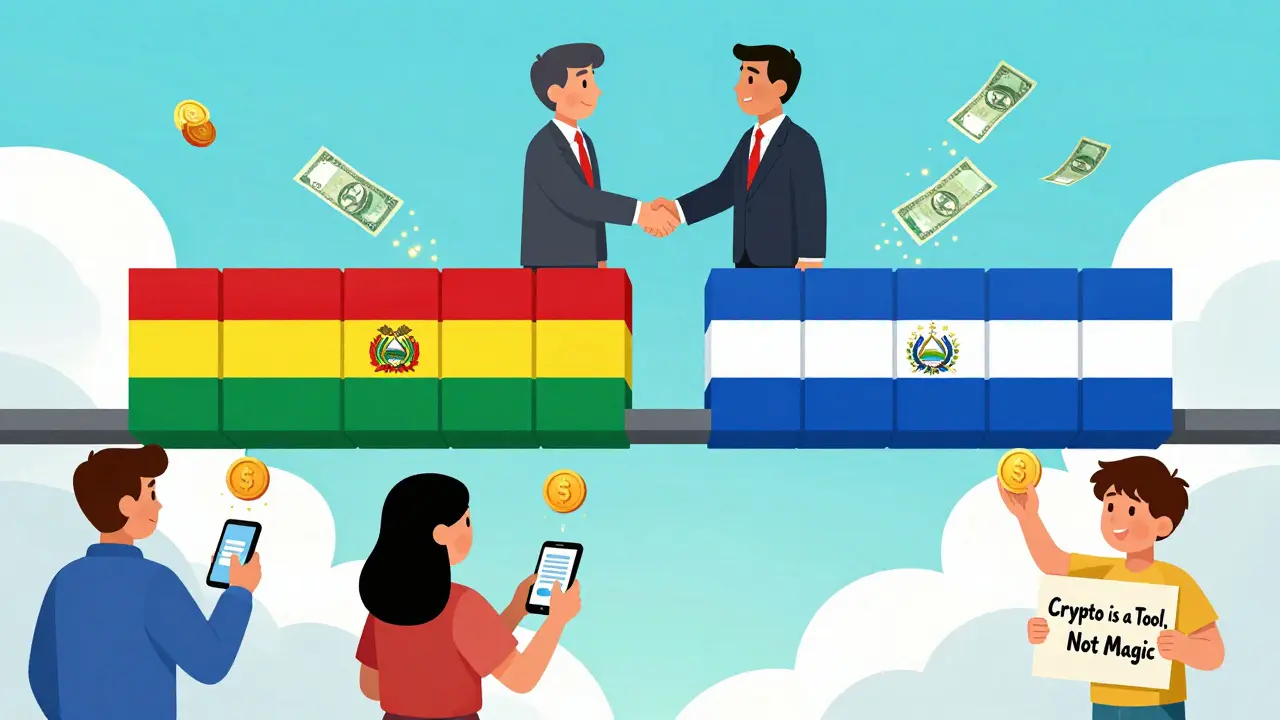
One of the most surprising moves? Bolivia signed a Memorandum of Understanding with El Salvador’s National Commission for Digital Assets (CNAD) in early 2025. This wasn’t just a handshake. It was a full knowledge-sharing deal. Bolivian regulators now train with Salvadoran experts on blockchain monitoring, risk analysis, and how to spot illegal crypto activity. In return, El Salvador gets access to Bolivia’s data on stablecoin usage in remittance corridors. It’s a rare example of two Latin American countries working together to build better crypto rules.
What’s Happening Now?
Today, Bolivia has over 15 licensed crypto service providers. You can open a wallet, buy Bitcoin, or trade stablecoins through regulated platforms. The government runs public education campaigns - YouTube videos, radio spots, and workshops in schools and community centers. The message is simple: crypto isn’t magic. It’s a tool. Use it wisely.Regulators are focused on three things: preventing scams, protecting consumers, and keeping the financial system stable. They’ve banned unlicensed exchanges. They require all platforms to verify users’ identities. They monitor transactions for suspicious activity. And they’re working with international agencies to track cross-border flows.
There are still risks. Some older Bolivians still don’t trust crypto. Scammers are trying to exploit the new system. But overall, the public response has been overwhelmingly positive. A survey by the Bolivian Consumer Protection Agency in November 2025 found that 72% of users felt more financially secure since using crypto - especially those who receive money from abroad.
What’s Next for Bolivia?
The next phase is deeper integration. The government is exploring blockchain-based land registries. It’s testing digital IDs tied to crypto wallets. And it’s looking at how to use smart contracts for public services - like paying for utilities or receiving subsidies.Experts believe Bolivia could become a regional model. Not because it’s rich or tech-savvy - but because it had nothing to lose. When a country’s currency is unstable, and its people are desperate for solutions, crypto isn’t a fad. It’s a lifeline. Bolivia didn’t just lift a ban. It rebuilt its financial future - one digital transaction at a time.
Is cryptocurrency still illegal in Bolivia?
No. Bolivia lifted its complete cryptocurrency prohibition on June 26, 2024. All crypto activities - including trading, holding, and using digital assets - are now legal under regulated conditions. The Central Bank of Bolivia now licenses and oversees virtual asset service providers.
What happened to crypto users during the ban?
Despite the ban, many Bolivians continued using cryptocurrency through informal channels. Peer-to-peer trades, encrypted messaging apps, and offshore wallets were common. The ban didn’t stop usage - it just made it riskier. People still needed ways to send money, protect savings, and pay for online services. The underground market grew quietly, setting the stage for the eventual legalization.
Why did Bolivia choose stablecoins over Bitcoin?
Stablecoins like USDT and USDC are pegged to the U.S. dollar, making them stable in value. In Bolivia, where inflation has eroded the boliviano for years, people needed a reliable store of value - not a volatile asset. Bitcoin is used for international transfers, but stablecoins are the go-to for daily transactions, remittances, and saving.
Can I open a crypto wallet in Bolivia today?
Yes. Several licensed platforms now offer crypto wallets to Bolivian residents. These include local services like Meru and international platforms with local compliance. All must follow Know Your Customer (KYC) rules and report transactions to the Central Bank. Users must verify their identity before opening an account.
Did Bolivia follow El Salvador’s Bitcoin model?
No. El Salvador made Bitcoin legal tender - meaning businesses had to accept it as payment. Bolivia took a different path. It didn’t make any cryptocurrency official money. Instead, it created a regulated framework for crypto services, focusing on utility, consumer protection, and financial stability. The two countries now share regulatory knowledge, but their approaches are fundamentally different.
What role did the Central Bank of Bolivia play in this change?
The Central Bank of Bolivia was the driving force. It started by banning crypto in 2014, then shifted to using stablecoins for its own cross-border payments in 2025. It drafted licensing rules, partnered with international regulators, and launched public education campaigns. The BCB didn’t just remove a ban - it built a new financial infrastructure from the ground up.





People Comments
Let me get this straight - a country with chronic inflation and zero financial infrastructure somehow became a crypto pioneer? That’s not innovation, that’s desperation dressed up as policy.
What’s fascinating isn’t that Bolivia lifted the ban - it’s that they did it with surgical precision. No Bitcoin legal tender nonsense. No reckless embrace of volatility. They recognized stablecoins as the functional bridge between hyperinflation and financial survival. This isn’t crypto evangelism - it’s macroeconomic pragmatism at its finest. The BCB didn’t just reverse policy; they engineered a new monetary layer.
Compare that to El Salvador’s performative blockchain theater. Bolivia didn’t need to make Bitcoin legal tender - they just made money usable again. That’s the difference between a stunt and a solution.
And let’s not pretend this was organic. The central bank was quietly using USDT for cross-border settlements months before legalization. That’s not coincidence - that’s institutional foresight. They didn’t wait for public pressure. They anticipated it, then weaponized it.
The 6,600% user surge on Meru? That’s not hype. That’s demand that was suppressed for a decade. When you ban something that people *need*, you don’t stop adoption - you create a black market with higher friction. Legalization didn’t create adoption. It removed the tax on survival.
Also - the MOU with El Salvador? Genius. Two nations with wildly different approaches, sharing regulatory DNA. One’s a crypto evangelist, the other’s a quiet engineer. Together, they’re building the first real Latin American crypto regulatory corridor. This is the future: not national dogmas, but cross-border utility networks.
I just cried reading this. My cousin in Cochabamba used to send me money through WhatsApp with Bitcoin because the bank took 3 days and charged $20. Now she can just use Meru. I’m so happy for her.
So Bolivia went from zero to regulated crypto in a year. That’s impressive. But let’s be real - this wasn’t about innovation. It was about the fact that half the country was already using crypto anyway. The government didn’t lead. They got dragged kicking and screaming into the 21st century.
And now they’re running ads on YouTube telling people to ‘use crypto wisely’? Like it’s a new credit card. This feels like a corporate PR stunt with a national flag on it.
This is actually one of the most inspiring stories I’ve read in a long time. It’s not about Bitcoin or blockchain tech - it’s about people finding ways to survive when the system fails them. And then, instead of punishing them, the government listened. That’s rare. That’s beautiful.
Stablecoins aren’t flashy. They don’t make headlines. But for a mother in Santa Cruz sending money to her daughter in La Paz? They’re everything. That’s real impact.
Thank you for sharing this. I hope more countries take note - not to copy, but to learn.
Wow, what an incredible journey! From prohibition to full integration in just a few years - this is the kind of transformation that gives me hope for the future of finance! I truly believe that when governments listen to the people, magic happens! And the fact that they partnered with El Salvador? That’s collaboration at its finest! Let’s all cheer for Bolivia - they turned a crisis into a revolution! 🙌🌍
The 72% satisfaction rate? That’s statistically meaningless without context. What’s the baseline? Was it 20% before? 50%? They didn’t release control data. And ‘licensed providers’? How many of them are shell companies with no real compliance? The Central Bank’s ‘regulation’ reads like a PowerPoint slide from a fintech startup that just got VC funding.
Also - the MOU with El Salvador? A PR play. One country’s crypto experiment is a trainwreck. The other’s is a quiet, desperate workaround. They’re not ‘sharing knowledge.’ They’re sharing scapegoats.
Let me guess - the Central Bank of Bolivia didn’t ‘change its mind.’ They were compromised. Crypto was never illegal because it was dangerous. It was illegal because it bypassed their control. Now? They see the money flowing. They smell power. So they slap a license on it, call it ‘regulation,’ and pretend they’re in charge. They didn’t embrace crypto - they co-opted it.
And the ‘public education campaigns’? That’s not outreach. That’s indoctrination. They’re teaching people to trust a system that spent a decade criminalizing them. The same system that printed money into oblivion. The same system that now wants to be the gatekeeper of your digital wallet.
Who benefits? Not the people. The licensed providers. The regulators. The banks that finally got their cut. The real story isn’t ‘Bolivia embraced crypto.’ It’s ‘Bolivia figured out how to tax it.’
And don’t even get me started on the USDT usage. Tether’s not a currency. It’s a corporate IOU with blockchain lipstick. The fact that a central bank is using it? That’s not adoption. That’s surrender.
They didn’t solve inflation. They just outsourced it to a private company in the Caymans.
Next stop: Bolivia’s new national cryptocurrency - issued by the Central Bank, backed by nothing, and called ‘Bolícoin.’ Don’t laugh. I’ve seen this script before.
This gave me chills 😭 I’ve been following crypto in emerging markets for years - this is the first time I’ve seen a government actually *listen*. Not because they were pressured. Not because they were convinced. But because they saw the human need. That’s rare. That’s powerful. 🙏
Bolivia didn’t legalize crypto - they legalized dignity. When your currency is a joke and your banks are a maze of bureaucracy, crypto isn’t an investment. It’s a lifeline. A way to say: ‘I am not powerless.’
The stablecoin revolution isn’t about technology. It’s about identity. People didn’t choose USDT because it was cool. They chose it because it was the only thing that didn’t lie to them.
This isn’t a financial innovation. It’s a moral one.
So the government banned crypto, then used it themselves to move money. Classic. They didn’t change their minds - they realized the ban was a joke and decided to monetize the underground economy instead. They didn’t embrace innovation. They institutionalized it.
And now they’re calling it ‘regulation’? That’s like arresting a thief, then hiring them as your accountant.
This case study deserves serious academic attention. The speed and coherence of Bolivia’s regulatory transition - from total prohibition to structured licensing in under a year - defies global norms. Most nations struggle with this over a decade. Bolivia’s success lies in its clarity of purpose: not to promote crypto, but to enable financial agency. A masterclass in policy adaptation.
6,600% growth? That’s not adoption. That’s panic. People were already using crypto because they had no other option. Legalization didn’t create demand - it just made it safer to admit they were already doing it.
And now they’re running ads? Please. This isn’t financial inclusion. It’s damage control.
Bolivia lifted the ban. Cool. But let’s not pretend this was some noble act. They did it because they realized the black market was bigger than their entire tax base. Now they’re trying to tax it. Classic.
I’m from the US and I’ve been watching this whole thing. Honestly? I didn’t think a country with so little infrastructure could pull this off. But the fact that they focused on stablecoins instead of trying to make Bitcoin the new boliviano? That’s smart. Real smart. People just want to send money home without getting ripped off. That’s all.
And now they’re teaching kids about it in school? That’s wild. I didn’t learn about credit cards until I was 18. These kids are gonna be way ahead.
What stands out is the clarity of intent. Bolivia didn’t try to reinvent money. They didn’t chase hype. They identified a specific pain point - remittances and inflation - and used the most stable tool available. That’s not crypto evangelism. That’s problem-solving. And it worked.
Their regulatory framework is minimal, targeted, and enforceable. That’s the gold standard. Most countries overcomplicate. Bolivia undercomplicated - and succeeded.
Let’s be clear: Bolivia didn’t lead. They followed. The real innovation happened in the shadows - by people who refused to obey a stupid law. Now the state gets to take credit. Classic.
Of course they legalized it. Now they can track every transaction. Now they can freeze wallets. Now they can say ‘we’re protecting you’ while building the ultimate surveillance ledger. This isn’t liberation. It’s onboarding.
And the ‘MOU with El Salvador’? That’s not cooperation. That’s two failed experiments holding hands while the world laughs.
And now the BCB is licensing wallets? That’s not regulation. That’s rent-seeking. They didn’t fix the system. They just started charging tolls on the highway people built themselves.