


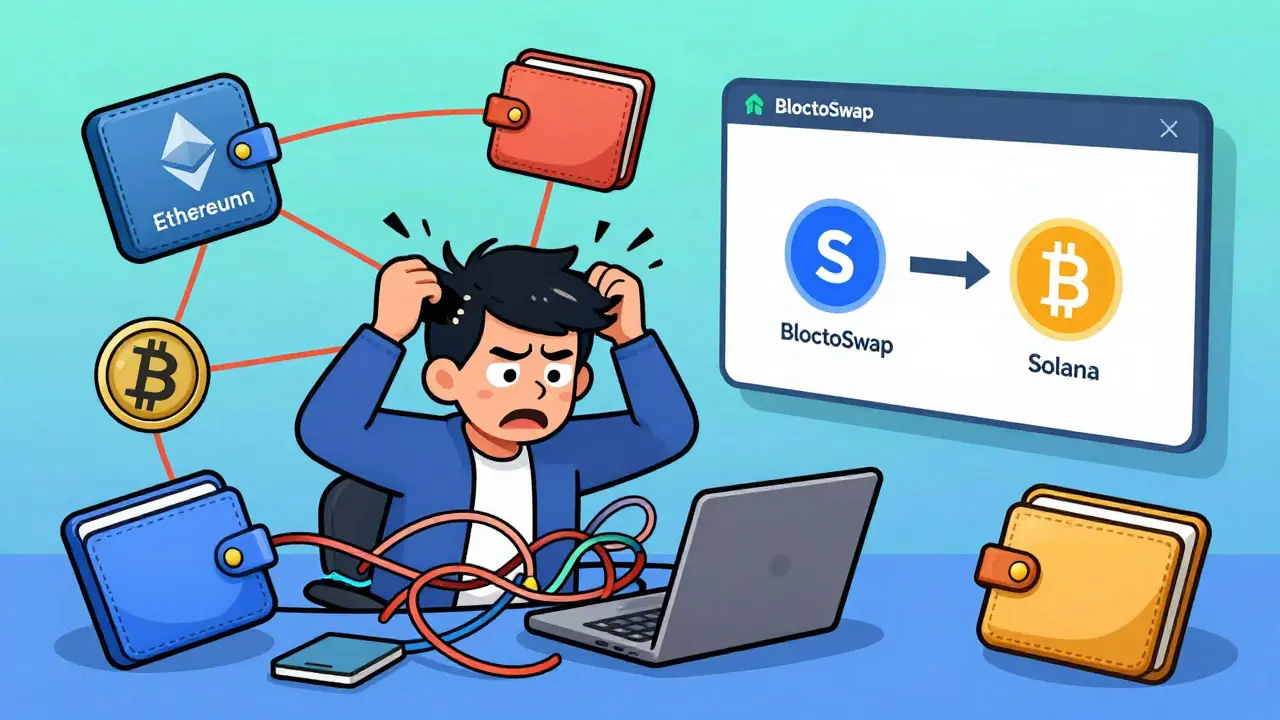
The crypto market is crowded with exchanges. You have giants like Binance, established DEXs like Uniswap, and newer entrants trying to carve out a niche. BloctoSwap doesn't try to be a standalone giant. Instead, it acts as a feature-rich trading layer inside the Blocto wallet. This integration is its biggest selling point, but also its biggest limitation. Before you deposit your funds, you need to know exactly what you are getting into.
What Exactly Is BloctoSwap?
To understand BloctoSwap, you first need to understand Blocto. Founded in 2019, Blocto started as a wallet designed for the Flow blockchain but quickly expanded to support dozens of other chains. BloctoSwap is the trading engine built on top of that wallet. It is not a separate website where you create a new account. It is a function you access directly from your existing Blocto wallet interface.
The core promise here is cross-chain swapping. In traditional decentralized finance, if you want to trade a token on BNB Smart Chain for one on Avalanche, you usually need two different wallets or complex bridge transactions. BloctoSwap abstracts this complexity. It uses its own routing algorithms to find the best path for your trade, often switching chains behind the scenes without you needing to manually manage gas fees on each network individually.
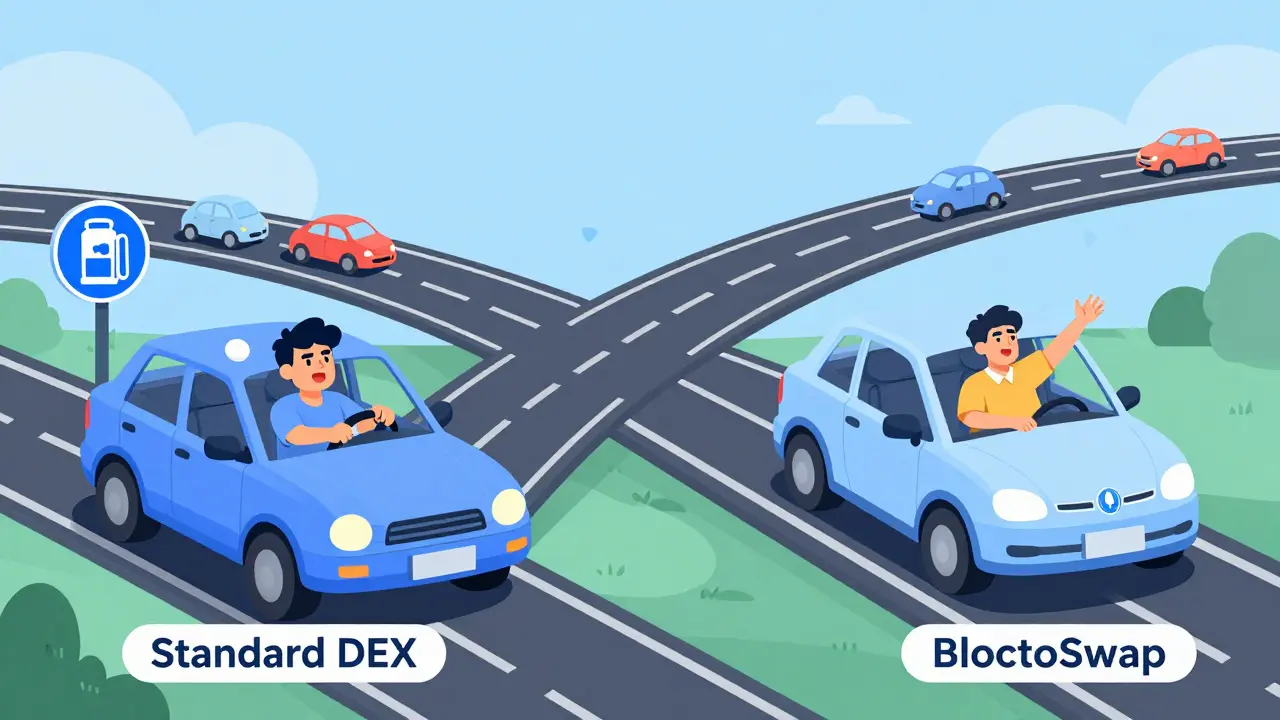
Think of it like using Uber vs. renting a car. With a standard DEX like Uniswap, you are renting a car-you need to know the roads (gas fees), the traffic (network congestion), and how to drive (wallet management). BloctoSwap is the Uber ride. You just input your destination (the token you want), and the platform handles the logistics. However, convenience usually comes at a cost, whether that is higher fees or less control over the transaction details.
Supported Blockchains and Wallet Integrations
One of the strongest arguments for using BloctoSwap is its multi-chain support. The platform does not lock you into a single ecosystem. According to current documentation, BloctoSwap supports major networks including:
- Ethereum: The original smart contract platform.
- BNB Smart Chain (BSC): Known for low fees and high speed.
- Avalanche: A high-performance alternative to Ethereum.
- Polygon (Matic): A popular Layer 2 scaling solution.
- Solana: Famous for its ultra-fast transaction speeds.
- Tezos: An energy-efficient proof-of-stake blockchain.
- Flow: The native chain for which Blocto was originally built.
This breadth is significant. Most DEXs specialize in one or two chains. By supporting all of these, BloctoSwap positions itself as a universal gateway. Furthermore, while it works natively with the Blocto wallet, it also integrates with other popular solutions. You can connect via MetaMask, Trust Wallet, SafePal, Coin98, and even Binance Web3 Wallet. This flexibility means you don't necessarily need to switch your primary wallet to use BloctoSwap's routing technology, though the experience is smoothest when staying within the Blocto ecosystem.
| Feature | BloctoSwap | Uniswap | PancakeSwap |
|---|---|---|---|
| Primary Focus | Cross-chain aggregation | Ethereum-centric DEX | BNB Chain-focused |
| Supported Chains | 7+ (ETH, BSC, AVAX, SOL, etc.) | Multiple (via bridges) | Primarily BNB Chain |
| User Onboarding | Email-based sign-up | Wallet connection required | Wallet connection required |
| Fee Transparency | Undisclosed / Variable | Standardized (0.05% - 1%) | Low (0.1% standard) |
| Best For | Beginners wanting simplicity | Advanced traders seeking liquidity | Users focused on BSC tokens |
The User Experience: Simplicity vs. Control
If you are new to crypto, BloctoSwap might feel like a breath of fresh air. Traditional DEXs require you to hold native tokens (like ETH for Ethereum or MATIC for Polygon) to pay for gas fees. Blocto introduces a points system that abstracts this away. You can execute swaps without worrying about whether you have enough BNB in your wallet to cover the transaction on the BSC network. The platform handles the fee payment internally.
This is a huge win for user experience. How many people have bought Bitcoin, wanted to swap some for an NFT on a different chain, and got stuck because they didn't realize they needed to buy the specific native token for that chain? BloctoSwap eliminates that friction. You sign up with just an email address, connect your wallet, and start trading. There is no KYC (Know Your Customer) process for basic swapping, which maintains the privacy ethos of decentralized finance.
However, this simplicity has a downside. When you lose control over gas fees and routing paths, you lose transparency. Advanced traders often prefer tools like 1inch or Kyber Network because they can see exactly how their order is being split across different liquidity pools. BloctoSwap operates more like a black box. You put tokens in, you get different tokens out. You trust the algorithm to give you the best rate, but you cannot easily verify the mechanics behind the scenes.
Fees and Hidden Costs
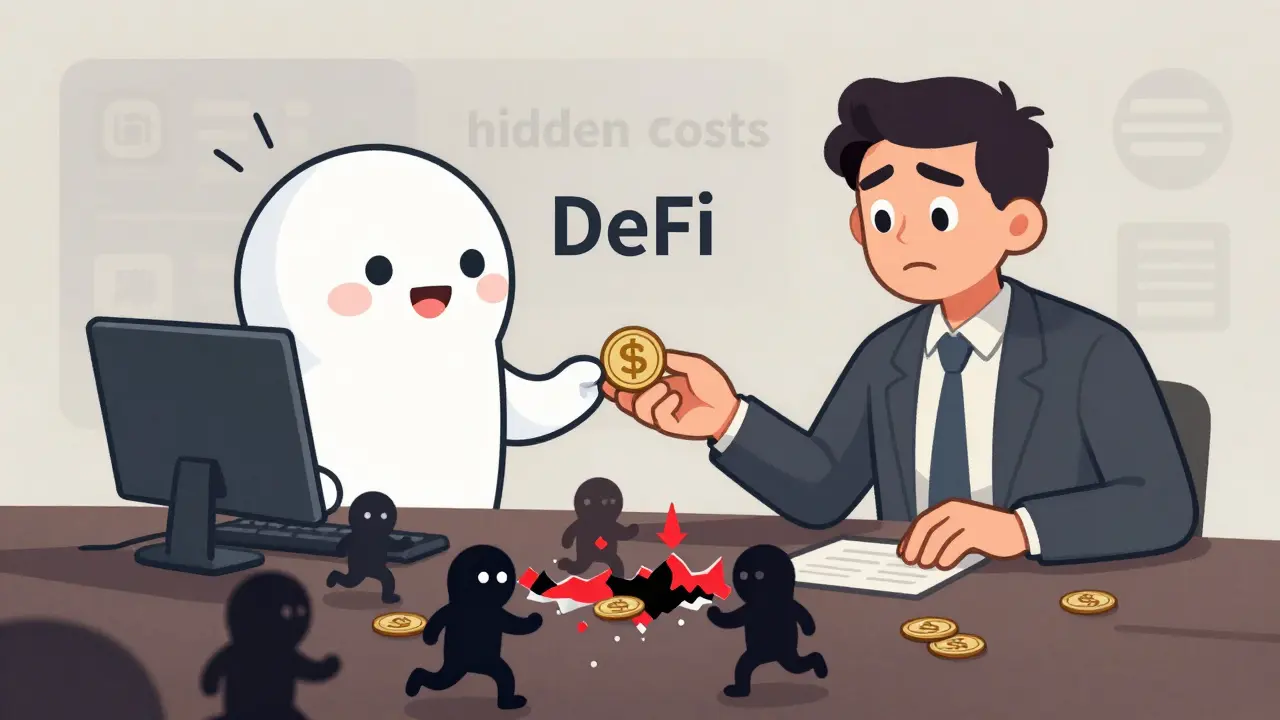
This is the most critical section for any exchange review. In the world of DeFi, "free" is rarely free. BloctoSwap operates on a freemium model, offering free trials and a free version. But what does that mean for your trades?
Unlike competitors such as Biswap, which clearly advertises a 0.1% trading fee, BloctoSwap's fee structure is not explicitly detailed in public documentation. This lack of transparency is a red flag for serious traders. Here is what you need to watch out for:
- Spread Markups: Since there is no clear flat fee, the cost may be hidden in the spread-the difference between the market price and the price you get. If the market price of Token A is $100, but BloctoSwap offers you $99.50, that 0.5% difference is your fee.
- Slippage Tolerance: DEXs allow you to set slippage tolerance (how much price movement you accept during the trade). BloctoSwap may default to settings that favor faster execution over better prices, potentially costing you more in volatile markets.
- Gas Fee Abstraction Cost: While you don't pay gas fees directly with native tokens, the platform likely passes these costs onto you via slightly worse exchange rates. The convenience of not managing gas fees is convenient, but it is rarely subsidized.
If you are moving large amounts of capital, these hidden costs can add up significantly. For small, casual swaps, the difference might be negligible. For day traders or arbitrageurs, the lack of fee clarity makes BloctoSwap a risky choice compared to transparent platforms like Uniswap or SushiSwap.
Security and Trust Factors
When you use a centralized exchange like Coinbase, you trust them with your private keys. With a true DEX, you never leave your wallet. BloctoSwap sits in a gray area. Because it is integrated into the Blocto wallet, your security depends heavily on the safety of the Blocto app itself.
Blocto has been around since 2019, which gives it some longevity credibility. It is backed by Portto, a reputable developer in the blockchain space. The platform supports hardware wallet connections, which adds a layer of security for cold storage users. However, because BloctoSwap aggregates liquidity from various sources, it inherits the risks of those underlying protocols. If a liquidity pool connected to BloctoSwap is exploited, your trade could be affected.
There is no insurance fund mentioned for BloctoSwap trades. Unlike some centralized exchanges that offer FDIC insurance on fiat holdings, or some DeFi protocols that have reinsurance coverage, BloctoSwap appears to operate with standard smart contract risk. Always do your own due diligence. Never invest more than you can afford to lose, and consider using a separate "hot wallet" for frequent swaps rather than your main long-term storage wallet.
Who Should Use BloctoSwap?
Not every tool is right for every user. Based on its features and limitations, here is who will benefit most from BloctoSwap:
- Crypto Beginners: If you are overwhelmed by the complexity of gas fees, bridging, and multiple wallets, BloctoSwap simplifies the process. The email-based onboarding and unified interface make it accessible.
- Cross-Chain Users: If you hold assets across Ethereum, Solana, and BSC, and hate logging into three different interfaces to move them, BloctoSwap’s aggregation saves time.
- Mobile Traders: Blocto has strong mobile apps for iOS and Android. If you trade primarily from your phone, the seamless integration between the wallet and the swap function is superior to opening a browser and connecting MetaMask repeatedly.
Conversely, BloctoSwap is likely not for you if:
- You Are a High-Volume Trader: The lack of transparent fee structures and potential for hidden spreads will eat into your profits.
- You Value Maximum Control: If you need to tweak advanced settings like exact slippage, deadline, and routing paths, stick with dedicated DEX interfaces.
- You Are Security Paranoiac: While Blocto is reputable, using a non-custodial wallet that aggregates multiple chains increases your attack surface compared to using isolated, audited single-chain DEXs.
Final Verdict
BloctoSwap is a competent tool that solves a real problem: the fragmentation of the crypto ecosystem. By allowing you to swap across seven major blockchains from a single interface, it reduces friction and lowers the barrier to entry for newcomers. The integration with the Blocto wallet creates a cohesive experience that feels more like a modern fintech app than a clunky DeFi protocol.
However, it is not a perfect solution. The lack of transparent fee disclosure is a significant drawback. In an industry where every basis point matters, hiding costs in spreads is unacceptable for professional traders. For casual users making occasional swaps, the convenience outweighs the minor inefficiencies. For active traders, the opacity is a dealbreaker.
If you decide to use BloctoSwap, start with small amounts to test the waters. Compare the final received amount against what you would get on a transparent platform like Uniswap or PancakeSwap for similar pairs. If the difference is minimal, enjoy the convenience. If it is significant, look elsewhere. The crypto market rewards vigilance, and understanding the true cost of your trades is the first step toward profitable trading.
Is BloctoSwap safe to use?
BloctoSwap is generally considered safe for casual use as it is built on the reputable Blocto wallet infrastructure founded in 2019. However, like all decentralized exchanges, it carries smart contract risks. There is no insurance on trades, so you should only connect wallets that contain funds you are willing to risk. Always ensure you are accessing the official swap.blocto.app URL to avoid phishing sites.
Does BloctoSwap require KYC verification?
No, BloctoSwap does not require Know Your Customer (KYC) verification for basic swapping functionality. It operates as a non-custodial decentralized exchange, meaning you retain control of your private keys. You can sign up using just an email address, preserving your anonymity while trading.
What are the fees for BloctoSwap?
BloctoSwap does not publicly disclose a fixed percentage fee structure like some competitors (e.g., Biswap's 0.1%). Fees are likely embedded in the spread (the difference between the market price and the execution price) and may vary depending on the token pair and network congestion. Users should compare the final output amount with other DEXs to estimate the effective cost.
Can I use BloctoSwap with MetaMask?
Yes, BloctoSwap supports integration with several third-party wallets, including MetaMask, Trust Wallet, SafePal, and Coin98. While it is optimized for the native Blocto wallet, you can connect these external wallets to access the cross-chain swapping features.
Which blockchains does BloctoSwap support?
BloctoSwap supports a wide range of blockchains, including Ethereum, BNB Smart Chain (BSC), Avalanche, Polygon (Matic), Solana, Tezos, and Flow. This multi-chain support allows users to swap assets across different ecosystems without needing separate bridges or wallets for each network.




People Comments
You really think you know what's best for people? You're just some elitist trying to gatekeep basic usability. Most people don't want to read a thesis on gas fees they just want to swap their tokens without getting their hands dirty. Your pretentious take on 'sovereignty' is laughable when the average user is struggling to even connect their wallet properly. Stop acting like you're the guardian of crypto purity when you're probably just hoarding dust in a cold wallet and complaining about everything.
I actually find BloctoSwap quite intuitive! 🌟 It’s great that beginners have an option that doesn’t require them to be experts in network congestion. While I agree that transparency is key, having a tool that simplifies the entry point for new users is a positive step for the ecosystem. We should encourage innovation that makes crypto more accessible, right? 😊
i totally get what you mean about the fees being hidden but i feel like its okay if you just use it for small amounts like i did yesterday and it was fine no big deal really just swapped some eth for solana and it worked out well enough for my needs
I disagree that it's intuitive. It feels clunky compared to Uniswap. The interface is nice but the execution is slow and the spreads are terrible if you look closely. Don't let the pretty UI fool you into thinking it's efficient. It's just another aggregator hiding behind a friendly face.
Oh, how original. Another review that screams 'look at me, I'm sophisticated.' Spoiler alert: nobody cares about your 'clunky' complaints unless you're losing money. For the rest of us, it works. Move along.
Let me explain something to you simpletons who keep defending this garbage. The reason BloctoSwap exists is to extract value from people who are too stupid to understand slippage. You think you're getting a deal because you didn't pay gas? Wrong. They ate your spread. It's predatory by design. Wake up sheeple. The algorithm is rigged against you every single time. You are literally donating your profits to Portto just to save yourself the trouble of clicking two buttons. Pathetic.
One must acknowledge the sophistication of the architecture behind BloctoSwap, despite its marketing towards the masses. The integration of cross-chain liquidity pools is technically impressive, even if the user-facing layer appears rudimentary. However, the lack of fee transparency is indeed a flaw that cannot be overlooked by serious investors. It is a shame that such potential is wasted on a platform that prioritizes convenience over clarity.
I mean, isn't all crypto just a scam anyway? Why are we arguing about fees? It's all going to zero eventually. But sure, let's pretend BloctoSwap is the devil's bargain when Binance is burning our accounts. Priorities people. 🙄
Look, I get the frustration, but let's keep it civil! 😤 BloctoSwap has its place. If you're a pro, use Uniswap. If you're casual, Blocto is fine. No need to attack each other. Let's help each other learn instead of tearing down tools that might work for some people. 🤝
i think its cool that they support flow blockchain since thats where i started my journey and its nice to see it integrated into a bigger ecosystem maybe they will add more features later on who knows
Here's the thing everyone is missing. BloctoSwap is basically a frontend for 1inch or Kyber. They don't have their own liquidity. They route through others. So you're paying their fee PLUS the underlying DEX fee. It's double taxation. Smart contracts are open source. Read the code. You'll see it's just a wrapper. Don't fall for the hype.
bro u guys r overthinking it. i used it to swap some meme coins and it worked fine. why do u always gotta make everything so complicated? just chill and enjoy the gains ok
The moral failure here is clear. Companies like Portto exploit the ignorance of retail investors by hiding fees in spreads. This is unethical business practice disguised as innovation. You should feel ashamed for using such a platform. It encourages lazy trading habits and prevents people from understanding the true cost of financial transactions. Educate yourselves or stay poor.
Lol, 'moral failure'? Get a life. You sound like a bot programmed to hate fun. I'll take my hidden spreads and easy swaps any day over your self-righteous lectures. Keep crying about ethics while I make profits. 🚀
Right, let's calm down everyone! 😂 It's just a tool. Use it or don't. But attacking each other isn't helping anyone. BloctoSwap is convenient, yes, but it's not perfect. That's fair. Let's move on!
How utterly tedious. The common man cannot be trusted with complex interfaces, so we build crutches for them. And then we complain when the crutches charge rent. Typical. The elite will always suffer from the incompetence of the masses.
nah its trash tbh. slow as hell and the app crashes on my phone all the time. waste of time. stick to binance web3 wallet its better
i dont know much about crypto but my friend told me bloctoswap is good for beginners so i tried it and it seemed okay i guess i didnt notice any hidden fees because i only swapped a tiny amount but maybe i should check more carefully next time
Hey, thanks for sharing your experience! It's good to hear from beginners. Just be careful with larger amounts. Always compare prices on other DEXs first. Stay safe out there! 💪
This is American tech failing again. Slow, buggy, and expensive. Why do we even bother with these foreign wallets? Stick to US-based solutions. Blocto is clearly not built for efficiency. Disgraceful.
I wonder if the cross-chain routing uses LayerZero or Wormhole? The documentation isn't clear. It would be interesting to see the technical specs on how they handle atomic swaps across different consensus mechanisms. Maybe someone with deeper knowledge can chime in?
From a UX perspective, the abstraction of gas fees is a double-edged sword. On one hand, it reduces cognitive load for users unfamiliar with EVM vs Solana differences. On the other, it creates a black box effect where users lose visibility into transaction mechanics. Interesting case study in DeFi usability trade-offs.