


You’ve likely seen the ticker MILO flash across a screen or heard whispers about it in crypto groups. But what exactly is this token, and why does it exist? At its core, Milo Inu is a speculative cryptocurrency token built on the Binance Smart Chain that markets itself as a "virtual idol" project combining anime branding with digital assets. It belongs to the broader category of meme coins-assets driven largely by community hype rather than immediate utility-but it tries to differentiate itself with a narrative around intellectual property (IP), non-fungible tokens (NFTs), and future gaming applications.
If you are considering buying MILO, you need to understand that this is not a stable investment like Bitcoin or Ethereum. It is a high-risk asset with a history of extreme volatility. This guide breaks down the token’s background, its promised roadmap, the real numbers behind its supply, and how to navigate the risks involved.
The Virtual Idol Narrative: More Than Just a Dog?
Most meme coins rely on simple imagery-a dog breed, a celebrity face, or a random internet joke. Milo Inu attempts something slightly different. The project positions itself as an IP-based brand centered on a patented virtual character. Think of it as trying to build a digital pop star or an anime protagonist that lives on the blockchain.
The team’s stated goal is to monetize this character through various channels:
- NFT Collections: Digital art pieces featuring the virtual idol.
- Physical Merchandise: Dolls and peripheral products for fans.
- GameFi Integration: Future games where the character plays a role.
- E-sports: Tournaments and competitive events tied to the brand.
This approach mirrors trends seen in the entertainment industry, such as VTubers (virtual YouTubers) who use animated avatars to stream content. However, while companies like Hololive have successfully scaled this model, crypto projects often struggle to deliver on these promises. As of now, the "virtual idol" ecosystem remains largely conceptual, with few concrete, widely adopted products launched compared to competitors like Shiba Inu, which has deployed its own decentralized exchange (ShibaSwap).
Tokenomics: Understanding the 690 Trillion Supply
When evaluating any cryptocurrency, the tokenomics-the economic structure of the token-are crucial. For Milo Inu, the numbers are staggering but also tell a specific story about its value proposition.
| Attribute | Value / Detail |
|---|---|
| Blockchain | Binance Smart Chain (BSC) / BEP-20 Standard |
| Max Supply | 690,000,000,000,000 (690 Trillion) |
| Transaction Tax | None (0% buy/sell tax) |
| Slippage Recommendation | 0.1% |
| Circulating Supply Transparency | Opaque; data varies significantly across trackers |
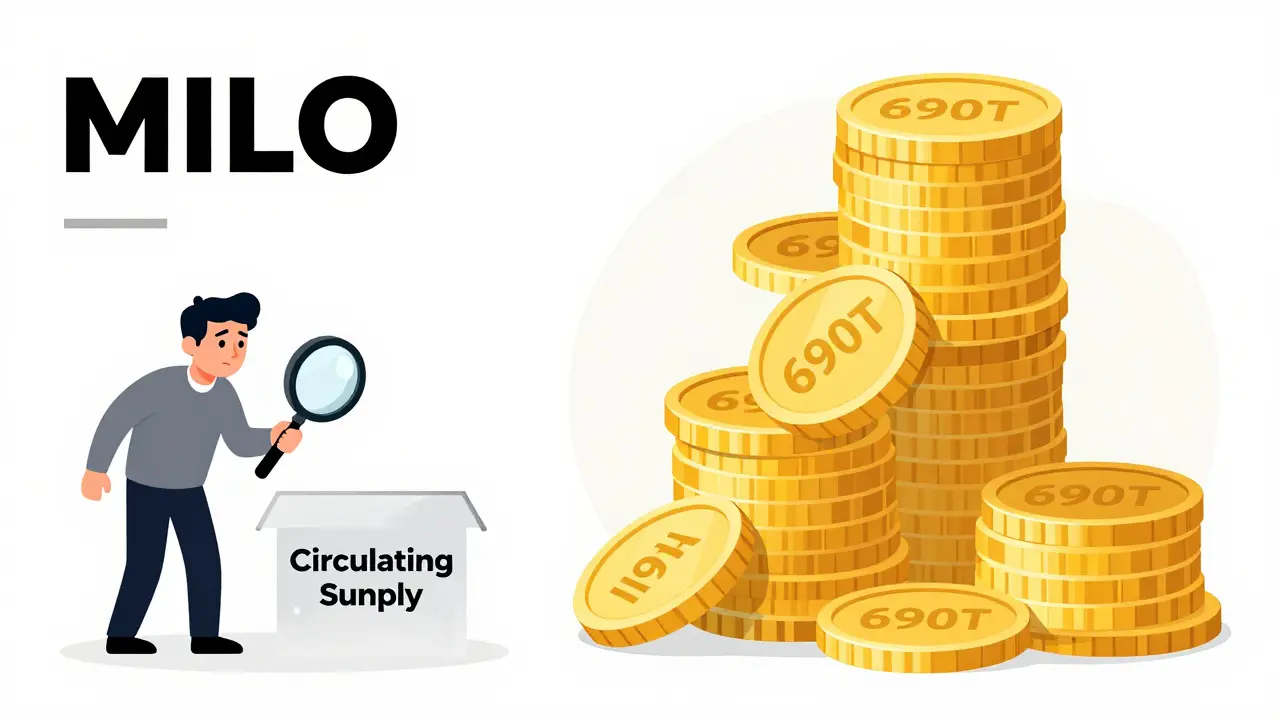
The maximum supply of 690 trillion tokens is fixed. This means no new tokens can be created beyond this number. However, the lack of clear data on circulating supply creates a major red flag. Some platforms list the circulating supply as zero or provide conflicting market capitalization figures. This opacity makes it difficult for investors to know how many tokens are actually held by the public versus locked in team wallets or burned. Without knowing the true circulating supply, calculating the real market cap is nearly impossible, increasing the risk of manipulation.
Price History and Volatility: The Boom and Bust Cycle
Milo Inu launched during the peak of the 2022 meme coin frenzy. Like many assets from that era, it experienced a rapid surge followed by a severe decline. Understanding this history is vital for managing expectations.
In March 2022, MILO reached its all-time high (ATH) of approximately $0.00000011. At that peak, its fully diluted valuation exceeded $66 million. Since then, the price has dropped dramatically. Recent data points show trading prices in the range of $0.0000000019 to $0.0000000036. This represents a decline of roughly 97% from its peak.
This trajectory is typical for low-cap meme coins. Initial hype drives prices up, early investors sell for profit, and without sustained utility or new buyer interest, the price collapses. While some traders look for "dead" coins to gamble on a revival, most small-cap meme coins never recover their all-time highs. The current liquidity is modest, with daily trading volumes often ranging between $500 and $100,000 depending on the exchange, indicating limited market depth.
Where and How to Buy MILO
Because Milo Inu is not listed on major centralized exchanges like Coinbase Pro or Binance Spot, acquiring it requires using decentralized exchanges (DEXs) or smaller centralized platforms. Here is how the process typically works:
- Set Up a Wallet: You need a Web3 wallet compatible with Binance Smart Chain. Popular options include MetaMask, Trust Wallet, or the Binance Web3 Wallet.
- Fund with BNB: Purchase BNB (Binance Coin) on a major exchange and transfer it to your wallet address. You will need BNB to pay for transaction fees (gas) on the BSC network.
- Connect to a DEX: Go to PancakeSwap, the primary decentralized exchange for BSC tokens. Connect your wallet.
- Find the Contract Address: This is critical. Scammers often create fake tokens with the same name. Always verify the official contract address from trusted sources like CoinGecko or BscScan. Paste this address into PancakeSwap to ensure you are swapping for the real MILO.
- Execute the Swap: Swap your BNB for MILO. Set your slippage tolerance to 0.1% as recommended by project documentation, since there are no transaction taxes.
Alternatively, you might find MILO listed on smaller centralized exchanges like Gate.io or BingX. These platforms handle the custody for you but may require identity verification (KYC) and charge higher fees.

Risks You Must Consider Before Investing
Investing in Milo Inu carries significant risks that go beyond normal market fluctuations. Here are the key concerns:
- Anonymity of the Team: The developers behind Milo Inu are not publicly doxxed (identified). In the crypto world, anonymous teams increase the risk of "rug pulls," where creators abandon the project and drain liquidity pools.
- Lack of Audits: There is no prominent evidence of third-party security audits by firms like CertiK or SlowMist. Unaudited smart contracts can contain vulnerabilities that hackers could exploit.
- Low Liquidity: With modest trading volumes, large buys or sells can drastically impact the price. You might find it difficult to sell a large position without crashing the price further.
- Regulatory Uncertainty: Meme coins operate in a legal gray area. If regulators classify them as unregistered securities, trading could become restricted or illegal in certain jurisdictions.
- Unproven Utility: The promise of NFTs, games, and merchandise remains largely aspirational. Without delivered products, the token’s value relies entirely on speculative demand.
How Milo Inu Compares to Other Meme Coins
To put MILO in perspective, let’s compare it to established players in the meme coin space. While all meme coins are risky, their scale and development progress differ vastly.
| Feature | Milo Inu (MILO) | Dogecoin (DOGE) | Shiba Inu (SHIB) |
|---|---|---|---|
| Market Cap Range | $1M - $3M (Small Cap) | $10B+ (Large Cap) | $4B - $7B (Large Cap) |
| Primary Utility | Speculative / Future IP | Payments / Tipping | DeFi / NFTs / Layer-2 Plans |
| Team Status | Anonymous | Community-driven / Open Source | Anonymous (but highly developed) |
| Exchange Listings | DEXs + Small CEXs | All Major Exchanges | All Major Exchanges |
While Dogecoin and Shiba Inu have survived multiple market cycles and built ecosystems, Milo Inu remains a niche project. Its smaller size offers higher potential percentage gains if it succeeds, but the probability of total loss is significantly higher due to lack of adoption and transparency.
Is Milo Inu a scam?
There is no definitive proof that Milo Inu is a scam, but it exhibits several high-risk characteristics common in fraudulent projects. These include an anonymous development team, lack of third-party security audits, and opaque circulating supply data. While it trades on legitimate decentralized exchanges, investors should exercise extreme caution and assume they could lose their entire investment.
What is the all-time high of MILO?
The all-time high for Milo Inu was approximately $0.00000011, reached in March 2022. Since then, the price has fallen by about 97%, reflecting the volatile nature of meme coins after initial hype cycles subside.
Can I buy MILO on Coinbase?
No, Milo Inu is not currently available for direct trading on the Coinbase Exchange. Coinbase lists it in its informational catalog to track price data, but you cannot buy or sell it directly on the platform. You must use decentralized exchanges like PancakeSwap or smaller centralized venues like Gate.io.
Does MILO have a transaction tax?
No, Milo Inu does not charge a transaction tax on buys or sells. The project recommends setting your slippage tolerance to 0.1% when trading on decentralized exchanges to ensure transactions go through smoothly without unnecessary fees.
What is the maximum supply of MILO?
The maximum supply of Milo Inu is fixed at 690 trillion tokens. This number will not change, but the amount of tokens actively circulating in the market is unclear due to inconsistent reporting across data aggregators.
Is Milo Inu listed on Binance?
Milo Inu is not listed on the main Binance centralized exchange (CEX). However, because it is built on the Binance Smart Chain, you can trade it using the Binance Web3 Wallet by connecting to decentralized exchanges like PancakeSwap.
- Poplular Tags
- Milo Inu
- MILO crypto
- meme coin risks
- virtual idol NFTs
- BSC token